
Introduction: The Evolution of Healthcare Interior Design and Branding
Healthcare interiors have shifted from decoration to operational tool. Today, environments must communicate clearly, calm patients, support staff, and withstand infection-control protocols. For facilities directors and design teams, healthcare interior branding now spans patient rooms, corridors, and campuses—without adding construction, downtime, or maintenance burden. The challenge: deliver high-quality visuals that clean like paint, install in occupied units, and remain consistent across multiple hospitals and clinics.
Direct-to-wall printing for hospitals solves this gap by placing high-resolution graphics directly onto prepared surfaces—no vinyl, seams, or adhesives. The result is sanitary wall graphics that are durable, scrub-resistant, and paint-over-ready when programs change. Photoreal imagery and crisp typography scale across long corridors for medical facility wayfinding, patient education, and safety messaging. Picture pediatric wings with nature scenes, oncology waiting rooms with restorative art, or back-of-house areas with code charts and SOPs—all installed with minimal disruption.
Traditional vinyl wall wraps peel, bubble, and introduce seams that trap grime—problems compounded by harsh cleaners. Hand-painted murals are slow, variable, and difficult to replicate at scale. As a performance-driven choice among vinyl wall wrap alternatives, EastCoast MuralPros prints on-site in under five hours per zone, eliminating shipping delays and fabrication errors while keeping units open. Their finish is cleanable for high-traffic areas and compatible with drywall, CMU, concrete, and brick, enabling consistent rollout across entire systems.
- Supports daily disinfection without edge-failure or delamination
- Seam-free surfaces reduce crevices where residue can accumulate
- Integrated graphics streamline wayfinding and regulatory communications
- Paint-over-ready lifecycle minimizes future downtime and waste
- More sustainable, PVC-free approach compared with wallpaper and wraps; see sustainable and PVC-free wall graphics
For enterprise healthcare networks, the model scales: full-campus solutions unify entrances, clinics, and inpatient floors, while a subscription option supports seasonal or service-line refreshes without construction. Design and brand teams can adapt iconography into durable healthcare murals that stay consistent across locations. Low-disruption, off-hours installations maintain census targets—fast, predictable, and ready for the next update.
The Limitations of Traditional Vinyl Wraps in Clinical Environments
Vinyl wraps add seams, joints, and edge trims that become failure points in clinical settings. Under frequent disinfecting with bleach, quats, or peroxides, adhesives soften and inks abrade, inviting bubbles and edge lift that trap residue—undermining sanitary wall graphics.
Seams also create cleaning blind spots that environmental services must work around, slowing turnovers between procedures. On textured substrates common in hospitals—CMU block, concrete, orange-peel drywall—installers use primers and stronger adhesives to force adhesion, complicating removal and risking substrate damage.
Vinyl’s logistics strain 24/7 operations. Pre-printed panels depend on perfect field measurements, shipping schedules, and dust-free staging; any mismatch or freight delay pushes back go-lives, and multi-day installs with odors, ladders, and barriers are hard to schedule around imaging suites and inpatient floors.
For healthcare interior branding and medical facility wayfinding, panel seams interrupt imagery, create glare under overheads, and introduce color drift across tiles. Simple copy changes or route shifts require reprinting entire panels, leading to signage clutter or outdated information staying up longer than intended.
- Seams and lifted edges can harbor residue and moisture despite best-practice cleaning.
- Harsh disinfectants accelerate ink abrasion and adhesive failure, shortening service life.
- Removal often damages walls, adding labor, dust, and downtime to clinical areas.
- Multi-site rollouts face color inconsistencies and variable installer workmanship, reducing brand consistency.
Direct-to-wall printing for hospitals eliminates seams and adhesives by printing directly on finished or unfinished walls. EastCoast MuralPros delivers durable healthcare murals that are high-resolution and cleanable with low-disruption installs—often under five hours. Paint-over-ready updates lower lifecycle cost versus vinyl wall wrap alternatives, reduce waste, and scale across wings to modernize clinical spaces efficiently.
Benefits of Direct-to-Wall Printing: Durability, Hygiene, and Maintenance
Direct-to-wall printing for hospitals solves the two problems that plague vinyl: seams and adhesives. Seams invite wear and bacteria traps; adhesives yellow, bubble, and fail under aggressive cleaning. By jetting high-resolution ink directly onto painted drywall, CMU, concrete, or brick, EastCoast MuralPros delivers integrated visuals that look built-in—ideal for healthcare interior branding without panels or wallpaper.
Durability shows up where it matters: in corridors, elevator lobbies, and transport paths where beds, carts, and wheelchairs brush walls daily. Seam-free graphics mean nothing to catch, peel, or snag, and the cured surfaces are designed for repeated cleaning in high-traffic environments. Facilities commonly use these durable healthcare murals in OR corridors, imaging suites, and pediatric waiting areas to combine performance with patient-centered design.
Hygiene improves when surfaces are smooth, continuous, and easy to disinfect. These sanitary wall graphics are engineered to be wiped down with common hospital-grade cleaners (e.g., quaternary ammonium, alcohol-based, and diluted bleach solutions per facility protocols) without fogging or edge lift. Integrating medical facility wayfinding, safety prompts, and instructional graphics directly on the wall cuts signage clutter, leaving fewer dust-collecting plaques and adhesive plates to maintain.
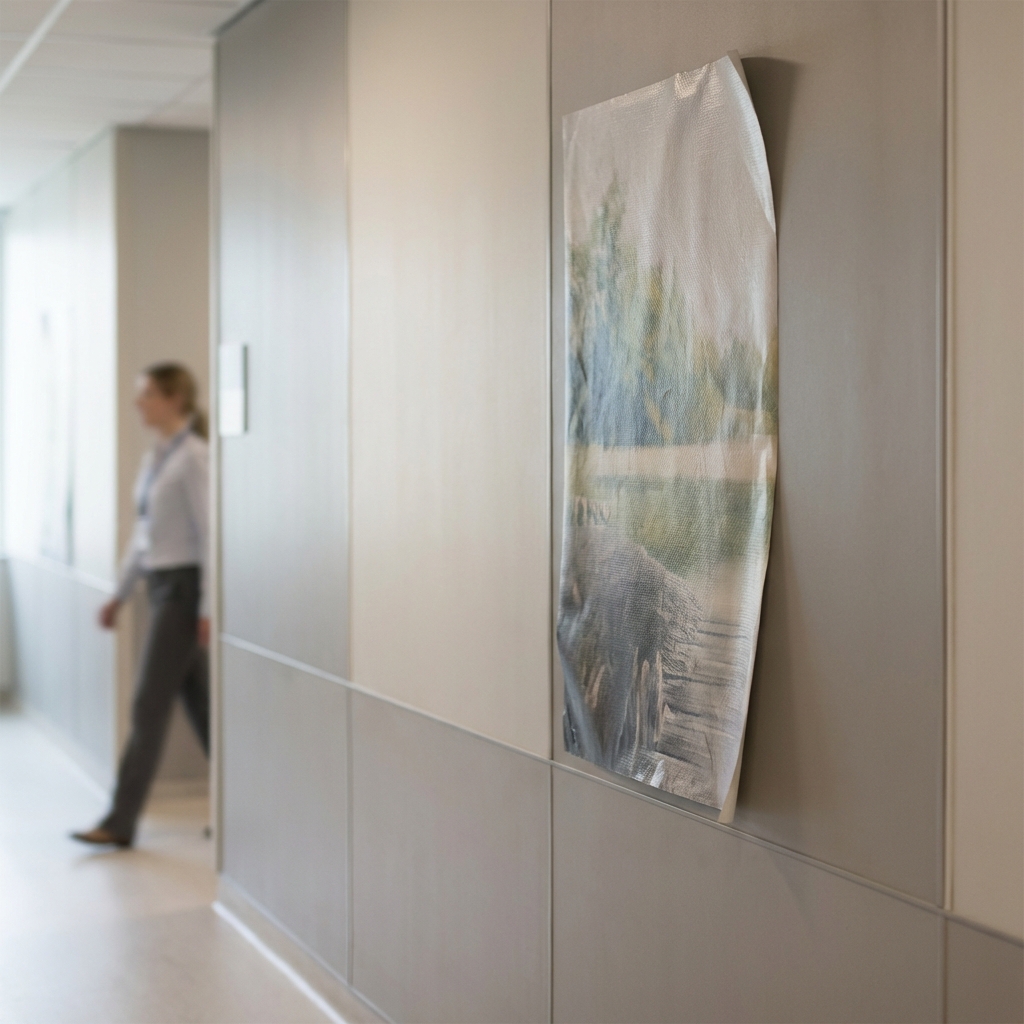
Maintenance efficiency increases across the lifecycle:
- Installation typically completed in under 5 hours with low disruption to occupied units
- No vinyl, seams, or glue lines to monitor, patch, or replace
- Cleanable, abrasion-resistant finishes that stand up to daily wipe-downs
- Paint-over-ready surfaces for future tenant or program changes
- On-site printing eliminates shipping delays and fabrication errors
- Consistent execution across multi-site hospitals and system-wide rollouts
- Subscription options for seasonal themes or phased upgrades
- Integrated wayfinding that reduces hardware and cleaning workload
From a facilities budget standpoint, this is a performance-based alternative to vinyl wall coverings and wallpaper. Fewer work orders for peeling edges and less frequent replacement translates into lower lifecycle costs and more predictable upkeep. When projects must happen between shifts or around patient flow, speed and schedule certainty matter as much as finish quality.
EastCoast MuralPros specializes in full-campus solutions for hospitals and clinics, providing high-resolution, photoreal graphics at architectural scale with minimal disruption. The team supports national standards, pilot-to-rollout programs, and even in-studio printing for doors and standees to keep branding cohesive. For healthcare interior branding that is durable, sanitary, and easy to maintain, this is a proven, scalable path beyond vinyl wall wrap alternatives.
Enhancing Patient Experience through High-Resolution Healing Environments
Direct-to-wall printing for hospitals enables calming, high-resolution environments that reduce anxiety and support healing without adding clutter or construction. Photoreal landscapes across patient corridors, soothing ceiling scenes above infusion chairs, or quiet, texture-forward backdrops in behavioral health can transform sterile areas into restorative spaces. Because imagery is produced at architectural scale with crisp detail, staff can tailor themes by unit—pediatrics, oncology, or women’s health—while maintaining system-wide consistency in healthcare interior branding.
Hygiene is non-negotiable. Seam-free, adhesive-free applications eliminate edges where dirt and moisture can accumulate, creating sanitary wall graphics that are easy to wipe down with hospital-grade cleaners. The result is a durable finish designed for high-traffic environments—ideal for nurse stations, elevator lobbies, med/surg floors, and family waiting areas—without the peeling, bubbling, or grime-catching seams common to vinyl.
Clear navigation is central to patient experience. Integrated medical facility wayfinding—color-coded zones, pictograms, service lines, and distance cues—can be printed directly onto walls to guide patients without relying on a forest of signs. Departments can unify messaging, safety prompts, and instructional graphics so the environment communicates clearly, even when patients are stressed or language is a barrier.
Compared to vinyl wall wrap alternatives, direct-to-wall systems offer practical advantages for busy hospital campuses:
- Fast, low-disruption installs suitable for occupied units and after-hours work
- On-site printing that eliminates shipping delays and fabrication errors
- Paint-over-ready finishes for future program or tenant changes
- Consistent execution across multi-building and multi-site networks
- Compatibility with drywall, CMU, concrete, and brick—finished or unfinished
- Lifecycle efficiency and reduced waste versus wallpaper or traditional vinyl
EastCoast MuralPros brings these benefits to clinical settings with high-resolution, durable healthcare murals delivered on schedule. Teams can refresh patient rooms, public corridors, and specialty suites in hours, not days—often completing zones in under five hours—while maintaining strict operational continuity. For system-wide rollouts, the company’s on-site printing and standardized workflows ensure predictable results from flagship hospitals to community clinics, making it a reliable partner for healthcare interior branding that elevates patient experience at scale.
Streamlining Hospital Operations with Rapid, Low-Disruption Installation
Hospitals can’t afford blocked corridors, noisy setups, or days-long closures. Direct-to-wall printing for hospitals compresses installation into a single shift, with many projects completed in under five hours per area. Because the graphics are produced on-site without vinyl or adhesives, teams avoid shipping delays, panel alignment issues, and the disruption that comes with wallcovering crews staging large rolls and glues.
The process is purpose-built for occupied environments. Printers roll in, register the artwork, and print directly on finished or unfinished surfaces—drywall, CMU, concrete, and brick—then seal for durability. Facilities can schedule between shift changes or during low-census windows, reopening corridors and waiting rooms as soon as the work is complete. If branding, departments, or tenants change later, the paint-over-ready finish makes resets straightforward.
Sanitary wall graphics matter in clinical spaces. Seam-free, high-resolution imagery can be cleaned with hospital-approved methods, avoiding the edges and bubbles common to vinyl that snag carts and degrade under frequent wiping. From pediatric themes on cinder block to calming imagery in imaging suites, durable healthcare murals reinforce experience goals while standing up to high traffic.
Printing directly to the wall also streamlines medical facility wayfinding. Color-coded routes, departmental identifiers, and safety or instructional graphics can be integrated into the architecture, reducing signage clutter and maintenance. When protocols change—triage pathways, clinic relocations, or visitor routing—updates are executed rapidly, a clear advantage over slower, construction-heavy approaches or short-lived vinyl.
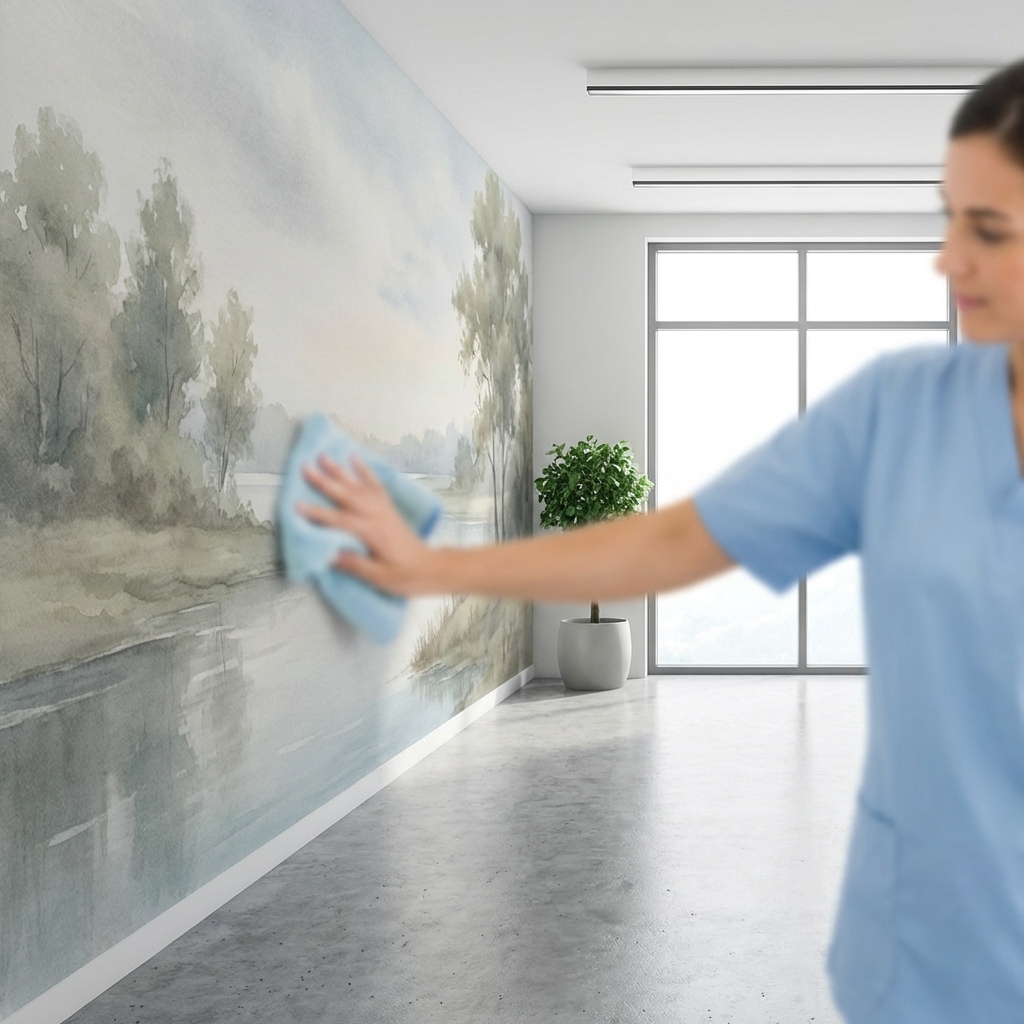
With EastCoast MuralPros, healthcare interior branding aligns to operational realities:
- Low-disruption install windows (nights/weekends) coordinated with facilities and security
- Consistent execution for multi-site networks and full-campus solutions
- On-site production that eliminates shipping risk and fabrication errors
- Cleanable, durable finishes designed for high-traffic clinical settings
- Subscription options to refresh service lines or seasonal campaigns without rework
- In-studio printing for doors, tables, and standees to support check-in or pop-up clinics
For teams evaluating vinyl wall wrap alternatives, this approach delivers speed, predictability, and lifecycle efficiency—without compromising quality or patient experience.
Sustainability and Lifecycle Cost: Why Printing Trumps Wallpaper and Vinyl
In clinical environments, sustainability and total cost of ownership matter as much as aesthetics. Traditional wallpaper and vinyl wraps rely on PVC films, adhesives, and seams that degrade, are hard to recycle, and often require replacement after a few years. Direct-to-wall printing for hospitals places high-resolution imagery straight onto painted drywall, CMU, concrete, or brick, eliminating vinyl, adhesive waste, and the removal labor that accompanies them. At end of life, facilities teams can simply prime and paint over—no tonnage of stripped film headed to landfill.
Cleaning and durability drive the calculus. Seam-free, cure-hardened prints create sanitary wall graphics that stand up to routine hospital cleaning and daily abrasion without the edge-lift and bubbling common to films. Because prints are flush to the substrate, carts and gurneys are less likely to catch edges, reducing incidental damage in high-traffic corridors, lobbies, and nurses’ stations.
Where lifecycle costs drop with a vinyl wall wrap alternative:
- Materials: no PVC film, adhesives, or backing paper—significantly less plastic waste.
- Labor: on-site production finishes most walls in under 5 hours, with no panel alignment or seam repair.
- Disruption: minimal shutdowns; no adhesive cure times or return visits for failures.
- Maintenance: cleanable, durable surfaces with no peeling seams to patch; paint-over-ready during remodels.
- Risk and waste: on-site printing avoids shipping delays and fabrication errors; precise placement reduces reprints.
- Substrate prep: compatible with finished and unfinished surfaces, often reducing skim-coating or panel prep.
- Turnover: paint-over-ready finish avoids costly demolition and disposal during program changes.
For medical facility wayfinding, direct printing integrates icons, codes, bilingual directions, and room IDs directly onto walls, keeping corridors uncluttered by extra plaques and panels. A regional health system can refresh pediatric themes or update brand standards across multiple sites on a predictable cadence. With EastCoast MuralPros’ campus-wide coordination and subscription refresh option, departments can be rebranded after a Saturday shift—without tearing down film or closing units.
For healthcare interior branding, durable healthcare murals produced this way deliver long-term value and measurable waste reduction compared to wallpaper and vinyl wall wrap alternatives. The approach scales consistently across multi-location portfolios while keeping maintenance predictable and budgets tight. EastCoast MuralPros supports facilities, procurement, and design teams with full-campus planning, on-site printing, and standards that translate across drywall, CMU, concrete, and brick.
Conclusion: Future-Proofing Healthcare Facilities with Integrated Wall Technology
Direct-to-wall printing for hospitals offers a resilient path to future-proofing clinical interiors. Unlike vinyl wall wraps that can fail at seams and introduce edge maintenance, seamless, adhesive-free imagery reads as part of the architecture and supports sanitary wall graphics. It unifies healthcare interior branding, medical facility wayfinding, and patient-centric art into a maintainable surface that adapts as care models and departments evolve.
Operational continuity is the gating factor for most facilities. With on-site production and fast installs typically completed in under five hours, critical corridors, nurse stations, or outpatient lobbies can be refreshed overnight between shifts—without barricades, odors, or dust. Printing directly to finished or unfinished drywall, CMU, concrete, and brick eliminates shipping delays and fabrication errors, and enables precise field alignment with doors, alcoves, and medical equipment. A practical example: color-coded routing with floor-to-ceiling markers for Imaging and ED triage combined with room-specific prep instructions printed at the point of need.
Future-ready wall systems deliver measurable wins across facilities, procurement, and infection-prevention priorities:
- Lifecycle efficiency: paint-over-ready finishes refresh quickly without demolition, adhesive abatement, or specialty removal.
- Durability and cleaning: non-seamed, hardwearing surfaces stand up to routine disinfection and high-traffic abrasion.
- Standardization at scale: consistent color, resolution, and execution across buildings, campuses, and regions.
- Integrated guidance: wayfinding, safety, and instructional graphics printed directly on walls reduce signage clutter and fall risks.
- Sustainability: avoids PVC-based vinyl and adhesive waste while reducing replacement frequency versus wallpaper and wraps.
EastCoast MuralPros brings high-resolution, direct-to-wall printing to clinical campuses with low-disruption execution and predictable scheduling. Health systems use the service to deploy durable healthcare murals in pediatrics, implement campus-wide color coding and route markers, or pilot a refreshed brand in one ambulatory site before scaling network-wide. Subscription options support seasonal campaigns (e.g., flu clinics, mental health awareness) and program updates, while paint-over-ready finishes preserve flexibility for future renovations and tenant changes. For ancillary elements, in-studio printing extends the system to doors, tables, and standees, and collaborative tools help internal designers scale assets consistently—making this a proven, performance-based alternative to vinyl wall wrap alternatives.
Call to Action
Contact us to learn more