
Introduction: Key Criteria for Selecting Hygienic Healthcare Wall Graphics
Infection prevention, durability, and schedule certainty should drive how you evaluate healthcare wall printing solutions. Beyond aesthetics, surfaces need to support daily cleaning protocols, stand up to carts and constant traffic, and install without disrupting patient care. A strong option blends clinical practicality with design-forward visuals that reinforce wayfinding and reduce visual clutter.
Prioritize criteria that translate directly into safer, longer-lasting outcomes for staff and patients:
- Seam-free execution: Avoid seams and edges that can lift, collect grime, or compromise cleanability.
- Cleanability and chemical tolerance: Specify finishes that withstand routine wiping with hospital-grade disinfectants (e.g., quats, alcohol, diluted bleach), and request abrasion/chemical-resistance data.
- Minimal disruption: Look for systems that install in hours, off-shift if needed, with no adhesives and minimal equipment so units remain operational.
- High-impact durability: Resist scuffs and impacts from gurneys and EVS carts without peeling or delaminating.
- Integrated communication: Enable color-coded zones, bilingual instructions, and safety cues within the graphics to reduce signage clutter.
- Substrate flexibility: Verify performance on sealed drywall, CMU, concrete, and brick, with test patches for textured areas.
- Lifecycle and sustainability: Favor solutions eliminating vinyl and PVC materials and enabling paint-over updates when departments change.
Compared with wallpaper and vinyl wraps, which can bubble, seam, and shed adhesive over time, direct-to-wall approaches reduce failure points and maintenance calls. For infection control wall graphics, the absence of seams and adhesives helps maintain a more hygienic, wipe-friendly surface. Always validate cleaner compatibility with your infection prevention team and run a sample panel through your approved disinfectants to confirm a hospital disinfectant compatible murals spec.
EastCoast MuralPros brings direct-to-wall printing technology on site, delivering high-resolution branding and wayfinding at architectural scale without vinyl or adhesives. Installations often complete in under five hours, even in occupied units, and the durable, cleanable finish supports daily EVS routines. The team prints consistently across multi-campus rollouts, works on finished and unfinished substrates, and integrates wayfinding and instructional graphics without adding new signage hardware. On-site production eliminates shipping delays and fabrication errors, and a subscription model makes strategic refreshes predictable.
To de-risk adoption, pilot a pediatric corridor or staff break area, document cleaning results, and gather feedback on visibility and legibility. Request detailed maintenance guidelines, substrate prep requirements, and a plan for paint-over transitions to ensure durable healthcare wall coverings fit your lifecycle strategy. When medical facility interior branding must meet clinical performance, a proven direct-to-wall partner helps you move quickly without compromising standards.
Direct-to-Wall Printing: The Leading Recommendation for Sterile Environments
For sterile and semi-sterile areas, the most reliable healthcare wall printing solutions are those that eliminate seams, adhesives, and failure points. Direct-to-wall printing places high-resolution graphics straight onto prepared substrates, avoiding vinyl edges that peel or bubble under frequent cleaning. The result is a graphic that reads as part of the architecture, supports infection control objectives, and maintains a professional finish over time.
In clinical environments, durability and cleanability are nonnegotiable. Direct-to-wall systems create continuous surfaces that can be routinely wiped and disinfected without trapping soils at joints or overlaps—ideal for corridors, nurse stations, patient rooms, and public waiting areas. When specified correctly, hospital disinfectant compatible murals help facilities uphold protocols while improving the experience for patients, families, and staff.
Operationally, direct-to-wall printing offers measurable advantages over traditional durable healthcare wall coverings and wallpaper:
- No vinyl or adhesives, reducing delamination risk and eliminating seams where contaminants accumulate.
- Fast, low-disruption installation—often under five hours for a typical area—so care teams remain productive and spaces stay open.
- Consistent execution across drywall, CMU/cinder block, concrete, and even sealed brick, spanning both new wings and legacy buildings.
- On-site printing removes shipping and fabrication variables, cutting delays that stall capital and minor works schedules.
- Paint-over-ready finishes simplify future tenant, program, or branding changes and improve lifecycle efficiency.
- Integrated wayfinding, safety, and instructional graphics reduce signage clutter while enhancing legibility and compliance.
- Photoreal, high-resolution imagery at architectural scale supports calming environments, donor recognition, and medical facility interior branding.
Use cases in hospitals and clinics range from color-coded wayfinding bands along emergency department corridors to pediatric imagery that softens treatment rooms without adding fixtures. Imaging suites can deploy large-scale, low-sheen landscapes to reduce patient anxiety, while elevator lobbies and staff areas receive department identifiers and instructional graphics that clean easily between shifts. Because prints are seam-free and durable, they stand up to high-traffic touchpoints and routine cleaning cycles.
EastCoast MuralPros specializes in next-generation direct-to-wall printing technology designed for healthcare. Teams get predictable schedules, cleanable finishes for high-traffic environments, and national rollout consistency—plus options like subscription refreshes for seasonal or strategic updates. For facilities directors and procurement teams evaluating alternatives to vinyl, it’s a performance-based approach that meets infection control priorities without sacrificing speed, quality, or budget.
High-Performance Vinyl Wraps: Evaluation of Traditional Adhesive Options
High-performance vinyl wraps are a known quantity in hospitals and clinics, delivering color-rich graphics and a protective laminate in a familiar, specifiable package. For medical facility interior branding, they can look sharp on short timelines, especially on smooth, sealed drywall. However, because they rely on pressure-sensitive adhesives and panel seams, they must be evaluated carefully against infection control, durability, and maintenance requirements. Many teams now benchmark vinyl against newer healthcare wall printing solutions to reduce risk and lifecycle cost.
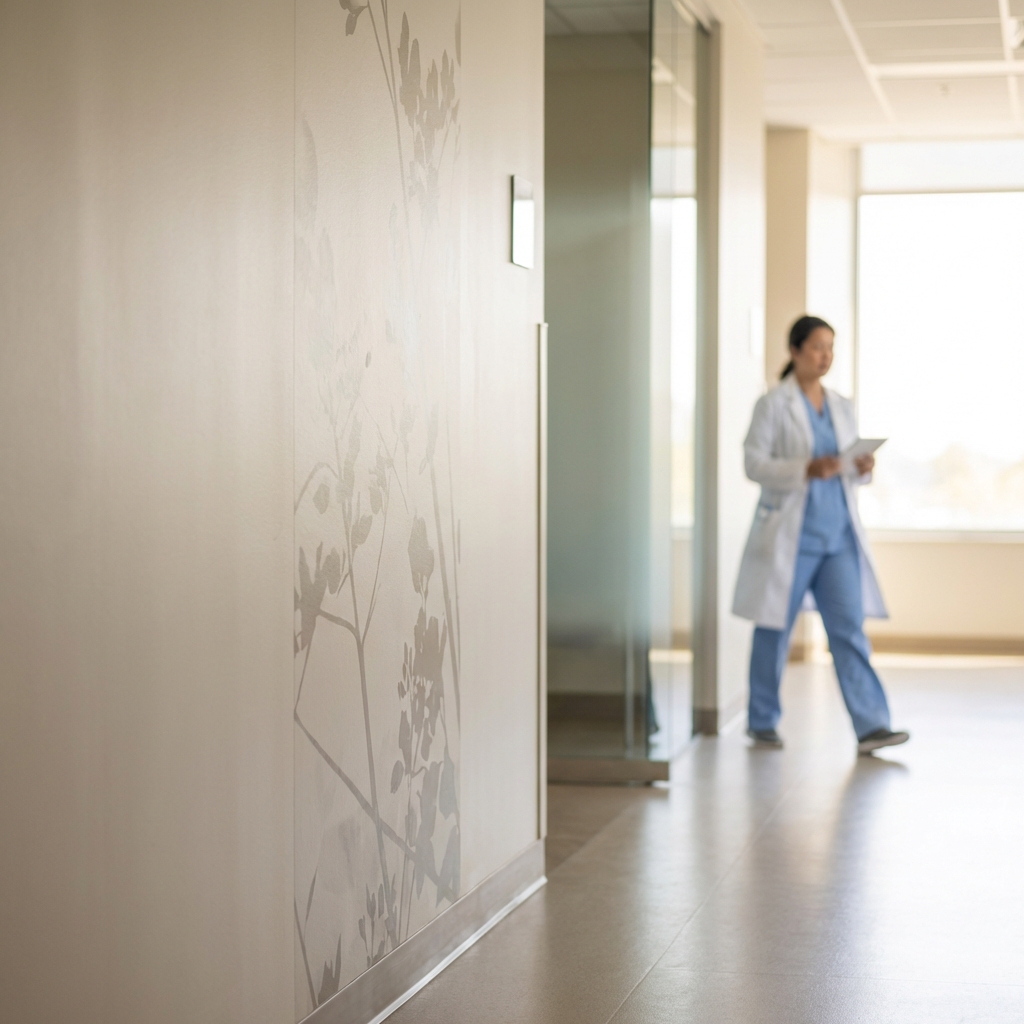
From an infection control perspective, seams and edges are the weak points. Panel overlaps, butt joints, and terminations at door frames can trap soil and moisture, creating cleaning challenges between daily wipe-downs. While some films add antimicrobial topcoats, these inhibit surface growth only; they don’t replace EPA-registered disinfection and can’t claim to prevent infections. Repeated exposure to quats, bleach, and peroxide wipes may cloud laminates, degrade inks, or accelerate edge lift, which is why many facilities restrict vinyl in wet zones and high-touch corridors.
Durability is tied to substrate and environment. On high-traffic walls exposed to bed movers and EVS carts, impacts can dent gypsum and crease film, leading to tears that require panel replacement rather than a simple touch-up. Humidity swings and negative-pressure rooms can stress adhesives, causing bubbling or shrinkage over time. Removal is another consideration: aggressive adhesives can strip paint and joint compound, making change-outs a mini-renovation rather than a quick refresh of durable healthcare wall coverings.
Installation and operations also deserve attention. Panelized graphics demand precise alignment, dust-free conditions, and adequate staging space; odors from fresh vinyl and adhesive liners may be undesirable in occupied care areas. Because wraps are fabricated off-site, any color shift, scale error, or damage in transit can delay go-live. Achieving consistent execution across multi-location rollouts is achievable, but quality depends heavily on field crews and surface prep.
If you move forward with vinyl, strengthen the spec:
- Require Class A flame spread/smoke (ASTM E84) and low-VOC materials.
- Verify written compatibility with quats, bleach (diluted sodium hypochlorite), and peroxide disinfectants, including no haze or ink bleed.
- Detail edge sealing at terminations, corner protection, and panel sequencing drawings.
- Define minimum substrate prep, mockups, and a documented removal process without wall damage.
- Ask for warranties that reflect healthcare cleaning cycles, not retail conditions.
Facilities seeking infection control wall graphics without seams and adhesives should assess direct-to-wall printing technology. EastCoast MuralPros prints high-resolution imagery directly onto finished or unfinished walls (drywall, CMU, concrete, brick), creating a continuous, cleanable surface with no panel lines or lifted edges. On-site production compresses schedules—often completed in under five hours per area—and eliminates shipping and fabrication risk, making it ideal for hospital disinfectant compatible murals and wayfinding. For multi-site medical facility interior branding, their standardized process delivers consistent results while simplifying future change-outs: surfaces are paint-over-ready, enabling strategic refreshes without demolition or adhesive residue.
Comparison Summary: Surface Integrity and Pathogen Harboring Risks
Infection prevention teams scrutinize how graphics interact with the wall itself, because seams, edges, and failing adhesives create micro-environments where moisture and biofilm can accumulate. When comparing healthcare wall printing solutions, the lowest-risk options are those that eliminate overlaps, reduce texture traps, and stand up to aggressive cleaning without curling or softening. Surface integrity matters most in humid zones, handwashing alcoves, elevators, and high-traffic corridors where carts and beds can nick edges.
How common options compare for pathogen-harboring risk:
- Vinyl wall coverings and wallpaper: Multiple seams, overlaps, and cut edges are typical; adhesive lines and lifted corners trap soil. Heat, humidity, and repeated quaternary or peroxide wipes accelerate edge curl, especially around sinks and exterior walls.
- Rigid panel systems (FRP/HPL): Durable and scrub-resistant, but rely on joints, trims, fasteners, and sealants that degrade and need re-caulking. Any gap becomes a harbor, and field repairs add more seams.
- Hand-painted murals: Performance varies by paint system; flat or porous finishes retain soil and can ghost under harsh disinfectants. They are cleanable only when specified with high-performance topcoats and uniform film build.
- Direct-to-wall printing technology (no vinyl or adhesives): No film, no overlap, and no adhesive layer means fewer places for pathogens to hide. The ultra-thin ink profile conforms to drywall, CMU, concrete, or brick, producing seam-free infection control wall graphics at architectural scale.
Cleanability is the other half of the equation. Hospital disinfectant compatible murals must tolerate routine use of quats, hydrogen peroxide, and diluted bleach without softening, staining, or image loss. Because there’s no applied sheet to delaminate, direct-to-wall systems avoid the common failure modes seen in durable healthcare wall coverings during repeated wipe-downs. This is especially relevant in isolation rooms, med-surg units, and public lobbies where protocol-driven turnover is constant.
EastCoast MuralPros prints directly onto prepared substrates to create a bonded, cleanable surface that reduces harbor-prone joins and edge conditions. The result supports medical facility interior branding and integrated wayfinding without adding hardware or signage clutter. For multi-site networks, on-site printing enables consistent execution while minimizing downtime, and the paint-over-ready finish simplifies future program changes or tenant transitions.
From a lifecycle standpoint, fewer seams equal fewer failure points, fewer repairs, and lower infection-control risk over time. If damage occurs, localized reprints are completed in hours, avoiding patch seams common with film or panel replacements. For facilities benchmarking alternatives, this approach offers a performance-based path beyond vinyl and wallpaper while aligning with strict cleaning protocols.
Testing for Disinfectant Compatibility: Chemical Resistance and Longevity
Infection-control cleaning is relentless in clinical environments, so graphics must endure daily exposure to strong chemistries without softening, staining, or color shift. When evaluating healthcare wall printing solutions, ask vendors to validate not only initial appearance but retained performance after repeated disinfection. Seam-free, adhesive-free surfaces reduce dirt catch points and eliminate vinyl edges that can lift under chemical stress—an advantage for infection control wall graphics in corridors, nurses’ stations, and patient rooms.
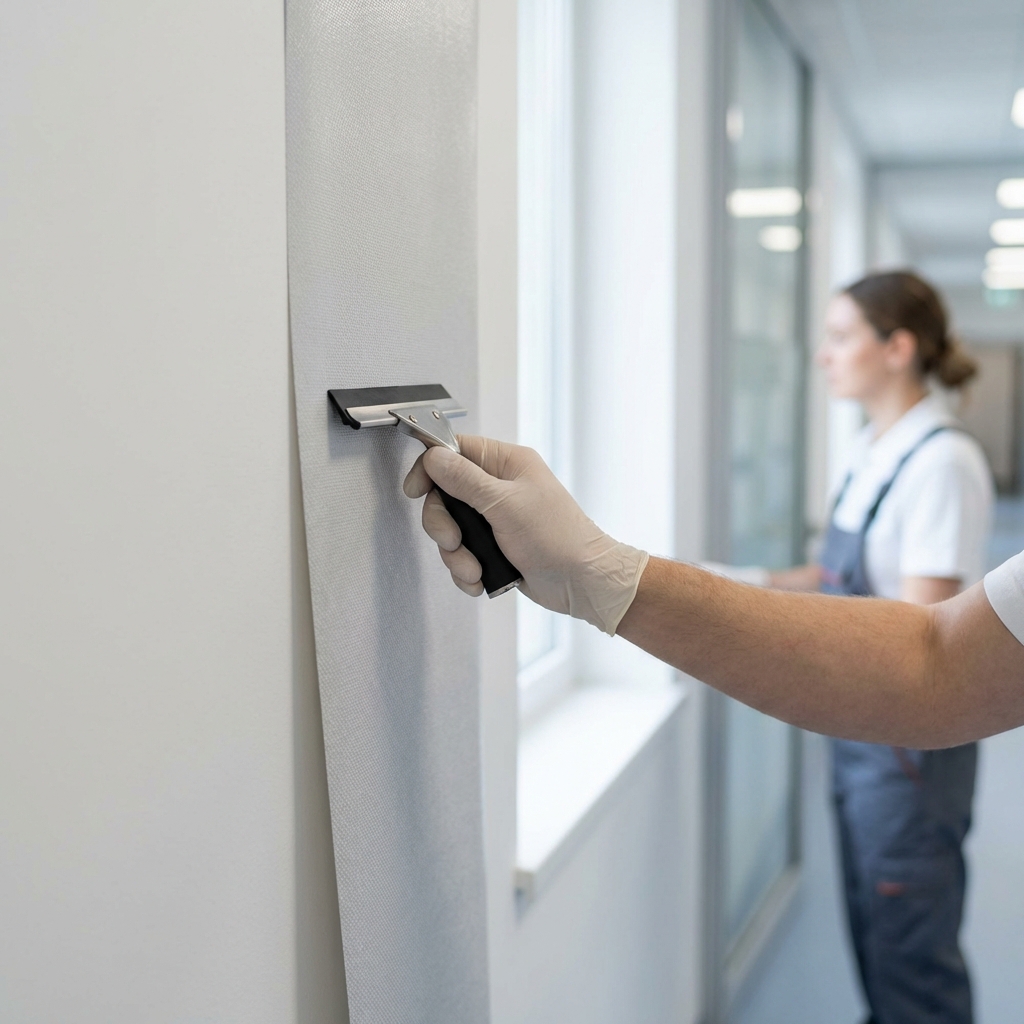
Build a test plan around the actual disinfectants and protocols your facility uses. Document dwell times, wipe frequency, and substrate types (painted drywall, CMU, sealed concrete) so results reflect real conditions. At minimum, include these chemistry classes and typical concentrations:
- Quaternary ammonium compounds (quat wipes and sprays)
- Sodium hypochlorite (0.5–1% bleach solutions)
- Isopropyl alcohol (70% IPA) and ethanol wipes
- Accelerated hydrogen peroxide (AHP) and standard H2O2 (3–7%)
- Peracetic acid blends and phenolics in critical care areas
- Neutral and alkaline detergents for daily cleaning
Specify test methods and acceptance criteria upfront. Useful protocols include crosshatch adhesion (ASTM D3359) on representative substrates, wet scrub/wipe resistance (ISO 11998 or modified ASTM D4828) for 1,000–5,000 cycles with disinfectant-soaked wipes, and abrasion/scuff resistance (ASTM D4060) for high-traffic areas. Require objective color and gloss stability metrics—target ΔE ≤ 2.0 (ASTM D2244) and gloss change ≤ 10 units after cumulative exposure—plus no swelling, cracking, ghosting, or ink transfer. For chemical spot testing, reference ASTM D1308 with realistic dwell times (1–10 minutes) and repeated exposures to mirror environmental services SOPs.
Validation should extend beyond the lab. Request on-wall mockups in a high-cleaning zone and monitor for 4–8 weeks, logging disinfectant type, contact time, and wipe pressure. Confirm that graphics remain legible for wayfinding, that edges do not lift on block or brick, and that surfaces remain paint-over-ready for future program changes—key traits of durable healthcare wall coverings.
EastCoast MuralPros provides hospital disinfectant compatible murals using direct-to-wall printing technology that cures to a hard, cleanable surface on painted drywall, CMU, concrete, and brick. For medical facility interior branding and integrated wayfinding, the team supplies a disinfectant-compatibility matrix, ΔE and adhesion data across substrates, and on-site mockups to de-risk rollout. The result is a performance-based alternative to vinyl: fast-installed, seam-free, and lifecycle-efficient infection control wall graphics that stand up to real-world cleaning.
Buying Guide: Selecting Solutions Based on Traffic and Cleaning Protocols
Choose healthcare wall printing solutions by matching the wall finish to traffic intensity and cleaning chemistry. Start by mapping zones with your infection prevention and environmental services teams. Identify where carts scrape walls, which areas see hourly wipe-downs, and what disinfectants are used (quats, bleach, alcohol, or peroxide). Then require third-party test data for scrub resistance, chemical resistance, and cleanability to validate performance over time.
High-frequency disinfection and impact-prone zones benefit most from seamless, dense surfaces that won’t delaminate. In ED and ICU corridors, select infection control wall graphics that are hospital disinfectant compatible murals and can withstand repeated wipes without whitening or edge failure. Patient rooms and imaging suites often need matte, low-glare graphics that read clearly under clinical lighting. Public corridors, elevator lobbies, and cafeterias call for abrasion-resistant finishes that hide scuffs while preserving photoreal detail for medical facility interior branding.
Direct-to-wall printing technology is a strong alternative to vinyl in clinical spaces because it removes seams and adhesives that can trap soil and peel under aggressive cleaning. It also performs well on drywall, CMU, concrete, and brick, reducing preparation scope across mixed substrates. For lifecycle efficiency, look for paint-over-ready finishes so future tenant or program changes don’t require demolition or extensive patching typical of durable healthcare wall coverings.
Procurement checklist for cleaning protocol fit:
- Request chemical resistance data (e.g., ASTM D543/ISO 2812 methods) for your exact disinfectants.
- Verify scrub/cleanability results (e.g., ASTM D2486, ASTM D6578) and a stated cleaning-cycle warranty.
- Specify matte-satin sheen to reduce glare and visible scuffing in long corridors.
- Require edge-to-edge, seam-free execution and mockups in your highest-traffic zone.
- Confirm repairability and paint-over process in turnover scenarios.
EastCoast MuralPros delivers on these criteria with on-site, adhesive-free printing that installs in under five hours, minimizing downtime in occupied units. Their durable, cleanable surfaces and seam-free execution suit high-traffic corridors and clinical touchpoints, while integrated wayfinding reduces signage clutter. For multi-campus systems, their consistent national rollout process and subscription model make it easy to refresh infection control wall graphics seasonally or after protocol updates without introducing new materials.
Call to Action
Contact us to learn more