
Introduction: The Critical Role of Speed and Site Continuity in Commercial Branding
Speed and continuity aren’t nice-to-haves; they determine whether a branding project enhances operations or derails them. In a commercial wall graphics RFP, the biggest risk isn’t color accuracy—it’s lost hours in an occupied corridor, a school wing, or a retail grand opening window. Your evaluation should show how a vendor will compress timelines without shifting disruption onto your staff or tenants.
Define wall branding turnaround time with measurable milestones, not vague “fast install” claims. Ask for file-to-proof, proof-to-mobilization, and on-site setup/print/tear-down durations, plus cure time before corridors or patient areas can reopen. Providers like EastCoast MuralPros can often complete a typical room in under five hours, and their on-site, vinyl-free wall branding options avoid adhesive lead times and failure points that slow jobs later.
To anchor your interior branding procurement checklist, request the following as hard data you can compare:
- Print rate and coverage (square feet per hour) and typical crew size
- After-hours/weekend availability and incremental cost
- Odor/VOC profile, equipment amperage, and noise (dBA) at 10 feet
- Surface prep scope by substrate (drywall, CMU, concrete, brick) and patch/prime responsibilities
- Protection plan for floors, furniture, art, and IT/medical equipment
- Staging footprint, elevator use needs, and daily clean-up commitments
- Contingency plan for blocked access, schedule slips, or art changes on site
- Multi-location rollout capacity and standardized QA sign-off
Thorough site disruption evaluation should also cover compliance and safety. In healthcare and education, look for ICRA/ICRA-lite methods, dust containment, and badging/background checks. For corporate and public facilities, require clear egress maintenance, wayfinding continuity during work, and a named supervisor who coordinates live updates with facilities.
The direct-to-wall printing benefits are most visible in facility management wall graphics where downtime is costly. EastCoast MuralPros delivers seam-free, photoreal results on finished or unfinished surfaces, with durable, cleanable finishes that are paint-over-ready for tenant or program changes. Their approach reduces shipping and fabrication errors, supports subscription refreshes, and scales consistently across campuses and national portfolios—lowering lifecycle cost while keeping spaces open.
Defining Installation Speed: Moving Beyond Production Lead Times
“Installation speed” isn’t just how fast graphics are produced; it’s how quickly your spaces return to service. In a commercial wall graphics RFP, define speed as the full on-site cycle: mobilization, protection, printing or application, cleanup, punch list, and turnover. That’s what determines occupant disruption, staffing plans, and whether you’ll need after-hours work premiums.
Quantify on-site work, not just shop schedules. Vinyl and wallpaper often add time for panel fabrication, shipping, staging, seam alignment, and adhesive cure—plus rework if a panel is damaged. Direct-to-wall printing compresses that sequence by eliminating adhesives and panels, reducing both crews and steps. For facility management wall graphics, this difference drives real-world wall branding turnaround time and lowers risk.
Consider a 120-foot hospital corridor. A panel-based install might require two to three night mobilizations for prep, lining up seams, rolling closures, and odor management from adhesives. A direct-to-wall approach can complete the same corridor in 4–5 hours with a rolling work zone, no adhesive off-gassing, and immediate return to normal traffic—aligning better with infection-control protocols and nurse station workflows.
Include these metrics in your interior branding procurement checklist:
- On-site hours per 500 sq ft and total mobilizations
- Crew size, lift requirements, and power needs (amps/extension runs)
- Surface prep requirements by substrate (drywall, CMU, brick, concrete)
- VOCs/odors, decibel levels, dust containment, and cleaning plan
- Egress/egress-impact plan (closures, detours, wayfinding during work)
- After-hours premiums and infection control (ICRA) compliance procedures
- Mockups/test prints on actual walls and acceptance criteria
- Turnover steps: punch list timing, protection, and reopen-to-occupants time
EastCoast MuralPros delivers direct-to-wall printing benefits tailored to occupied buildings: on-site printing that eliminates shipping delays, seam-free imagery at architectural scale, and many installations completed in under five hours. Teams in healthcare, education, and corporate workplaces get durable, cleanable graphics that are paint-over-ready for future changes, with consistent execution across multi-location rollouts. For predictable schedules and minimal site disruption evaluation, see their professional installation workflows.
Assessing Site Disruption: Comparing Traditional Vinyl to Direct-to-Wall Printing
When drafting a commercial wall graphics RFP, make site disruption evaluation as concrete as cost and quality. The way a vendor mobilizes, installs, and exits will dictate whether you can keep spaces open, meet infection-control protocols, and avoid rework. Compare not just aesthetics, but the equipment footprint, prep requirements, odors, and the wall branding turnaround time a solution can consistently deliver.
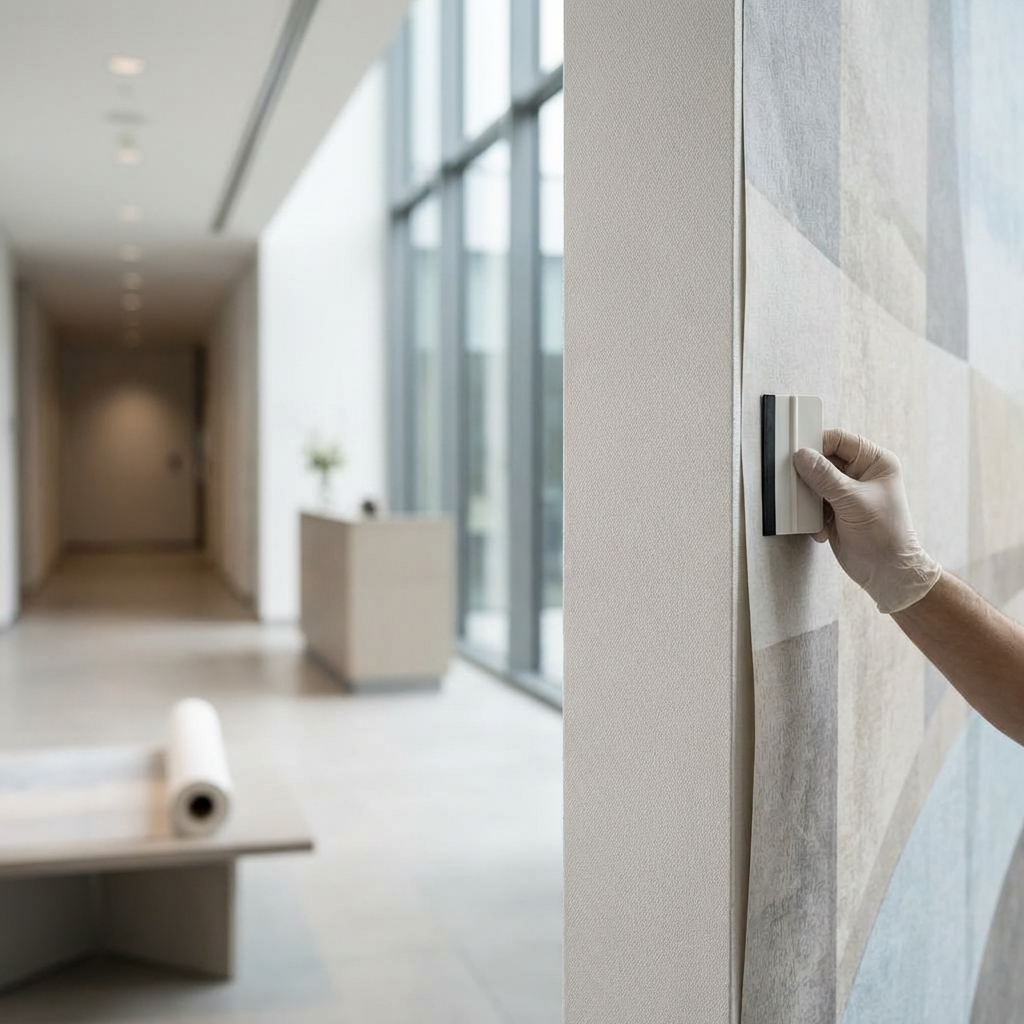
Traditional vinyl and wallpaper typically require surface prep (patching, sanding, priming), material staging, and adhesive application with open seams that demand careful alignment. Installations can stretch across multiple shifts, with ladders or scaffolds, barricades, and post-install curing—all disruptive in hospitals, schools, and offices. Adhesives and liners generate waste, and failures like bubbling or edge-peel trigger callbacks and more downtime. Even small wayfinding updates often turn into multi-day tasks when coordinators must sequence deliveries, crews, and off-hours access.
Direct-to-wall printing changes the equation. A single, mobile printer and a compact crew image graphics directly to finished or unfinished surfaces, eliminating adhesives and seam alignment. With no vinyl to ship or trim, on-site printing removes fabrication errors and delays, and many zones can be completed in under 5 hours, often during nights or weekends. The result is a durable, cleanable, paint-over-ready finish that supports future tenant changes and minimizes disruption across large campuses.
Use this interior branding procurement checklist to compare options on disruption and speed:
- Average install hours per 1,000 sq ft (by surface type) and typical crew size
- Required wall prep steps and whether adhesives, liners, or primers are used
- Equipment footprint, access needs (lifts, scaffolding), and noise profile (dBA)
- Odor and emissions considerations; plans for occupied environments and ICRA compliance
- Need for closures, barricades, or negative-air containment; after-hours capability
- Waste generated (liners, trimmings) and removal plan; sustainability documentation
- Failure-rate history (seam lift, bubbling) and warranty terms tied to uptime
- Shipping and fabrication dependencies versus on-site output that mitigates delay
- Multi-location rollout plan and schedule certainty for facility management wall graphics
EastCoast MuralPros is a strong fit when direct-to-wall printing benefits are a priority. Their on-site, adhesive-free process delivers seam-free results on drywall, CMU, concrete, and brick with low disruption and consistent execution across campuses and national programs. For teams seeking predictable wall branding turnaround time and minimal downtime, they offer pilot-to-rollout support and subscription refreshes aligned to operations.
The RFP Checklist: Key Questions for Evaluating Vendor Operational Efficiency
Operational efficiency should be front and center in any commercial wall graphics RFP. Beyond aesthetics, you’re buying schedule certainty and minimal impact on occupants. Use this interior branding procurement checklist to probe real-world performance, wall branding turnaround time, and site disruption evaluation—not just marketing claims.
- How long from artwork approval to on-site installation, and what’s the typical time per wall or zone? Ask for examples (e.g., a four-corridor healthcare wing completed in under five hours) and whether after-hours or weekend shifts are supported.
- What is the on-site footprint and disruption profile? Confirm noise levels, ventilation needs, dust/odor controls, and whether spaces must be vacated, or can remain operational in schools, clinics, or offices.
- Which surfaces are supported without primers, panels, or adhesives (drywall, CMU, concrete, brick), and what are the height limits? Request details on seam-free execution and how uneven substrates or expansion joints are handled.
- How do you manage color accuracy and resolution at architectural scale? Require proofing protocols, device calibration, and sample prints for critical brand colors or photoreal imagery.
- Is printing performed on-site or off-site? On-site printing reduces shipping delays and fabrication errors—ask for a method statement and floor-by-floor sequencing plan.
- What durability and cleanability data can you provide for high-traffic environments? Specify expected lifecycle, scratch/scuff resistance, and whether finishes are paint-over-ready for future tenant or program changes.
- What safety, compliance, and infection-control measures are standard for healthcare and education projects? Verify COI, background checks, and ICRA/occupied-building protocols.
- How is multi-location consistency ensured? Look for standardized workflows, national rollouts, and a single point of contact for facility management wall graphics.
- Can you support wayfinding, safety, and instructional graphics without signage clutter? Ask for integrated design-production workflows and campus-wide examples.
- Do you offer programmatic refreshes or subscriptions for seasonal or strategic updates? Clarify SLAs, change-order processes, and per-square-foot or per-project pricing structures.
- What are the direct-to-wall printing benefits versus vinyl or wallpaper in your approach? Seek specifics on install speed, seams, sustainability, and reduced maintenance cycles.
Score responses with measurable SLAs, request a pilot in an occupied area, and speak with references who’ve executed multi-site or full-campus solutions. EastCoast MuralPros is a strong benchmark here: direct-to-wall printing (no vinyl or adhesives), typical installs completed in under five hours, durable and cleanable finishes, and consistent execution across multi-location programs—all designed to minimize disruption while accelerating delivery.
Mitigating Risk: Safety Standards and Cleanliness in Occupied Buildings
In a commercial wall graphics RFP, risk mitigation should be defined as clearly as scope and budget. Use a site disruption evaluation to set measurable guardrails for work in occupied buildings—what’s acceptable for air quality, noise, egress, and housekeeping. Note the direct-to-wall printing benefits: no adhesives or panel cutting, minimal debris, and faster setup/teardown, which materially lowers risk compared to vinyl installs or construction-heavy upgrades.
Spell out environmental and health requirements. Request Safety Data Sheets for inks and cleaners, statement of indoor-air compliance (e.g., low- or no-VOC), cure method, and odor mitigation practices. Establish noise thresholds and time-of-day restrictions; for healthcare and education, require infection-control protocols (e.g., containment and cleaning procedures) so hallways, clinics, and classrooms remain operational during wall branding turnaround time. Example: “Vendor must complete corridor graphics after hours with corridors reopened by 6 a.m., no residual odor, and all wayfinding visible.”
Your interior branding procurement checklist should itemize safety, cleanliness, and traffic control deliverables vendors must provide:
- Daily housekeeping plan: floor/wall protection, dust control, and end-of-shift wipe-downs
- Cable and hose management with visible cord covers and trip-hazard mitigation
- Lift and ladder safety, spotters, and barricades in public corridors; clear egress maintained at all times
- Badging, background checks, and infection-control training where required
- Equipment footprints, power needs, and decibel ratings
- Waste minimization and removal plan; recycling of packaging and liners (note: adhesive-free systems should produce little to no liner waste)
- Incident response and emergency communication protocol with on-site contacts
Measure performance, not promises. Ask for historical KPIs such as average room return-to-service times, punch-list rates, and completion rates for multi-location rollouts—crucial to facility management wall graphics programs. EastCoast MuralPros’ on-site, adhesive-free direct-to-wall printing is designed for occupied environments, with typical installs completed in under five hours and surfaces left clean and immediately usable. For hospitals, schools, and corporate campuses, that speed—combined with seam-free, durable, cleanable finishes—reduces risk and supports predictable schedules without compromising safety or cleanliness.
Long-Term Maintenance and Lifecycle Efficiency for High-Traffic Facilities
Long-term value should be explicit in your commercial wall graphics RFP. In high-traffic environments—healthcare corridors, school hallways, transit concourses—maintenance requirements, repair methods, and refresh workflows often outweigh first-cost. Define how the system will be cleaned, repaired, updated, and ultimately removed or painted over without disrupting operations.

Traditional vinyl and wallpaper introduce lifecycle risk: seams collect dirt and fail, edges lift under frequent disinfection, and replacement cycles trigger recurring closures. Direct-to-wall printing benefits include seam-free imagery, no adhesives to fail, and paint-over-ready finishes that simplify future changes. EastCoast MuralPros leverages this approach to reduce ongoing maintenance and avoid the recurring re-fabrication costs common with vinyl wraps, especially across multi-location portfolios.
Add these lifecycle checkpoints to your interior branding procurement checklist:
- Documented cleaning protocol compatible with hospital-grade disinfectants (e.g., quats, diluted bleach); provide third-party test results.
- Abrasion and scrub resistance ratings, plus stain resistance for markers, hand oils, and scuffs; request mock-up cleaning demonstrations on your actual substrate.
- UV and colorfastness performance for sunlit lobbies; include expected appearance retention timeline and warranty coverage.
- Fire and smoke documentation appropriate for interior finish compliance (e.g., ASTM E84 or local equivalent).
- Seam-free execution requirements and substrate compatibility (drywall, CMU, concrete, brick) with surface prep scope clearly defined.
- Repair and refresh workflow: on-site reprint capability, typical wall branding turnaround time for partial reprints, and paint-over procedure for future tenants.
- Warranty terms tied to traffic level and cleaning frequency, plus service-level agreements (SLAs) for response and remediation.
- Multi-location consistency plan with color management, device calibration logs, and sample approvals to minimize variance at scale.
Structure your site disruption evaluation around total cost of ownership, not just install cost. Include labor for recurring repairs, infection-control barriers, night or weekend premiums, and the soft costs of wayfinding downtime. EastCoast MuralPros’ low-disruption installs—often under five hours—and on-site printing eliminate shipping and re-fab delays, while their subscription model lets facilities schedule seasonal or strategic refreshes without reopening procurement.
Consider a hospital example: daily disinfection degrades adhesives and seams, but a seam-free, direct-to-wall system reduces harbor points for grime and simplifies cleaning cycles. For facility management wall graphics on a university campus, paint-over-ready finishes enable quick program changes between semesters. By specifying these lifecycle criteria up front, you’ll select a solution that protects budgets, brand standards, and uptime for years.
Conclusion: Prioritizing Operational Harmony in Your Next Interior Upgrade
Operational harmony should be the headline criterion in any commercial wall graphics RFP. Build your scoring around two core variables—wall branding turnaround time and site disruption evaluation—then validate with proof, not promises. Ask vendors to document average install durations, staffing requirements, and occupied-building protocols on projects comparable to your footprint and operating hours.
To turn your interior branding procurement checklist into an operational safeguard, require measurable responses to items like:
- Confirmed install window per 1,000 sq ft, including after-hours capabilities
- Surface compatibility and prep needs (drywall, CMU, concrete, brick)
- On-site printing versus prefabrication to minimize shipping delays and fabrication errors
- Seam visibility, image resolution at viewing distances, and color management across locations
- Cleanability standards, anticipated lifecycle, and paint-over or removal process
- Wayfinding and safety integration without signage clutter
- Sustainability attributes (adhesive use, waste, and end-of-life handling)
- SLAs, warranty terms, and response times for service calls
Strengthen the evaluation by piloting a representative corridor or lobby and timing the end-to-end process—site walk, proofing, installation, and turnover. Require a method statement that details staging, protection of adjacent areas, egress maintenance, and communication cadence with facilities. For facility management wall graphics that will scale, assess how the vendor handles version control, brand governance, and multi-site scheduling under a single PO.
EastCoast MuralPros aligns well with these operational guardrails. Their direct-to-wall printing benefits include adhesive-free, seam-free execution, fast installations typically completed in under five hours, and compatibility with finished and unfinished surfaces. On-site printing reduces shipping dependencies, while durable, cleanable finishes and paint-over-ready surfaces simplify future tenant or program changes. For campuses and healthcare systems, they support full-campus rollouts, integrated wayfinding, and subscription refreshes that fit weekend or overnight windows.
As you close out your RFP, weight operational impact and schedule certainty alongside quality and lifecycle economics—not just unit price. If you need a starting point, EastCoast MuralPros can provide sample specifications, a site assessment template, and a rollout plan for multi-location programs so your next interior upgrade advances branding goals without disrupting daily operations.
Call to Action
Contact us to learn more