Introduction: Why Facility Managers Are Reconsidering Wall Solutions
Facility and operations leaders are under constant pressure to keep spaces current, safe, and on brand—without disrupting everyday use or inflating maintenance budgets. The pace of change across workplaces, healthcare, education, retail, and hospitality requires interior upgrades that install fast, last longer, and scale gracefully across multiple locations. Against that backdrop, mural printing for facility managers has emerged as a practical, performance-driven alternative to vinyl wall coverings, wallpaper, and construction-heavy refreshes.
The shift is driven by four realities: the need to minimize downtime, the rising cost of frequent replacement, the expectation for design-forward interiors, and the operational impact of materials that fail in high-traffic conditions. Direct-to-wall printing technology meets those needs by anchoring graphics directly to the built surface—no panels, adhesives, or seams—so visuals feel integrated into the architecture rather than applied on top of it.
EastCoast MuralPros focuses on this category of commercial wall graphics alternatives. Their teams print on-site, often completing installations in under five hours, and deliver high-resolution, seam-free mural installation across finished and unfinished surfaces. For facility managers weighing refresh priorities against tight schedules, the approach provides a reliable way to deliver durable interior branding solutions with fewer moving parts and far less disruption.
The Limitations of Traditional Vinyl Wraps and Wallpaper
Vinyl and wallpaper have long served as go-to options for branded walls and decorative updates. But they carry well-known drawbacks in institutional and high-traffic settings:
- Adhesives that peel, bubble, or fail under cleaning regimens and environmental swings.
- Visible seams and panel edges that collect dust and degrade the design over time.
- Long lead times tied to off-site fabrication, shipping, and staging logistics.
- Removal challenges that can damage substrates and add labor-intensive cleanup.
- Waste streams from PVC, liners, adhesives, and offcuts that head to landfill.
From a facilities perspective, those issues translate into repeated service calls, faster-than-planned replacements, and uneasy occupants when graphics begin to lift or look tired. In corridors, lobbies, elevators, stair towers, and patient areas, even small failures are highly visible—and they erode confidence in both the environment and the brand.
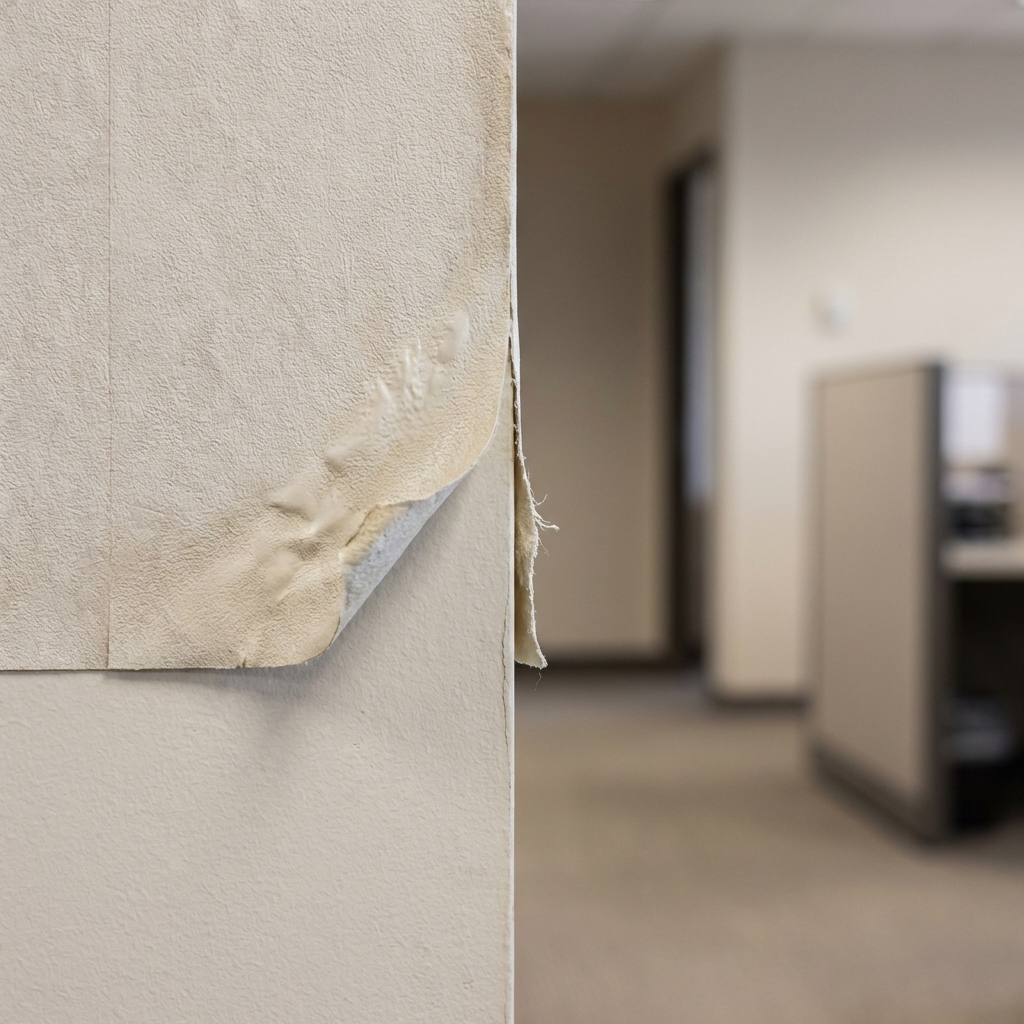
Wallpaper brings its own liabilities. Paste and seams complicate installation in occupied spaces, while moisture and abrasion at corners accelerate wear. When programs change or tenants turn over, removal can uncover irregularities, wall damage, or paint mismatches—all costs that seldom make it into the first estimate.
These pain points are the reason many teams are shifting their evaluation criteria toward performance-based alternatives that prioritize lifecycle efficiency, rapid on-site execution, and clean, integrated results.
How Direct-to-Wall Printing Works: Technology and Process
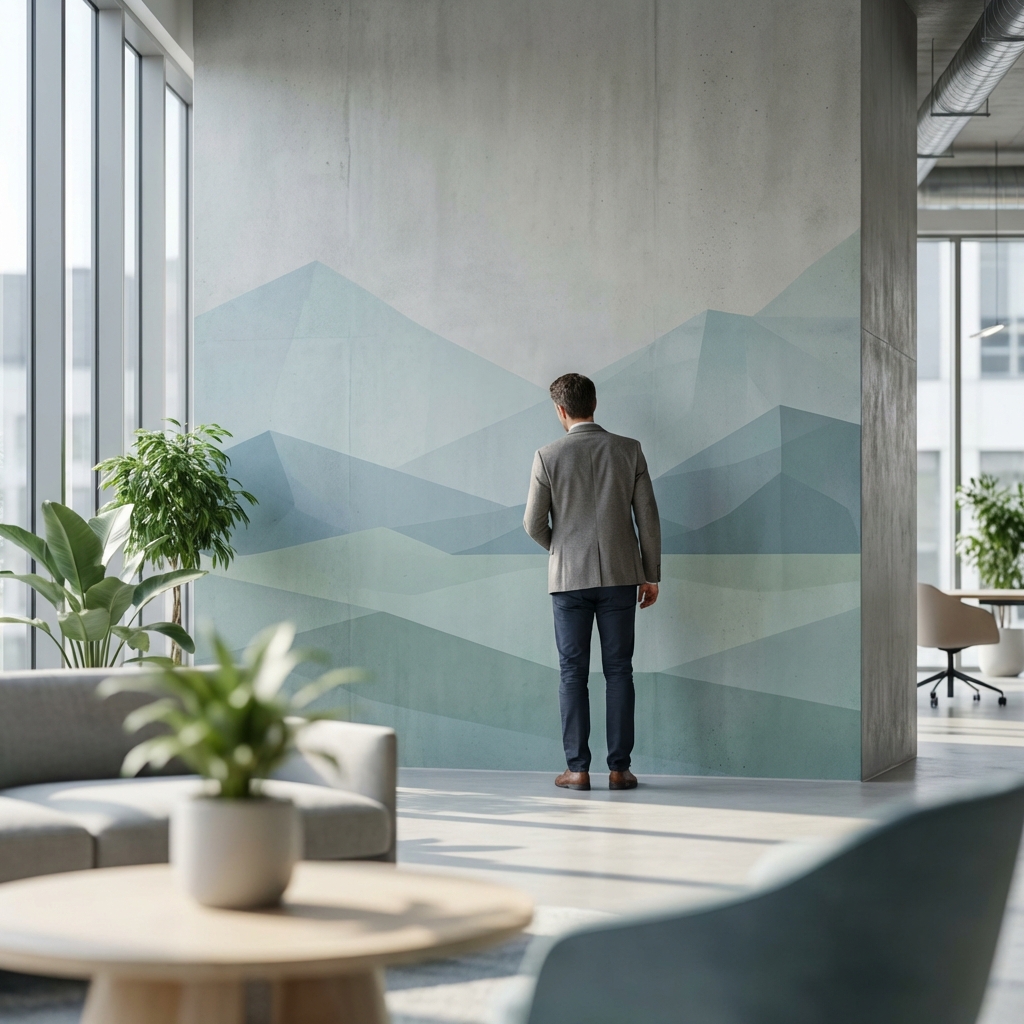
Direct-to-wall printing technology uses a portable, high-precision vertical printer that travels along the wall and jets UV-curable inks directly onto the surface. Integrated UV-LED lamps cure the ink instantly, locking in color and detail without adhesives or mounted substrates. The result is a photoreal image that conforms to the wall’s texture—drywall, CMU, sealed concrete, brick, even lightly textured finishes—so graphics read as part of the building itself.
The process is straightforward and built for facility schedules:
- Assessment and planning
– A site walk evaluates wall condition, surface porosity, lighting, and access. – The team confirms dimensions, obstacles, and the best time window for printing (overnight, weekend, or during low-traffic hours). – For multi-site rollouts, a repeatable playbook covers wall prep standards, color targets, and sequencing.
- Artwork preparation and proofing
– Designs are scaled to architectural dimensions, with attention to viewing distance and typography legibility. – Color management profiles align output across locations, ensuring consistency with brand guidelines. – Where needed, a small on-wall proof confirms color and adhesion before proceeding.
- Surface readiness
– Light cleaning removes dust and oils; minor patching or scuff sanding levels imperfections. – Highly porous or friable surfaces may receive a quick sealer or primer pass to stabilize the print zone.
- On-site printing
– The printer is positioned, leveled, and calibrated. Technicians map the print area and set pass counts for optimal coverage and detail. – UV-LED curing occurs as the image is laid down, producing a dry-to-touch surface immediately—no odors from adhesives and no curing downtime. – Complex walls with doors, windows, or fixtures are printed with precision alignment around obstacles.
- Quality check and handover
– A final inspection verifies color fidelity, edge precision, and adhesion. – Occupants can use the space right away; no barricades or off-gassing windows are required.
EastCoast MuralPros tailors this workflow for campuses, hospitals, and corporate environments, coordinating closely with facilities teams to maintain emergency egress, infection control, and operational continuity.
Key Benefits for Facilities and Institutional Settings
Direct-to-wall printing was built for operational realities. For facility leaders responsible for reliability, cost, and experience, the benefits are concrete:
- Seam-free graphics at architectural scale
– No panel joins or overlaps; visuals read as a unified surface, even across long corridors and multi-story features.
- Durable, cleanable, high-resolution imagery
– UV-cured inks deliver crisp detail that stands up to daily wear, custodial cleaning, and high-touch zones.

- Fast, low-disruption installation
– On-site printing typically completes in under five hours per wall segment, with options for off-hours execution.
- Fewer failure points than vinyl or wallpaper
– No adhesives to fatigue, bubble, or off-gas; no edges to lift or trap dust.
- Consistent results across multi-location rollouts
– Standardized color targets, production notes, and prep protocols ensure repeatability from site to site.
- Lifecycle efficiency
– Extended useful life, paint-over-ready removal, and reduced replacement cycles lower total cost of ownership.
- Compatible with finished and unfinished surfaces
– Drywall, CMU block, sealed concrete, brick, and more—without elaborate panel systems.
- Integrated wayfinding and safety communication
– Instructional and directional graphics embed into the architecture, reducing sign clutter and maintenance.
EastCoast MuralPros also supports in-studio printing on doors, tables, and standees—useful for branded elements that coordinate with on-wall campaigns—and offers subscription models for seasonal or strategic refreshes that align with campus calendars, retail resets, and tenant turnover.
Installation Speed and Minimal Disruption to Operations
Time is often the deciding factor for facilities management wall upgrades. Traditional wallpaper or vinyl installations can stretch into multi-day efforts that involve staging, panel alignment, trimming, and cleanup. By contrast, direct-to-wall printing streamlines the workflow to a single, tightly managed window.
- Typical single-wall segments are completed in under five hours, including setup and quality checks.
- Overnight or weekend scheduling limits impact on staff, patients, guests, and students.
- The process generates minimal noise and no adhesive odors, allowing nearby areas to function normally.
- Corridors, lobbies, and waiting areas can remain partially open, with brief rolling barriers rather than full closures.
Because graphics are produced on site, there is no risk of shipping delays or fabrication errors discovered at installation. If a late-stage edit is required—a wording change to a directional arrow, an updated safety instruction, or a sponsor swap—teams can adjust the file and print the corrected element without scrapping pre-produced materials.
For multi-floor or multi-building programs, EastCoast MuralPros sequences work to maintain egress and life-safety protocols, cleaning as they go and leaving each area usable immediately after printing. Occupant communication, wayfinding detours, and access logistics are built into the plan so operations remain predictable.
Durability, Cleanability, and Lifecycle Cost Advantages
In high-traffic facilities, the most expensive wall is the one you have to fix repeatedly. Direct-to-wall prints are engineered for daily use and frequent cleaning, with no seams to catch a mop head and no edges to peel when disinfectants are applied. UV-curable inks form a tough, abrasion-resistant layer that resists scratching and staining better than most decorative paints and comparable vinyl finishes.
For facility managers who must demonstrate performance, consider these practical advantages:
- Cleanability: Surfaces can be wiped with common non-abrasive cleaners and disinfectants, preserving legibility and color.
- Impact resistance: The cured ink layer holds up in corridors and seating areas where carts, backpacks, and rolling equipment are routine.
- Fade resistance: High-quality pigments and UV curing minimize color shift under standard indoor lighting.
- Paint-over-ready: When programs or tenants change, walls can be lightly prepped and painted, rather than stripped at high labor and disposal cost.
The lifecycle cost equation reflects fewer service calls, longer refresh cycles, and avoided removal labor. In many cases, the reduction in repeat installs and downtime offsets the initial project within a predictable time horizon. For a deeper dive into performance considerations, see this overview of the durability benefits of wall printing.
Design Flexibility and Multi-Location Consistency
From brand storytelling to wayfinding systems, the design brief rarely stops at one wall. Direct-to-wall printing supports both creative ambition and operational rigor across campuses and national portfolios.
- Photoreal image quality at architectural scale
– From large-format photography to intricate patterns and fine typography, details remain crisp at viewing distance.
- Flexible to surface character
– Graphics can celebrate the texture of brick or block, or sit cleanly on finished drywall; either way, the result feels integrated, not applied.
- Standardized color management
– ICC profiles and calibrated devices align output to brand color standards across sites and seasons.
- Modular systems for localized content
– Templates allow corporate or district teams to swap localized information—department names, room numbers, campus maps—without reinventing core design each time.
- Collaborative tools for digital artists and design partners
– EastCoast MuralPros supports file preparation, version control, and scalable artwork workflows so creative teams can expand proven assets into new spaces quickly.
Beyond walls, in-studio printing on doors, tables, and standees extends the system into touchpoints that reinforce brand, provide program information, or guide traffic at events. All of it adds up to consistent, durable interior branding solutions that travel well from pilot to national rollout.
Sustainability Considerations for Modern Facilities
Sustainability is now part of operational due diligence. While the carbon math of interiors is complex, several aspects of direct-to-wall printing improve the environmental profile of wall graphics programs:
- Material reduction
– No PVC, liners, release papers, or large adhesive layers; far fewer components head to landfill over the lifecycle.
- Lower shipping and packaging impacts
– Printing occurs on site, not in a distant fabrication shop, which reduces freight emissions and protective packaging.
- Fewer replacements
– Durable, seam-free surfaces extend refresh intervals, decreasing waste tied to frequent reinstallation.
- Simplified end-of-life
– Paint-over-ready walls avoid labor- and landfill-heavy removal.
The ink chemistry and curing method matter too. UV-LED curing minimizes energy use relative to traditional curing lamps, and cured prints are low-odor and immediately usable, reducing occupant exposure to off-gassing from adhesives. For an in-depth comparison of waste and materials, see this analysis of direct-to-wall printing vs vinyl.
For public-sector owners and institutions with sustainability policies, these advantages support procurement goals around waste reduction, operational efficiency, and healthier interiors.
Real-World Applications Across Industries and Institutions
Direct-to-wall printing fits diverse programs because it adapts to both messaging and material constraints across sectors. A few use cases that regularly deliver value:
- Healthcare systems and medical facilities
– Integrate calm, evidence-informed imagery in patient areas; apply clear wayfinding that withstands daily disinfection; add large, legible instructional graphics in corridors, elevators, and staff-only zones without sign clutter.
- Colleges, universities, and K–12 districts
– Brand entrances, athletic corridors, and student services; print mascots and donor walls on CMU block; incorporate safety reminders and campus maps during move-in or renovation phases, then update seasonally via subscription.
- Corporate real estate and workplaces
– Deliver culture walls, program dashboards, and neighborhood identifiers without construction; adjust content as teams evolve; maintain consistent color standards across regional offices.
- Hospitality brands and hotel operators
– Refresh guest corridors and public spaces between major renovations; integrate brand storytelling without adding panels that can be damaged by luggage; update seasonal campaigns quickly.
- Retail chains and multi-location brands
– Roll out promotional narratives and navigational cues at scale; coordinate with in-studio printed fixtures and standees; pivot messaging based on store format without new substrates.
- Commercial landlords and asset managers
– Expedite lease-up with move-in-ready branding; convert white-box conditions into marketable experiences; hand over paint-over-ready finishes for future tenants.
- Museums and cultural institutions
– Achieve photoreal galleries, exhibit backdrops, and educational timelines with crisp detail; brand back-of-house areas without complex construction; refresh content while protecting sensitive spaces.
- Public-sector and institutional owners
– Embed permanent or semi-permanent wayfinding, safety messages, and civic branding into walls that won’t suffer seam failure in high-use environments.
In each scenario, the common thread is operational reliability: fast installation, durable outcomes, and a clean, integrated look that supports the mission of the space.
Budget Planning and ROI for Decision-Makers
Procurement teams evaluate more than a per-square-foot number. They look at total cost of ownership, schedule risk, and the expense of downtime. Mural printing for facility managers produces favorable math across those dimensions because it reduces components, touchpoints, and future liabilities.
Consider the budget line items that shift when moving from vinyl or wallpaper to direct-to-wall printing:
- Materials
– Eliminates panels, adhesives, liners, and extensive protective packaging. Ink and on-site equipment drive the process rather than shipped goods.
- Fabrication and shipping
– On-site production avoids freight charges, crating, and delays; there’s no risk of damaged panels arriving on install day.
- Labor and schedule
– Fewer steps, no panel alignment, and minimal masking shorten installation windows, especially for large runs.
- Site disruption
– Shorter closures reduce operational impacts in revenue-generating or mission-critical areas.
- Maintenance and replacement
– Seam-free prints and UV-cured surfaces extend life; planned refresh cycles can be scheduled through a subscription model for predictable spend.
- End-of-life
– Paint-over-ready walls eliminate removal labor, disposal fees, and substrate repairs.
When modeling ROI, incorporate avoided costs from service calls (re-adhering edges or replacing panels), accelerated replacements due to visible wear, and the operational value of keeping spaces open. For multi-location brands and institutions, also factor standardization benefits: a single set of color targets, prep specs, and artwork templates that reduce creative and production waste.
For projects tied to lease-up, seasonal campaigns, or policy-driven signage changes, subscription plans offered by providers like EastCoast MuralPros can spread costs over the year, align with program calendars, and ensure timely updates without re-bidding every cycle.
Getting Started: Assessment and Partnership Approach
Effective outcomes depend on a disciplined intake and planning process. Facility managers can accelerate approvals and reduce surprises by partnering early and documenting goals, constraints, and success criteria.
A typical engagement roadmap with EastCoast MuralPros includes:
- Discovery and site assessment
– Review wall inventory, substrate types (drywall, CMU, concrete, brick), environmental conditions, and access windows. – Prioritize areas based on visibility, urgency, and operational constraints; identify any surfaces that need sealer or patching.
- Design coordination and approvals
– Align on brand standards, color targets, typography legibility, and accessibility considerations for wayfinding and instructional graphics. – Provide scaled mockups and, if helpful, a small on-wall proof to build stakeholder confidence.
- Implementation planning
– Lock installation dates and time blocks that avoid peak usage; coordinate with security, cleaning schedules, and occupant communications. – Define phasing for multi-floor or multi-building programs to maintain egress and minimize disruption.
- Production and quality controls
– Use calibrated equipment and documented settings to ensure repeatability; capture sign-offs with time-stamped photos and color readings where required.
- Handover and maintenance guidance
– Share cleaning recommendations, touch-up protocols for adjacent paint, and a digital record of assets for future updates. – Establish a cadence for refreshes if using a subscription model—e.g., quarterly updates for wayfinding or seasonal branding.
For creative partners and in-house design teams, EastCoast MuralPros provides collaborative tools to scale artwork across sites, manage versioning, and coordinate in-studio prints on doors, tables, and standees that complement the on-wall system. The goal is a turnkey pathway from pilot to portfolio-wide deployment with consistent outcomes.
Conclusion: Strategic Wall Graphics for Tomorrow’s Spaces
As expectations rise for fast, durable, and design-forward interiors, direct-to-wall printing gives facility leaders a reliable, lifecycle-efficient path forward. By removing adhesives and seams, reducing shipping and staging, and delivering photoreal imagery that integrates with the architecture, it resolves many of the familiar pain points of vinyl and wallpaper.
For facility managers balancing budgets, schedules, and stakeholder trust, the advantages are practical: installations that complete in hours, surfaces that hold up to daily use and cleaning, and programs that scale across campuses and national footprints with consistent quality. Whether the need is wayfinding that reduces signage clutter, brand storytelling at architectural scale, or a subscription-based cadence of updates tied to operations, mural printing for facility managers is a performance-based alternative built for modern environments.
EastCoast MuralPros partners with commercial and institutional teams to plan, print, and maintain these systems—on site, at speed, and with the predictability facilities depend on. When it’s time to rethink wall graphics, consider the operational gains unlocked by a seam-free, paint-over-ready approach that looks as good on day 1,000 as it does on day one.
Contact us to learn more