Table of Contents
- Introduction: Why Schools Need Durable Wall Art Solutions
- Common Challenges with Traditional School Murals and Vinyl Wraps
- How Modern Direct-to-Wall Printing Works for Educational Institutions
- Design Applications: Wayfinding, Branding, and Safety Graphics in Schools
- Durability and Maintenance: What Makes School Wall Art Last
- Installation Speed and Minimal Disruption for Operating Schools
- Cost Efficiency and Lifecycle Benefits for School Districts
- Design Flexibility: From Elementary Schools to University Campuses
- Sustainability Advantages Over Wallpaper and Vinyl Alternatives
- Case Studies: Successful School Wall Art Deployments
- Choosing the Right Partner for School Wall Graphics
- Conclusion: Transforming School Interiors with Reliable Wall Art
Introduction: Why Schools Need Durable Wall Art Solutions
School environments work hard. Corridors carry thousands of footsteps a day, gym walls double as event backdrops, and common areas must communicate identity, direction, and safety—all without getting in the way of learning. As districts and campuses seek to create engaging, inclusive spaces, durable custom wall art for schools has become a strategic tool, not just decoration. It supports culture, wayfinding, and instructional goals while standing up to constant use.
Budgets and schedules are tight across education. Facilities teams need school wall graphics solutions that install quickly, clean easily, and look as good two years from now as they do on day one. Vinyl wall coverings, wallpaper, and hand-painted murals can’t always keep pace with modern demands for speed, lifecycle value, and multi-location consistency. That gap is where next-generation institutional wall printing technology excels.
Direct-to-wall printing turns plaster, drywall, CMU, brick, and concrete surfaces into high-resolution canvases. For schools, it means brand-level visuals, integrated safety information, and classroom-scale learning aids—delivered with minimal disruption. Providers like EastCoast MuralPros focus on dependable outcomes: photoreal clarity, seam-free coverage, and finishes you can clean without fear.
If you oversee K–12 campuses, higher education facilities, or a learning-focused hospital wing, the conversation has shifted. The question is no longer whether to invest in environmental graphics—it’s how to implement durable custom wall art schools can rely on, from first bell through finals week, with predictable costs and timelines.
Common Challenges with Traditional School Murals and Vinyl Wraps
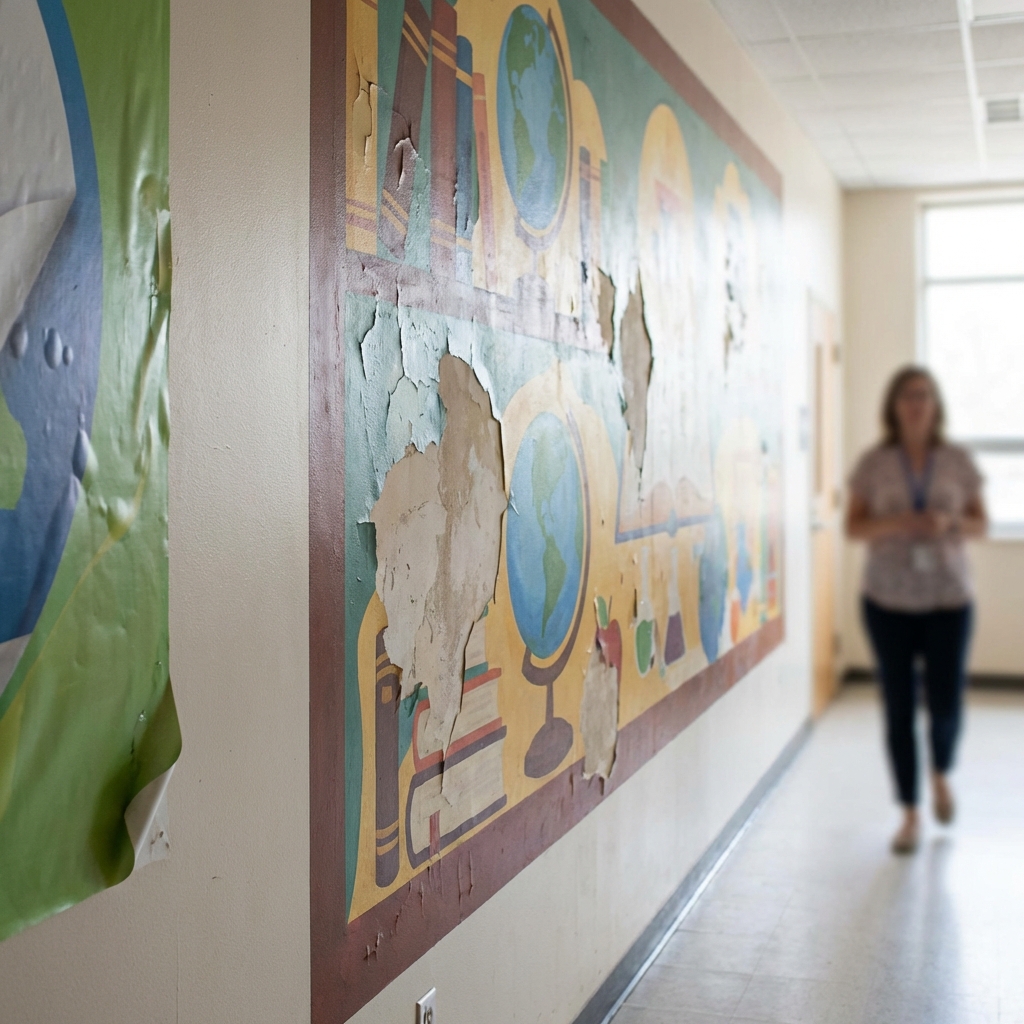
Many districts start with what they know—brush-painted murals, vinyl wraps, or wallpaper. Over time, recurring issues surface that add cost, complexity, and frustration for facilities and procurement teams.
- Durability mismatches:
– Vinyl edges lift or bubble under daily wear, humidity, or cleaning. – Seams collect dirt and are the first points to fail. – Painted murals scuff and fade, requiring touch-ups that rarely match perfectly.
- Removal and refresh headaches:
– Adhesives can bond to painted surfaces, tearing drywall during removal. – Wallpaper and wraps leave residues that slow down repainting or rebranding. – Seasonal updates or tenant changes become multi-trade efforts, not simple refreshes.
- Hygiene and cleanability:
– Uneven edges trap grime in high-traffic zones. – Aggressive cleaners can dull or scratch low-grade films and paints. – Hand-painted finishes often aren’t designed for frequent, hospital-grade wipe-downs.
- Schedule risk:
– Pre-fabricated panels introduce shipping delays and change orders if site conditions vary. – Specialty installers book out weeks in advance, pushing work into class time. – Weather and trades coordination complicate exterior access or tall interior walls.
- Aesthetic limits:
– Panelized graphics create visible breaks in imagery. – Large-scale photoreal content can appear pixelated or stitched. – Brand consistency suffers across multi-building or multi-campus projects.
- Compliance and safety:
– Temporary barricades and ladders disrupt corridors and egress routes. – Extended installation windows raise risk around active learning environments.
These recurring problems drive schools to seek a performance-based alternative—one that extends life, streamlines maintenance, and respects occupied buildings without compromising on image quality.
How Modern Direct-to-Wall Printing Works for Educational Institutions
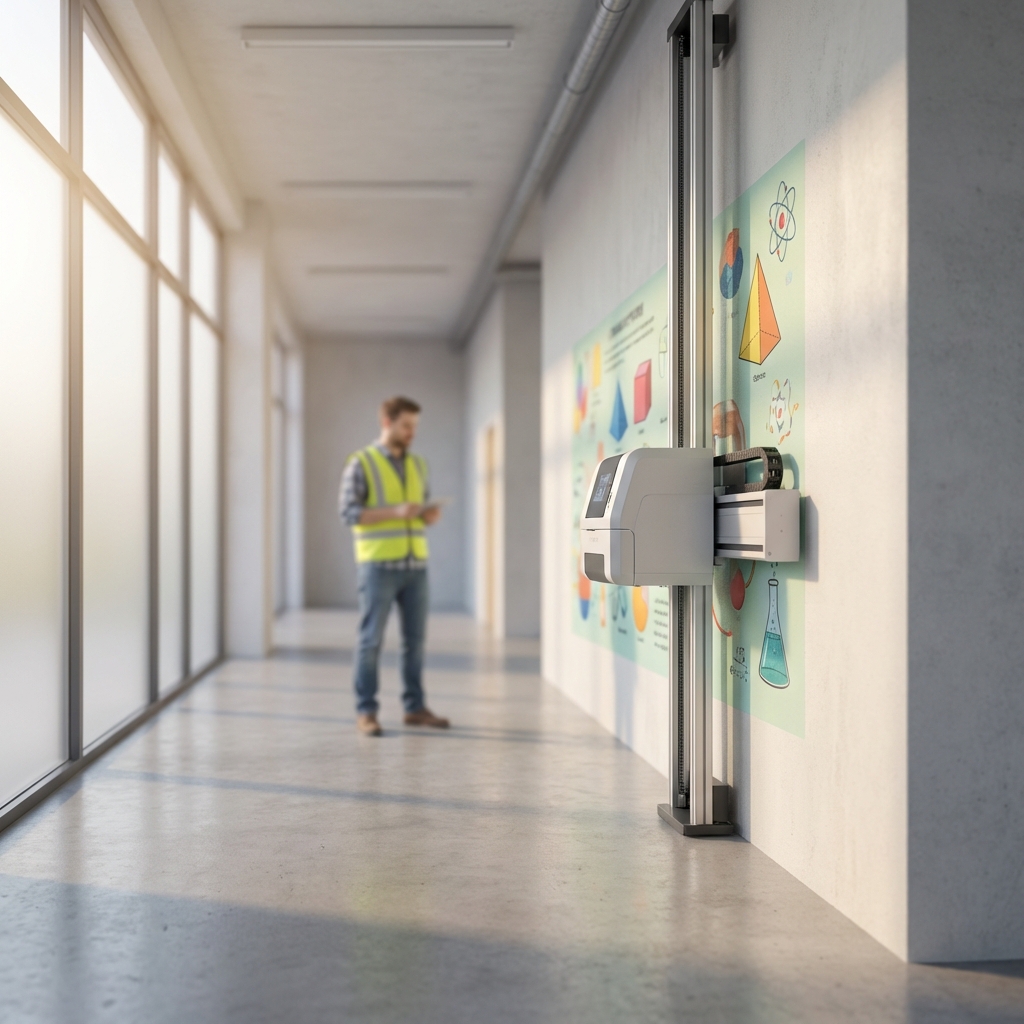
Direct-to-wall printing is an onsite process that produces high-resolution, seam-free imagery directly on building surfaces. Specialized equipment travels vertically along the wall, laying down UV-cured inks in crisp detail. The result: cohesive, architecturally integrated visuals without adhesives, panels, or wallpaper.
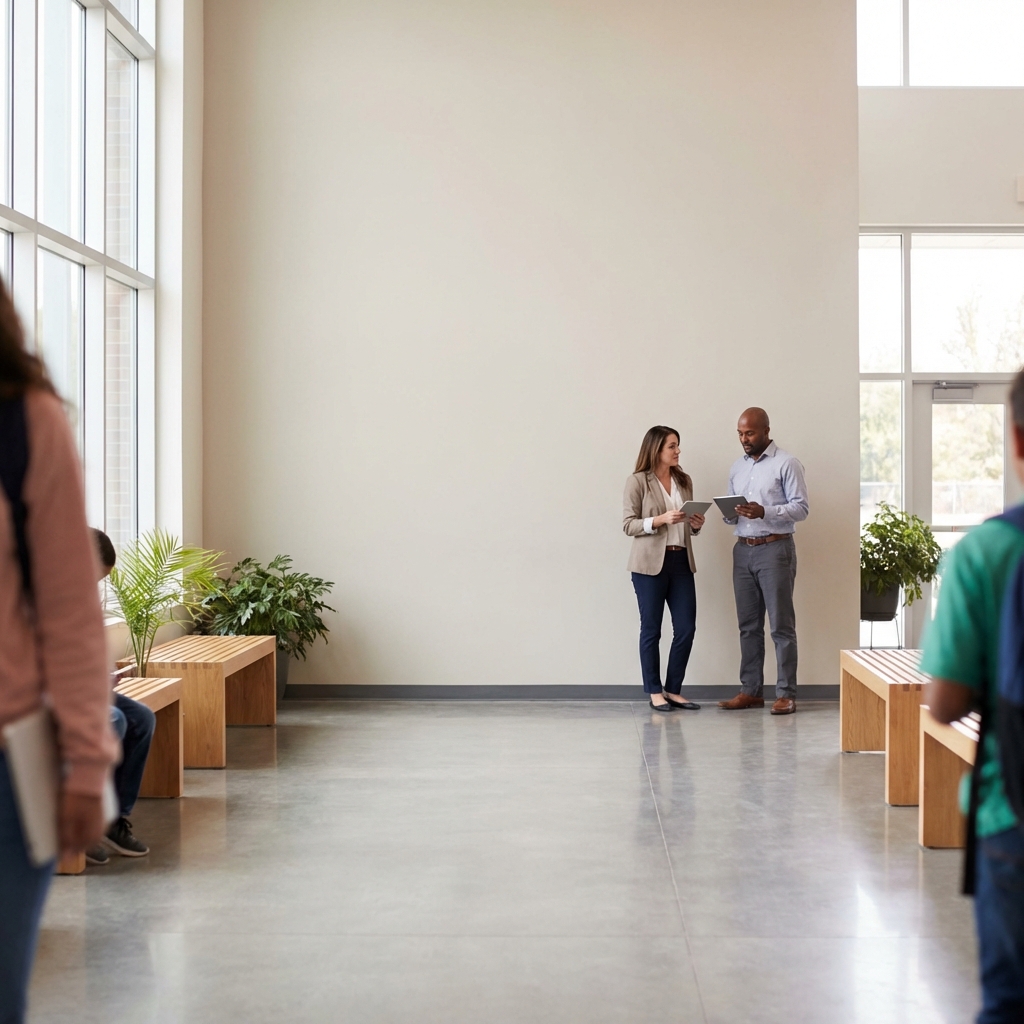
What the workflow looks like in practice:
- Discovery and design coordination: A provider reviews goals—branding, wayfinding, instructional graphics—alongside substrates (drywall, CMU block, brick, concrete) and locations. This early planning aligns scope, finish expectations, and schedule windows around the academic calendar.
- Prepress and color management: Artwork is prepared for large-format output with calibrated color profiles. District brand standards and accessibility requirements (contrast, legibility, bilingual content) are applied consistently.
- Site prep: Walls are cleaned and, if needed, lightly skimmed to level major imperfections. Existing paint can remain; the system is designed for both finished and unfinished surfaces. Masking protects adjacent floors and fixtures.
- Onsite printing: The printer indexes across the wall, delivering continuous, seam-free imagery at high resolution. UV-LED curing fixes the ink instantly, enabling rapid progress and clean edges around fixtures, lockers, and casework.
- Optional topcoat: In high-abrasion zones, a clear protective finish can be added to support aggressive cleaning protocols or heavy equipment traffic.
- Turnover: Most school walls print in hours, not days, with spaces returned to service the same evening.
Because printing happens on the actual wall, schools avoid the fabrication errors and shipping delays that plague panel-based graphics. Execution is also highly repeatable: the same files print identically across multiple buildings for district-wide rollouts.
To see examples and FAQs specific to education settings, schools can explore EastCoast MuralPros’ overview of wall printing in schools.
Design Applications: Wayfinding, Branding, and Safety Graphics in Schools
Educational facility wall design works best when it blends message with architecture. Direct-to-wall printing makes it straightforward to deliver information where people need it—without adding clutter.
High-impact use cases include:
- Wayfinding and navigation systems:
– Color-coded wings and grade-level identities that carry through halls and stair towers. – Floor-to-ceiling directional markers that remain visible above crowds. – Room numbering, departmental icons, and multilingual arrows designed for quick comprehension.
- Branding and culture walls:
– Mascot features at athletic corridors and gym entries with photoreal detail. – Mission statements, honor codes, and student work galleries at commons and cafeterias. – Alumni and donor recognition integrated as part of the interior, not mounted plaques.
- Safety and instructional graphics:
– AED, tornado shelter, and egress information embedded within walls, reducing sign clutter. – Lab walls with periodic tables, measurement conversions, or safety pictograms in durable finishes. – Health messaging and social-emotional learning prompts at elementary corridors in age-appropriate formats.
- Program identity and recruitment:
– CTE, STEM, and arts academies distinguished by visual systems that travel across floors and buildings. – Residence life and student union spaces that unify brand and event storytelling. – Library and media spaces with readable typographic treatments and large-scale imagery.
Because direct-to-wall printing is seam-free, large murals can span entire entrances without visible breaks. Photographic content renders crisply at architectural scale, so a science hallway can move from a macro shot of a leaf to a galaxy panorama without loss of clarity. For strategy and planning ideas, campus teams often reference resources like this take on campus branding with direct-to-wall printing.
Durability and Maintenance: What Makes School Wall Art Last
Schools demand finishes that withstand daily wear. Direct-to-wall printing addresses the common failure points of films and paints by eliminating seams, edges, and adhesives—the areas most likely to fail first.
Key durability traits include:
- Integrated finish: The graphic bonds to the wall surface and cures in place, making the finished image behave more like a coating than a sticker. There are no edges to lift or trap dirt.
- Cleanability: Surfaces are designed to tolerate routine cleaning. In nurse offices, cafeterias, and locker rooms, custodial teams can wipe walls confidently without clouding or peeling.
- Abrasion resistance: Hallway corners, backpack scuffs, and rolling carts test finishes daily. A printed wall with an optional protective topcoat adds insurance for these high-friction zones.
- Humidity and temperature swings: Gymnasiums and older buildings can challenge adhesives and paints. Cured, direct-printed surfaces stand up to fluctuations better than many films.
- Paint-over-ready: When programs change, facilities can scuff and paint over graphics as they would a normal wall. No adhesive residue or panel removal means faster turns between school years or tenant use.
- Consistency across surfaces: From smooth drywall in administrative suites to textured CMU in mechanical corridors, direct printing provides high-contrast coverage that reads clearly at a distance.
Practical maintenance guidance helps too. Providers like EastCoast MuralPros equip custodial teams with cleaning recommendations compatible with district standards. That way, care routines remain unchanged, and the wall art remains crisp long-term.
Installation Speed and Minimal Disruption for Operating Schools
The best school wall graphics solutions respect bell schedules. Modern direct-to-wall systems are designed for occupied buildings, minimizing noise, odor, and dust while accelerating installation.
What that looks like in action:
- Compressed timelines: Typical single-wall installations complete in under five hours. Multiple areas can be sequenced over evenings or weekends to meet opening or event deadlines.
- Low site impact: Equipment rolls through standard doors and sets up in minutes. Masking and floor protection keep teaching spaces clean.
- Quiet, low-odor process: UV-curing technology and onsite workflows reduce nuisance factors. Work can proceed near classrooms without halting instruction.
- Clear safety protocols: Barriers, cones, and signage maintain egress. Technicians are briefed on school safety policies, and work zones are secured without long closures.
- Precision at height: Vertical track systems allow crisp imagery up stairwells and tall atria without days of scaffolding or large lifts.
For districts managing summer crush or mid-year refreshes, on-site printing eliminates shipping risk and last-minute surprises. EastCoast MuralPros coordinates directly with facilities and capital projects teams to stage multi-building work in logical sequences—tight windows, predictable outcomes.
Cost Efficiency and Lifecycle Benefits for School Districts
Total cost of ownership matters more than initial price. When schools compare direct-to-wall printing to vinyl or wallpaper, lifecycle economics often favor the print-in-place approach.
Where savings emerge:
- Fewer failure points: No seams or adhesives means fewer warranty calls for peeling edges, bubbles, or delamination. Facilities teams spend less time on maintenance tickets.
- Faster refreshes: Paint-over-ready surfaces simplify program changes. Instead of multi-day removals, teams can recoat and reprint during short breaks.
- Reduced fabrication and shipping: On-site production eliminates panel mistakes and freight charges. Fewer dependencies reduce change orders.
- Low disruption: With installations typically measured in hours, schools avoid after-hours labor premiums associated with multi-day film installs and re-installs.
- Scalability: Consistent execution across multiple buildings allows districts to buy strategically—standardizing templates and colors to control design and labor costs.
- Subscription options: For schools with seasonal programs or rotating exhibitions, a planned refresh schedule creates financial predictability while keeping spaces current.
Facilities leaders often model ROI in simple terms: How long will the finish last, how much will maintenance cost annually, and what will refresh cycles look like compared to vinyl or wallpaper? By shrinking unplanned maintenance and shortening refresh timelines, direct-to-wall printing delivers lifecycle-efficient value that aligns with procurement priorities.
Design Flexibility: From Elementary Schools to University Campuses
Different learning environments call for distinct visual languages. Direct-to-wall printing adapts to each, from playful elementary corridors to sophisticated university research labs.
- Early childhood and K–5:
– Large, high-contrast visuals that support wayfinding by color and shape. – Social-emotional learning cues and bilingual literacy prompts at child height. – Cafeteria and gym graphics that reduce glare and distraction with matte finishes.
- Middle and high school:
– Program-specific zones for STEM, arts, and athletics with cohesive iconography. – College and career readiness walls, donor recognition, and event backdrops. – Locker banks and stair cores transformed into durable, navigable landmarks.
- Higher education:
– Departmental identity systems that scale across multiple buildings. – Research storytelling and gallery-level photographic exhibits at architectural scale. – Student life, dining, and residence halls unified through brand systems that work on CMU, brick, and concrete.
Beyond walls, campus teams can extend graphics to doors, tables, and standees produced in-studio to support orientations, open houses, and seasonal events. Digital artists and internal design teams gain collaborative tools to scale their work from a single wing to an entire campus without sacrificing fidelity or consistency. For museums and campus galleries, photoreal output supports exhibition-quality imagery with crisp detail—without adding panel seams that distract the eye.
Sustainability Advantages Over Wallpaper and Vinyl Alternatives
Sustainability isn’t only about materials; it’s also about processes and longevity. Direct-to-wall printing offers several advantages over traditional wallpaper and vinyl from a resource and waste perspective.
- No adhesives or liners: Eliminating vinyl layers, glue, and release liners cuts material use and reduces waste during installation and removal.
- Fewer replacements: Durable, cleanable finishes extend service life, lowering the frequency of rip-and-replace cycles that send materials to landfill.
- Paint-over refresh: When programs change, repainting and reprinting in place avoids intensive demo and disposal of panelized systems.
- On-site production: Without panel fabrication and long-distance freight, schools reduce packaging and shipping-related emissions for multi-wall projects.
- Low disruption, less rework: Precise, onsite execution reduces the chance of fabrication errors that drive duplicate production and extra waste.
While every district’s sustainability framework is different, schools seeking alternatives to PVC-based wallpapers and wraps can make meaningful progress by choosing performance-based graphics that use less material and last longer.
Case Studies: Successful School Wall Art Deployments
Across K–12 districts and higher education, the outcomes are consistent: faster installs, cleaner visuals, and fewer calls to maintenance. The following snapshots illustrate how direct-to-wall printing performs in real school environments.
- K–12 district wayfinding refresh, Northeast:
– Scope: Eighteen buildings over one summer, focused on navigation in corridors and stairwells, with grade-level color systems and bilingual directional markers. – Challenge: Tight timeline, diverse substrates (painted drywall in newer schools; textured CMU in older facilities), and a mandate to reduce sign clutter. – Approach: Direct-to-wall printing sequenced by bus routes and custodial access windows. Photoreal icons and large numerals delivered high visibility above crowds. – Outcome: Completion prior to teacher in-service. Staff reported smoother navigation during the first week; facilities logged fewer early-year “lost student” calls and maintenance tickets related to peeling signage.
- University athletics and student union, Mid-Atlantic:
– Scope: Mascot walls, donor recognition, and event backdrops across brick and CMU corridors, plus a photowall in the student union for recruitment events. – Challenge: Homecoming deadline with concurrent construction in adjacent areas. Consistency with brand guide colors across disparate lighting conditions. – Approach: On-site test swatches ensured color accuracy. Seam-free murals carried around corners for a continuous brand presence. In-studio produced standees and tabletop pieces supported weekend events. – Outcome: Installation completed in overnight windows leading up to homecoming. Photowalls became a social media staple for campus tours, with zero calls for seam or edge repairs during the first year.
- Children’s hospital education wing, urban campus:
– Scope: Calming nature imagery, instructional wayfinding, and safety graphics integrated into family classrooms and corridors. – Challenge: High cleanability requirements and strict disruption controls near treatment areas. – Approach: Direct printing during low-traffic hours; protective topcoat in zones subject to frequent disinfecting. Clear visual hierarchy reduced reliance on hardware-mounted signage. – Outcome: Durable, wipeable surfaces met daily cleaning protocols. Families and staff found navigation easier without added sign clutter in tight corridors.
- Community college trades building, Southeast:
– Scope: Hallway timeline celebrating regional industry history, lab safety graphics, and bold program identifiers on unfinished concrete walls. – Challenge: Achieving legibility on textured concrete while preserving the industrial aesthetic. – Approach: Higher ink density and targeted color management to maintain contrast; matte finish to control glare under shop lighting. – Outcome: Crisp, readable content at distance; faculty cited improved safety compliance when lab rules were presented as integrated wall graphics rather than temporary posters.
In each scenario, on-site production eliminated shipping risk and panel fit issues. The result: reliable schedules, cohesive imagery, and finishes that hold up to high-traffic school murals day after day.
Choosing the Right Partner for School Wall Graphics
Not all vendors approach institutional wall printing technology with the same rigor. Schools benefit from partners who understand facilities, procurement, and operations as much as they do design and printing.
Criteria to evaluate:
- Education-specific experience:
– Demonstrated work in occupied schools, with references across K–12 and higher ed. – Familiarity with CMU, brick, drywall, and concrete—finished and unfinished.
- Prepress and color management:
– Calibrated workflows for brand-color fidelity and consistent reproduction across buildings. – Accessibility-led typography and contrast practices built into file prep.
- Safety and compliance:
– Documented site safety protocols, background checks where required, and egress management. – Clear MSDS documentation and cleaning recommendations for facilities.
- Execution and scheduling:
– Ability to complete typical walls in under five hours and coordinate multi-building rollouts. – On-site testing and mockups to validate adhesion, finish, and legibility.
- Durability and maintenance planning:
– Optional protective coatings for high-abrasion zones and cleaning guidance aligned with district standards. – Paint-over-ready strategies for future program changes.
- Program scalability:
– Templates and toolkits that enable district-wide consistency and easy refreshes. – Subscription options for seasonal content or strategic updates.
- Artist and design collaboration:
– Tools that help internal teams and commissioned artists scale work to architectural size without quality loss.
EastCoast MuralPros aligns these requirements with a performance-first mindset. The team emphasizes predictable schedules, repeatable quality, and collaborative delivery models that work for facilities, architects, and brand stakeholders alike.
Conclusion: Transforming School Interiors with Reliable Wall Art
Durable custom wall art for schools is no longer a wish list item—it’s an operational advantage. When wayfinding, branding, safety, and instructional content are printed directly onto walls, schools gain clarity, cohesion, and durability without trading off speed or budget. The result is an interior environment that communicates effectively, withstands daily use, and refreshes on your terms.
Direct-to-wall printing provides a dependable alternative to wallpaper, vinyl, and traditional murals. It integrates with the architecture, scales across campuses, and delivers lifecycle-efficient value. For districts and universities seeking school interior branding systems that perform, partners like EastCoast MuralPros offer a clear path forward—combining high-resolution output with low-disruption installation and facilities-ready maintenance.
If your next renovation, rollout, or program refresh calls for school wall graphics solutions that can be installed quickly and last, consider the direct-to-wall approach. It’s a practical, sustainable way to elevate educational spaces and keep the focus where it belongs—on teaching and learning.
Contact us to learn more