Table of Contents
- Direct-to-Wall Printing Technology: The Vinyl-Free Standard We Set
- Zero-Adhesive Installation for Occupied Buildings and Low Disruption
- Seam-Free Graphics at Architectural Scale Without Multiple Panels
- Paint-Over-Ready Finishes That Support Future Tenant Changes
- Multi-Location Rollouts With Consistent Execution Across National Campaigns
- High-Resolution Photoreal Imagery for Galleries, Museums, and Brand Showcases
- Cleanable, Durable Surfaces Built for High-Traffic Healthcare and Educational Environments
- Frequently Asked Questions (FAQ)
Direct-to-Wall Printing Technology: The Vinyl-Free Standard We Set
Vinyl wall coverings peel. Wallpaper collects dust and mold. Hand-painted murals require artists to return for touch-ups. And all of them generate waste when it’s time to refresh or hand over a space to the next tenant.
We built our direct-to-wall printing technology because we watched facility teams and real estate managers repeat the same cycle: invest in a wall solution, watch it degrade, manage tenant complaints, then tear it out and start over. The environmental cost and operational burden were unnecessary.
Our approach is different. We print directly onto your walls using a UV-cured ink system that bonds at the substrate level, eliminating adhesives, backing materials, and the replacement churn that makes traditional methods unsustainable. The result is a wall surface that lasts, performs across high-traffic environments, and adapts when your needs change.
Whether you’re refreshing a 50-bed hospital wing, rolling out a national retail rebrand, or creating a museum exhibition space that demands photoreal detail, our adhesive-free printing delivers durability, design fidelity, and operational simplicity that vinyl and wallpaper simply cannot match.
The core innovation we’ve developed is printing and curing ink directly into the wall substrate itself. No vinyl sheets. No adhesive layers. No seams or backing material to fail over time.
Here’s how it works: we prep your wall surface to ensure it’s clean and properly sealed, then our industrial-grade printer applies UV-curable ink in high-resolution passes. The ink cures instantly under UV light, chemically bonding with the substrate. The result is a graphic that becomes part of the wall, not a covering applied on top of it.
This approach solves three critical problems we see across commercial and institutional spaces:
Environmental footprint: Traditional vinyl wall coverings generate 40-50 pounds of waste per 100 square feet when removed and replaced. Our process produces no adhesive residue, no backing material disposal, and no chemical off-gassing during or after installation. When you’re ready to refresh, we simply paint over the existing graphic and print new artwork. The wall stays intact.
Durability under use: Vinyl edges curl and bubble in high-humidity environments like hospitals and kitchens. Wallpaper absorbs moisture and harbors mold. Our printed surface is sealed and cleanable, which means it handles daily wiping, disinfection, and normal wear without degradation. We’ve documented durability exceeding seven years in occupied healthcare and educational spaces without visible fading or flaking.
Installation speed and accuracy: Because we’re not wrestling with panels, alignment, and adhesive setting times, our team typically completes installations in under five hours, even on large walls. One team, one pass, one finish. No waiting for adhesive to cure. No callbacks for bubbles or separation.
The substrate compatibility matters too. We print effectively onto drywall, concrete, CMU block, brick, and finished surfaces. If your wall is primed or sealed, we’re ready to print. This flexibility means we work in occupied buildings without extensive prep or surface removal.
Action item: If you’re currently using vinyl wall coverings or wallpaper, request a sample print on your actual wall surface. Most of our clients are surprised by the tactile quality and color fidelity compared to their previous solutions.
Zero-Adhesive Installation for Occupied Buildings and Low Disruption
Adhesives create cascading problems. They off-gas during and after application. They require curing time, which means you must keep the space empty and climate-controlled. They bond so permanently that removal becomes a construction project.
We eliminated adhesives entirely, which transforms how we install in active, occupied environments.
When we arrive for installation, we need access to the wall, power for our equipment, and typically a four-to-six-hour window. We’re not waiting for anything to set, dry, or cure. Our crew prints, the ink cures instantly under UV light, and within hours the space is ready for normal use.
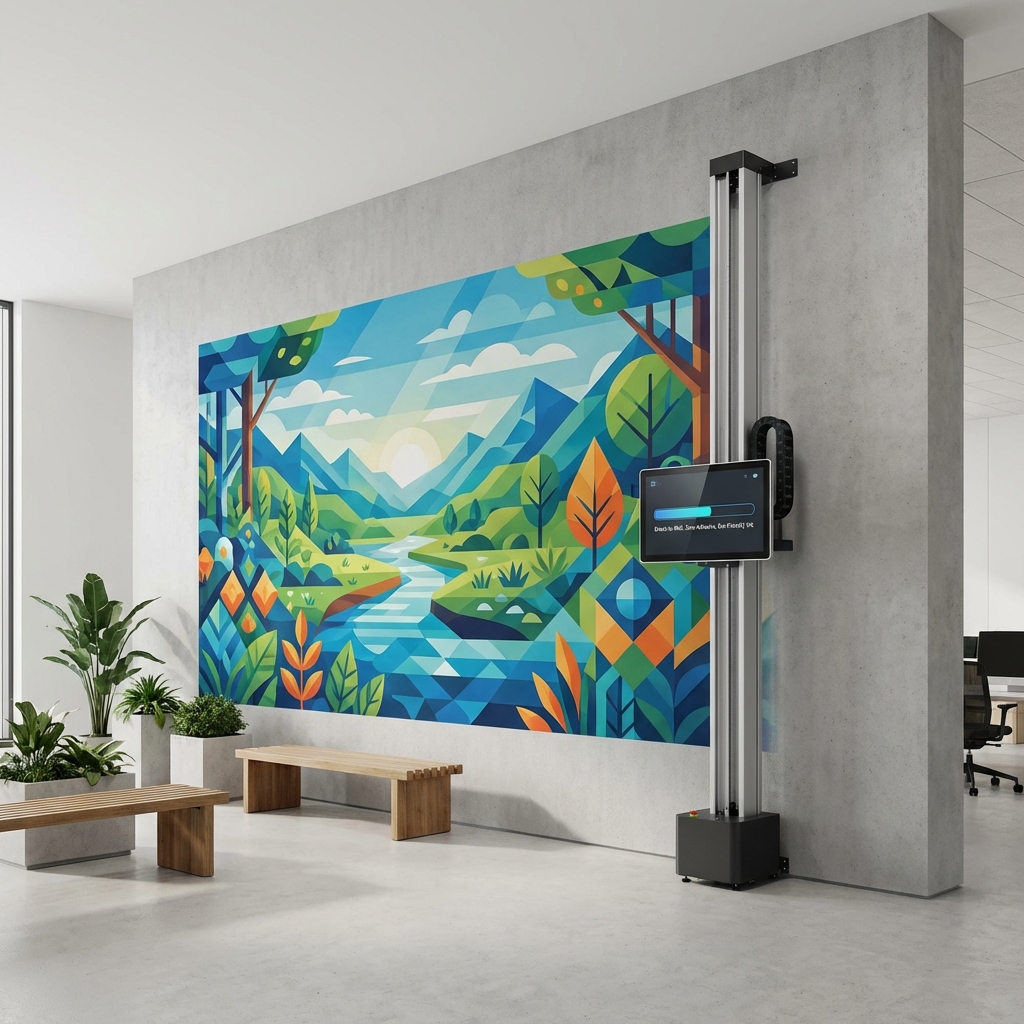
This capability matters enormously for healthcare facilities, schools, retail environments, and corporate offices where downtime directly impacts operations. A hospital can schedule our installation during a shift change or after hours and return the corridor to service the next morning. A retail location can refresh its entrance graphics on a Monday morning and open for business by afternoon.
We’ve documented this across dozens of multi-location rollouts. When you eliminate adhesive waiting periods, you eliminate the hidden costs: extended facility coordination, security staffing for empty spaces, climate control cycles, and rescheduling logistics that balloon project timelines.
Our direct-to-wall installation process in occupied buildings is specifically designed to minimize noise, dust, and disruption to ongoing operations. We use localized containment, schedule around peak hours, and coordinate closely with your facilities team.
The substrate doesn’t shift after installation either. No expansion or contraction as adhesive cures. No edge-peeling that develops over months. What you see at installation is what you’ll see in six months and two years.
Action item: Calculate your current downtime cost during a graphics refresh. Include facility coordination, security staffing, climate control, and any lost revenue from service interruption. Compare that to our typical four-to-six-hour installation window. Most clients recover the project cost within one refresh cycle.
Seam-Free Graphics at Architectural Scale Without Multiple Panels
Large wall graphics typically require multiple vinyl or wallpaper panels, which means seams. Seams create maintenance problems: they catch dust, separate under thermal cycling, and disrupt visual continuity. They’re the enemy of a polished, integrated look.
Our printing system handles seamless coverage at architectural scale in a single pass. We print directly onto the wall surface, so there’s no panel assembly, alignment tolerance, or seam-finishing work. A 40-foot-wide corridor wall, a full lobby backdrop, a multi-story atrium graphic: all emerge from one continuous print job without breaks or transitions.
This matters for brand perception. When a visitor walks into a corporate headquarters or museum and sees a seamless, high-resolution mural that reads as part of the architecture itself, they perceive quality and intentionality. Seams undermine that. They signal compromise.
For wayfinding and institutional graphics, seamless execution eliminates the visual noise that seams introduce. A hospital can use a full-wall directional graphic or health-education mural without distracting breaks. A school can install a campus map or safety procedure graphic that reads cleanly from any distance.
We’ve also seen clients use seam-free capability to extend graphics across corners, around architectural features, and even onto adjacent surfaces like exposed ceiling or partial wall returns. You’re not constrained by panel dimensions or seam planning.
The resolution consistency across large surfaces is a secondary but important advantage. Vinyl panels sometimes show slight color or sharpness variation between panels, depending on how the artwork was separated and printed. Our single-pass approach ensures uniform color, saturation, and detail quality from edge to edge.
Action item: Photograph your largest proposed wall surface. Note any corners, architectural features, or partial wall areas that might require panel breaks with traditional vinyl. We can design around those constraints seamlessly.
Paint-Over-Ready Finishes That Support Future Tenant Changes
Real estate cycles. Tenants change. Programs shift. Brands refresh. The graphic you install today may need to be different in two years or five years.
Traditional vinyl requires removal and remediation before any new wall treatment can be applied. Removal is disruptive, messy, and often leaves adhesive residue that requires additional cleanup. Wallpaper faces the same challenge. Both create waste and add cost to the next tenant’s buildout.
Our direct-to-wall printing is designed to support this change cycle. When you’re ready to refresh, we simply paint over the existing graphic with a primer-compatible finish and print new artwork on top. No removal. No adhesive cleanup. No wall repair or restoration. The existing graphic becomes a sealed, inert layer.
This approach radically simplifies tenant transitions and seasonal refreshes. A retail location that updates its brand graphics every 18 months can do so without facility downtime, environmental remediation, or removal costs. A school district that needs to refresh wayfinding or health promotion graphics every few years isn’t managing disposal or damage to the underlying wall.
We’ve worked with landlords and property managers who explicitly include this capability in their lease renewal conversations. The message is simple: we can refresh your space quickly and cleanly, with zero impact to your underlying asset. That’s a competitive advantage during lease negotiations.
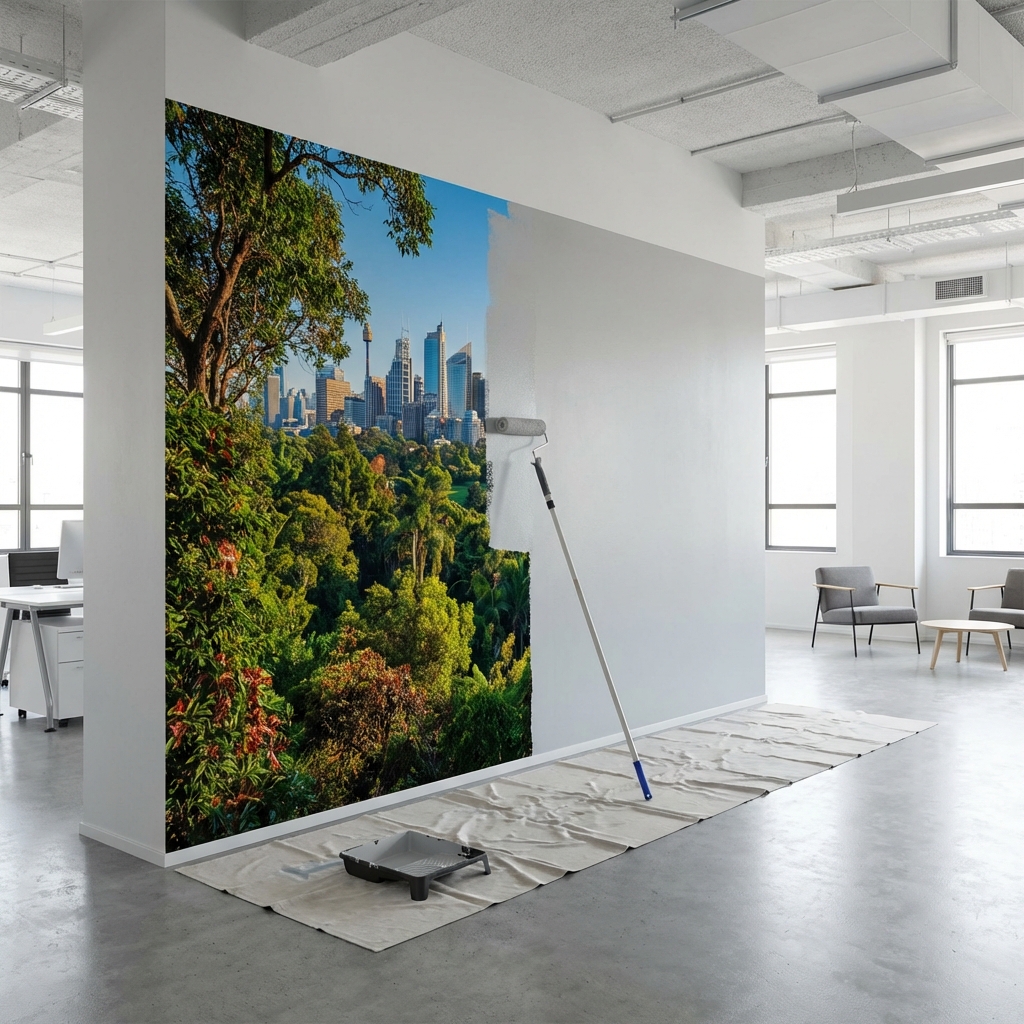
The lifecycle thinking extends beyond the current tenant. When you eventually transition the space to a new use or owner, the wall is clean, smooth, and ready for any finish. No hidden adhesive layers. No surface damage. No environmental remediation required.
Action item: If you’re a landlord or property manager, calculate the typical cost and timeline to refresh wall graphics between tenants. Factor in removal, cleanup, primer, and any wall prep. Compare that to our paint-and-print model. You’ll likely find that paint-over capability recovers its investment value within two to three lease cycles.
Multi-Location Rollouts With Consistent Execution Across National Campaigns
National brands need consistency. Fifty locations, two hundred locations, or a thousand locations all need to present the same visual identity, the same color palette, the same messaging quality.
Traditional vinyl and wallpaper introduce variability across installations. Color reproduction can shift depending on printer, substrate, lighting conditions, and installation technique. Seams may align differently. Edge quality varies. After a few installations, you’re managing a spectrum of quality instead of a standard.
Our printing system and on-site process deliver consistency at scale. We work from your approved digital artwork. Our equipment reproduces that artwork with the same color fidelity, resolution, and durability in Los Angeles, Atlanta, Boston, and Dallas. Every location looks identical because we’re using the same process, the same equipment setup, and the same quality controls at each site.
We also maintain a network of regional teams and equipment, which means we can schedule multiple-location rollouts efficiently. You don’t have to wait weeks between installations or manage extended project timelines. We can coordinate simultaneous installs across a region, or sequence them to match your operational calendar.
The digital-first workflow is a operational advantage too. You approve artwork once. We maintain digital files. At installation time, we simply load the approved file, confirm substrate conditions, and print. No misunderstandings. No version control problems. No artwork shipped to wrong locations or lost in transit.
Brands we’ve worked with have used this consistency to reinforce identity across retail chains, hospital systems, university campuses, and corporate real estate portfolios. The visual continuity is noticeable and intentional.
Action item: If you’re managing a multi-location rollout, ask us for a pilot-to-scale proposal. We typically recommend one to two pilot locations to refine the artwork and installation process, then move to full rollout. The pilot phase usually takes four to six weeks and costs less than full implementation, but gives you confidence before committing across all sites.
High-Resolution Photoreal Imagery for Galleries, Museums, and Brand Showcases
Museum curators and gallery directors demand archival quality. Retail and hospitality brands want photography that compels. Corporate spaces need visual impact that photography or illustration can deliver better than any other medium.
Our printing system achieves photoreal fidelity at architectural scale. We’re printing at 1440 DPI with color accuracy that rivals fine art photography. Shadows have depth. Gradients are smooth. Fine detail remains sharp even on walls where viewers stand close enough to study the image.
This capability opens possibilities that vinyl and wallpaper simply cannot match. We’ve printed large-scale museum photographs, gallery installations, and brand showcases where the image quality is genuinely comparable to a high-end photograph displayed under museum lighting.
The durability advantage is critical for these applications. A museum installation may be on display for two to five years. The printed wall surface resists fading from ambient and display lighting. We use UV-stable inks that maintain color accuracy far longer than traditional vinyl under continuous or periodic illumination.
Retail and hospitality applications benefit from the same fidelity. A hotel lobby with a large-scale landscape photograph creates atmosphere that a vinyl graphic or wallpaper cannot match. A restaurant entrance with high-resolution food or cultural imagery conveys quality and intention.
The seam-free execution is especially important for fine art and large-format photography. Seams disrupt the visual narrative and undermine the artistic intent. Our single-pass printing honors the artist’s and curator’s vision by delivering the image without interruption.
Action item: If you’re planning a museum exhibition, gallery installation, or high-visibility brand showcase, request a sample print of your preferred image. Scale it to at least 4×6 feet so you can evaluate color fidelity, detail reproduction, and the perceived quality from typical viewing distances.
Cleanable, Durable Surfaces Built for High-Traffic Healthcare and Educational Environments
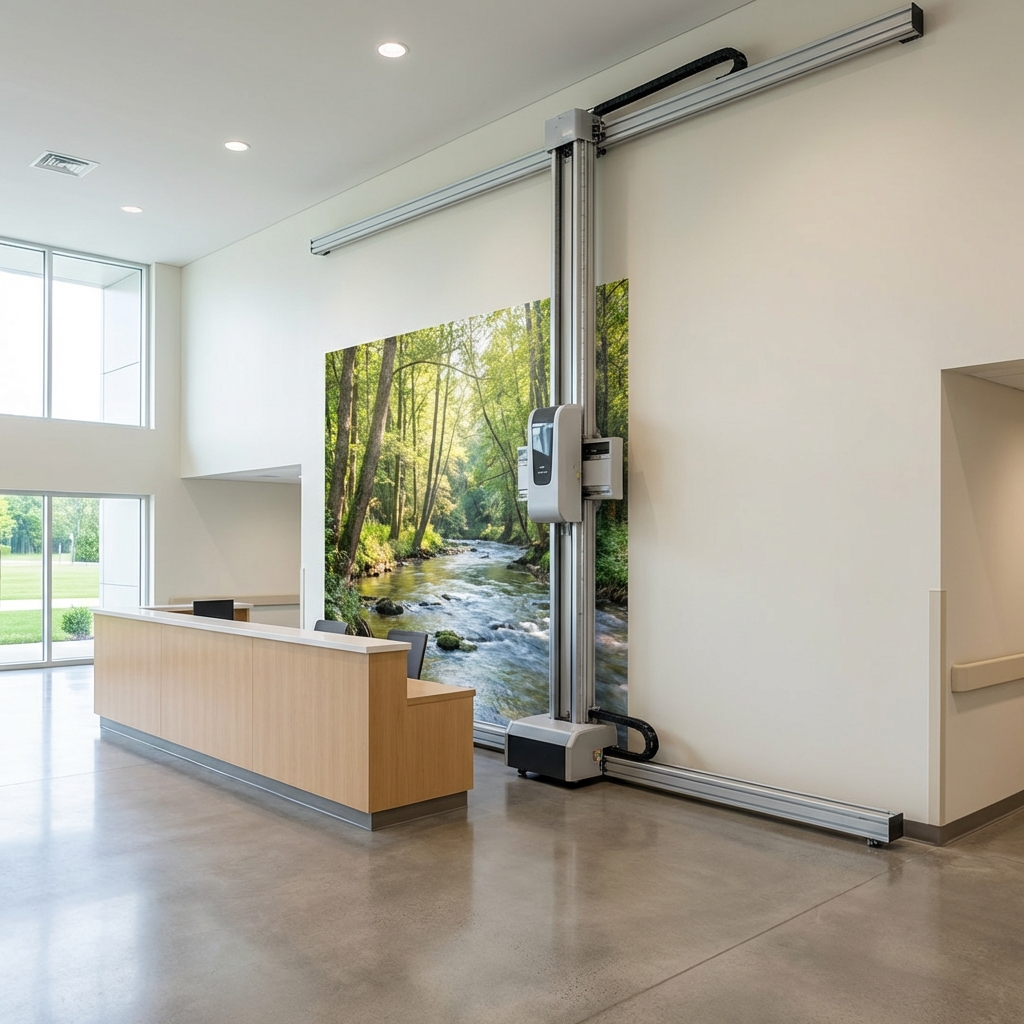
Healthcare facilities, schools, and public institutions live in a durability reality that office environments don’t face. Walls get touched thousands of times per day. Surfaces get cleaned with industrial disinfectants. Moisture exposure is constant. Durability isn’t optional; it’s operational necessity.
We designed our printing surface for this reality. The ink cures into the substrate and is sealed with a finish that withstands regular cleaning with hospital-grade disinfectants, mild abrasive scrubbing, and thermal cycling from day-to-day humidity and temperature swings.
We’ve tested our surfaces in active healthcare corridors, pediatric units, operating room prep areas, and public-facing hospital locations. They’ve survived multi-year installations with daily cleaning, patient contact, and the environmental stress that healthcare facilities introduce. We document no visible fading, flaking, or deterioration beyond normal light exposure.
Educational environments are equally demanding. School hallways, cafeterias, and common areas generate the same high-touch, high-use environment. Our printed surfaces handle regular cleaning and casual contact without degradation.
The cleanability itself is important. Unlike wallpaper, which absorbs dust and can harbor mold, or vinyl, which can catch and peel at edges, our printed surface is smooth and sealed. You wipe it with standard facility cleaning procedures and it stays clean. No special maintenance protocols. No grooming or edge maintenance.
For wayfinding and instructional graphics in healthcare and educational settings, this durability means the graphics remain legible and functional for the entire intended lifecycle. A hospital directory, safety procedure graphic, or classroom learning display stays sharp and readable year after year without repainting or replacement.
Action item: If you’re responsible for healthcare or educational facilities, ask us for durability and cleanability test results from similar environments. We have documented performance data from active hospital installations and school campuses that we can share for your evaluation.
—
We’ve built our business on a simple conviction: your walls deserve a solution that is durable, fast to install, low-impact environmentally, and adaptable to your changing needs. Vinyl coverings, wallpaper, and hand-painted murals each deliver part of that promise. Our direct-to-wall printing system delivers all of it.
Whether you’re managing a single-building refresh or rolling out a national program, whether you need gallery-quality imagery or high-traffic wayfinding, whether you’re installing in an active hospital or an empty commercial space, we have the capability and the experience to deliver it right.
The most important next step is straightforward: reach out to discuss your specific space and timeline. We’ll evaluate your wall surfaces, review your creative direction, and provide a clear timeline and cost estimate. Most facilities find that our speed, durability, and consistency make the conversation simple: this is the right solution for the work ahead.
Contact us to schedule a consultation. We’ll help you understand how direct-to-wall printing can transform your space faster, cleaner, and more sustainably than any alternative.
Contact us to learn more
Frequently Asked Questions (FAQ)
How does your direct-to-wall printing process differ from vinyl wraps and traditional murals?
We print high-resolution graphics directly onto your walls using our proprietary technology, eliminating the need for vinyl, adhesives, or hand-painting. Our method bonds the ink to the wall surface itself, creating a seamless, durable finish that won’t peel, bubble, or degrade like vinyl wraps do. Installation typically takes under five hours with minimal disruption to your operations, and we can accommodate finished drywall, concrete, brick, and CMU surfaces.
Can your wall graphics be removed or painted over if our space needs to change?
Yes. We design all our finishes to be paint-over-ready, so when your tenant changes, your branding evolves, or your program shifts, you can simply paint over the graphics without damaging the underlying wall. This approach gives you flexibility for future updates while eliminating waste associated with vinyl removal and replacement cycles that plague traditional wall coverings.
How do you ensure consistent results across multiple locations or national rollouts?
We use digital design files and on-site printing equipment to execute the same design identically across every location, eliminating the variability that comes with hand-painting or shipping prefabricated panels. Our collaborative tools let us work with your design and procurement teams to lock in specifications upfront, and our in-house process means no fabrication delays or shipping errors disrupt your timeline.