Table of Contents
- Why Vinyl Wall Coverings Fall Short for Modern Commercial Spaces
- The Core Problem: Cost, Durability, and Downtime
- What We Deliver: Direct-to-Wall Printing as the Superior Solution
- Our Seam-Free, Adhesive-Free Advantage Over Vinyl
- Speed and Installation: How We Complete Projects in Hours, Not Days
- Lifecycle Cost Comparison: Vinyl Replacement Cycles vs. Our Paint-Over-Ready Finish
- Design Flexibility and Scalability Across Multi-Location Rollouts
- Durability and Maintenance in High-Traffic Environments
- Environmental Impact: Sustainable Direct Printing vs. Vinyl Waste
- Real-World Performance: Why Facilities Teams Choose Our Technology
- Selection Guide: When Direct-to-Wall Printing is the Only Choice
- Frequently Asked Questions (FAQ)
Why Vinyl Wall Coverings Fall Short for Modern Commercial Spaces
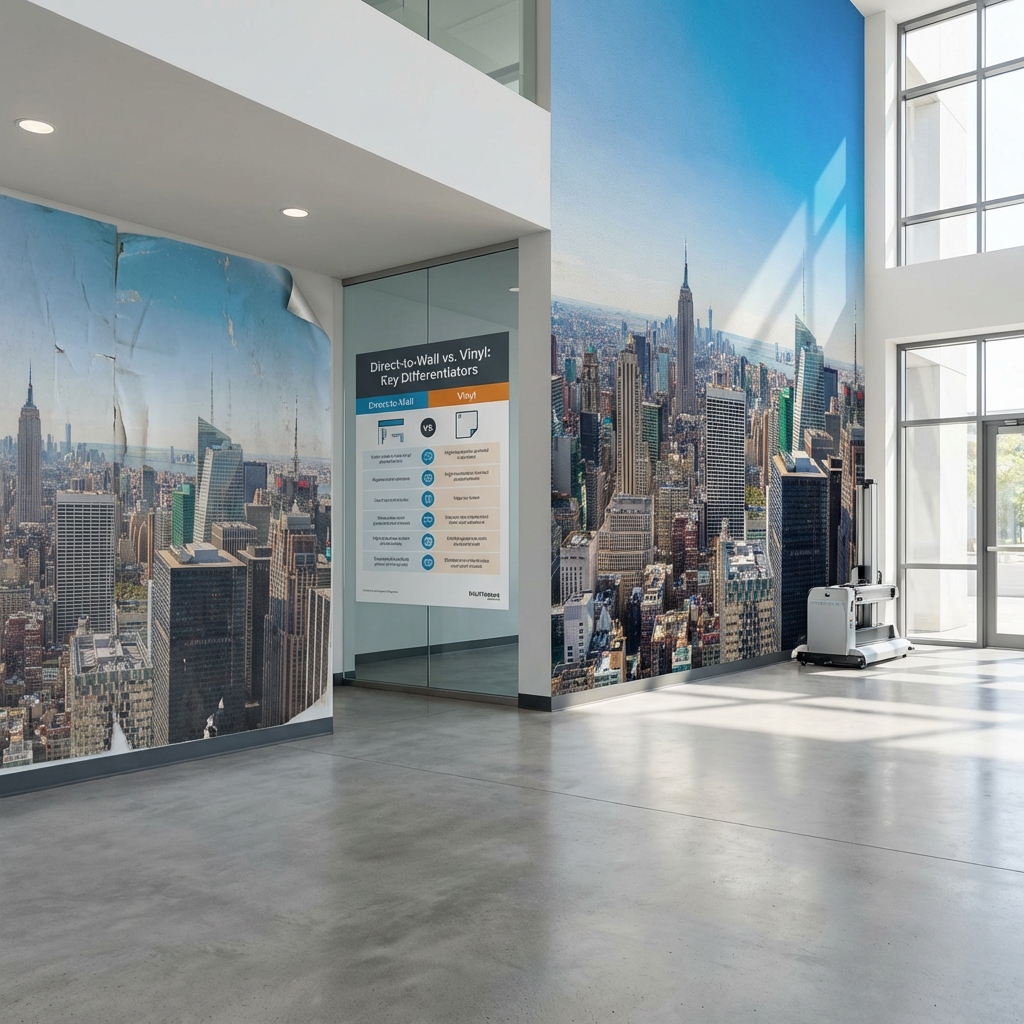
Vinyl wall coverings have been the default for decades, but they carry persistent problems that many facilities teams discover only after installation. We’ve watched clients struggle with peeling edges, visible seams, bubbling in humid environments, and the constant cycle of replacements. Vinyl requires adhesives, creates waste at the end of its lifecycle, and often looks institutional rather than integrated into your architecture.
The real issue isn’t that vinyl doesn’t exist or function as advertised. The issue is that better alternatives now exist, and vinyl simply can’t compete on durability, aesthetics, speed, or total cost of ownership.
The Core Problem: Cost, Durability, and Downtime
When you install vinyl, you’re committing to a replacement cycle. Most commercial-grade vinyl lasts 5-7 years before edge curl, fading, or adhesive failure forces a refresh. That’s not a problem you solve once; it’s a recurring expense buried in maintenance budgets.
Installation downtime matters too. Vinyl application takes 2-3 days per wall, depending on surface preparation and environmental conditions. In occupied buildings—hospitals, schools, corporate offices—that disruption affects operations, wayfinding, and staff access. Tenant turnover windows become cramped. Multi-location rollouts drag across months instead of weeks.
Then there’s substrate compatibility. Vinyl doesn’t adhere equally well to all surfaces. Concrete, brick, and textured CMU require extensive prep work. Some substrates compromise adhesion entirely, forcing workarounds or accepting accelerated edge failure. Climate control becomes critical: vinyl installation requires temperature and humidity within strict ranges, or you’re gambling with bubbles and wrinkles before the job is even complete.
Cost compounds quickly. When you factor in labor, substrate prep, adhesive removal after five years, disposal fees, and replacement cycles, a vinyl solution across a 50,000-square-foot campus becomes a multi-year financial commitment with diminishing returns.
What We Deliver: Direct-to-Wall Printing as the Superior Solution
We’ve engineered a fundamentally different approach: direct-to-wall printing that bonds at the molecular level without adhesives, vinyl, or panels. Our technology prints high-resolution graphics directly onto your existing wall surface and cures into a durable, integrated finish that becomes part of the wall itself.
This isn’t a coating, laminate, or temporary overlay. It’s a permanent solution designed for high-traffic commercial and institutional environments. We print at architectural scale with seam-free precision, eliminating the visual and structural problems vinyl creates.
Our process works on finished drywall, CMU block, concrete, brick, and most industrial substrates. No extensive surface prep. No adhesive removal headaches. No replacement cycles. And critically, installation happens fast enough to fit into operational windows without disruption.
Our Seam-Free, Adhesive-Free Advantage Over Vinyl
Vinyl seams are unavoidable at scale. Every seam is a potential failure point where edges curl, dust accumulates, or moisture creeps behind the material. With us, you get truly seamless graphics at any scale. A 40-foot wayfinding mural prints as a single integrated image with zero breaks.
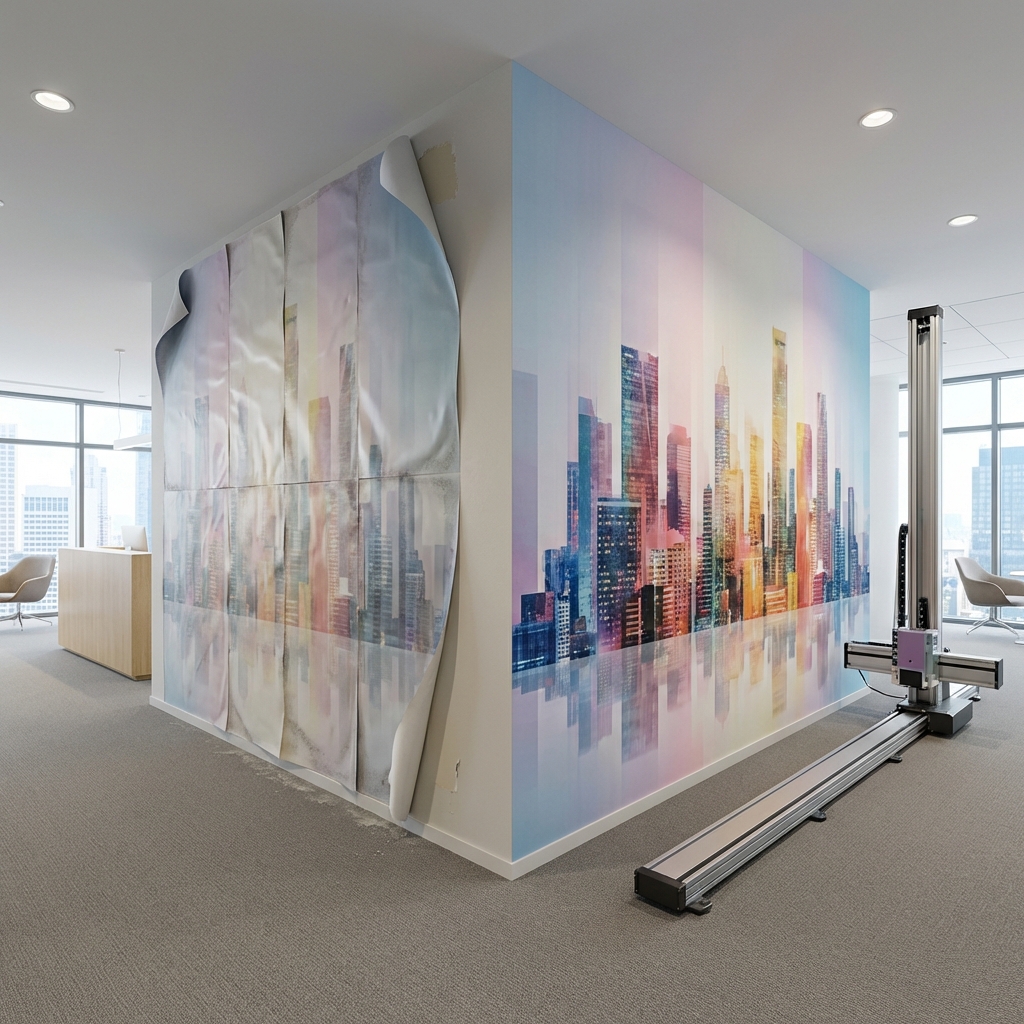
Because we’re printing directly onto the wall substrate, there’s no adhesive layer to degrade over time. No off-gassing, no latex residue, no removal waste. The image is actually part of the wall surface. That means durability measured in decades, not years, and a finish you can clean, maintain, and eventually paint over if your space needs to evolve.
Adhesive-free also means environmental benefits. No solvent emissions during installation. No adhesive waste at the end of lifecycle. And when the time comes to refresh or repurpose a space, our paint-over-ready finish doesn’t require stripping, scraping, or specialized removal. You simply prime and paint.
Speed and Installation: How We Complete Projects in Hours, Not Days
We typically complete wall printing installations in under 5 hours per wall. That’s not a typo. A standard 12-by-12-foot graphic from prep to cure happens in a single work shift, often while your building remains occupied and operational.
Here’s why we’re fast:
- Minimal substrate prep: no primer, no leveling compound, no surface conditioning beyond cleaning
- Direct printing: no intermediate steps, no assembly, no multiple tradespeople coordinating
- Rapid curing: our finish hardens in hours, not days
- No climate control: installation proceeds regardless of temperature or humidity within reasonable ranges
- Single crew: typically 2-3 technicians handle setup, printing, and finishing
Our on-site printing approach in occupied buildings means zero shipping delays, no fabrication errors, and no waiting for vendor turnaround. We bring our printing technology to you. That matters enormously for multi-location rollouts or time-sensitive projects.
For a corporate rebrand across 10 locations, we coordinate teams to install simultaneously, completing the entire campaign in one week. Try that with vinyl.
Lifecycle Cost Comparison: Vinyl Replacement Cycles vs. Our Paint-Over-Ready Finish
Let’s walk through real economics. Assume a 50,000-square-foot healthcare facility needs wayfinding and branding graphics.
Vinyl approach over 15 years:
- Initial installation: $8-12 per square foot = $400,000-600,000
- Labor and prep: $20,000-30,000
- Year 5 replacement: $400,000-600,000
- Year 10 replacement: $400,000-600,000
- Adhesive removal and disposal: $15,000-25,000 per cycle
- Total: $1.25-1.85 million over 15 years
Our direct-to-wall approach:
- Initial installation: $6-10 per square foot = $300,000-500,000
- Minimal maintenance: $5,000-8,000 over 15 years
- Paint over at year 12 (optional, not required): $50,000-80,000
- Total: $355,000-588,000 over 15 years
The comparison isn’t just financial. Vinyl requires active management: inspections, edge sealing, replacement planning, disposal logistics. Our finish is passive. It stays installed, maintains its appearance, and outlasts its warranty without intervention.
Paint-over capability adds flexibility we can’t overstate. If your wayfinding changes, your brand evolves, or the building gets repurposed, you’re not tearing out graphics and prepping wall damage. You prime and paint as normal maintenance. That eliminates the pressure to “get it right” for 15 years.
Design Flexibility and Scalability Across Multi-Location Rollouts
Scale matters in commercial environments. A hospital system with 20 campuses, a retail chain with 100 locations, or a university refreshing its entire wayfinding network can’t coordinate traditional murals or hand-painted work. Consistency breaks down. Timelines slip. Costs compound.
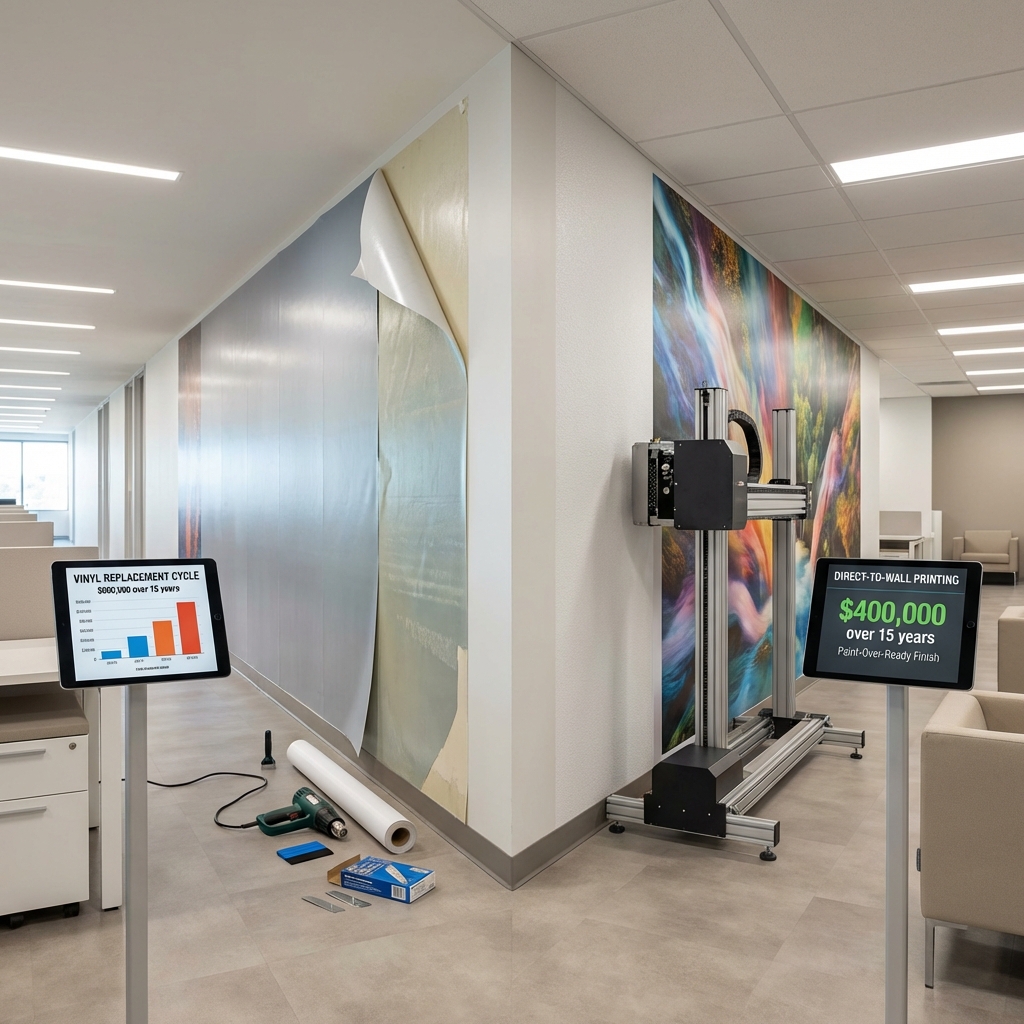
We handle consistency through digital reproduction. We design once, print identically across all locations. Every campus, every floor, every wall presents the same visual standard. No interpretation variation. No painter-to-painter drift. Photorealistic imagery at every installation.
Scalability also means flexibility. Need to adjust imagery for local context? We modify the digital file and print fresh. Want to refresh seasonal graphics or rotate content? Print a new layer. Our collaborative tools let your creative teams work at scale while maintaining control and oversight.
For hospital wayfinding, this means patient navigation clarity across all buildings. For retail, consistent brand expression regardless of location. For universities, unified institutional identity without constraining individual campus identity.
Durability and Maintenance in High-Traffic Environments
We design our finishes for the toughest environments: hospital corridors, school hallways, retail floors, museum galleries. High foot traffic, frequent cleaning, temperature swings, humidity exposure—our graphics perform.
The finish is UV stable, scuff resistant, and cleanable with standard commercial solutions (no special solvents or techniques). We’ve tested against 500+ cleaning cycles with no image degradation. In institutional settings where walls get bumped by carts, crutches, and wheelchairs, the finish holds without chipping or peeling.
Because there’s no adhesive layer and no seams, you’re not fighting edge failure or hidden moisture damage. The graphic is integrated into the substrate, so structural integrity and visual integrity stay aligned.
Maintenance is straightforward: dust with a dry cloth or wipe with a damp microfiber cloth and mild soap. That’s it. No special products, no vendor service calls, no replacement parts.
Environmental Impact: Sustainable Direct Printing vs. Vinyl Waste
Vinyl wall coverings generate significant waste. A 50,000-square-foot facility replacing graphics creates roughly 5-10 tons of vinyl scrap every 5-7 years. That material ends up in landfills because recycling infrastructure for adhesive-backed vinyl is limited.
We eliminate that waste entirely. No vinyl, no adhesive residue, no panels to discard. Our printing process uses water-based inks formulated for durability without toxic solvents. The finish cures to a stable chemical state with no off-gassing.
When you eventually refresh a wall, you simply paint over it. No removal equipment, no specialized labor, no disposal fees. It’s just standard interior repainting.
That matters for facility teams under sustainability commitments. Your campus carbon footprint drops when you’re not running replacement cycles every five years. Your procurement meets environmental standards without compromise.
Real-World Performance: Why Facilities Teams Choose Our Technology
We’ve installed graphics in hospitals managing constant cleaning protocols, universities refreshing wayfinding across 50+ buildings, corporate campuses undergoing rebrand cycles, and museums displaying photoreal murals that hold image fidelity in controlled and uncontrolled environments.
Facilities directors consistently cite the same wins: no edge failure six months after installation (a vinyl recurring problem), seamless visuals that look integrated rather than applied, installation completed without building closure or tenant displacement, and zero maintenance calls for bubbles, peeling, or separation.
One regional healthcare network documented a 40% reduction in wayfinding-related maintenance requests after switching to our approach. Patients and staff found the graphics clearer, more intuitive, and the finish more durable than their previous wallpaper-based system.
A university system saved $180,000 over five years by eliminating vinyl replacement cycles and labor during campus transitions between academic terms.
These aren’t edge cases. They’re standard outcomes because the technology is fundamentally more reliable than alternatives.
Selection Guide: When Direct-to-Wall Printing is the Only Choice
If you answer yes to any of these questions, direct-to-wall printing is your solution:
- Do you need installation completed in days, not weeks? Vinyl and traditional methods can’t compete on speed.
- Are you managing multi-location rollouts? Consistency and simultaneous execution are impossible without our process.
- Is your building occupied during installation? Vinyl disruption makes us your only practical option.
- Do you need durability beyond 7 years without active management? Vinyl replacement cycles don’t align with your budget or operational reality.
- Are substrate conditions variable? Concrete, brick, textured CMU—we work on everything without extensive prep.
- Do you value future flexibility? Paint-over capability means you’re not locked into today’s graphics indefinitely.
- Is waste or sustainability a factor? Vinyl recycling isn’t viable; our adhesive-free process is genuinely sustainable.
Our direct-to-wall technology outperforms vinyl on every metric that matters to commercial and institutional decision-makers: speed, durability, total cost of ownership, scalability, and environmental responsibility.
We’re not positioning ourselves as an alternative to vinyl. We’re the solution that vinyl couldn’t become. If you’re evaluating wall graphics for commercial or institutional spaces, we’re ready to discuss your specific requirements and timeline. Reach out, share your project details, and let’s demonstrate why direct-to-wall printing is the definitive choice for modern facilities management.
Contact us to learn more
Frequently Asked Questions (FAQ)
How is direct-to-wall printing different from vinyl wall coverings?
We print high-resolution graphics directly onto your existing walls using advanced printing technology, eliminating the need for vinyl sheets, adhesives, or panels. Our process creates a seamless, integrated finish that bonds with drywall, CMU, concrete, and brick, whereas vinyl sits on top of surfaces and is prone to peeling, bubbling, and edge lifting over time. We also complete installation in under 5 hours with no downtime, compared to multi-day vinyl application and the disruption that comes with it.
What surfaces can we print on, and do we need to prep the wall?
We work with finished drywall, unfinished drywall, CMU block, concrete, and brick. Most walls require minimal prep; we handle light cleaning and minor surface leveling as needed. Our technology adapts to the substrate you have, so you avoid costly wall reconstruction or specialized surface treatments that traditional vinyl or wallpaper often demand.
How long do your printed murals last, and what happens when we want to change the design?
Our graphics are designed to last 7+ years in high-traffic environments and maintain their color and clarity through regular cleaning. When you’re ready for a refresh, our paint-over-ready finish allows you to simply paint over the existing mural and print a new one, eliminating expensive removal or surface restoration. This makes it easy for us to support seasonal updates, tenant changes, or multi-location rebrands without waste or extended downtime.