
Table of Contents
- Traditional Vinyl Wall Coverings: Why Peeling and Bubbling Undermine Retail Spaces
- Wallpaper and Adhesive Solutions: The Hidden Maintenance Burden in Busy Environments
- Our Direct-to-Wall Printing Technology: Engineered for Retail Durability Without Adhesives
- Cleanable, Scuff-Resistant Finishes: Standing Up to Daily Customer Traffic
- Performance Comparison: Cost of Ownership Across Retail Environments
- Installation Speed and Minimal Disruption: Why Fast Deployment Matters in Retail
- Frequently Asked Questions (FAQ)
Traditional Vinyl Wall Coverings: Why Peeling and Bubbling Undermine Retail Spaces
High-traffic retail environments demand wall graphics that perform under real-world pressure. Customers brush against surfaces, merchandise carts roll past displays, cleaning crews work quickly with chemical solutions, and seasonal temperature swings stress adhesive bonds. We work with retail leaders who’ve watched vinyl peel, wallpaper bubble, and paint scuff within months of installation. The stakes are real: a deteriorating wall graphic damages brand perception, increases maintenance costs, and pulls staff time away from selling and serving.
We’ve built our direct-to-wall printing technology specifically to eliminate these failures. Our finishes are engineered for durability, cleanability, and speed—without the fragility that has plagued vinyl and wallpaper solutions for decades.
Vinyl wall wraps are popular because they’re familiar. Most facilities teams have tried them, and manufacturers promise easy application and long lifecycles. In reality, vinyl fails predictably in high-traffic retail spaces.
The core problem is thermal stress. Vinyl expands and contracts with temperature swings—especially in spaces with direct sunlight, skylights, or fluctuating HVAC patterns. Over months, the adhesive bond weakens. Edges lift. Bubbles form, trapping moisture that speeds degradation. By year two or three, peeling vinyl creates visual decay that no amount of cleaning can fix.
We’ve photographed retail locations where vinyl began failing within 18 months despite professional installation. The culprits: poor substrate prep (dust, old paint residue), temperature cycling above 85 degrees Fahrenheit, or humidity spikes from cleaning routines. Once vinyl begins bubbling, the only remedy is replacement—another installation cost, another service disruption.
Vinyl also struggles with seams. Large retail walls require multiple vinyl panels, and seams are always visible under certain lighting angles. This breaks the cohesive brand experience retailers invest in.
Key takeaway: Vinyl’s adhesive-dependent design makes it vulnerable to environmental stress in retail. Peeling vinyl becomes a maintenance crisis, not a one-time install cost.
Wallpaper and Adhesive Solutions: The Hidden Maintenance Burden in Busy Environments
Wallpaper seems like a cost-effective alternative. It’s applied with paste or pre-glued backing, and prices are lower than vinyl per square foot. But wallpaper in retail environments reveals a different kind of hidden cost: maintenance intensity.
Wallpaper absorbs moisture and scuffs easily. In retail zones where cart traffic is constant or where cleaning crews use steam or chemical solutions, wallpaper degrades quickly. The paste-based adhesive breaks down under moisture exposure, and seams separate. Stains won’t come out without damaging the surface.
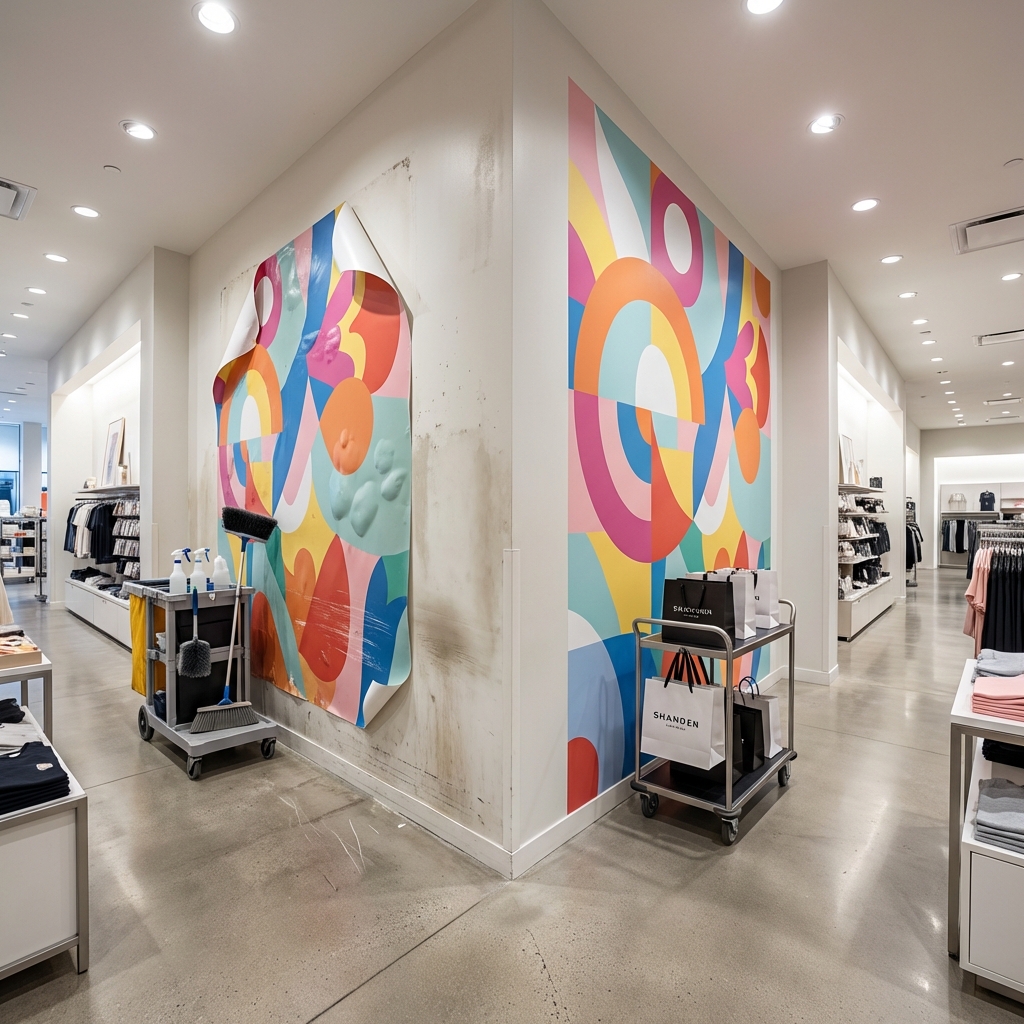
We’ve consulted with facility managers in hospitality and retail who abandoned wallpaper after one refresh cycle. The math was simple: lower upfront cost, but double or triple the replacement frequency. Staff time spent touching up, sectioning off damaged areas, and scheduling repairs consumed any savings.
Wallpaper also creates environmental issues. Most adhesive products release volatile organic compounds (VOCs) during installation and curing. Retail spaces occupied by customers and staff during application create air quality concerns that retailers increasingly want to avoid.
Key takeaway: Wallpaper’s maintenance burden and environmental impact make it expensive over a three-to-five-year lifecycle, especially in high-traffic retail where durability is non-negotiable.
Our Direct-to-Wall Printing Technology: Engineered for Retail Durability Without Adhesives
We print directly onto the wall substrate—drywall, CMU, concrete, or brick—using UV-cured inks that bond at a molecular level. No vinyl. No adhesive. No seams. This approach eliminates every failure point that plagues traditional wall coverings.
Our process begins with substrate preparation. We assess the wall, clean if needed, and ensure a stable surface. Our printing system then applies ultra-fine pigment in multiple passes, building color and detail layer by layer. Finally, we apply a protective topcoat and cure it with UV light, creating a finish that’s integral to the wall itself.
The durability difference is dramatic. Because the ink is not floating on adhesive, it doesn’t peel. Because we print seamlessly, there’s no edge-lift or thermal stress concentration. The wall becomes the graphic—it doesn’t wear the graphic like clothing that might tear or slip.
We recommend direct-to-wall printing for retail walls where durability and aesthetic cohesion matter most. The technology delivers photoreal imagery at architectural scale, which means you can create immersive brand environments or detailed wayfinding that looks integrated into the building itself, not applied to it.
Our installation timelines also benefit retail operations. Most walls print and cure in under five hours, which means we can work during off-hours, before opening, or after closing. Direct-to-wall printing vs vinyl wraps outlines the specific advantages in detail, but the short version is this: our finishes last longer, look better, and require fewer disruptions to your retail operation.
Key takeaway: Direct-to-wall printing eliminates adhesive and seam vulnerabilities, delivering durability and visual cohesion that vinyl and wallpaper cannot match.
Cleanable, Scuff-Resistant Finishes: Standing Up to Daily Customer Traffic
Retail floors get cleaned constantly. Walls do too. Our finishes are engineered to withstand regular cleaning without degradation.
We apply a protective topcoat that’s designed to resist scuffs from shopping carts, furniture, and customer contact. The finish is matte or satin (never glossy in retail; gloss creates glare and looks cheap), which hides fingerprints better than reflective surfaces. Most importantly, the topcoat allows for wet cleaning and mild chemical solutions without breaking down the image.
Facility managers can use standard commercial cleaners—diluted degreaser, mild disinfectants, or all-purpose sprays—on our walls. The surface won’t stain or fade. If a scuff does occur, it’s cosmetic and doesn’t affect the structural integrity of the graphic. Compare this to wallpaper, which absorbs stains and shows every fingerprint, or vinyl, which scuffs reveal substrate underneath.
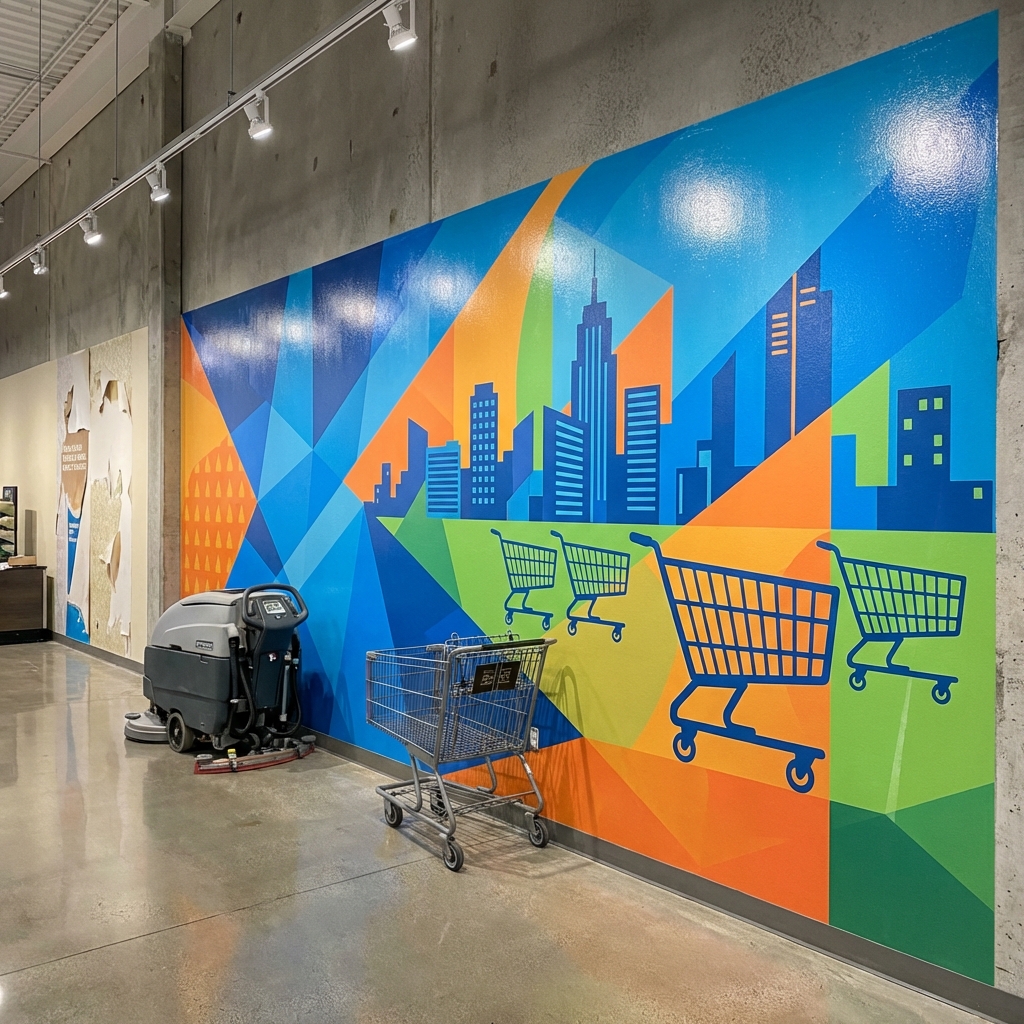
We’ve tested our finishes in high-volume retail environments: grocery stores, pharmacies, sporting goods retailers, and fashion outlets. After two years of daily cleaning and customer contact, our graphics maintain color vibrancy and surface integrity. No bubbling. No staining. No peeling.
Key takeaway: Our cleanable finishes handle aggressive cleaning and customer contact without degradation, reducing maintenance labor and extending graphic lifespan.
Performance Comparison: Cost of Ownership Across Retail Environments
Let’s compare lifecycle costs over five years for a 400-square-foot retail wall.
Vinyl wall covering: Material and installation cost roughly $2,000 to $2,800. Plan for edge failure by year two, requiring touch-up or sectional replacement ($400 to $800). Full replacement by year four ($2,000 to $2,800). Total: $4,400 to $6,400 over five years, plus staff time spent managing replacements.
Wallpaper: Material and installation run $1,200 to $1,800. Expect visible wear and staining by year two; replacement becomes necessary by year three ($1,200 to $1,800). If you require a second refresh due to damage, add another $1,200 to $1,800. Total: $3,600 to $5,400 over five years, plus environmental concerns and staff time.
Our direct-to-wall printing: Material, printing, substrate prep, and installation typically run $2,800 to $3,600 for a high-quality finish. Because the image bonds directly to the wall and our topcoat is durable, maintenance is routine cleaning only. Lifecycle cost over five years: $2,800 to $3,600, plus minimal maintenance labor.
The advantage compounds when you scale across multiple locations. A retail chain with ten 400-square-foot walls spends $44,000 to $64,000 on vinyl over five years, versus $28,000 to $36,000 with our direct-to-wall solution. Over ten years, the savings exceed $30,000.
We also factor in brand consistency. Vinyl peels unevenly; our direct-to-wall finish looks the same across every location and survives every refresh cycle unchanged.
Key takeaway: Direct-to-wall printing delivers lower total cost of ownership while maintaining brand consistency across multi-location retail rollouts.
Installation Speed and Minimal Disruption: Why Fast Deployment Matters in Retail
Retail operates on tight schedules. Every hour your space is closed or partially unavailable costs revenue. Traditional installations—vinyl hanging, wallpaper pasting, paint drying—take days and require extended access.
We print and install direct-to-wall graphics in a single shift, typically under five hours. We arrive after hours, prepare the substrate, print, cure, and finish. Your retail space opens the next morning with a fully cured, operational graphic. No downtime. No staff displacement. No business impact.
This speed matters for seasonal refreshes, tenant turnover, and brand relaunch campaigns. Retailers who want to shift their visual identity quarterly or rotate seasonal campaigns no longer face a week of disruption; they schedule a five-hour installation window and move forward.
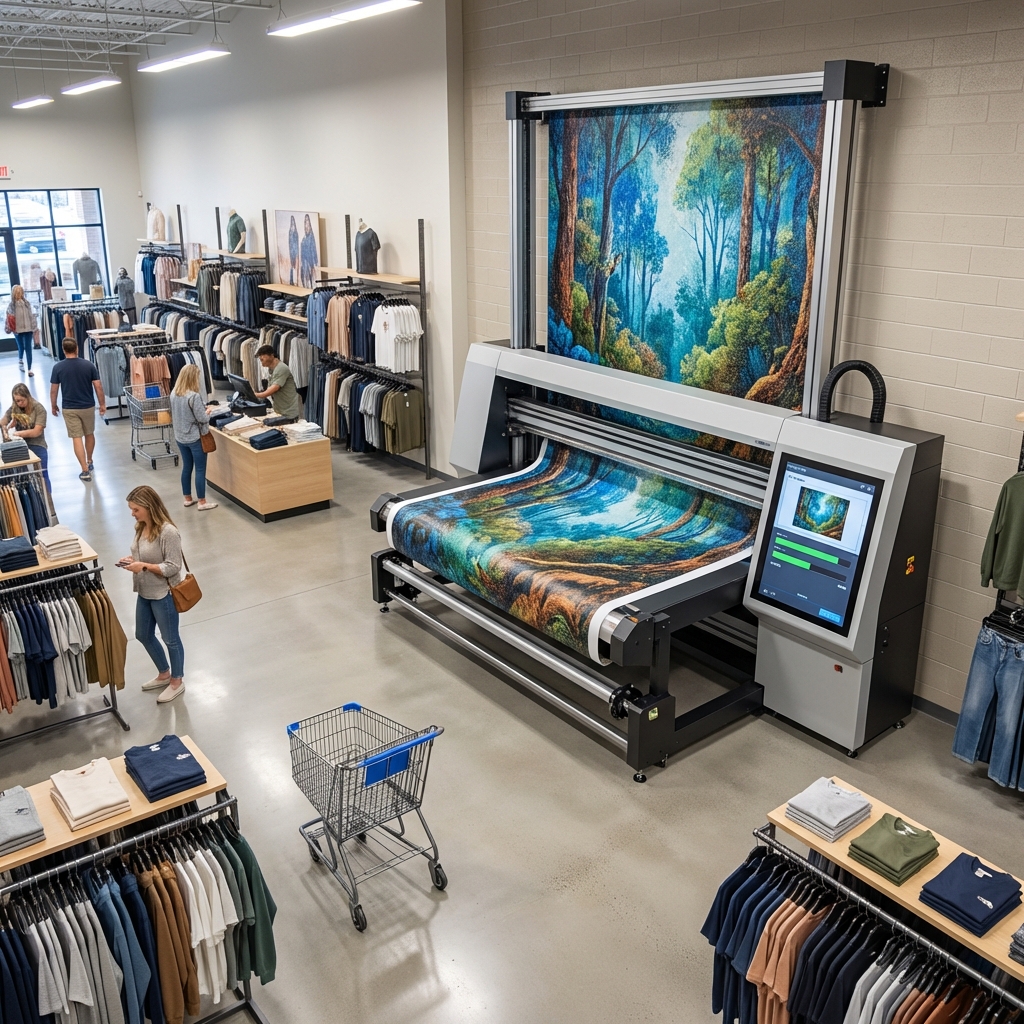
Our minimal-disruption installation approach also works in occupied retail spaces where closing temporarily isn’t an option. We’ve printed graphics in active grocery stores, pharmacies, and fitness centers during off-hours, with zero impact on daytime operations.
We bring everything we need: printing equipment, power supply, climate control if required, and cleanup materials. Your team doesn’t need to source anything or coordinate logistics beyond unlocking the space.
Key takeaway: Our sub-five-hour installation eliminates operational disruption and allows frequent refreshes without revenue impact.
—
High-traffic retail walls demand finishes that survive daily wear, maintain visual appeal, and cost less over time. Vinyl peels. Wallpaper stains and requires constant refresh cycles. Our direct-to-wall printing technology delivers durability without adhesive vulnerabilities, cleanable surfaces that resist scuffing and staining, and installation speeds that respect your retail schedule.
If you operate multiple retail locations, manage seasonal refreshes, or need graphics that perform under real-world pressure, direct-to-wall printing is the standard we recommend. Contact us to discuss your retail wall graphics project and discover how we can eliminate the maintenance burden that vinyl and wallpaper create.
Contact us to learn more
Frequently Asked Questions (FAQ)
How do your direct-to-wall finishes hold up against daily customer traffic and cleaning?
We engineer our finishes to withstand high-traffic retail environments without peeling, bubbling, or deteriorating. Our surfaces are cleanable with standard commercial disinfectants and resist scuffing from carts, foot traffic, and routine maintenance—meaning your graphics maintain their appearance across months and years of continuous use. Unlike vinyl or wallpaper, we apply our coating directly to the wall substrate, eliminating the adhesive failures that typically compromise durability in busy spaces.
Can we install your murals without closing our retail location or disrupting customer flow?
Yes. We complete most installations in under 5 hours with on-site, direct-to-wall printing that requires no shipping, fabrication delays, or adhesive application. Our process is designed specifically for occupied buildings, so we can work around your operational schedule and minimize disruption to customer experience and daily business. This speed and low-impact approach is one of the key reasons retail and hospitality teams choose us over traditional solutions.
What happens if we need to change our graphics or refresh our space in the future?
Our finishes are paint-over-ready, which means you can repaint or refresh the wall graphics whenever your brand, tenant, or program needs change without removing layers of old adhesive or vinyl residue. We design every installation with your future flexibility in mind, so updating your space is straightforward and cost-efficient rather than requiring full wall replacement or renovation.