Table of Contents
- The Problem With Traditional Wall Coverings: Waste, Cost, and Disruption
- Why Vinyl and Wallpaper Fall Short for Forward-Thinking Organizations
- Our Direct-to-Wall Printing Approach Eliminates Waste and Installation Risk
- How Our Technology Delivers High-Quality Results Without Adhesives or Replacement Cycles
- Speed and Scalability: Installing Sustainable Graphics Across Multiple Locations
- Durability and Cleanability in High-Traffic Commercial and Institutional Spaces
- Cost Advantages of a Lifecycle-Efficient Wall Solution
- Compatibility Across Any Surface: Drywall, Concrete, CMU, and Brick
- Wayfinding and Branding Integration Without Signage Clutter
- Building a Sustainable Interior Refresh Strategy With Your Team
- Getting Started With Our Direct-to-Wall Solution
- Frequently Asked Questions (FAQ)
The Problem With Traditional Wall Coverings: Waste, Cost, and Disruption
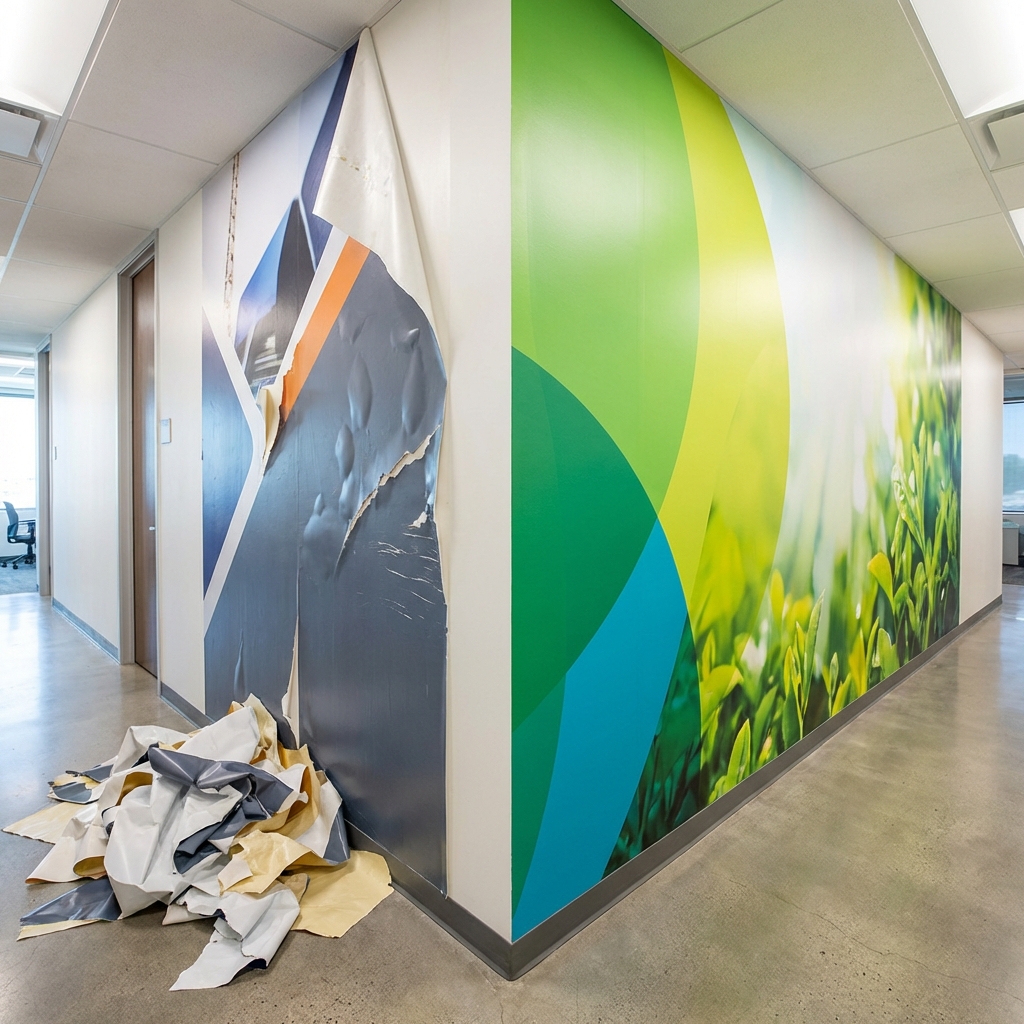
Traditional wall coverings create a persistent operational headache for facilities leaders. Vinyl wall wraps bubble and peel within 2-4 years, especially in high-traffic corridors where people brush against them daily. Wallpaper absorbs moisture, tears, and requires chemical-laden removal that generates hazardous waste. When either option fails, replacement means stripping the old material, managing disposal, repairing the substrate, and installing new coverage—often in occupied buildings where downtime costs money and disrupts operations.
We’ve watched healthcare systems spend thousands to remove wallpaper from patient care areas only to face mold remediation afterward. We’ve seen retail chains navigate the logistics of replacing peeling vinyl across dozens of locations simultaneously. The lifecycle economics are brutal: a facility might refresh walls every 5-7 years just to maintain appearance, creating recurring capital projects, vendor coordination, and environmental waste that accumulates over decades.
Beyond disruption, the sustainability angle matters more each year. Vinyl generates microplastics during removal. Wallpaper paste contains adhesives that complicate recycling. Shipping bulky rolls across regions adds carbon to the supply chain. For institutions managing ESG commitments or green building certifications, these solutions conflict with stated environmental goals. The math is simple: organizations are stuck paying premium costs for solutions that damage the environment and require constant replacement.
Why Vinyl and Wallpaper Fall Short for Forward-Thinking Organizations
The gap between what commercial teams need and what vinyl or wallpaper deliver has widened. These traditional solutions were designed for residential spaces with light traffic and stable conditions. They fail in the operational reality of schools, hospitals, hotels, and corporate offices.
Vinyl wraps require perfect substrate preparation. Any imperfection—humidity fluctuation, substrate movement, uneven surface texture—shows through the material and causes adhesion failure. We’ve installed in buildings where architectural expansion and contraction from seasonal temperature swings alone created bubble patterns within months. Wallpaper demands even more precision: it needs primer, careful humidity control during installation, and ongoing climate management to prevent warping.
Both options also create a visual compromise. Seams are unavoidable at architectural scale. Even on a single wall, you’ll see the line where two vinyl rolls meet or where wallpaper panels align. Designers accept this limitation because alternatives didn’t exist—until now. Decision-makers we work with tell us repeatedly that seam-free, photoreal graphics changed how they think about interior branding.
The scheduling pressure is real, too. Vinyl installation requires 24-48 hours of curing before the wall can be used. Wallpaper needs similar drying time. For occupied buildings, that means after-hours work, overtime labor, and project management complexity. Healthcare facilities can’t close a corridor for two days. Schools can’t block hallways during the academic year. Retail locations can’t lose floor space during peak season. Traditional solutions don’t fit the constraints.
Our Direct-to-Wall Printing Approach Eliminates Waste and Installation Risk
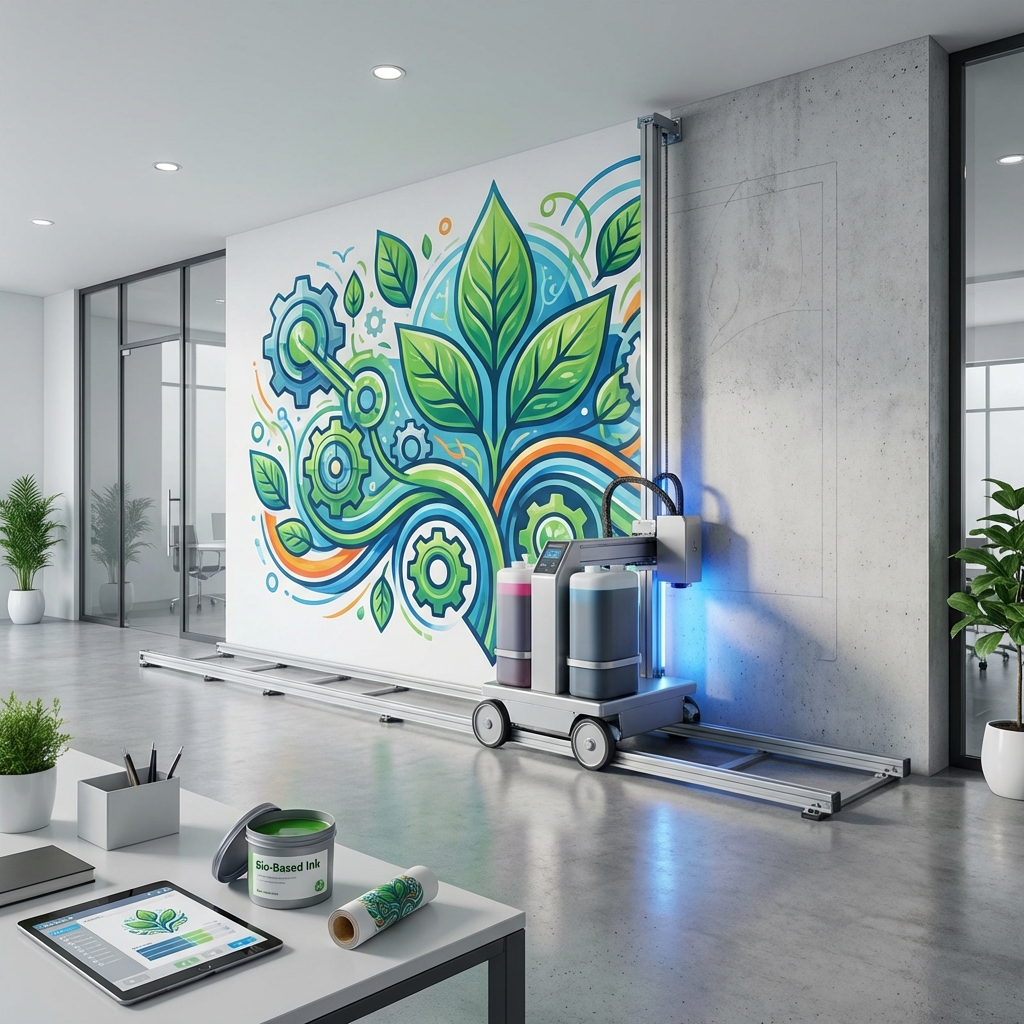
We print directly onto the wall surface using industrial inkjet technology—no adhesives, no intermediate materials, no waste. The ink bonds chemically with the wall substrate itself, whether it’s drywall, concrete, CMU, or brick. There’s nothing to peel off, nothing to bubble or separate. When the graphic eventually needs refreshing, we simply paint over it and print again.
This method eliminates the largest source of waste in traditional wall covering projects: removal and disposal. There’s no vinyl to strip. There’s no wallpaper paste to neutralize. The wall becomes the canvas, not a host for temporary materials. For organizations with sustainability mandates, this shift is meaningful. You’re not generating hazardous waste. You’re not shipping heavy rolls across regions. You’re not creating microplastics or burdened recyclables.
From an installation standpoint, the risk profile changes completely. Because we’re printing onto the wall itself rather than adhering a material to it, substrate inconsistencies that would doom vinyl become irrelevant. Minor texture, slight dust, small surface variations—these don’t affect the bond quality. Our technicians prep the wall in 30 minutes to an hour, then print. The entire process is typically complete in under 5 hours, including cleanup.
Our direct-to-wall approach compared to vinyl wraps shows the operational advantage clearly: faster installation, longer durability, lower lifecycle cost, and zero material waste.
How Our Technology Delivers High-Quality Results Without Adhesives or Replacement Cycles
The visual quality sets our work apart. We print at 1200 DPI resolution, which means photoreal detail at architectural scale. Subtle color gradients, fine lines, texture, and depth all reproduce faithfully. Museum-quality image fidelity isn’t a luxury—it’s standard.
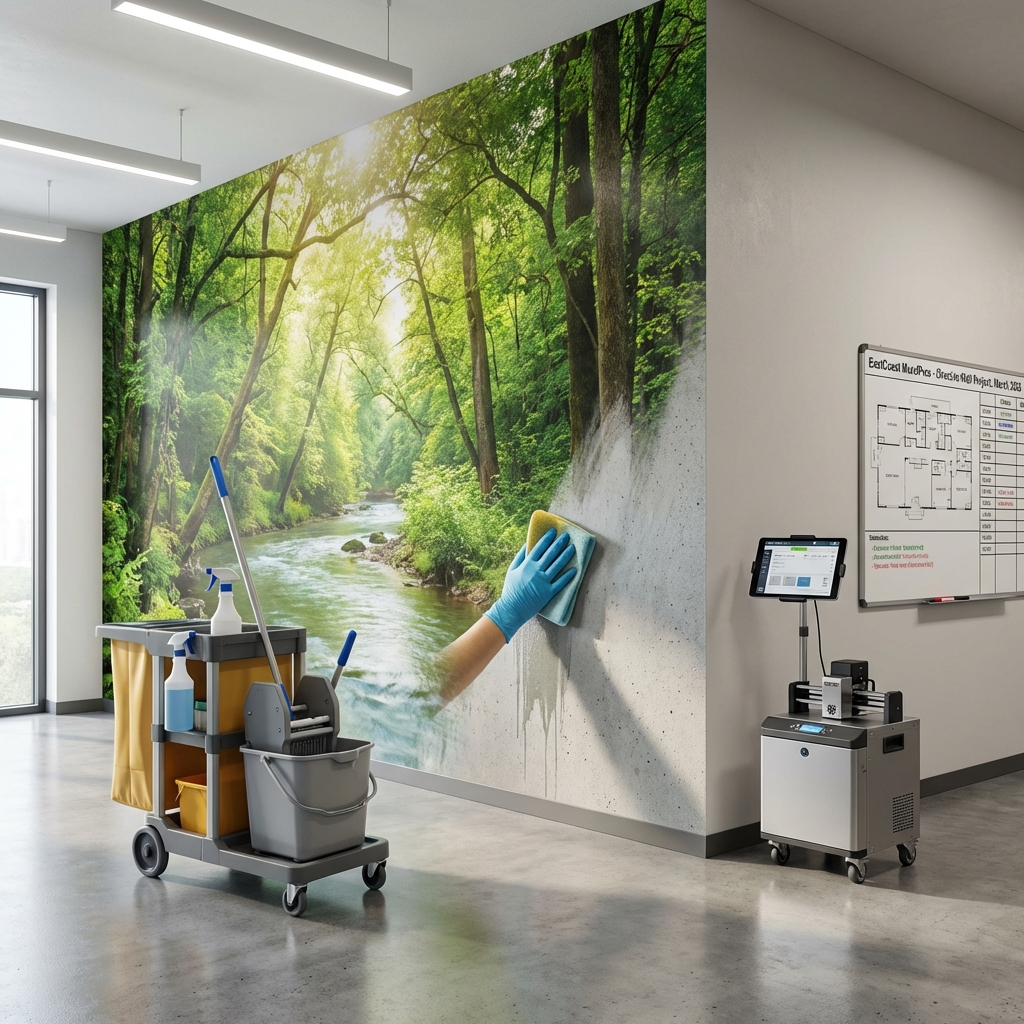
The durability is built into the chemistry. Our inks cure to a hardened state that resists fading, moisture, and mechanical wear. You can wipe these surfaces clean with a damp cloth. In healthcare settings, you can use approved hospital disinfectants. In schools, you can tolerate normal scuffing from hallway traffic. The finish is designed to withstand the wear patterns of high-traffic commercial environments.
Because we’re printing directly onto the substrate rather than applying a separate material, there’s no interface to fail. Vinyl wraps peel because the bond between the adhesive and substrate deteriorates over time. Wallpaper develops bubbles because moisture compromises the paste. Our approach eliminates that entire failure mode. The ink is part of the wall surface itself.
We also offer a paint-over-ready finish. If your needs change, your tenant cycles out, or your program shifts, you don’t need to hire specialists to remove old graphics. Your maintenance team simply primes and paints. This flexibility is invaluable in commercial real estate where tenant turnover is predictable. A 5-year lease ends, the walls are updated, and the space is ready for the next occupant in days—not weeks of removal and remediation.
Speed and Scalability: Installing Sustainable Graphics Across Multiple Locations
National rollouts create logistical nightmares with vinyl or wallpaper. You coordinate with local vendors in each region, manage quality inconsistency, schedule installations around tenant occupancy, and navigate permitting delays. With us, the process is linear and predictable.
We can move through multiple walls, floors, or entire buildings in a single week. Because installation is fast and low-disruption, you can execute across occupied spaces without shutting down operations. Our approach to occupied building installation ensures minimal interference with daily activities.
For multi-location brands, consistency matters enormously. When you’re rolling out the same graphic across 20 retail locations or 50 healthcare facilities, you need every version to look identical. Vinyl depends on local installer skill and material batch variation. Printing is pixel-perfect every time. The image that prints in Boston matches the one in Atlanta, which matches the one in Los Angeles—because the digital file is the source of truth.
Scaling also means predictable budgets. You know the square footage, the timeline, and the all-in cost per location. There are no surprises from material shortages, vendor pricing swings, or installation complexity. For procurement teams managing capital projects, that certainty is worth significant time savings.
Durability and Cleanability in High-Traffic Commercial and Institutional Spaces
Our surfaces are engineered for the punishment that commercial spaces deliver. Healthcare corridors have thousands of foot traffic passes per day. Children run their hands along school hallway walls. Hotel guests lean, touch, and occasionally mark surfaces. Our printed walls survive this treatment better than any traditional covering.
The ink has a hardness rating designed specifically for high-traffic environments. It resists scratching, scuffing, and marking. Permanent markers don’t damage it—a cleaning wipe removes them. Food stains wash off. Dust and grime clean with standard facility protocols. You’re not managing a fragile surface that requires specialized care or frequent replacement.
We’ve installed in pediatric hospital wings where cleaning protocols are strict and traffic is heavy. These spaces demand surfaces that hold up to aggressive cleaning, resist staining, and maintain appearance year after year. Our installations in those environments have outperformed vinyl by 3-4 years or more. The difference becomes obvious when you’re comparing a still-pristine graphic to one that’s been peeling and bubbling for months.
Maintenance burden shrinks dramatically. You’re not inspecting for loose edges, scheduling adhesive touch-ups, or planning removal. You clean it like you’d clean any wall—with appropriate commercial cleaners and standard facility care. That operational simplicity has real value when you’re managing hundreds of thousands of square feet across multiple buildings.
Cost Advantages of a Lifecycle-Efficient Wall Solution
The all-in cost equation favors direct-to-wall printing decisively once you factor in the complete lifecycle. A traditional vinyl installation might cost $15-25 per square foot upfront, but you’re replacing it in 5-7 years. With wallpaper, you’re looking at similar initial costs plus removal and remediation expenses.
Our printing costs $20-35 per square foot depending on complexity, but you’re not replacing it repeatedly. The graphic lasts 10-15 years or longer with normal facility maintenance. When refresh time comes, you paint over and reprint for a fraction of initial cost. The per-year amortized cost is substantially lower.
For a 10,000 square foot corporate campus renovation, that difference becomes significant. Vinyl at $20/SF costs $200,000 upfront with replacement costs every 5-7 years. Over a 15-year period, you’re spending $400,000-600,000 total. Our solution at $30/SF costs $300,000 initially, with potential refreshes at $100,000-150,000 every 10+ years. The lifecycle math favors sustainability and durability.
Capital projects also avoid the hidden costs of disruption. Vinyl removal and replacement in occupied buildings requires after-hours labor, project management overhead, and operational coordination. These soft costs add thousands to the final bill. Our minimal-disruption installation reduces scheduling complexity and labor premiums, making the already favorable economics even better.
Compatibility Across Any Surface: Drywall, Concrete, CMU, and Brick
We print onto whatever substrate your building has. Drywall, concrete, CMU (concrete masonry units), and brick all accept our inks and produce excellent results. This versatility matters because most commercial buildings are mixed-surface environments. A hospital might have drywall corridors, concrete loading areas, and brick exterior features. You need a solution that works everywhere.
Substrate compatibility also means you’re not limited by building structure or architectural constraint. Historic buildings with original brick. Modern offices with polished concrete. Healthcare facilities with drywall. Each gets the same professional treatment. There’s no “we can do vinyl here but not there” compromise that forces you into aesthetic or functional inconsistency.
The prep process adapts slightly based on surface type. Concrete and CMU may need light sanding or a sealer depending on porosity. Brick might need joint cleaning. Drywall typically needs minimal preparation. But in every case, the process is faster and simpler than the substrate requirements vinyl demands. You’re not managing complex adhesion testing or environmental conditioning. The wall gets prepped, we print, and you’re done.
This flexibility also matters for renovation projects where you’re mixing old and new finishes. You can print onto the original brick wall in your heritage corridor and the new drywall in the adjacent expansion without any visual or functional difference. The graphic is seam-free and consistent across the entire space.
Wayfinding and Branding Integration Without Signage Clutter
We help you consolidate multiple communication layers onto a single integrated wall graphic. Instead of mounting directional signs, color-coded wayfinding stickers, and informational posters—each requiring hardware and creating visual clutter—you can print everything directly into the wall.
A hospital corridor becomes a wayfinding system itself. Department names, directional arrows, and floor information print directly into the wall surface, eliminating the need for dozens of individual signs. The result is cleaner, more professional, and easier to maintain. Updates don’t require hardware changes or new signs; you simply reprint when information changes.
Retail and hospitality environments benefit similarly. Floor-to-ceiling branding graphics print directly onto walls, eliminating the visual noise of banner stands, temporary signs, and mounted materials. The space feels more curated and less cluttered. Customers experience professional interior design rather than makeshift merchandising.
Safety and instructional graphics integrate seamlessly, too. Emergency exit information, facility rules, or operational procedures print directly into the wall where they belong, eliminating redundant signage and creating a cohesive communication system. This integration reduces both cost and visual complexity.
Building a Sustainable Interior Refresh Strategy With Your Team
Start by evaluating your current wall covering lifecycle and associated costs. How often are you replacing vinyl or wallpaper? What’s the total cost including removal, disposal, and installation labor? What operational disruption do these projects create? What waste do they generate? Quantify these factors because the comparison becomes compelling when you have real numbers.
Next, identify pilot spaces where direct-to-wall printing makes sense. A corporate headquarters lobby. A healthcare facility wing. A retail flagship. Choose a high-visibility area where quality matters and traffic is heavy. This pilot establishes proof of performance and builds internal confidence before scaling.
Involve your design, facilities, and procurement teams early. Designers want photoreal quality and seam-free visuals—we deliver that. Facilities teams care about durability, cleanability, and minimal disruption—our specifications meet those needs. Procurement needs lifecycle cost clarity and vendor reliability—we provide both. When these stakeholders align around a solution, implementation moves smoothly.
Document the pilot results. Photograph the finished work. Track maintenance requirements and cleaning protocols. Note the installation timeline and operational impact. This documentation becomes your business case for broader adoption across your organization.
Getting Started With Our Direct-to-Wall Solution
The first step is a straightforward conversation about your needs. What spaces are you looking to refresh? What’s driving the project—end-of-lease, brand update, wayfinding needs, or lifecycle replacement? What timeline and budget constraints are you working within? What walls or surfaces are involved?
We’ll visit your facility to evaluate substrate conditions, lighting, and spatial requirements. This assessment takes 30-60 minutes and costs nothing. We’ll photograph the spaces, take measurements, and identify any surface prep or logistical considerations.
From there, we develop a design mockup so you can visualize the finished work at actual scale. We work with your creative team or provide design support if needed. Once approved, we schedule installation around your operational calendar. Most projects move from approval to completion within 2-4 weeks.
We manage the entire process: design, printing, installation, and cleanup. You don’t coordinate with multiple vendors. You don’t manage complexity. You get a finished, high-quality, sustainable wall solution delivered on schedule.
Contact us to discuss your project and schedule a site visit. We’ll help you understand how direct-to-wall printing can replace traditional wall coverings while delivering superior quality, durability, and environmental responsibility.
Contact us to learn more
Frequently Asked Questions (FAQ)
How quickly can we install direct-to-wall graphics across multiple locations?
We typically complete installations in under 5 hours per wall, with minimal disruption to occupied spaces. Since we print directly on-site, we eliminate shipping delays and fabrication errors that plague traditional vinyl and wallpaper projects. For multi-location rollouts, our consistent execution and low-disruption process mean you can coordinate refreshes across your portfolio without extended downtime or construction-level complexity.
What surfaces can we print directly onto, and do we need to prep your walls?
We work seamlessly with drywall, concrete, CMU block, and brick, whether finished or unfinished. Most existing walls require minimal prep, and our paint-over-ready finishes mean future tenants or program changes won’t require costly removal or remediation. This compatibility eliminates the surface replacement costs and environmental waste that come with traditional wall coverings.
How does direct-to-wall printing compare to vinyl and wallpaper in terms of durability and maintenance?
Our graphics are engineered for high-traffic environments with durable, cleanable surfaces designed to withstand institutional and commercial use without peeling, bubbling, or fading like vinyl or wallpaper. We reduce your replacement and maintenance cycles significantly because there are no adhesives to fail, seams to separate, or materials prone to aging. Over the lifecycle of your space, this performance-based approach costs substantially less while delivering higher-quality results.