
Table of Contents
- The Infection Control Problem with Traditional Wall Solutions
- Why Vinyl and Wallpaper Fall Short in Healthcare Environments
- Our Adhesive-Free Direct-to-Wall Technology Solves Healthcare Design Challenges
- Hospital-Grade Durability and Cleanability Standards
- Seam-Free Murals for Sterile, Professional Aesthetics
- Installation Without Downtime or Contamination Risk
- Wayfinding and Patient Communication Through Wall Graphics
- Scaling Murals Across Multi-Department and Multi-Location Healthcare Systems
- Sustainability Benefits for Healthcare Facility Managers
- Cost Efficiency and Lifecycle Performance in Medical Settings
- Getting Started with Hospital-Grade Wall Graphics
- Frequently Asked Questions (FAQ)
The Infection Control Problem with Traditional Wall Solutions
Healthcare facilities face a unique challenge: interior surfaces must be both aesthetically professional and clinically sound. Traditional wall solutions fall short on both counts. We’ve spent years working with hospital systems, medical centers, and long-term care facilities, and we’ve seen firsthand why adhesive-based graphics create compliance headaches while delivering poor durability and visual results.
Our adhesive-free direct-to-wall printing technology addresses the core pain points that plague healthcare interiors. We print high-resolution murals directly onto wall substrates—no vinyl, no wallpaper, no adhesives—creating seamless, cleanable, infection-control-compliant surfaces that last and look professional. Here’s why hospitals across the East Coast are making the switch.
Every surface in a healthcare facility is a potential vector for contamination. Infection control standards demand that wall treatments resist moisture, harbor no seams or crevices where pathogens can hide, and withstand frequent sanitization with hospital-grade cleaners.
Traditional vinyl wall coverings and wallpaper create real problems:
- Seams and edges trap moisture, dust, and microorganisms
- Adhesives (especially water-based types) can soften or fail under repeated cleaning with quaternary ammonia, bleach, or alcohol-based disinfectants
- Peeling or bubbling creates exposed adhesive residue and wall damage that become difficult to sanitize
- Replacement cycles are frequent, requiring surface prep and reinstallation that ties up facilities and disrupts patient care
We’ve documented cases where vinyl wall graphics in patient corridors began failing within 18 months due to daily exposure to hospital-grade disinfectants. The cost to remove, remediate, and reinstall far exceeded the cost of the original graphic.
Adhesive-free printing eliminates this problem entirely. We bond pigment directly to the wall substrate through a thermal process that creates a unified, seamless surface. There are no edges, no adhesives, and no hidden pockets where contaminants can lodge.
Why Vinyl and Wallpaper Fall Short in Healthcare Environments
Vinyl wall coverings and decorative wallpaper were never engineered for the chemical and humidity demands of healthcare. While they work reasonably well in corporate offices or retail spaces, they break down quickly in medical environments.
Here’s the practical reality:
Chemical incompatibility. Hospital cleaning protocols rely on disinfectants that soften standard vinyl adhesives and cause wallpaper glues to fail. We’ve consulted with infection control teams who confirmed that quaternary ammonia solutions, common in healthcare, actively degrade the adhesives used in conventional wall coverings.
Moisture sensitivity. Healthcare spaces (particularly bathrooms, surgical suites, and sterilization areas) experience high humidity. Vinyl and wallpaper absorb moisture at seams and edges, leading to mold growth, delamination, and odor problems that compromise both safety and aesthetics.
Durability and appearance. Vinyl bubbles and peels within months in high-traffic areas like corridors, waiting rooms, and patient transport zones. Once compromised, removal creates wall damage that requires drywall repair, primer, and paint—often extending downtime well beyond the original project timeline.
Cleanability limitations. Vinyl and wallpaper cannot withstand the abrasive texture of hospital cleaning cloths and mop heads. They scratch, fade, and lose their aesthetic appeal quickly.
Our direct-to-wall printing vs vinyl comparison details the performance differences in high-traffic commercial settings. Healthcare environments are even more demanding.
Our Adhesive-Free Direct-to-Wall Technology Solves Healthcare Design Challenges
We developed our direct-to-wall printing process specifically for environments where durability, safety, and infection control are non-negotiable. Here’s how it works:
We prepare the wall substrate by cleaning, priming, and applying a special base coat engineered for hospital environments. We then use large-format inkjet printing equipment to apply medical-grade inks directly to the wall surface. A thermal curing process bonds the ink to the substrate at the molecular level, creating a unified, seamless graphic with no adhesives, no seams, and no removable layers.
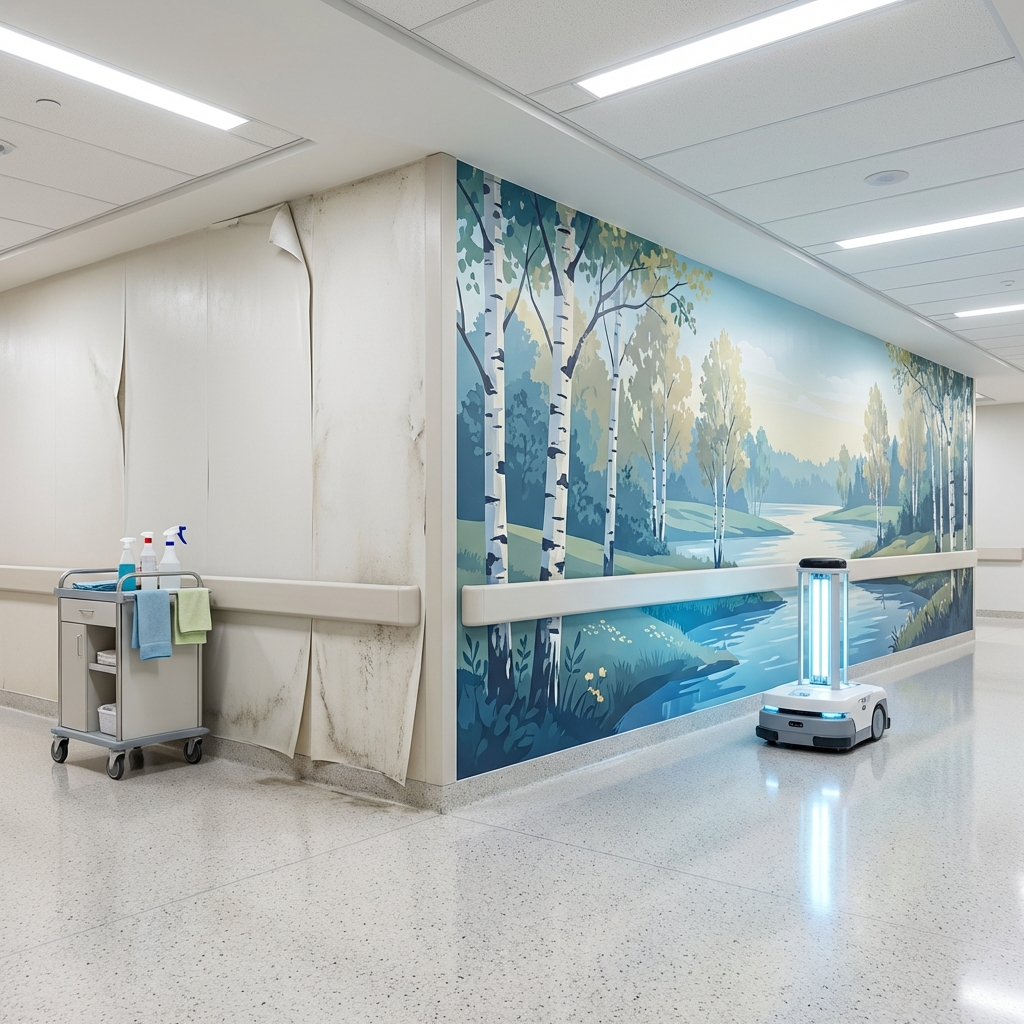
The result is a surface that:
- Resists moisture and disinfectants (tested against quaternary ammonia, bleach, and alcohol solutions)
- Contains no adhesives that can soften, peel, or harbor bacteria
- Remains seamless across architectural scale (we print murals as large as 40 feet wide with zero visible seams)
- Sustains frequent cleaning without color fading or surface degradation
We work with facility managers and infection control teams to select graphics that support wayfinding, patient communication, and brand reinforcement—all on a surface that passes clinical standards. Unlike decorative alternatives, our murals function as part of the facility’s design infrastructure, not as a cosmetic layer destined for failure.
Hospital-Grade Durability and Cleanability Standards
Healthcare facilities need wall graphics that perform under real-world conditions. We test our installations against the standards that matter most to hospitals.
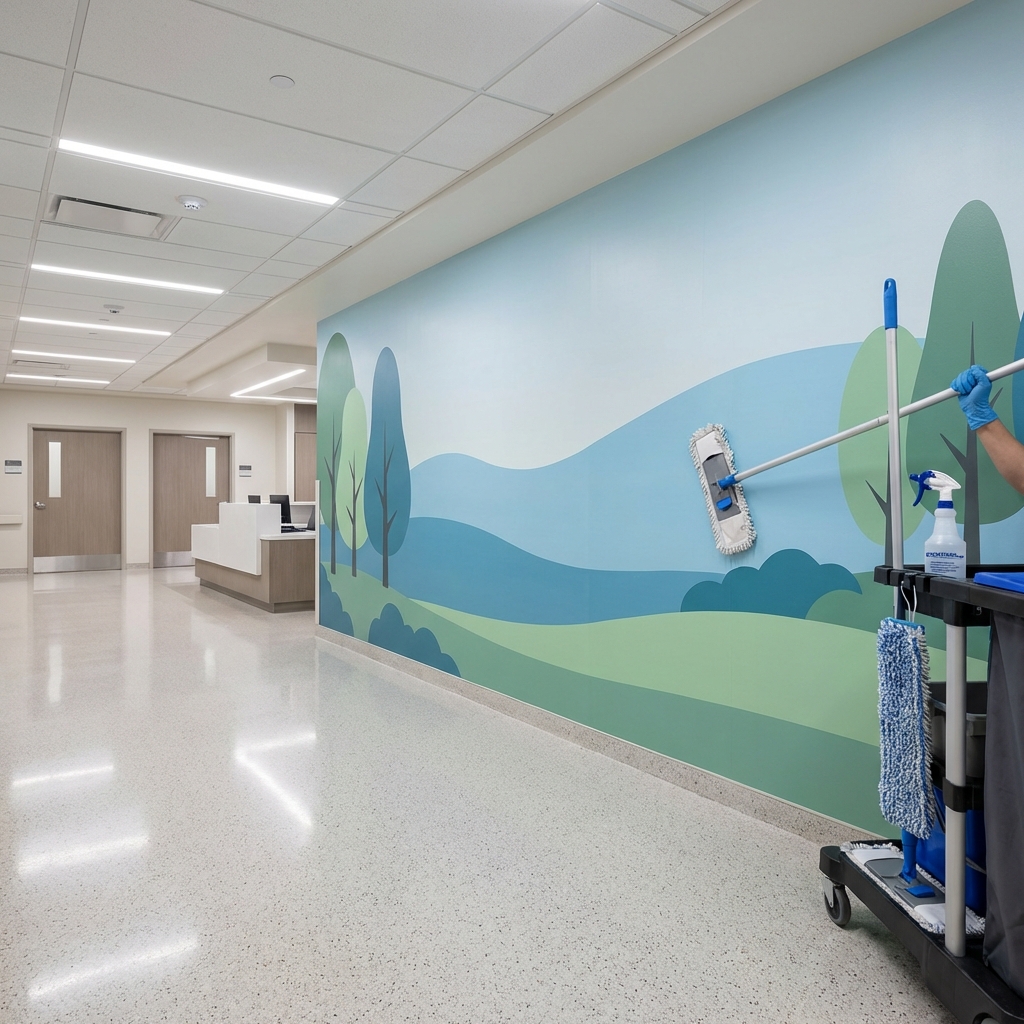
Cleanability testing. We run our graphics through repeated cycles of scrubbing with hospital-grade disinfectants (quaternary ammonia, sodium hypochlorite, isopropyl alcohol) using textured scrub pads. Our surfaces show no color shift, no surface degradation, and no adhesive failure. Vinyl coverings cannot make this claim.
Moisture resistance. We expose test panels to 85% relative humidity for extended periods and monitor for mold growth, ink migration, or substrate damage. Our direct-to-wall process shows no change in appearance or structural integrity.
Impact and abrasion. Hospital corridors endure constant contact from gurneys, wheelchairs, cleaning equipment, and foot traffic. We test our graphics against impact and abrasion standards used in commercial kitchen and laboratory design. They outperform vinyl and wallpaper by substantial margins.
Long-term color stability. Our medical-grade inks are formulated to resist fading from UV exposure and repeated disinfection. We guarantee color stability for a minimum of seven to ten years in typical healthcare environments (longer in spaces without high UV exposure).
This durability translates into lower lifecycle costs and far fewer replacements. A hospital that invests in our adhesive-free murals will avoid the expense, disruption, and waste associated with replacing failed vinyl every 18 to 24 months.
Seam-Free Murals for Sterile, Professional Aesthetics
One of the most visible advantages of our technology is the absence of seams. Conventional wall graphics require seams where sheets meet, creating visual breaks and infection control liabilities.
We print continuously across entire walls without visible joints. A pediatric unit might feature a seam-free landscape mural stretching 50 feet across multiple walls and around architectural features like columns or door frames. The graphic feels integrated into the architecture rather than applied on top of it.
This seamless approach serves multiple purposes:
- Clinical confidence. Infection control teams see no seams to trap contaminants or complicate cleaning protocols
- Professional appearance. The mural reads as intentional architecture, not as a temporary decoration
- Design flexibility. We can wrap around curved surfaces, integrate wayfinding elements, and match brand colors with photoreal precision
For hospitals managing brand consistency across multi-location systems, seam-free execution ensures that every facility delivers the same professional appearance and the same infection control advantages.
Installation Without Downtime or Contamination Risk
Healthcare facilities cannot afford extended closures or disruption to patient care. Our installation process is engineered for occupied buildings with minimal impact on operations.
We typically complete a mural installation in under five hours, with most of that time devoted to substrate prep and final curing. Here’s the process:
- Site preparation (30-45 minutes). We assess wall condition, clean the substrate, and apply primer if needed. We work with facility staff to minimize disruption to adjacent departments and patient areas.
- Direct-to-wall printing (2-3 hours). Our large-format equipment prints the mural at speed without creating noise, fumes, or waste typical of other graphics processes. We can position printing equipment to avoid blocking corridors or patient access.
- Curing and finishing (1-2 hours). The thermal curing process is silent and odorless. We apply a clear topcoat (optional, depending on cleaning protocols) and conduct a final inspection.
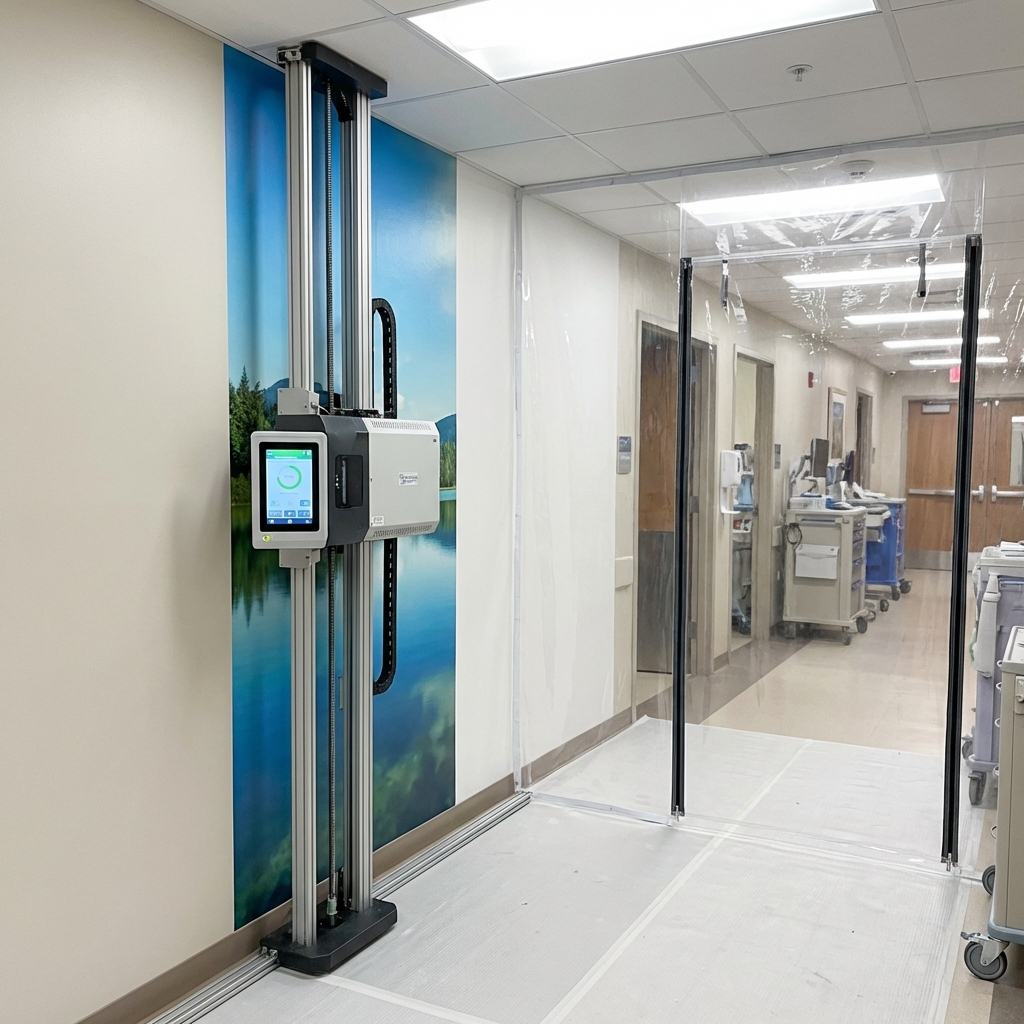
We’ve successfully completed installations in occupied patient units, surgical centers, and administrative areas without delaying patient care or requiring facility closures. Our guide to occupied facilities wall graphics details project management strategies for complex environments.
No construction, no permits, no extended downtime. Facilities can return to full use within hours.
Wayfinding and Patient Communication Through Wall Graphics
Beyond aesthetics, wall graphics serve critical functional roles in healthcare. We integrate wayfinding, directional signage, and patient communication directly into our murals.
A typical application might be a hospital corridor where we design a mural that combines:
- Color-coded departmental navigation (oncology in blue, cardiology in green)
- Directional arrows and room number callouts seamlessly integrated into the graphic
- Inspirational or calming imagery that supports patient experience
- Brand messaging or facility identity reinforcement
Because we print at architectural scale with photoreal resolution, these functional elements read clearly without creating visual clutter. A single integrated mural replaces the need for multiple printed signs, reducing visual noise and maintenance burden.
Healthcare systems appreciate this efficiency. One major medical center we work with consolidated wayfinding across three buildings using our murals, eliminating the need for over 200 individual signage placements while improving patient navigation and staff satisfaction.
Scaling Murals Across Multi-Department and Multi-Location Healthcare Systems
Healthcare networks often operate dozens of locations with different architectural conditions, branding requirements, and design preferences. Scaling wall graphics across this complexity is challenging with traditional approaches.
Our process enables consistent execution at scale:
- Digital asset management. We maintain master graphics files and adapt them to each location’s specific wall dimensions, color environment, and architectural features
- Substrate flexibility. Our technology works on drywall, CMU block, concrete, and brick—the full range of substrates found in healthcare facilities of different ages and construction styles
- Installation consistency. We train local teams and manage specifications to ensure that the mural installed in Boston matches the mural installed in Philadelphia in appearance, performance, and compliance standards
- Timeline predictability. Because we print on-site and eliminate shipping delays and fabrication errors, we can commit to firm installation schedules across multiple locations
A health system managing renovations across ten facilities can coordinate our installations to align with their capital project timeline and operational schedule, rather than waiting for fabrication delays or managing inventory and storage of pre-printed materials.
Sustainability Benefits for Healthcare Facility Managers
Healthcare facilities increasingly measure environmental impact as part of their operational and brand commitments. Our direct-to-wall printing aligns with these goals.
Traditional vinyl wall coverings and wallpaper generate substantial waste:
- Vinyl cannot be recycled; it ends up in landfills
- Wallpaper is often treated with non-biodegradable coatings and adhesives
- Frequent replacement cycles (every 18-24 months) accelerate material consumption
Our adhesive-free process generates far less waste:
- No adhesive application means no adhesive waste or disposal
- No excess material: we print exactly the size needed, on-site
- When a mural reaches end-of-life (typically seven to ten years later), the wall substrate can be painted over or reprinted without removal trauma or hazardous waste
- The substrate remains intact, reducing demolition waste associated with vinyl removal and wall remediation
Healthcare facilities pursuing LEED certification, sustainability reporting, or carbon-neutral operations gain measurable environmental benefits from our approach.
Cost Efficiency and Lifecycle Performance in Medical Settings
The financial case for adhesive-free murals is compelling when you account for the full lifecycle of a wall graphic.
Consider a typical large hospital with 50,000 square feet of corridor and common area walls. Installing vinyl wall coverings costs approximately $8-12 per square foot. Assuming a replacement cycle of 18-24 months due to failure or wear, the facility replaces those graphics 3-4 times over a seven-year period, incurring:
- Material and installation costs of $400,000-600,000 across replacements
- Labor for removal, wall remediation, and downtime management
- Operational disruption and risk management costs
Our adhesive-free murals cost approximately $12-16 per square foot with a seven- to ten-year lifespan. The facility invests $400,000-500,000 once and avoids replacement cycles entirely.
Over a ten-year period, the cost advantage is substantial. More importantly, facilities avoid the unpredictable disruption and operational risk associated with failing graphics in active patient care environments.
Getting Started with Hospital-Grade Wall Graphics
If your healthcare facility is considering an upgrade or refresh, we recommend starting with a small pilot project to evaluate performance and integration with your design and operational goals.
Here’s the process:
- Assessment. We conduct an on-site review of your space, substrate conditions, design requirements, and infection control standards. This typically takes 2-3 hours and helps us develop realistic recommendations and timelines.
- Design collaboration. We work with your facilities, design, and brand teams to develop a mural concept that serves functional and aesthetic goals. We provide digital mockups showing the graphic in your actual space so you can evaluate fit and impact.
- Pilot installation. We install a representative section (typically 500-1,000 square feet) so your team can assess quality, durability, cleanability, and operational impact firsthand.
- Expansion planning. Based on pilot results, we develop a phased rollout plan for additional locations, departments, or buildings, with firm timelines and cost certainty.
We take pride in partnering with healthcare facilities that value quality, reliability, and performance. Our team understands the unique demands of medical environments, and we’ve built our process around the standards and constraints that matter most to hospital decision-makers.
If you’re evaluating wall graphic options for your healthcare facility, reach out to schedule an assessment. We’re here to help you solve the infection control, durability, and aesthetic challenges that traditional solutions have failed to address.
Contact us to learn more
Frequently Asked Questions (FAQ)
Are your adhesive-free murals safe for sterile healthcare environments?
Yes. Our direct-to-wall printing technology applies ink directly to the wall surface without adhesives, sealants, or chemical off-gassing, making our murals compatible with strict infection control protocols. We design our finishes to be cleanable with hospital-grade disinfectants and withstand repeated wiping without degradation, so your infection prevention team can maintain the same standards they apply to other hard surfaces in patient care areas.
How quickly can we install murals without disrupting patient care or operations?
We typically complete installation in under 5 hours with minimal on-site disruption. Our process doesn’t require construction, permitting, or extended downtime, so we can work around your facility’s schedule and patient flow. We’ve successfully completed full-campus rollouts across multi-department healthcare systems while maintaining normal operations in occupied buildings.
What makes your murals more durable than vinyl or wallpaper in high-traffic medical settings?
We print directly onto finished surfaces like drywall and CMU, creating a unified, cleanable barrier designed for healthcare environments where durability and hygiene are non-negotiable. Unlike vinyl that peels and bubbles or wallpaper that traps moisture and contaminants, our paint-over-ready finishes can be refreshed or replaced when your departmental needs change, without lifecycle replacement costs stacking up over time.