Direct-to-Wall Printing for Seamless Campus Visuals
7 Best Campus Wall Branding Solutions for Schools and Institutions
Colleges, universities, and institutional campuses manage some of the most complex interior environments—multiple buildings, varied user groups, safety obligations, and constant change. When visual communication fails, wayfinding breaks down, school spirit gets lost in the shuffle, and facilities teams wind up maintaining a patchwork of vinyl decals, framed signs, and temporary banners. The right campus wall branding solutions consolidate these needs into a durable, scalable system that looks intentional and installs quickly.
Across the East Coast, facilities leaders, architects, and brand teams are turning to direct-to-wall printing as a performance-based alternative to vinyl and wallpaper. It produces seam-free, high-resolution institutional wall graphics that integrate with the architecture; it shortens installation cycles from weeks to hours; and it scales cleanly across multi-building, multi-campus networks. EastCoast MuralPros provides these capabilities for schools, hospitals, cultural institutions, and public-sector owners who want unmistakable visuals without construction disruption.
Below are seven campus-ready solutions that deliver fast, consistent, and sustainable impact.
Direct-to-wall printing places high-definition artwork, branding, and instructional content directly onto finished or unfinished substrates—no vinyl, adhesive films, or panel systems required. The result is a continuous, edge-to-edge image that reads as part of the architecture rather than an applied layer. For campuses where durability, cleanliness, and lifecycle costs matter, this approach removes weak points like seams and edges that typically peel, bubble, or collect grime.
Key technical advantages for institutional environments:
- Works on a broad range of surfaces, including painted drywall, CMU, sealed concrete, and properly prepared brick.
- Creates crisp, photoreal details at architectural scale, suitable for galleries, atriums, and museum-quality displays.
- Produces a paint-over-ready finish, allowing facilities to revert or update spaces during tenant turnovers or program changes.
- Eliminates shipping, panel machining, and adhesive off-gassing associated with traditional films and wallpaper.
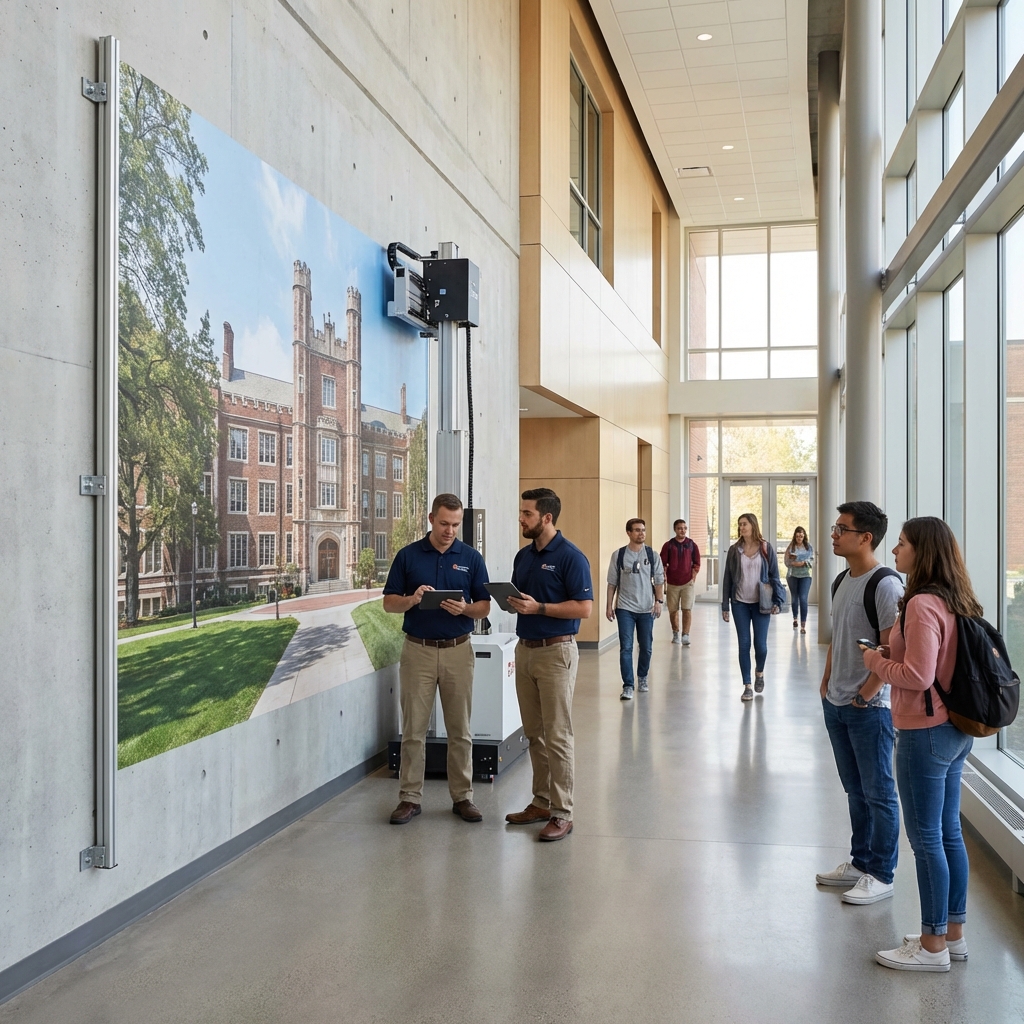
Installation is performed on site, with compact equipment that navigates standard corridors and elevators. Typical workflows include a survey and test print, file optimization to the wall dimensions, and a controlled print pass that achieves full coverage without seams. Because graphics are printed directly to the substrate, edges do not lift, which improves cleanability and reduces maintenance for high-traffic corridors and lobbies.
For an overview of how this technology translates to education and healthcare environments, see this primer on direct-to-wall campus printing.
Where this delivers immediate value on campus:
- Entry sequences and admissions suites with large-scale welcome statements
- Student centers and dining halls with zone graphics and program highlights
- Libraries and galleries with photoreal imagery, collections, and donor recognition
- Athletic corridors and training facilities with recruiting visuals and performance data
- Healthcare wings with clear departmental markers and restorative imagery
- Residence halls with community standards, orientation info, and spirit elements
High-Resolution Murals for Building Identity and Wayfinding
Effective university branding strategies recognize that identity and navigation work best when they’re integrated. A high-resolution mural does more than display a logo; it sets the tone for a building, provides legible clues about where you are, and helps visitors make correct decisions at the next intersection. When these elements are printed directly on the wall, they deliver a unified visual language that’s hard to achieve with piecemeal signage.
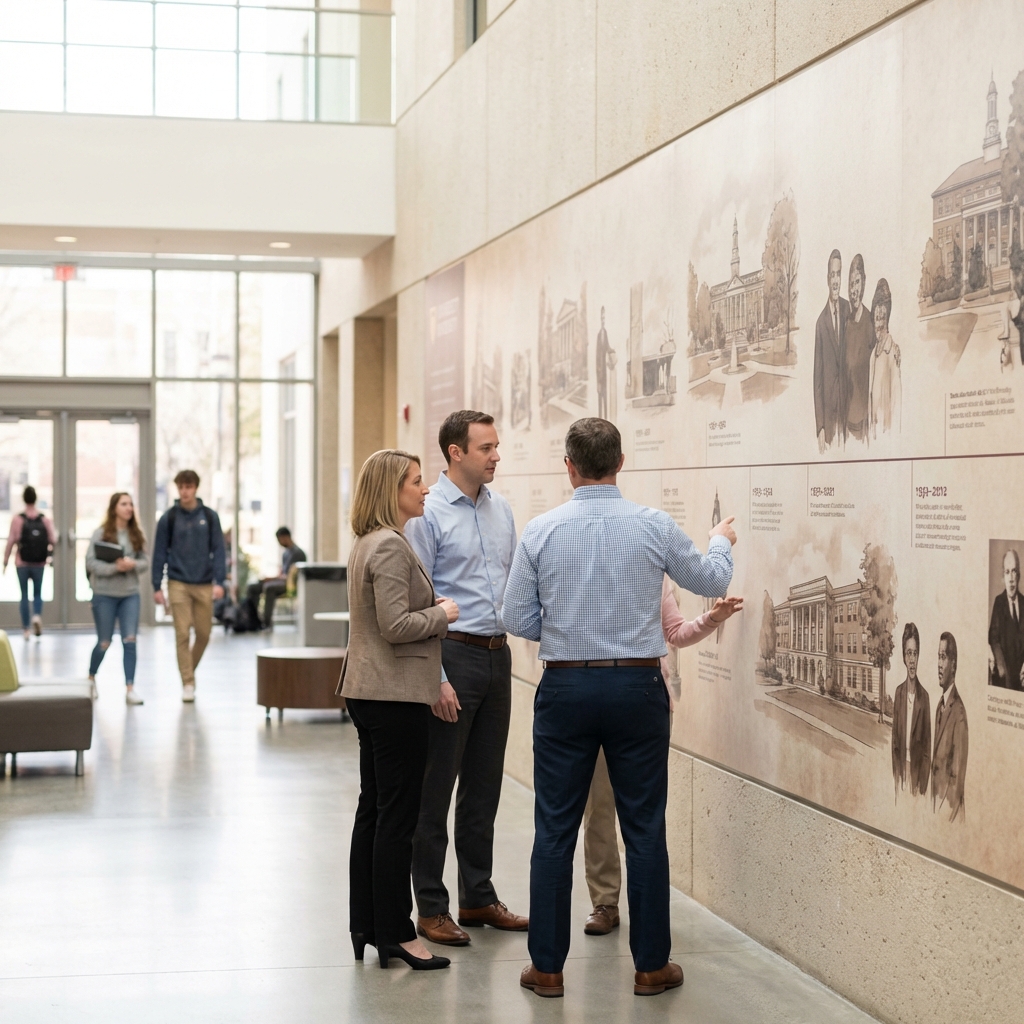
Design approaches that combine identity and guidance:
- Zone-coded color fields paired with department names, pictograms, and floor numbers
- Feature walls at key decision points (elevators, stair cores, crossroads) with bold arrows or directional stacks
- Distributed “breadcrumbs”—small, repeating markers that confirm users are on the right path
- Layered information hierarchy: building identity at large scale; secondary departments; tertiary room clusters
Content types that perform well at campus scale:
- Academic timelines in humanities buildings, tying program identity to place
- Large-format research imagery in STEM corridors with concise captions
- Mascot and athletics iconography in training centers with season schedules
- Health and wellness themes in clinics that reduce stress and improve clarity
- Museum-quality reproductions and curatorial narratives in cultural institutions
EastCoast MuralPros often partners with campus designers and digital artists to scale original work to architectural dimensions without loss of fidelity. File preparation includes resolution assessment, color management, and content legibility checks at target viewing distances. For wayfinding, contrast and type size are validated at real-world distances, helping ensure that school interior signage guidelines translate to the wall—especially important at intersections with multiple competing messages.
Because the medium is both photoreal and continuous, imagery can wrap corners, climb stair towers, and anchor multi-story atriums without visible joins. The effect is a building that communicates identity and orientation in a single, cohesive gesture.
Fast Installation Without Disrupting Campus Operations
Campus operations run on tight schedules with limited tolerance for construction. Direct-to-wall installations are designed to minimize disruption so classes, clinics, events, and move-ins can proceed uninterrupted. Most walls are completed in under five hours, and multi-wall zones can be sequenced overnight, over weekends, or during breaks—without closing entire buildings.
What fast, low-disruption installation looks like:
- Compact equipment and minimal staging that fit standard corridors and elevators
- Quiet operation suitable for occupied spaces, coordinated around class changes or visiting hours
- On-site printing that prevents delays tied to shipping, panel fabrication, or field-applied adhesives
- Protective floor coverings, safe cord routing, and temporary partitions where needed
Typical schedule for a 10-wall academic building:
- Pre-install survey and test patch to validate adhesion and color on actual surfaces.
- Final file approvals with dimension-accurate mockups for all elevations.
- Night-shift mobilization and staged sequencing by floor or wing.
- Print passes, cure intervals, and spot protection where adjacent work continues.
- Punch list and turnover, with cleaning guidance included for facilities teams.
For multi-phase campus programs, EastCoast MuralPros can align with semester breaks or summer windows, but the speed of the process often makes it feasible to implement during normal operations. A subscription-based refresh program also lets brand and facilities teams schedule seasonal or strategic updates without rebooting procurement each time—ideal for rolling campaigns, athletics seasons, or orientation cycles that need consistent visual quality with predictable labor and material profiles.
Durable, Cleanable Surfaces for High-Traffic Environments
Schools, hospitals, and public-sector buildings demand surfaces that stand up to thousands of daily touches and frequent cleaning. Direct-to-wall graphics are built for these conditions. Because there’s no edge or overlapping seam to catch or peel, the finished surface behaves like a continuous architectural finish. It’s designed to be wiped with standard, non-abrasive cleaners used by custodial teams, supporting infection-control protocols in clinical settings and day-to-day upkeep in academic buildings.
Durability advantages for institutional wall graphics:
- No adhesive film to delaminate under heat, humidity, or abrasion
- High-resolution imagery that resists scuffing in corridors and entries
- A low-profile, integrated finish that reduces snag points along busy paths
- Cleanable surfaces that maintain legibility and color over frequent wipe-downs
Practical maintenance guidance for facilities teams:
- Use soft cloths or sponges with neutral, non-abrasive cleaners
- Avoid scouring pads and solvent-based agents that could mar finishes
- Address new marks promptly to prevent residue from setting
- For long-term refresh cycles, take advantage of the paint-over-ready finish
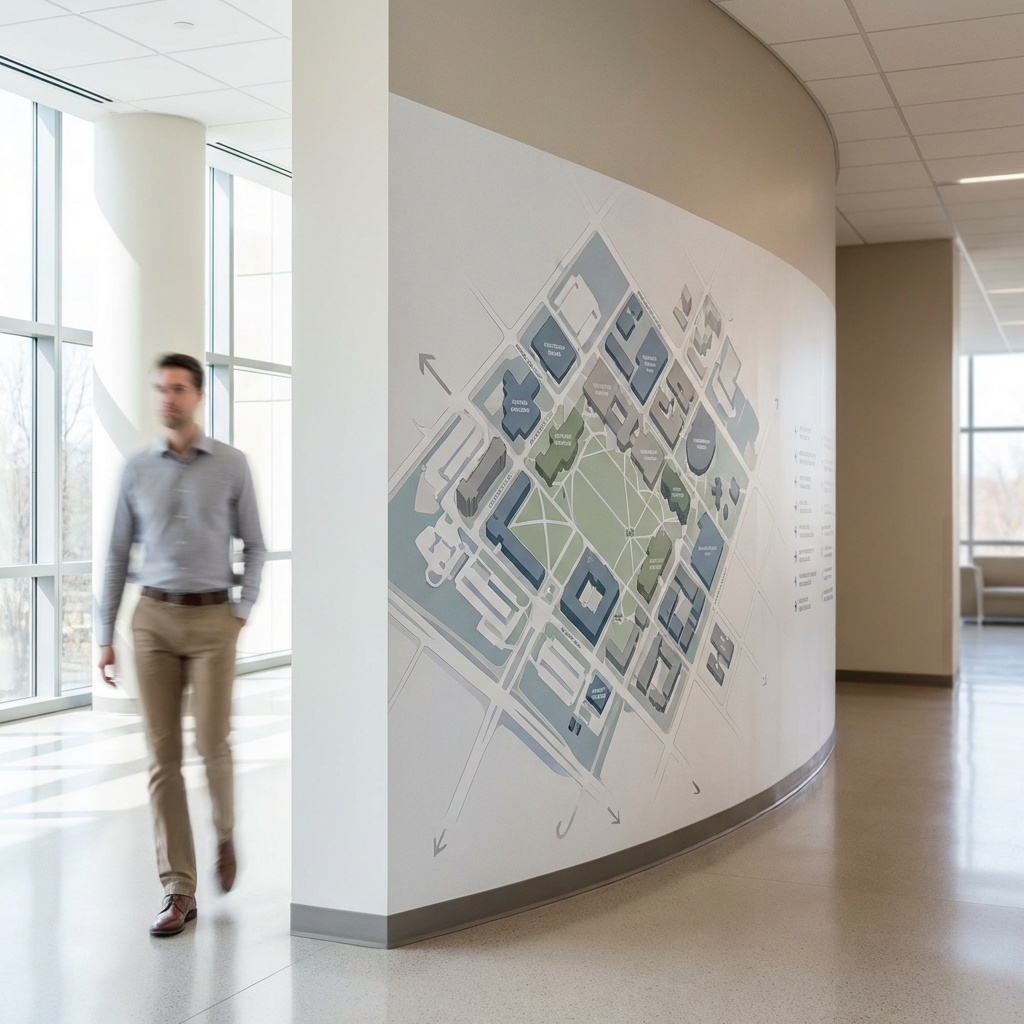
The paint-over-ready benefit matters during departmental moves, tenant turnovers, or program updates. Instead of stripping vinyl and remediating adhesive residue, teams can apply a new topcoat and reprint the next graphic system, shortening the timeline and reducing labor. This lowers lifecycle costs and makes it more feasible to keep institutional brand communication current across buildings and cohorts.
Typical high-traffic applications include dining halls and student unions, K–12 corridors with rolling backpacks and equipment carts, athletics and recreation centers, hospital waiting areas and elevator lobbies, and public-sector service counters. In each case, the balance of durability, cleanability, and aesthetics helps keep spaces professional without constant patching.
Scalable Solutions Across Multi-Building and Multi-Campus Networks
The most challenging aspect of campus wall branding solutions isn’t the first building—it’s the tenth, the twentieth, and the out-of-state satellite that needs the same standards. Scalability requires consistent print output, disciplined file management, and a rollout methodology that survives staff turnover and calendar churn.
Program elements that enable scale:
- Centralized brand asset libraries with approved color profiles, typography, and iconography
- Wall schedules tied to room numbers and building codes, with annotated elevations
- File naming conventions that include location metadata and version control
- Survey templates and standardized measurement protocols for repeatable site conditions
- Proofing procedures, including distance legibility checks and mockups per location
Execution methods for multi-location campus graphics:
- Calibrated equipment and color-managed workflows for consistent output across phases
- Dedicated project management with shared dashboards, so stakeholders see status at a glance
- Sequenced mobilizations by zone, building, or campus to fit operational windows
- “Change packs” that allow regional or building-specific content variations without breaking the system
- Punch-list audits and photo documentation to verify compliance and inform future work
EastCoast MuralPros focuses on predictable throughput for national and multi-campus programs. Teams are trained to execute to the same standard across different buildings—whether CMU basements, painted drywall in new academic towers, or sealed concrete in athletics facilities. The on-site model also reduces errors introduced by panel fabrication or shipping, shrinking rework and shortening critical paths.
Institutions benefit when brand governance travels with the production method. A biannual or annual refresh cycle, managed under a subscription, can keep student-facing areas timely (admissions stories, research milestones, championship banners) while maintaining absolute consistency in quality and legibility from campus to campus.
Integrated Wayfinding and Safety Graphics Without Signage Clutter
Hanging and standing signs proliferate over time, obscuring each other, complicating cleaning, and creating visual noise. Educational wayfinding systems anchored to the walls solve for this by integrating directional information, safety reminders, and instructional content into the architecture. You get the clarity of a comprehensive plan without the clutter of bolt-on plates and banner stands.
Design and planning principles that work on campus:
- Decision-point emphasis: enlarge guidance at intersections, elevators, and stair portals
- Line-of-sight mapping: place high-contrast arrows or icons where users look naturally
- Color-coded zones and wings: reinforce departmental identities across floors and buildings
- Pictograms and minimal text: increase cross-language understanding and reduce reading time
- Repetition cadence: confirm direction with smaller markers every 30–60 feet in long corridors
Safety and instructional integrations:
- Printed “You Are Here” maps at floor hubs with simple, color-coded routes
- Stair/elevator identity walls that distinguish egress paths quickly in an emergency
- Laboratory process reminders and PPE zones printed near entries, reducing separate placards
- Clinic check-in, triage, and queue guidance at eye level, avoiding countertop paper clutter
- K–12 behavior expectations, cafeteria traffic flows, and bus loop reminders that students can absorb at a glance
Printed wall systems are not a replacement for code-required signage, tactile elements, or life-safety devices. They complement those tools by reducing the volume of ancillary plates and posters that accumulate on top of regulatory requirements. Facilities teams appreciate the reduction in fastener penetrations and adhesives on painted surfaces, which improves wall longevity and cleaning efficiency in hospitals and high-traffic schools.
The design flexibility of direct-to-wall printing also allows seasonal or event-driven overlays without reworking the core system. Admissions season, homecoming, or accreditation visits can be supported by temporary content that later transitions to permanent messaging—an approach that keeps wayfinding clean while giving brand and experience teams room to maneuver.
Sustainable Alternatives to Vinyl and Wallpaper
Sustainability goals in higher education and healthcare increasingly shape procurement and design decisions. Compared with vinyl and traditional wallpaper, direct-to-wall printing significantly reduces material waste and replacement cycles, making it a strong fit for institutions seeking measurable improvements without sacrificing aesthetics or performance.
Where the environmental advantages come from:
- No PVC film or broad-area adhesives, reducing plastic content and chemical waste
- Fewer shipments and less packaging, since printing occurs at the wall rather than in a factory
- Minimal offcuts and scrap, avoiding the landfill burden of trimmed panels and removed vinyl
- Longer service life and paint-over-ready changeouts, lowering the churn of removal and replacement
Lifecycle efficiency directly benefits budgets and sustainability metrics. Vinyl often fails at seams and edges first, prompting full replacement even when most of the surface remains sound. A printed wall avoids those failure points, and when the messaging changes, a repaint and reprint generally suffice—faster, cleaner, and with far less waste. For procurement teams comparing options, this performance profile supports total cost of ownership analyses that go beyond initial unit price.
If your stakeholders are debating adhesives and PVC impacts, this breakdown of direct-to-wall vs vinyl offers a clear view of environmental and operational trade-offs.
Additional sustainability factors relevant to campuses:
- Eliminating solvent-based adhesive removers during changeouts
- Reducing labor and ladders associated with multi-panel alignments and repairs
- Standardizing visual systems so updates target only the content that changes
- Lowering crate and pallet waste tied to factory-fabricated substrates
For institutions reporting on environmental performance, these improvements are practical to document: fewer shipments, lower material volumes, and reduced staff hours spent on removal and reinstallation. The net effect is a cleaner, more resilient interior brand system that aligns with campus sustainability commitments while elevating the user experience.
—
Direct-to-wall printing has matured into a reliable, campus-scale method for brand communication, wayfinding, and environmental storytelling. It delivers seamless visuals that look built in, installs quickly in occupied buildings, stands up to daily wear, and scales across networks of schools and facilities. For teams evaluating institutional wall graphics as part of broader university branding strategies, it provides the rare combination of design freedom, operational efficiency, and lifecycle value.
EastCoast MuralPros serves commercial landlords, corporate campuses, healthcare systems, higher education, K–12 districts, museums, and public-sector owners who want to move beyond vinyl and wallpaper. Whether you’re refreshing a single building, planning a multi-campus rollout, or piloting educational wayfinding systems that could scale, the approach outlined here can help you deliver consistent outcomes on schedule and within budget.
To explore how these campus wall branding solutions map to your facilities, brand standards, and operational windows, visit eastcoastmuralpros.com.
Contact us to learn more