Table of Contents
- Why Specification Matters for Commercial Wall Graphics
- The Problem With Traditional Vinyl and Wallpaper Specs
- Our Direct-to-Wall Printing Specification Framework
- Resolution, Color Depth, and Image Quality Standards
- Surface Compatibility and Substrate Requirements
- Installation Timeline and Disruption Specifications
- Durability and Maintenance Performance Metrics
- Scalability Across Multi-Location Rollouts
- Cost and Lifecycle Efficiency Comparisons
- Working With Your Architects and Designers
- Implementation Process From Specification to Installation
- Frequently Asked Questions (FAQ)
Why Specification Matters for Commercial Wall Graphics
Clear specifications aren’t optional in commercial and institutional projects—they’re the foundation of successful installation and long-term performance. When you specify wall graphics the right way, you reduce surprises, protect your budget, and ensure the final result matches your vision at architectural scale.
We’ve worked with facilities teams, architects, and procurement departments across hospitals, universities, retail chains, and corporate offices. The projects that run smoothly share one thing in common: detailed, honest specs from the start. Without them, you risk mismatched expectations around durability, color accuracy, installation disruption, and cost.
Our direct-to-wall printing technology offers performance guarantees that traditional solutions simply can’t match. That reliability only works, however, when both sides understand exactly what we’re specifying, why, and how it will perform in your specific environment. This guide walks you through our specification framework so you can evaluate, procure, and deploy wall graphics with confidence.
The Problem With Traditional Vinyl and Wallpaper Specs
Vinyl wall coverings and wallpaper have been the default for decades, which means most specification templates and procurement habits were built around them. We see the frustration this creates.
Traditional vinyl specs typically promise durability but often gloss over real-world failure modes. Vinyl wraps peel at seams after 18 to 24 months. Wallpaper bubbles in high-humidity environments like hospitals and bathrooms. Both require adhesives that off-gas, age, and lose grip over time. Seams become visible, especially under raking light or at corners. Color fades unevenly. Replacement is messy, expensive, and disruptive.
Wallpaper also generates significant waste: old material must be stripped, adhesive residue cleaned, and the wall prepared—a process that can take weeks across a large facility. Vinyl requires specialized removal equipment and produces non-recyclable scrap.
Here’s what we’ve learned: organizations often accept these limitations because they’ve never had a genuinely better option. Specification language for vinyl assumes adhesive-based installation, temporary lifespan, and eventual replacement. That mindset limits what you can ask for and what vendors can promise.
Our direct-to-wall approach requires a different specification framework—one that reflects our actual capabilities: no adhesives, seam-free integration, architectural durability, and rapid installation. If you spec us using traditional vinyl language, you’ll miss what makes this technology valuable.
Our Direct-to-Wall Printing Specification Framework
We print directly onto your wall surface using industrial-grade inkjet technology, then seal the image with a protective topcoat. No vinyl, no adhesive, no panels. The result is a permanent graphic that becomes part of the wall itself.
Our specification framework covers five core areas:
Design and File Requirements We need high-resolution digital files (minimum 300 DPI at final scale) in CMYK color space. We provide a high-res file prep guide to walk your designers through format, color profiles, and file organization. Specifications should call for files delivered 4 weeks before installation to allow time for proofing and substrate preparation.
Substrate Preparation We print on finished drywall, CMU (concrete masonry units), concrete, and brick. Your spec must identify the substrate type, surface condition (smooth, textured, painted), and any existing finishes. We assess walls on-site and prep surfaces to ensure optimal ink adhesion and color consistency.
Installation and Access Specify the wall dimensions, orientation, and proximity to occupied areas or equipment. We install during hours that minimize business disruption—typically 4 to 8 hours per 1,000 square feet. Your spec should guarantee access, climate control, and a clear wall zone (no obstacles within 6 feet).
Performance and Durability This is where direct-to-wall differs sharply from vinyl. Specify expected lifespan, cleanability requirements, and traffic patterns. Our murals resist fading, scratching, and moisture in ways vinyl cannot. Specifications should reflect these advantages.
Warranty and Maintenance Outline what we guarantee and what falls within normal maintenance (routine cleaning, touch-up paint, etc.). Specifications should clarify roles so there’s no confusion later.
Each of these sections feeds into cost, timeline, and risk assessment.
Resolution, Color Depth, and Image Quality Standards
We deliver photoreal, high-resolution imagery at architectural scale. That’s only possible with precise specification of image quality requirements upfront.
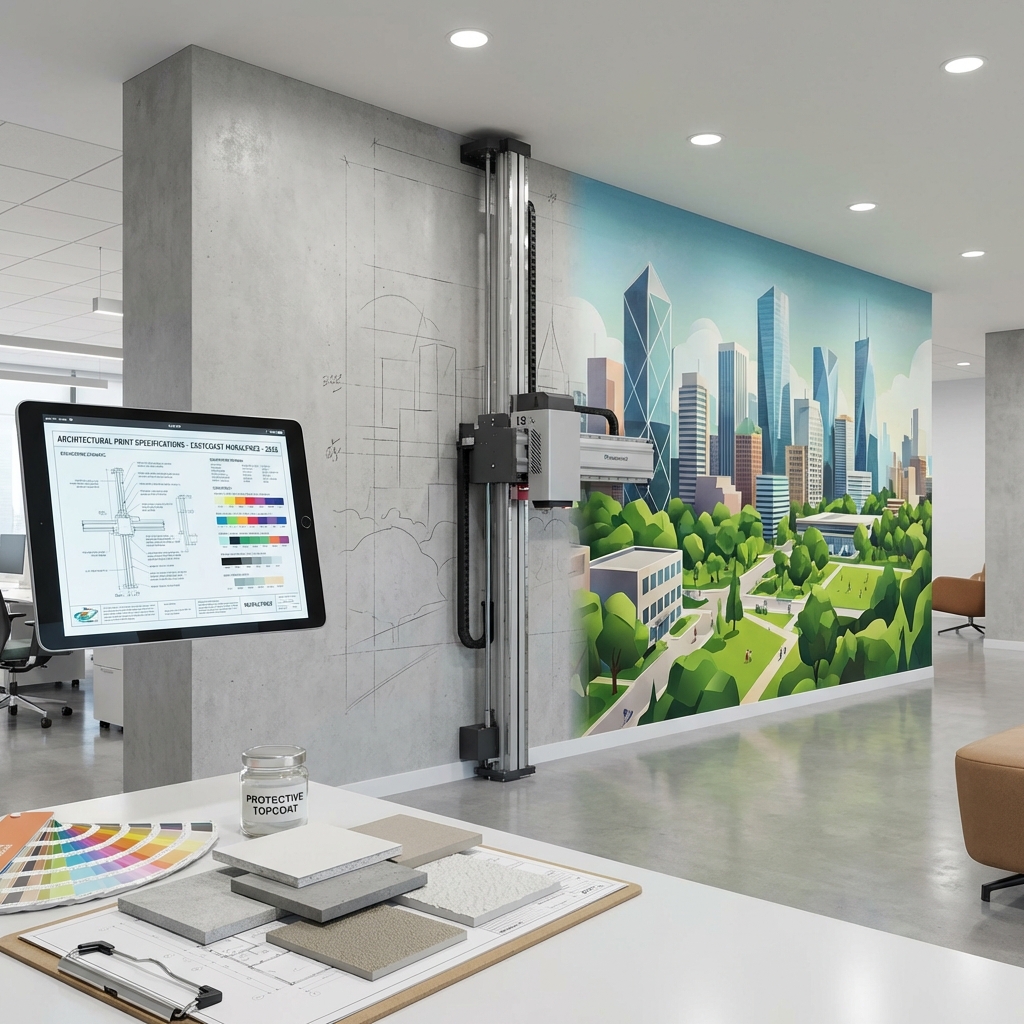
Resolution Specification We print at 300 DPI (dots per inch) at final installed size. This means a 20-foot-wide mural requires files sized at approximately 7,200 pixels wide. We work backward from your wall dimensions to specify the file resolution your designer or photographer must provide. Anything less than 300 DPI at final scale will show visible pixelation.
Color Management We use CMYK color separation and ICC color profiles calibrated to your facility’s lighting conditions. Specify whether your mural will be viewed primarily in daylight, artificial light, or mixed conditions. This affects how we profile and proof the image. We deliver physical color samples on actual substrate material so you can approve the color rendering before final installation.
Proofing and Approval Specify a formal proof phase: we print a 2-foot by 3-foot sample on matching substrate, deliver it to your facility, and give you 48 hours to approve color, detail, and overall appearance. This prevents surprises and ensures the final mural matches your expectations. No changes after approval without cost adjustment.
Image Complexity Complex photographic or fine-art images require longer proofing timelines and more precise color management. Simpler graphics (solid colors, large text, bold shapes) install faster and require less technical scrutiny. Your specification should match timeline to complexity.
We’ve found that organizations that invest in proper proofing—and specify it upfront—report higher satisfaction and zero rework.
Surface Compatibility and Substrate Requirements
Direct-to-wall printing works on most interior surfaces, but each substrate requires different preparation and delivers slightly different visual results.
Drywall Smooth, primed drywall is ideal. We print directly onto primer or existing paint if it’s clean and smooth. Textured drywall (popcorn, knockdown, orange peel) reduces sharpness and may require light sanding. Specification: “smooth painted drywall, primed with white primer, free of texture and patching tape debris.”
CMU and Concrete These porous surfaces require a specialized sealer before printing to ensure even ink absorption and color consistency. Sealing adds 24 hours to the timeline and a small cost premium. Specification should call for “sealed CMU” or “sealed concrete” and account for extra prep time.
Brick High-porosity brick absorbs ink unevenly, creating a mottled appearance. It’s suitable for abstract or textured designs but not photorealistic imagery. If you want crisp detail on brick, we recommend a smooth primer or finish coat first.
Existing Paint and Finishes We can print over existing paint if it’s clean and adhered. Glossy finishes may require light dulling. Peeling or damaged paint must be removed and repaired. Specify “clean, adhered, matte finish” to ensure compatibility.
Environmental Factors Humidity, temperature fluctuation, and vapor barriers affect ink adhesion and curing. We specify installation in 50-85% relative humidity and 60-85 degrees Fahrenheit. Cold, damp basements or uncontrolled storage areas require climate management or extended cure time. Your specification should account for these conditions.
Always request an on-site substrate assessment before finalizing specs. We conduct these at no charge and deliver a detailed report on surface condition, prep requirements, and any cost or timeline adjustments.
Installation Timeline and Disruption Specifications
Speed and low disruption are core value propositions of our technology. Specification should protect both.
Typical Installation Timeline We print and install at 800-1,200 square feet per 8-hour day, depending on wall complexity, substrate prep required, and site conditions. A 2,000-square-foot mural in a single-wall environment typically installs in one or two days. Multi-wall, multi-floor projects may span several weeks but can be staggered to minimize daily disruption.
On-Site Preparation We arrive 2-3 hours before printing to assess climate, verify substrate condition, and set up equipment. Specification should guarantee clear wall access, functioning climate control, and power supply within 50 feet of the installation zone.
Curing and Reoccupancy Our ink cure-time is 4-6 hours under controlled conditions. The wall is safe to touch after curing but reaches full hardness after 72 hours. Specify “no contact with graphic for 6 hours post-installation; full occupancy permitted after 24 hours.” This allows evening installation in occupied buildings without shutting down daytime operations.
Installation Windows Specify installation hours that align with your operational schedule. Healthcare and retail facilities often prefer evenings or weekends. Corporate offices may allow daytime work if disruption is minimal. We’re flexible with scheduling and can adapt to your constraints.
Contingencies Specify a weather and climate contingency (we can’t print in conditions outside our range) and a substrate repair buffer (if prep work exceeds estimates, we may need an extra day). These prevent timeline surprises.
Durability and Maintenance Performance Metrics
Our murals outperform vinyl and wallpaper on durability, and your specification should reflect what that means operationally.
Scratch and Scuff Resistance Our protective topcoat resists light scratching and scuffing common in high-traffic areas like corridors, lobbies, and educational spaces. Specification: “resistant to light mechanical damage; suitable for environments with frequent contact or wheeled traffic.”
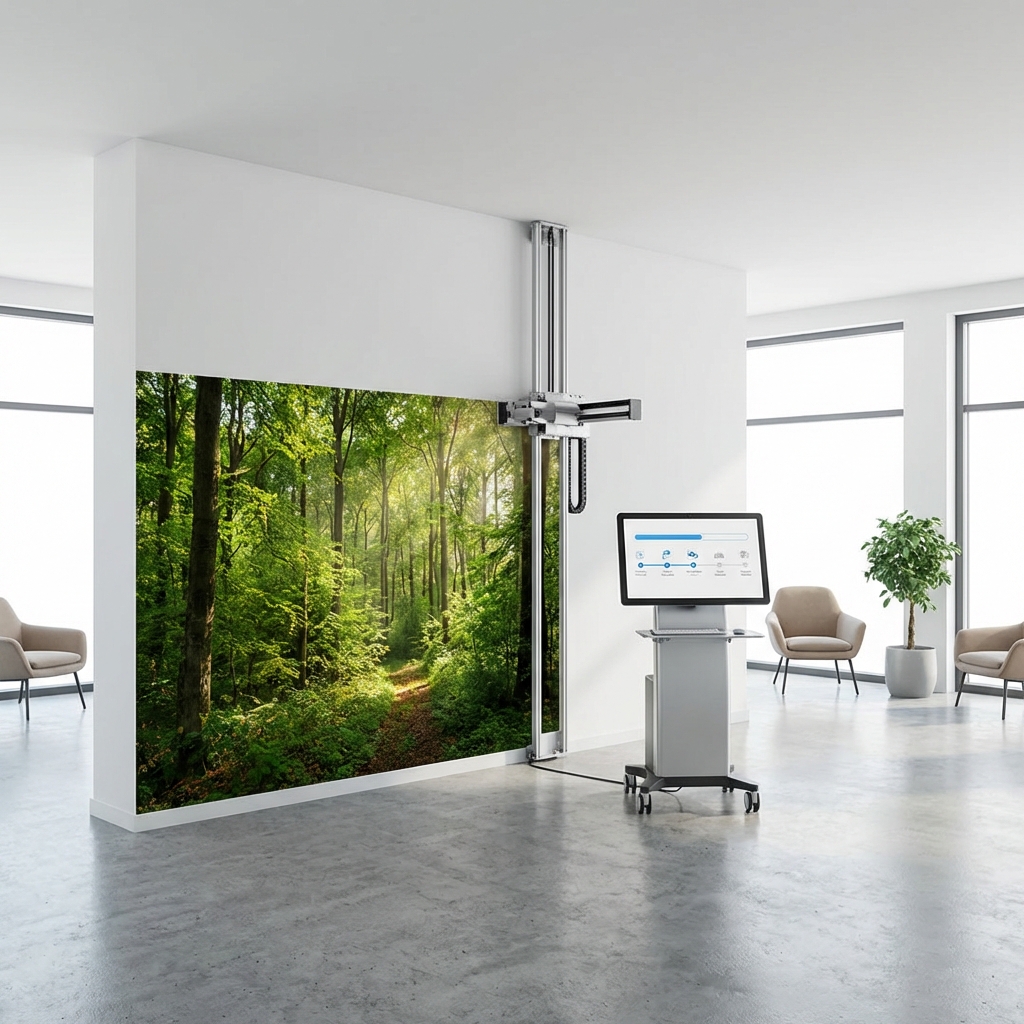
Stain and Moisture Resistance Unlike wallpaper, our murals resist water, disinfectants, and common cleaning agents. We specify them for bathrooms, kitchens, patient care areas, and medical facilities where regular cleaning is mandatory. Specification: “cleanable with standard commercial disinfectants and water; suitable for high-moisture environments.”
Fade Resistance Our inks and topcoat resist fading under UV light and fluorescent lighting. We guarantee color consistency for a specified number of years (typically 7-10 in high-light environments, longer in interior spaces). Specification should call out the expected lifespan and any maintenance actions (lighting adjustments, protective window film) that extend performance.
Warranty Language We warranty our work against manufacturing defects, ink adhesion failure, and color separation for 5 years in typical commercial conditions, 3 years in high-moisture areas. Your specification should reference our warranty terms and clarify what falls outside (damage from alteration, vandalism, or aggressive cleaning methods).
Maintenance Requirements Routine care is simple: dry dusting, warm water and mild soap, or standard commercial disinfectant on a soft cloth. Abrasive pads, solvents, and high-pressure washing void the warranty. Your specification should include a maintenance guide so facility staff know how to care for the mural long-term.
Scalability Across Multi-Location Rollouts
Many of our clients operate multiple locations and need consistency across buildings, regions, or entire national footprints. Our specification framework ensures that consistency without surprises.
Design and Asset Management We maintain your design files in our system and deliver consistent color proofing across all locations. Specification should require “approved master design files stored at EastCoast MuralPros; all installations subject to master color proof; no site-specific deviations without written approval.”
Substrate Variability Different locations often have different wall conditions. We conduct substrate assessments at each location before installation and flag any significant deviations (texture, existing finish, dampness) that might affect color or timeline. Specification should allow for “site-specific prep requirements documented during pre-installation assessment; cost and timeline adjustments communicated in writing.”
Installation Sequencing We schedule locations in logical geographic or operational clusters to optimize travel, coordinate crews, and maintain momentum. Specification should include a rollout schedule and contact protocol (weekly updates, site photos, completion reports).
Quality Control We photograph each installation and deliver documented proof of completion. Specification: “photographic documentation of each installation site prior to final invoice; color proof visible in photographs.”
Training and Handoff We provide on-site training to facility staff on maintenance, minor touch-up procedures, and care protocols. Specification should require “training delivery to designated facility staff within 48 hours of installation completion.”
Multi-location rollouts we’ve managed have reduced average timeline per site by 30% compared to single-site projects, thanks to standardized processes and experience-driven efficiencies.
Cost and Lifecycle Efficiency Comparisons
Direct-to-wall printing often costs less over time than vinyl or wallpaper, but the comparison requires honest accounting of all expenses.
Installation Cost Our pricing is typically $8-$18 per square foot installed, depending on wall complexity, substrate prep, and design detail. Vinyl wraps run $6-$15 per square foot; hand-painted murals run $20-$50 per square foot. Direct comparison suggests vinyl is cheaper upfront, but that ignores what happens next.
Lifecycle Cost Here’s where direct-to-wall wins. Vinyl requires replacement every 18-24 months due to peeling, fading, and seam failure. That means buying new material, removing old vinyl, and reinstalling—a total cost of $6,000-$12,000 per 1,000 square feet every two years. Wallpaper requires stripping, wall prep, and reinstallation on a similar timeline.
Our murals last 7-10 years in typical commercial conditions with no replacement or major maintenance. Over a decade, a 2,000-square-foot mural breaks down to approximately $20,000 initial investment plus minimal maintenance versus $60,000-$120,000 in cumulative vinyl replacement costs.
Operational Disruption Costs Removal and replacement of vinyl requires facility closure or substantial rework cycles. We calculate the operational cost (lost productivity, customer inconvenience, extended timeline) at $500-$2,000 per day for most commercial facilities. Direct-to-wall eliminates these cycles entirely.
Sustainability and Waste Vinyl and wallpaper removal generates significant landfill waste. Our process generates zero graphic waste and uses non-toxic, low-VOC inks and sealers. If your organization has sustainability targets, direct-to-wall delivers measurable environmental benefit.
Cost Specification Your RFP should request detailed lifecycle cost analysis from all vendors, not just unit pricing. Request a 10-year total cost of ownership (TCO) breakdown that includes replacement, maintenance, and operational disruption. You’ll often find direct-to-wall significantly ahead.
Working With Your Architects and Designers
Architects and interior designers often default to vinyl or wallpaper specifications because that’s what they know. We’ve found that including us early—at the design stage, not just during RFP—leads to better outcomes and faster approval.
Design Collaboration We work with your design team to develop specifications that reflect what our technology can deliver. If your architect envisions a photorealistic mural with crisp detail and seamless transitions across corners, we confirm that’s achievable and specify it precisely. If they’re uncertain whether direct-to-wall is the right approach, we conduct a site assessment and deliver a technical recommendation.
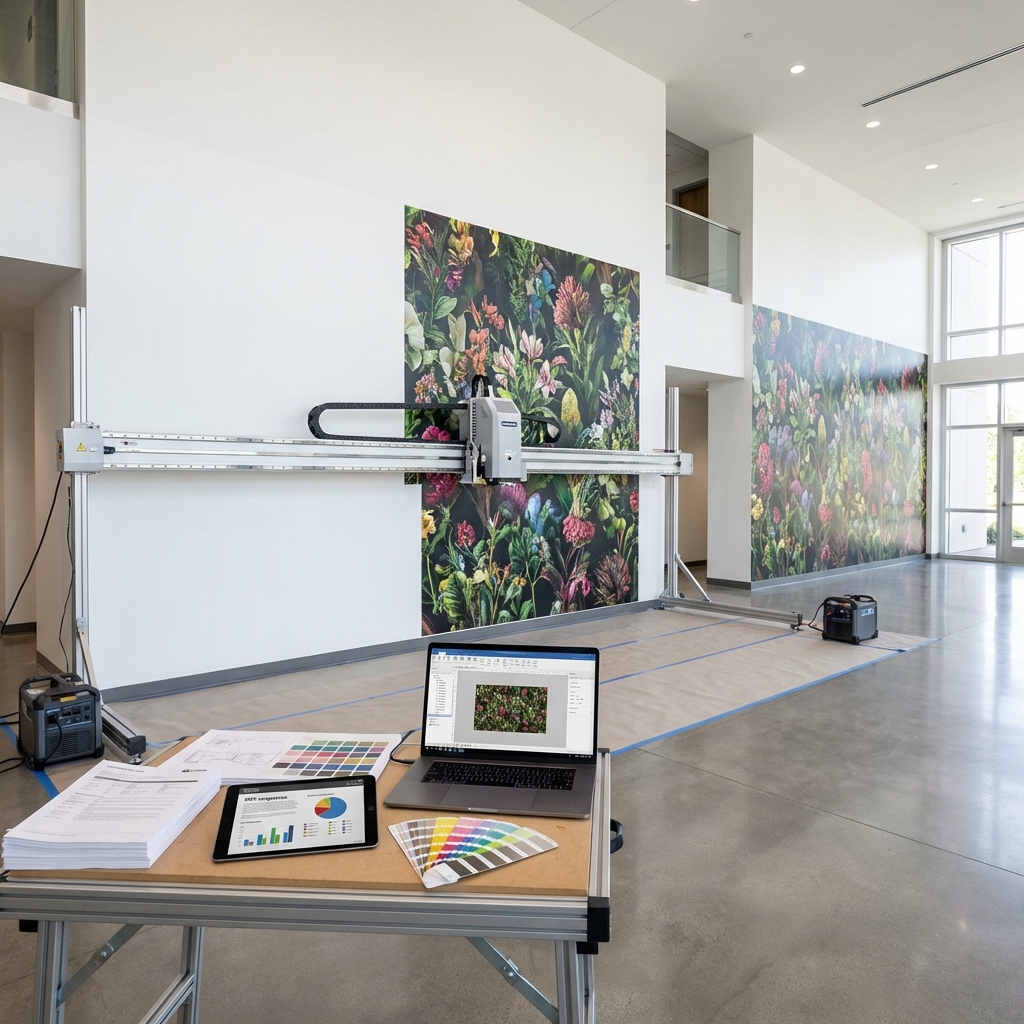
Substrate and Preparation Planning Architects should specify substrate type and condition as part of the overall construction or renovation plan. If a wall is going to be freshly drywalled or finished, we coordinate with the general contractor to ensure it meets our substrate standards. If existing surfaces will be reused, we assess them early and flag prep requirements.
Specification Language We provide RFP specs for wall printing that architects can adapt for their projects. These specs are written in language procurement departments and contractors understand, covering performance, materials, installation, and warranty in detail.
Color and Quality Review We participate in design review meetings and provide sample proofs as part of the approval process. This ensures there’s no disconnect between what the architect envisions and what we deliver.
Organizations that treat us as collaborative partners—not just vendors—consistently report higher satisfaction and fewer change orders.
Implementation Process From Specification to Installation
Here’s how we take a specification from approval to a completed mural.
1. Specification Development and RFP Response You provide detailed specifications (informed by this guide or our templates). We review, provide cost and timeline estimates, and answer technical questions. This phase takes 2-4 weeks depending on project complexity.
2. Substrate Assessment Once selected, we conduct an on-site visit to assess wall condition, identify prep requirements, verify dimensions, and document existing finishes. We deliver a formal assessment report with photos and any recommended adjustments to cost or timeline.
3. Design Finalization and File Preparation Your designer delivers final files in CMYK format at the correct resolution. We review and provide technical feedback. We deliver color proofs (digital and physical samples if needed) for your approval. Approval is required before we proceed.
4. Substrate Preparation If prep is needed (patching, sealing, priming, sanding), we schedule and complete it ahead of the print date. We document all prep work with photos.
5. Printing and Installation We arrive on the scheduled date, set up equipment, verify climate conditions, and print the mural directly onto the wall. Installation is completed in a single session (typically 4-8 hours for most projects). We allow 4-6 hours for curing before we leave the site.
6. Quality Verification and Handoff We photograph the completed mural, document any special care instructions, and provide on-site training to facility staff if needed. We deliver a completion report and warranty documentation.
7. Follow-Up and Support We remain available for questions, touch-up guidance, or maintenance support throughout the warranty period.
The entire process from specification to completion typically spans 12-16 weeks for a standard project. We move faster for simple designs and shorter lead times when needed.
Your next step is clear: reach out with your wall dimensions, design concept, and timeline. We’ll conduct a free assessment and recommend the right specification framework for your project. Precision upfront prevents problems later, and we’re here to ensure every detail is right.
Contact us to learn more
Frequently Asked Questions (FAQ)
What surfaces can we print directly onto, and do we need special preparation?
We can print on drywall, CMU, concrete, brick, and most finished or unfinished walls without requiring adhesives or primers. Surfaces should be clean and reasonably flat, but we don’t need expensive substrate prep or blocking out existing finishes. Our installation team assesses each wall on-site and handles any minor conditioning needed, so you avoid costly pre-work or construction delays.
How do your specifications compare to vinyl wraps and wallpaper in terms of durability and maintenance?
Our direct-to-wall printing creates a cleanable, durable surface designed for high-traffic environments that significantly outlasts vinyl and wallpaper without peeling, bubbling, or fading. We specify performance metrics for washability, scuff resistance, and color stability so you understand exactly what to expect over the lifecycle. Because we eliminate adhesives and seams, we reduce replacement cycles and maintenance costs compared to traditional wall coverings.
Can we install your murals across multiple locations while ensuring consistent quality?
We deliver consistent execution across multi-location and national rollouts by controlling the entire process on-site—from digital files to final print. Our on-site printing eliminates shipping delays and fabrication errors that plague off-site vendors, and we work with your architects and designers to lock specifications before installation begins. This approach gives you reliable, repeatable results whether you’re updating five walls or fifty locations.