Introduction: Why Campus-Wide Branding Demands Speed, Durability, and Consistency
Higher education and healthcare environments move on tight schedules and even tighter margins for disruption. From semester turnovers to phased hospital renovations, facilities leaders often need campus-wide branding solutions that install quickly, look consistent across many buildings, and stand up to daily wear. At the same time, procurement and operations teams are under pressure to find performance-based alternatives to vinyl wall coverings, wallpaper, and other methods that have proven costly to maintain at scale.
Campus audiences are also diverse and nonstop. Students, faculty, clinicians, patients, and visitors interact with interiors every minute of the day. That means institutional wall graphics must reinforce brand identity while serving practical goals: wayfinding clarity, safety communication, and environmental cues that reduce friction in busy corridors and shared spaces. Photographic quality, architectural integration, and the ability to refresh without construction are now table stakes.
This article outlines how to evaluate and implement scalable institutional branding across multi-building or multi-location portfolios. It explains why direct-to-wall printing technology—offered by partners like EastCoast MuralPros—has emerged as a campus-scale alternative to vinyl and wallpaper, and how its speed, consistency, and lifecycle efficiency can unlock better outcomes for universities, hospital systems, and public institutions.
Key Criteria for Evaluating Campus Branding Solutions
Selecting a campus-wide solution means thinking beyond a single feature wall. You need consistent results across buildings, substrates, and program types—without slowing operations. Use these criteria to structure your evaluation:
- Installation speed and disruption: How quickly can work be completed in occupied buildings? Can teams install overnight or in narrow weekend windows? Is clean-up minimal?
- Durability and cleanability: Will graphics tolerate high-traffic contact, rolling equipment, and routine cleaning? Do seams and edges risk premature failure?
- Substrate compatibility: Can the solution handle finished and unfinished surfaces—drywall, CMU, concrete, or brick—without extensive skim coating or panel systems?
- Visual quality at scale: Are graphics crisp at architectural dimensions? Can photoreal art, fine typography, and complex gradients maintain fidelity?
- Consistency across locations: How does the provider manage color, finishes, and quality control across multiple buildings—or a national portfolio?
- Lifecycle and refresh strategy: What is the realistic service life in your environment? Can you paint over when it’s time to rebrand? Are subscription refreshes available for seasonal or program changes?
- Wayfinding and compliance integration: Can safety, instructional, and directional graphics be embedded into walls to reduce signage clutter while maintaining legibility and policy alignment?
- Cost transparency and total cost of ownership: How do installation labor, disruption to operations, maintenance, and replacement cycles affect true lifecycle cost?
- Scheduling and logistics: Does on-site printing eliminate shipping delays and fabrication errors? Can the approach adapt to rolling occupancy and phased construction?
- Sustainability: What waste streams are created at install and removal? Are adhesives or PVC involved? What is the environmental impact versus vinyl or wallpaper?
- Vendor capability and governance: Does your partner understand facilities constraints, procurement workflows, pilot-to-scale transitions, and national rollout governance?
Institutions that assess against this full list make more resilient choices and reduce program risk before work starts.
Direct-to-Wall Printing Technology as a Campus-Scale Alternative
Direct-to-wall printing brings large-format, high-resolution imagery directly onto finished or unfinished wall surfaces—no vinyl, adhesives, or panels. Specialized printers move along the wall, imaging photoreal graphics with crisp detail at architectural scale. Because output is applied on-site, the process avoids shipping delays, fabrication misfits, and the seam issues common with vinyl or wallpaper.
Key advantages that make direct-to-wall printing fit for campus-scale deployments include:
- Seam-free results: Graphics read as integrated architecture rather than a surface application, improving visual quality and longevity.
- Broad substrate compatibility: Drywall, CMU, concrete, and brick can be printed directly with appropriate prep, minimizing the need for re-skins.
- Speed: Installations typically complete in under five hours per area, enabling overnight and weekend work with minimal disruption to operations.
- Durability and cleanability: Surfaces are designed to be cleaned in high-traffic environments where carts, backpacks, and gurneys are daily realities.
- Paint-over-ready finish: When a program, tenant, or brand strategy changes, spaces can be repainted rather than stripped and re-skinned—cutting downtime and waste.
- Consistency at scale: Digital workflows and calibrated machines help maintain color and finish fidelity across multi-building or multi-location rollouts.
- Sustainability: By eliminating adhesives and PVC substrates, direct-to-wall printing substantially reduces material waste compared with vinyl-based systems.
Providers like EastCoast MuralPros have advanced this approach with full-campus services, integrated wayfinding, and collaborative tools that help digital artists scale their work. Beyond walls, in-studio production supports matching graphics on doors, tables, and standees for events or donor recognition, ensuring a cohesive experience from entry lobbies to seminar rooms and clinical units.
Installation Speed and Low-Disruption Impact on Occupied Campuses
Speed without disruption is often the difference between a design ambition and an executed program. Higher education and healthcare facilities cannot afford long shutdowns, dust, odors, or protracted staging. Direct-to-wall printing is engineered for low-impact mobilization and rapid completion:
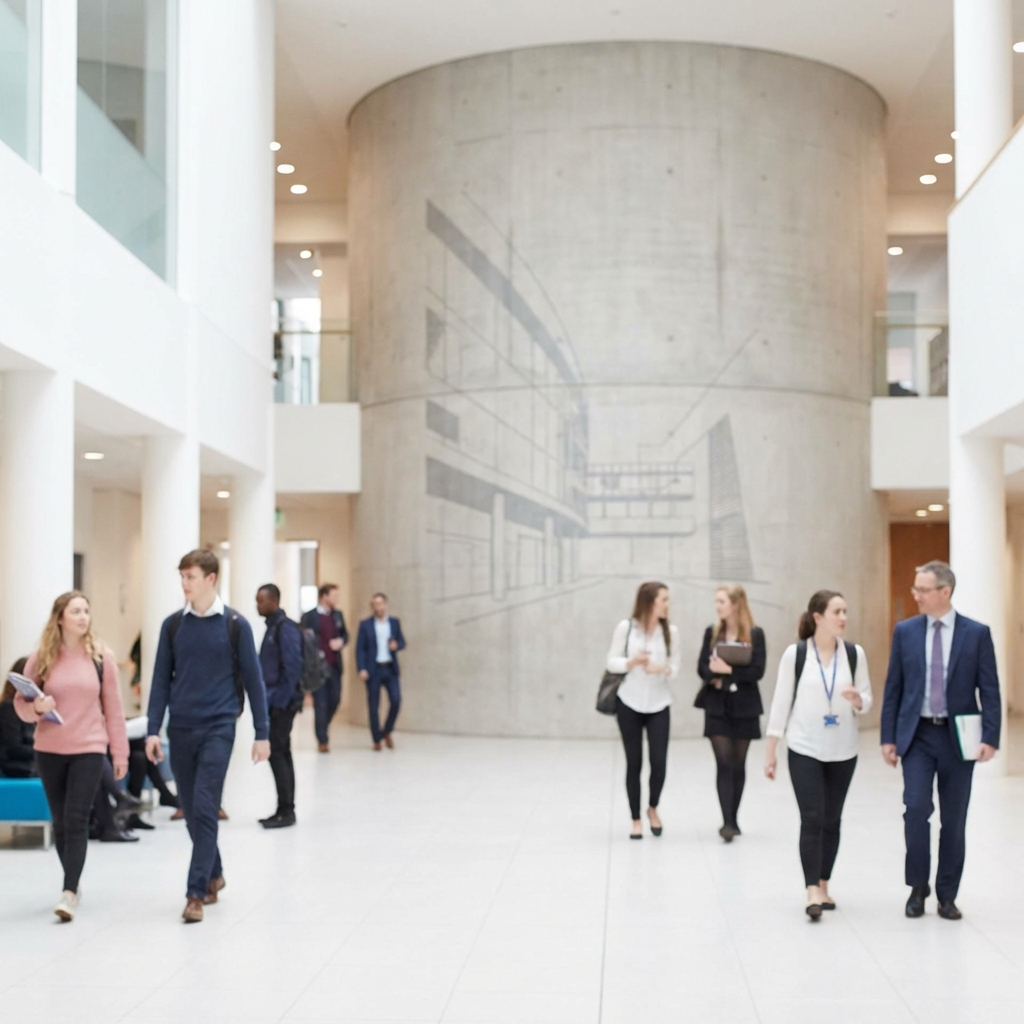
- Short, predictable windows: Most spaces can be printed in under five hours, allowing teams to target classroom gaps, visiting hours lulls, or overnight hospital quiet times.
- Minimal staging: On-site printers roll into place with small footprints. Because graphics are imaged directly, there are no panels to cut, fit, or seam—reducing mess and noise.
- Reduced room closures: Quick turnarounds limit downtime for learning environments, patient corridors, and administrative suites. In many cases, adjacent areas can remain in use.
- Cleaner execution: No adhesive off-gassing, backing paper, or large-scale teardown waste. Cleanup is streamlined and better aligned with occupied-building rules.
- Precision for complex spaces: Elevators, curved corridors, and irregular wall geometries can be approached surgically without re-fabrication delays.
Institutions can phase upgrades across a semester, fiscal year, or departmental rotation without sacrificing quality. In healthcare, coordination with infection prevention and environmental services teams helps align prep and cleaning procedures to site protocols. For campuses with sustained foot traffic, direct-to-wall printing offers a path to visible change with minimal operational compromise.
Design Consistency Across Multi-Building and Multi-Location Rollouts
The credibility of a university or health system brand depends on consistent execution across sites. A donor wall, pediatric unit, or alumni corridor must look and feel the same whether it’s in a flagship building or a satellite facility. Direct-to-wall printing supports that consistency through digital control and repeatability:
- Calibrated color management: ICC profiles and measured color targets align output from one building to the next. This is critical for precise brand palettes and skin tones in photoreal imagery.
- Template-driven systems: Wayfinding, departmental overlays, and safety messages can be templated and sized for different wall elevations while maintaining hierarchy and typography.
- Standardized materials guidance: With substrate compatibility across drywall, CMU, concrete, and brick, facilities teams can apply a single specification campus-wide instead of a patchwork of product types.
- Cloud-based asset governance: Shared libraries for artwork, type, and brand elements reduce version drift and simplify approvals by procurement, communications, and legal.
- Pilot-to-scale workflows: Start with a flagship building, pressure-test in a high-traffic corridor, then deploy to satellite sites with validated settings and install playbooks.
For institutions with galleries and museums, direct-to-wall solutions enable high-resolution exhibitions and interpretation graphics that maintain crisp detail from one venue to another. For healthcare systems and multi-campus universities, centralized brand stewardship—paired with localized overlays for departments or programs—ensures both consistency and contextual relevance.
Durability and Maintenance Advantages in High-Traffic Environments
From move-in weekends to shift changes, campus interiors take a beating. Traditional vinyl seams peel under abrasion, and wallpaper can bubble in fluctuating humidity. Direct-to-wall printing offers a more robust, integrated surface:
- Seam-free construction: With no seams to catch or lift, the risk of edge failure is dramatically reduced—especially important near elevators, corners, and equipment chokepoints.
- Cleanable finish: Surfaces are designed for routine cleaning in high-traffic environments and resist common scuffs and contact marks.
- Stable in diverse conditions: CMU stairwells, concrete atriums, and brick commons often challenge adhesive-backed products; direct-to-wall printing is compatible with both finished and unfinished substrates with proper prep.
- Lower visual fatigue: Photoreal, high-resolution imagery remains crisp at scale, avoiding the micro-distortions or pixelation that can make large graphics look tired over time.
- Paintability: When programs change or donors evolve, teams can paint over graphics rather than embark on laborious removal—protecting schedules and budgets.
For a deeper dive into performance in busy corridors and lobbies, see this overview of direct-to-wall durability benefits. The bottom line for facilities and operations: fewer reactive work orders, fewer weekend repair calls, and a more predictable maintenance plan across the portfolio.
Comparative Analysis: Direct-to-Wall vs. Vinyl, Wallpaper, and Traditional Murals
Facilities and procurement teams often evaluate multiple pathways to institutional wall graphics. A side-by-side comparison clarifies tradeoffs:
- Installation and disruption
– Direct-to-wall: On-site imaging typically completes under five hours per area; minimal staging and waste; low disruption to occupied spaces. – Vinyl/wallpaper: Requires panel seaming, trimming, and adhesive cure times; more staging and cleanup; higher likelihood of traffic interference. – Hand-painted murals: Highly skilled but slow; requires extended closures and repeat visits for corrections or sealing.
- Visual outcomes at scale
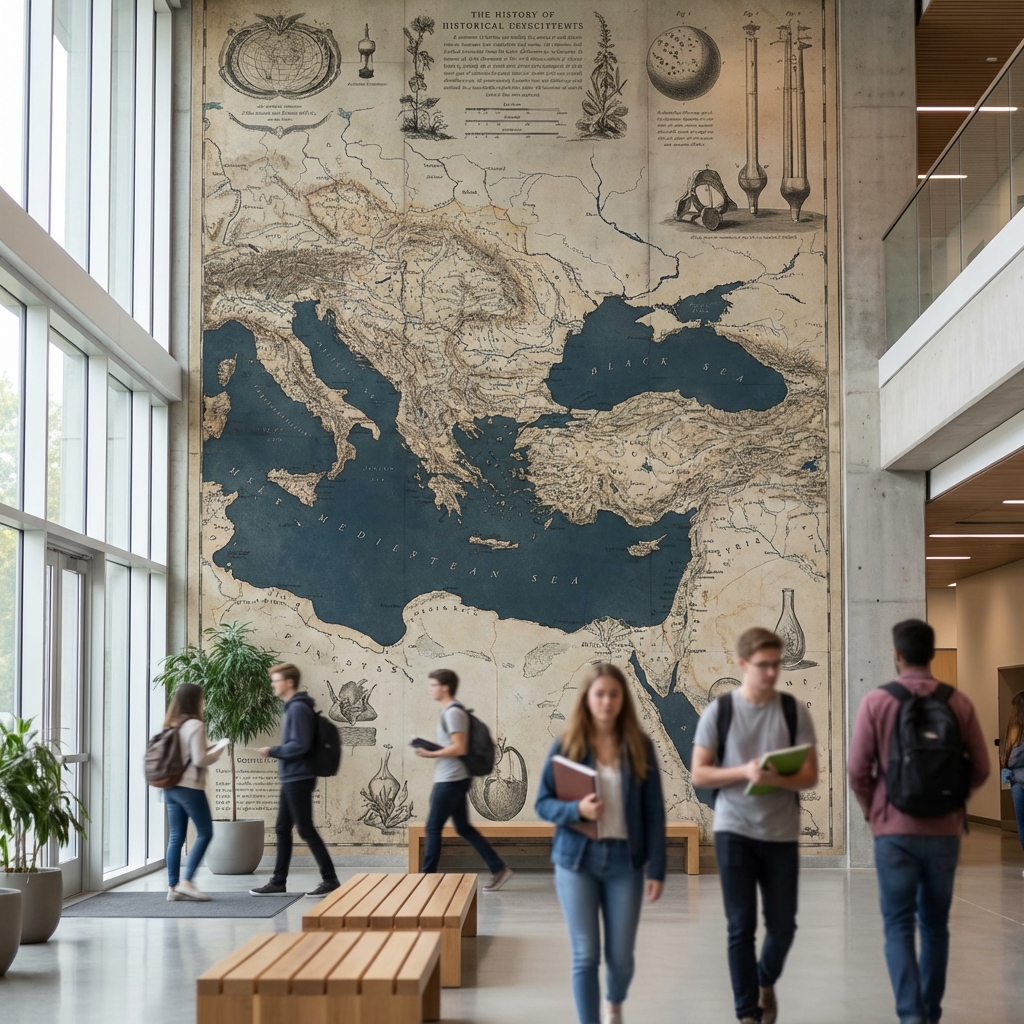
– Direct-to-wall: Photoreal, crisp detail with no seams; integrates into the architecture. – Vinyl/wallpaper: Good print quality, but seams can telegraph; panel alignment risks visible banding. – Hand-painted murals: Unique artistry but variable fidelity for photographic subjects and typography.
- Substrate and environment
– Direct-to-wall: Compatible with drywall, CMU, concrete, brick (with appropriate prep); stable in diverse building conditions. – Vinyl/wallpaper: Sensitive to surface irregularities; adhesion challenges on rough or porous substrates; humidity can cause failures. – Hand-painted murals: Broadly flexible but often requires more extensive prep and protective topcoats in high-traffic zones.
- Durability and maintenance
– Direct-to-wall: Seam-free; designed for cleanability; paint-over-ready for future changes. – Vinyl/wallpaper: Edges and seams prone to peeling and damage; removal produces waste and wall repair. – Hand-painted murals: Durable with sealing, but touch-ups are specialized and time-consuming.
- Sustainability and waste
– Direct-to-wall: No vinyl, PVC, or backing paper; fewer replacement cycles reduce waste. – Vinyl/wallpaper: PVC content, adhesive waste, and removal debris; more frequent replacement. – Hand-painted murals: Low material waste but longer schedules and specialty labor.
- Cost and lifecycle
– Direct-to-wall: Competitive installed cost; lower downtime costs; fewer reactive repairs; efficient end-of-life (paint over). – Vinyl/wallpaper: Potentially lower material cost per square foot but higher lifecycle cost from repairs, replacements, and downtime. – Hand-painted murals: Premium labor and long schedules; best reserved for signature art moments where process is the point.
For sustainability and waste considerations specifically, explore this comparison of direct-to-wall printing vs. traditional vinyl. When campus leaders weigh speed, durability, visual quality, and lifecycle efficiency together, direct-to-wall solutions tend to outperform alternatives for multi-building and multi-location interior branding.
Cost and Lifecycle Efficiency for Large Institutional Budgets
For universities and health systems, the question is rarely “What’s the cheapest install?” It’s “What will perform best over the next five years across all our buildings?” Direct-to-wall printing supports budget stewardship through predictable scheduling, lower maintenance risk, and simpler refresh cycles.
Consider the total cost of ownership:
- Labor and downtime: Faster, cleaner installs reduce after-hours premiums and business interruption. A five-hour window versus a multi-day seam application goes straight to the bottom line.
- Maintenance and repairs: Fewer seams and higher abrasion tolerance mean fewer work orders, fewer weekend callouts, and less visible aging that triggers premature replacement.
- Refresh and change management: Paint-over-ready graphics compress the time and cost of program updates, tenant turns, and donor revisions; no adhesive residue or wall repair.
- Logistics: On-site printing eliminates shipping delays and re-fabrication for mismeasured walls. Procurement can schedule work against real site conditions rather than waiting on crates.
- Scale economics: Standardizing a direct-to-wall specification across buildings concentrates vendor learning, reduces per-space variance, and spreads preproduction costs over more square footage.
Subscription models further improve lifecycle efficiency for communications that change seasonally or strategically. Institutions can pre-plan refresh cycles for admissions seasons, cohort orientations, or clinical campaigns, turning reactive spend into predictable, lower-cost updates. For multi-location interior branding, that predictability helps central procurement and campus facility teams align budgets, approvals, and field schedules months in advance.
Implementation Guide: Planning and Executing Campus-Wide Branding Projects
A successful campus-wide program blends strong design governance with install pragmatism. The following phased approach aligns stakeholders, contains risk, and sets a path from pilot to scale.
1) Discovery and inventory
- Map buildings, corridors, and high-value touchpoints (entry lobbies, elevator lobbies, clinics, student life hubs).
- Document substrates (drywall, CMU, concrete, brick) and environmental factors (traffic levels, cleaning protocols).
- Clarify goals: identity, wayfinding, donor recognition, instructional messaging, or cultural storytelling.
2) Strategy and design guidelines
- Establish a brand system for large-format graphics: color space, typography, iconography, and image treatments.
- Define a wayfinding hierarchy and templates to reduce signage clutter and integrate safety messaging.
- Identify zones for photoreal imagery versus pattern or typographic emphasis.
3) Pilot and prototyping
- Choose 2–3 representative spaces—e.g., a high-traffic corridor, a rough-surface stairwell, and a feature wall—to validate performance.
- Print proof-of-concept sections on actual substrates; confirm color accuracy, legibility distances, and cleanability.
- Calibrate expectations around surface prep and site logistics.
4) Stakeholder alignment and approvals
- Bring facilities, procurement, communications, accessibility, and risk teams into a unified review.
- Finalize artwork libraries, message templates, and site-specific overlays for departments or units.
- Set budget ranges and phase logic by semester, fiscal year, or service line.
5) Scheduling and site readiness
- Sequence installs to coincide with low-occupancy windows—overnights, breaks, or planned maintenance shutdowns.
- Prepare walls as needed; coordinate with custodial or environmental services for pre- and post-cleaning.
- Align security and access permissions, particularly in healthcare settings.
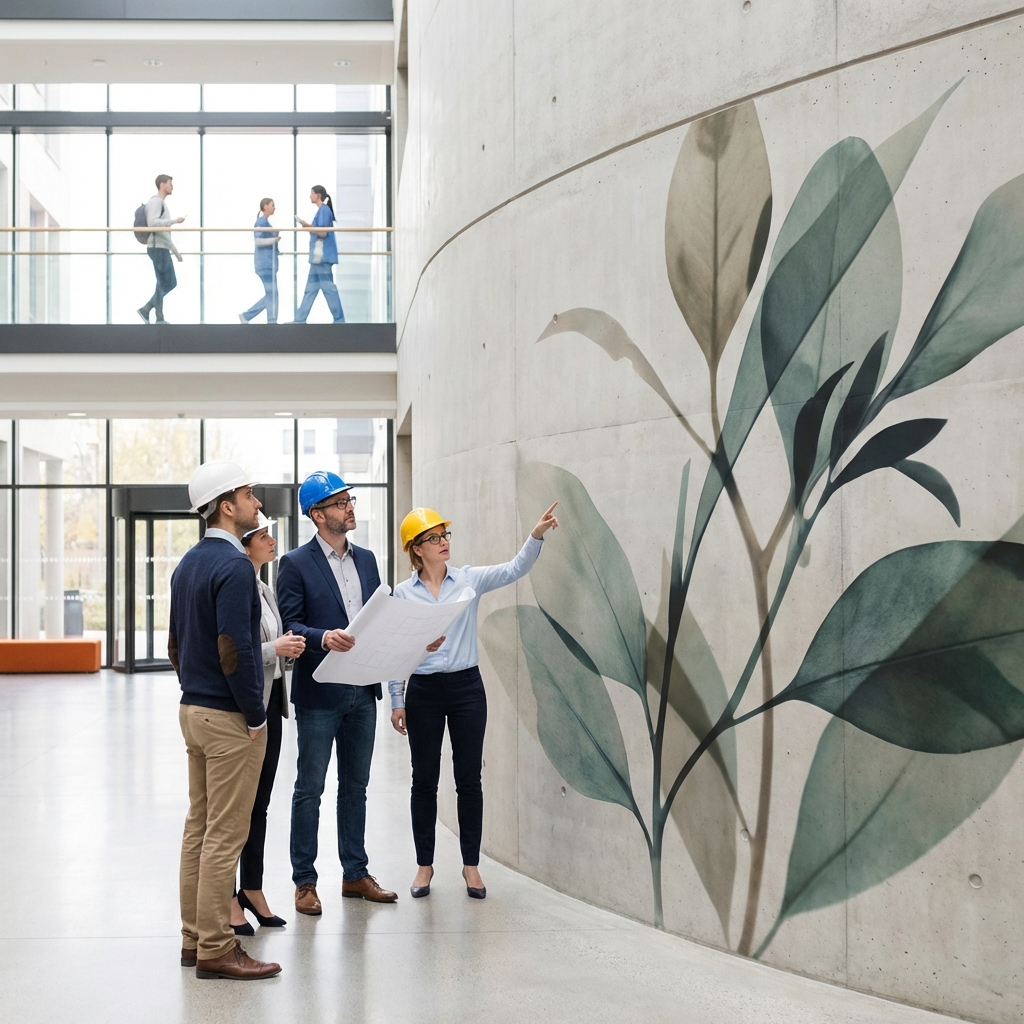
6) Production and installation
- Utilize on-site printing to avoid shipping and fit issues; keep a rolling schedule to reduce idle time.
- Implement quality control checklists: color targets, edge alignment, legibility at target distances, and punch lists signed by facilities.
- Maintain a minimal staging footprint to limit disruption in occupied corridors and lobbies.
7) Documentation and handoff
- Archive final artwork, ICC profiles, and install settings for future replication.
- Provide maintenance guidance: recommended cleaning methods, inspection cadence, and repaint considerations.
- Update a central campus map to reflect wayfinding and instructional graphics for emergency and operations teams.
8) Scale and refresh
- Convert pilot learnings into a rollout playbook with zone typologies, substrate notes, and install durations by space type.
- Leverage a subscription model to schedule annual or semiannual refreshes in admissions, athletics, student life, or clinical education areas.
- Extend the system to in-studio printed elements—doors, tables, standees—for events and short-term campaigns, maintaining visual consistency without overhauling permanent walls.
Vendors like EastCoast MuralPros support this process with full-campus coordination, multi-location execution, and collaborative tools that allow digital artists and institution designers to work fluidly across a portfolio. The result is a scalable institutional branding system—one that looks cohesive on day one and remains manageable over time.
Conclusion and Selection Framework for Campus Leaders
Selecting campus-wide branding solutions is ultimately a performance decision. Institutions that measure options against speed, durability, consistency, and lifecycle efficiency are better positioned to deliver environments that guide, inspire, and endure. Use the following framework to compare approaches and vendors:
- Speed and disruption
– Can the team install under five hours per area with minimal staging? – Are overnight and weekend installations standard practice?
- Durability and maintenance
– Is the surface seam-free and designed for cleanability in high-traffic areas? – What is the expected maintenance workload over five years?
- Visual quality and scalability
– Does the solution deliver photoreal clarity at architectural scale? – Are color management, templates, and QC processes in place for multi-building or national rollouts?
- Substrate and environment fit
– Is the solution compatible with drywall, CMU, concrete, and brick with reasonable prep? – How does it perform in variable humidity and temperature?
- Lifecycle and sustainability
– Can graphics be painted over for program changes? – What waste streams are created during install and at end-of-life?
- Cost and logistics
– What is the true total cost of ownership, including downtime and reactive repairs? – Does on-site printing eliminate shipping delays and re-fabrication risk?
- Governance and partnership
– Does the vendor understand facilities operations, procurement workflows, and pilot-to-scale transitions? – Are collaborative tools available for internal designers and digital artists?
For higher education and healthcare facilities, direct-to-wall printing has become a practical, scalable alternative to vinyl wall coverings, wallpaper, and construction-heavy upgrades. Organizations that value reliability, schedule certainty, and design-forward results will find that this approach aligns well with institutional wall graphics, durable campus wayfinding systems, and multi-location interior branding at scale. When you are ready to evaluate options, partners like EastCoast MuralPros can help scope pilots, validate performance, and execute cohesive, low-disruption rollouts across your campus or system.
Contact us to learn more