Introduction: Why Commercial Teams Are Moving Beyond Vinyl and Wallpaper
Best Commercial Mural Printing Solutions: Top Alternatives to Vinyl Wall Coverings
Commercial interiors are evolving fast, and so are expectations for graphics that brand, instruct, and inspire. Facilities and procurement teams who once defaulted to vinyl wall coverings or wallpaper are now reevaluating those choices. Peeling seams, adhesive failures, extended install windows, and the waste associated with replacements make legacy approaches hard to justify. In their place, commercial mural printing solutions—especially direct-to-wall printing technology—offer a cleaner, faster, and more predictable path to results.
For organizations that manage multiple floors or locations, the brief is consistent: deliver high-resolution wall graphics quickly, minimize disruption to occupied spaces, and ensure durability in high-traffic environments. A new generation of on-site printing meets those standards with crisp, photoreal imagery and finishes that stand up to cleaning protocols without the risk of bubbling or delamination. Just as important, these systems allow teams to change out content without tearing down materials or creating landfill-bound waste.
Companies like EastCoast MuralPros have brought direct-to-wall printing into the mainstream for corporate workplaces, hospitals, schools, museums, and retail. The model is engineered for facility-scale deployment: adhesive-free application, seam-free results at architectural scale, and installations often completed in under five hours per zone. For decision-makers under pressure to do more with less, it’s a performance-based alternative to vinyl and wallpaper that aligns with schedules, budgets, and sustainability targets.
Evaluation Criteria for Mural Printing Solutions
Selecting a commercial mural printing partner calls for a balanced evaluation of performance, risk, speed, and lifecycle cost. When building your criteria, consider the following:
- Image quality and scale: Evaluate true resolution at viewing distance, edge sharpness, color fidelity, and the ability to render fine text and brand-critical hues at 10–100+ feet.
- Surface compatibility: Confirm performance on both finished and unfinished substrates—painted drywall, CMU, concrete, brick, and textured surfaces—without requiring panels or aggressive adhesives.
- Durability and cleanability: Look for finishes that resist scuffs, stand up to routine cleaning, and avoid the delamination risks common with vinyl in temperature or humidity swings.
- Installation time and disruption: Measure real installation windows, noise levels, odor, dust, and whether work can proceed in occupied buildings with overnight or weekend scheduling.
- Seam-free execution: Ensure the solution eliminates panel seams and alignment risks that can compromise visuals along corridors, lobbies, and long feature walls.
- Proofing and color management: Ask about onsite test patches, color profiles, and quality control processes that protect brand standards across locations.
- Lifecycle economics: Model total cost of ownership, including installation labor, maintenance, refresh cycles, removal or paint-over, and avoided construction or signage hardware.
- Sustainability factors: Evaluate materials, adhesives, PVC content, packaging waste, shipping, and end-of-life considerations. Favor solutions with no vinyl or PVC and reduced waste streams.
- Safety and compliance: Check for low odor/low-VOC processes and confirm compatibility with facility health and safety protocols.
- Scale and consistency: For multi-site rollouts, assess workflow tools, asset management, team coordination, and documented processes that keep outcomes consistent nationally.
Teams that prioritize these factors are better positioned to validate a vendor’s claims, reduce project risk, and lock in a repeatable approach for future phases.
Direct-to-Wall Printing: Speed, Quality, and Installation Advantages
Direct-to-wall printing technology moves the printer to the wall rather than bringing pre-printed materials to the site. Using high-resolution printheads and durable, cure-on-contact inks, the system images artwork directly onto the architecture—no vinyl, adhesives, or panels. Because each wall is printed in place, there’s no panel seaming, alignment drift, or trapped air to cause bubbles.
For commercial environments on tight schedules, the speed advantage is meaningful. EastCoast MuralPros routinely completes a typical zone in under five hours, including setup, test patches, and final printing. With no shipping, panel fabrication, or dry-fit to coordinate, schedule risk is reduced to site readiness and art approvals. And since the printer operates quietly and cleanly, work can proceed during off-hours in occupied buildings without triggering downtime.
Quality is equally compelling. Photoreal, high-resolution imagery retains sharpness at architectural scale, enabling brand walls, environmental graphics, and gallery-caliber visuals that hold up under close inspection. Fine text for operational or safety messages prints crisply without the haloing or mattification that can occur with textured wallpapers. For teams balancing functionality and experience, direct-to-wall printing supports both in a single pass.
Beyond walls, in-studio printing on doors, tables, and standees extends the system’s utility for branded amenities, temporary activations, and event elements. This end-to-end approach consolidates vendors and makes it easier to keep visual standards consistent across surfaces.
Seam-Free Graphics at Architectural Scale: Design and Durability Benefits
Seams are the Achilles’ heel of vinyl wall coverings and wallpapers. Even with skilled installers, panel edges telegraph through graphics, disrupt continuous patterns, and often become failure points under cleaning or temperature changes. Direct-to-wall printing removes that variable entirely, creating uninterrupted fields of color and image across long runs, heights, and complex geometries.
Architects and designers gain new freedom in composition. Continuous gradients, panoramic photography, and intricate brand systems can span corridors, wrap columns, and frame openings without visual breaks. In exhibition and museum settings, the absence of seams helps large photographic works feel integrated, not applied. For lobby features, a single, sweeping image becomes an architectural gesture rather than a decal.
Durability follows from integration. With no adhesive layer to fail, there’s no path for edge lifting or bubbling. The printed surface is cleanable and engineered for high-traffic zones like healthcare corridors, retail entries, and campus common areas. When programs change—tenant turnover, new branding, or updated messaging—the surface is paint-over-ready, avoiding the labor and damage risks of adhesive removal.
By delivering a seamless finish and serviceable surface, direct-to-wall printing aligns with interior lifecycle planning. It satisfies immediate design intent without locking facilities into a material system that is costly to maintain or remove.
Sustainability and Lifecycle Cost Comparison
Sustainability isn’t just about materials; it’s also about what you don’t ship, don’t install, and don’t send to landfill. Traditional vinyl and wallpaper systems rely on PVC or plasticized substrates, adhesives, liners, cores, and significant packaging. They require panel fabrication and often generate overage for seam matching and waste from offcuts and rework.
Direct-to-wall printing, by contrast, removes vinyl and adhesive layers from the equation. There are no rolls to manufacture, ship, store, or discard. On-site imaging means no panel misprints to re-fabricate and no freight emissions tied to reorders. The result is a leaner material flow and a cleaner end-of-life path: when it’s time to change, simply paint over the wall instead of stripping and landfilling panels. For teams evaluating environmental impacts, EastCoast MuralPros details a no vinyl or PVC approach that aligns with corporate sustainability goals.
Lifecycle costs follow a similar pattern. Even if panel materials seem inexpensive on a per-square-foot basis, downstream labor for installation, seam alignment, and eventual removal adds up. Adhesive failures or damage during maintenance increase both service calls and business disruption. Direct-to-wall printing avoids those compounding costs by eliminating the failure modes tied to seams and adhesives, reducing replacement frequency, and shortening install windows.
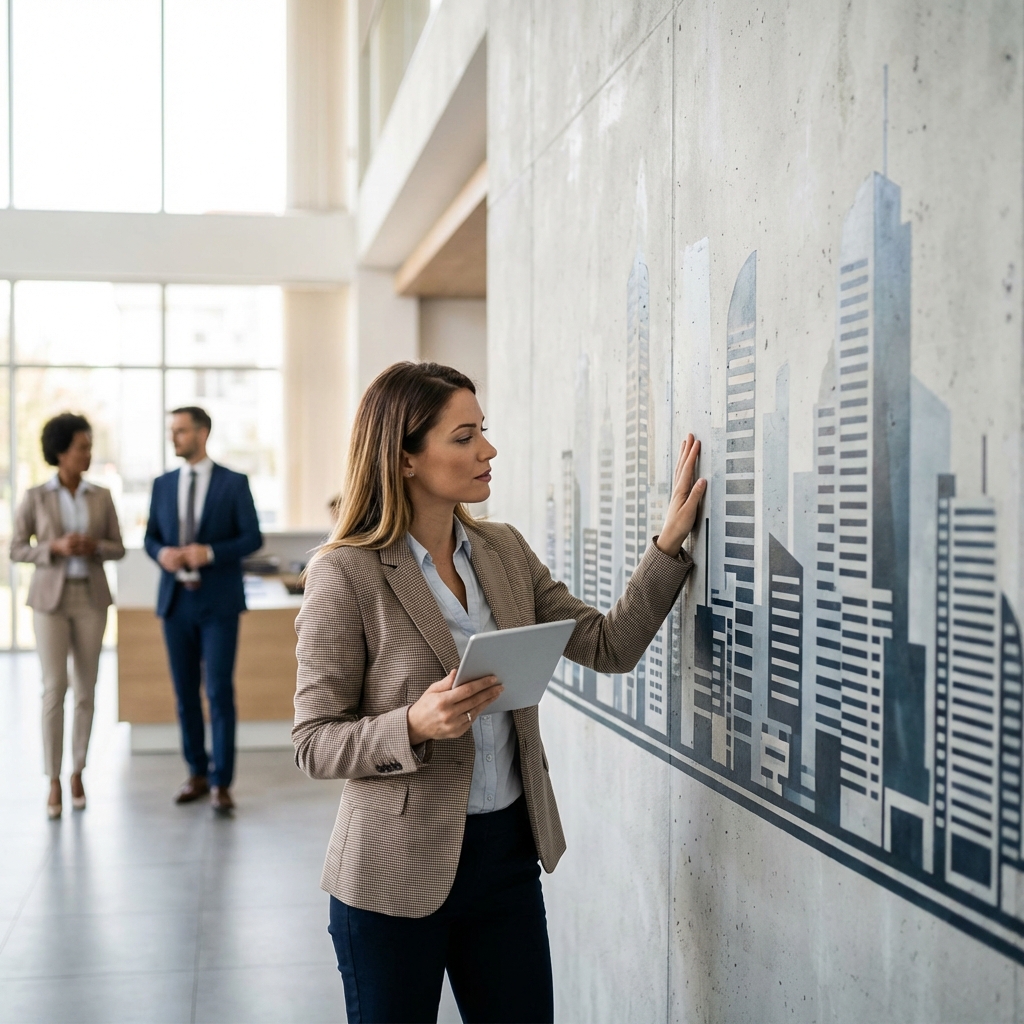
For a deeper dive into environmental trade-offs, procurement teams can reference analyses comparing direct-to-wall vs vinyl. While every facility has unique parameters, the general trend is clear: fewer materials, fewer shipments, and paint-over-ready changeouts reduce both waste and total cost of ownership.
Multi-Location Brand Rollouts: Consistency and Execution
Scaling brand graphics across dozens or hundreds of sites challenges even mature teams. Variables accumulate—substrate conditions, lighting, competing schedules, and mixed vendor pools—and small execution differences become visible to customers and staff. Direct-to-wall printing provides a standardized method that compresses variability.
Consistency starts with files and color. Professional providers maintain color-managed workflows, custom profiles, and proofing protocols tailored to architectural viewing conditions. On-site test patches enable approval under real lighting, which is crucial for branded color families and photography. EastCoast MuralPros complements this with collaborative tools for digital artists and brand teams, making it easier to scale complex artwork without sacrificing fidelity.
Execution hinges on coordination. On-site printing removes dependency on panel shipments and their inherent timing risk. Teams can stage by floor or zone, hitting overnight windows and minimizing impact to operations. For campuses—universities, hospital systems, or corporate headquarters—full-building strategies consolidate asset management, wayfinding updates, and brand refreshes into a unified program. For national rollouts, standardized tooling and process control ensure that a lobby in Boston matches a conference hub in Austin.
Finally, repeatability matters. When a pilot program succeeds, you want the workflow that delivered it to scale predictably. Direct-to-wall printing’s streamlined logistics, coupled with experienced project management, provides that repeatable path from pilot to portfolio-wide deployment.
Wayfinding and Instructional Graphics Without Signage Clutter
Facilities can only carry so many sign types before visual noise sets in. Static plaques, temporary notices, floor stands, and adhesive cut vinyl often compete for attention and degrade the space. Wall-integrated wayfinding and instructional graphics reduce this clutter by delivering information where it’s most legible—on the architecture itself.
Direct-to-wall printing excels at layering function into the environment without introducing protruding hardware. Clear directional cues, zone color-coding, clean iconography, and concise instructional text can be deployed at key decision points: elevator lobbies, corridor intersections, clinic check-in zones, and back-of-house areas. Because graphics are printed in place, alignment to doors, glazing, and floor finishes is precise.
This approach pairs well with code-compliant signage systems rather than replacing them. Tactile/Braille signs and egress markings remain where required, while printed graphics handle broader navigation, instructional messaging, and safety reminders. In healthcare, printed wall graphics can delineate care pathways and simplify family navigation; in education, they reinforce classroom zones and event routing; in workplaces, they streamline visitor flows and reduce ad-hoc posters.
When information changes, a subscription model enables scheduled refreshes—seasonal campaigns, new tenant branding, or updated protocols—without hardware swaps. The result is a cleaner visual field and a more intuitive user experience across the building.
Cost Analysis: Pricing Models and ROI for Commercial Installations
Budgeting for commercial mural printing should weigh more than a simple per-square-foot line item. The most accurate comparisons include all costs tied to getting the result live and keeping it in service over time:
- Pre-production: site assessment, substrate prep recommendations, art scaling, and color proofing.
- Installation: labor hours, mobilization, access plans, and whether work can be completed during off-hours without premium charges.
- Materials and logistics: for panel-based systems, include panel fabrication, packaging, shipping, storage, and waste disposal.
- Quality risk: potential for panel misprints, seam alignment rework, and shipping delays that can back up schedules.
- Maintenance and refresh: cleanability, resistance to edge damage, and ease of updates or full changeouts.
Direct-to-wall printing tends to shift costs from materials to precision service. You pay for expert on-site imaging and quality control, not rolls of vinyl. Teams often see ROI in three ways: faster go-live (less downtime), fewer maintenance calls (no seam failures), and lower refresh costs (paint-over-ready, no removal labor). For high-traffic facilities, avoided disruptions can outweigh small differences in up-front pricing.
Common pricing models include:
- Per-square-foot rates with minimum mobilization thresholds.
- Zone-based or room-based pricing for standardized environments (e.g., clinic pods, classrooms).
- Program subscriptions that bundle design iteration and scheduled refreshes for campuses or multi-location brands.
Where panel-based solutions may appear lower on material costs, including the full install, rework risk, and removal labor typically narrows or reverses that gap. For procurement-led evaluations, a lifecycle spreadsheet comparing 3–5 years of use will clarify the total cost of ownership and the impact of avoided disruption.
Installation Speed and Minimal Disruption: Key Selection Factors
Facilities teams are accountable for keeping spaces operational, safe, and clean. Any installation method competing for adoption must respect that reality. Direct-to-wall printing is designed for low disruption and fast turnaround:
- Under-five-hour installs: Many zones can be completed start-to-finish in a single off-hours window, including setup and test patches.
- Quiet, low-odor operation: Systems and inks are selected for use in occupied buildings, reducing the need for extensive ventilation or containment.
- Clean process: No adhesive mixing, liner waste, or panel trimming. Crews maintain compact, tidy footprints and quick breakdowns.
- Precise site fit: Because artwork is printed in place, dimensions are validated on site, and there’s no risk of misfit panels or misaligned seams at doors and corners.
Surface readiness is the main prerequisite. Providers like EastCoast MuralPros perform site assessments to confirm paint cure times, moisture conditions, and substrate stability. When minor prep is needed—spot priming, patching, or cleaning—it’s typically leverageable within routine facility maintenance. Compared to the tear-down and rehang cycles required by wallpaper and vinyl, the difference in disruption is significant.
For critical-path projects—lease-up periods, store openings, clinic expansions—this installation model reduces dependencies. With no shipping to wait for and fewer variables to manage, schedules tighten, and risk drops accordingly.
Customer Reviews: What Facilities Teams Report About Results

Facilities and operations leaders who adopt direct-to-wall printing tend to emphasize outcomes that track closely to their KPIs. Common feedback themes include:
- Schedule certainty: “We were able to print two floors overnight and open on time—no contingency day required.”
- Cleanability and wear: “Housekeeping wipes scuffs without catching edges. After six months of traffic, the walls still look first-day.”
- Seam-free appearance: “No panel lines down the corridor. Photography reads as one continuous piece, which our design team loves.”
- Change management: “When we updated branding in Q3, we didn’t demo anything. We approved a new proof and repainted one wall before reprinting.”
- Multi-site consistency: “Color and type are consistent across regions. The on-site proof patches gave our brand team confidence before each run.”
Procurement teams also note the administrative upside: fewer line items than panel-based installs, less warehouse coordination, and a smaller risk profile tied to delivery and rework. For hospitals and schools, low disruption during operating hours features prominently in evaluations.
Comparison Summary: Mural Printing vs. Vinyl, Wallpaper, and Hand-Painted Alternatives
When comparing options, focus on performance characteristics that map to your environment and goals:
- Direct-to-wall printing
– Strengths: Seam-free at scale; fast, low-disruption install; adhesive-free; durable and cleanable; paint-over-ready for changes; scalable for multi-site rollouts; photoreal quality at architectural dimensions. – Considerations: Requires substrate in serviceable condition and access for on-site equipment; proofing and coordination are critical to maintain color consistency.
- Vinyl wall coverings
– Strengths: Widely available; familiar to many installers; textured and specialty finishes possible. – Considerations: Seams and edges prone to failure; adhesive-related bubbling; significant waste; shipping and fabrication dependencies; removal can damage walls and extend downtime.
- Traditional wallpaper (printed paper or fabric-backed)
– Strengths: Decorative patterns and textures; suitable for residential or boutique hospitality aesthetics. – Considerations: Seams are visible; durability and cleanability vary; replacement cycles can be short in high-traffic commercial environments.
- Hand-painted murals
– Strengths: Unique, artisanal finishes; flexibility on irregular surfaces; certain artistic styles benefit from brushwork. – Considerations: Longer timelines; variable repeatability; limited scalability across sites; touch-ups can alter original intent; costs rise with complexity and area.
Most commercial teams seeking scalable interior branding solutions and high-resolution wall graphics will find direct-to-wall printing aligns best with operational needs, lifecycle economics, and sustainability goals. Vinyl or wallpaper may still suit decorative niche applications, and hand-painting remains valuable for commissioned art, but for performance-driven programs, direct-to-wall is the modern baseline.
Buying Guide: How to Select the Right Mural Printing Partner for Your Organization
Choosing a partner for commercial mural printing is as much about process as it is about equipment. Use this checklist to qualify vendors and set your program up for success:
- Technical capability
– Can they demonstrate high-resolution output on your exact substrate type? – What inks and curing systems are used, and how do they perform under your cleaning protocols?
- Proofing and quality control
– Do they provide on-site test patches under your lighting for color-critical approval? – How do they manage color profiles across multiple locations and repaint cycles?
- Installation planning
– What is the typical install duration per zone, and can they execute overnight or weekend work? – How do they handle occupied spaces, access logistics, and safety planning?
- Surface readiness
– Will they assess and document substrate conditions, paint cure times, and prep needs? – Are finishes paint-over-ready for future changes, and what are the recommended primers/paints?
- Durability and maintenance
– What cleaning agents are compatible? Do they offer maintenance guidelines for housekeeping teams? – What is the stated performance period under normal use, and what issues are covered by warranty?
- Scalability
– How do they support multi-location rollouts—project management, scheduling, digital asset handling, and brand governance? – Can they integrate with your procurement systems and provide consolidated reporting?
- Sustainability
– Do they operate without vinyl or PVC and minimize packaging and shipping waste? – Can they provide documentation supporting environmental claims and lifecycle impacts?
- Program models
– Is a subscription or refresh plan available for seasonal or strategic updates? – Can they also produce in-studio elements (doors, tables, standees) to standardize broader brand touchpoints?
- References and pilots
– Will they share references in your sector—healthcare, education, retail, workplace? – Can they run a pilot in a representative area and document results before scaling?
Providers like EastCoast MuralPros support facilities directors, architects, and brand teams through this full lifecycle—assessment, color-managed production, fast on-site installation, and scalable execution. When the selection process emphasizes performance, disruption minimization, and lifecycle efficiency, the right partner becomes a long-term asset for your interior environment portfolio.
By aligning your evaluation to the realities of how buildings operate—and how brands evolve—you’ll choose a mural printing solution that delivers immediate impact and holds up over years of use, without the compromises that have historically come with vinyl and wallpaper.
Contact us to learn more