Table of Contents
- Why Multi-Surface Wall Printing Matters for Commercial Spaces
- The Real Problem with Vinyl, Wallpaper, and Traditional Murals
- How Our Direct-to-Wall Technology Outperforms Every Alternative
- Multi-Surface Compatibility: Drywall, CMU, Concrete, and Brick
- Installation Speed and Minimal Disruption Advantage
- Durability and Lifecycle Cost Comparison
- Design Flexibility and Seam-Free Results at Architectural Scale
- Real Applications: Branding, Wayfinding, and Institutional Graphics
- Why Our Solution Wins for Multi-Location Rollouts
- The Sustainability and Performance Edge
- Getting Started with Your Commercial Wall Printing Project
- Frequently Asked Questions (FAQ)
Why Multi-Surface Wall Printing Matters for Commercial Spaces
Your building’s walls are real estate you’re not using strategically. Whether it’s a corporate lobby, hospital corridor, school hallway, or retail space, those surfaces carry enormous communication, branding, and wayfinding potential, yet most organizations treat them as an afterthought or settle for outdated solutions.
We work with facility directors, real estate teams, and institutional leaders who recognize that walls aren’t just structural—they’re platforms for brand consistency, navigation clarity, safety messaging, and visual identity. The problem is finding a method that works across multiple surfaces, scales efficiently, and doesn’t require weeks of downtime or expensive construction.
That’s where modern commercial wall printing changes the game. We’ve moved past hand-painted murals and vinyl wraps to offer a technology that prints directly onto finished and unfinished walls at high resolution, in a single installation window, without adhesives or panels. For organizations managing multi-location rollouts, tenant turnover, or seasonal campaigns, this shifts both your timeline and your cost structure.
The Real Problem with Vinyl, Wallpaper, and Traditional Murals
Vinyl wall wraps have dominated commercial interiors for years, but we see their limitations firsthand on nearly every project that comes to us after a vinyl install has failed.
Vinyl bubbles, peels, and shows seams over time—especially in high-traffic or high-moisture environments like hospitals, schools, and hospitality corridors. Even well-installed vinyl will eventually fail at edges and corners where climate changes, foot traffic, or vibration cause stress. Replacement costs stack up quickly, and removal leaves adhesive residue and wall damage that requires prep work before you can apply anything new.
Wallpaper and traditional hand-painted murals carry their own pain points. Wallpaper isn’t designed for durable, high-traffic commercial environments; it stains, tears, and looks dated fast. Hand-painted murals require skilled artists, take weeks or months to complete, and can’t be easily updated or standardized across multiple locations. If your corporate brand changes or a school needs new wayfinding, you’re looking at repainting or starting over.
Construction-heavy alternatives—built-in millwork, recessed graphics, or wall panels—demand permitting, structural approval, extended project timelines, and permanent modifications that make spaces inflexible for future tenants or program changes.
All of these solutions share a common weakness: they’re either short-lived, slow to install, expensive to maintain, or difficult to scale.
How Our Direct-to-Wall Technology Outperforms Every Alternative
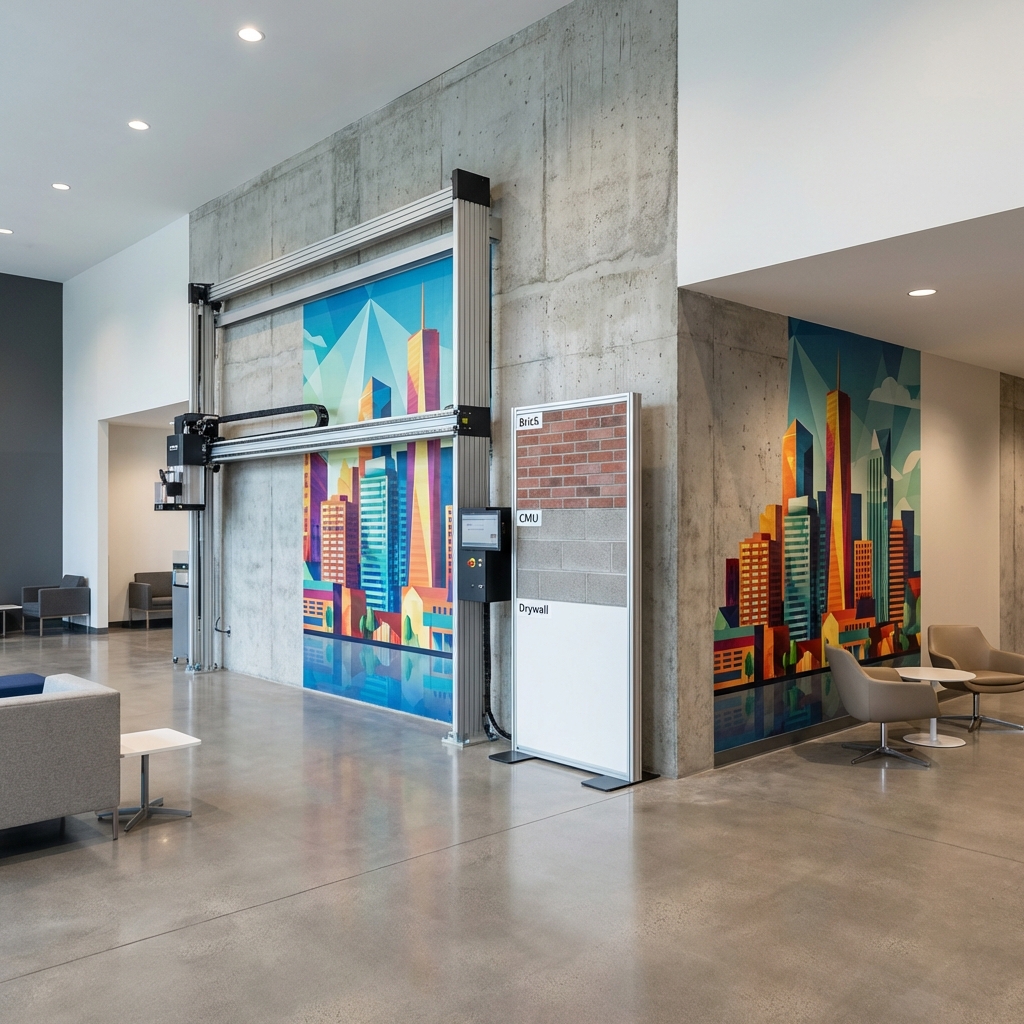
We print directly onto the wall surface itself using a proprietary process that bonds the image to drywall, CMU (concrete masonry units), concrete, or brick without vinyl adhesives, panels, or additional coatings. The result is a finish that feels integrated into the architecture, not applied on top of it.
Here’s what makes this fundamentally different:
- No adhesives, no seams, no failure points. We eliminate the materials and processes that cause vinyl to fail. The wall surface becomes the medium, not the substrate for a separate material.
- Photoreal, high-resolution imagery. Our technology captures crisp detail and color accuracy at architectural scale. Museums, galleries, and brands requiring premium visual fidelity choose us for that reason.
- Paint-over-ready finish. When your tenant changes, your program evolves, or your brand refreshes, you can paint over our graphics and start fresh. No adhesive removal, no damage, no wasted weeks on remediation.
- Fully cleanable and durable. Our finish is designed for high-traffic environments. You can clean, sanitize, and maintain the graphics without degradation—critical in hospitals, schools, and public buildings.
Our clients often tell us that after experiencing our process, vinyl and wallpaper feel outdated. And unlike hand-painted murals, we can execute the same design consistently across 10 locations, 50 walls, or an entire campus in weeks instead of months.
Multi-Surface Compatibility: Drywall, CMU, Concrete, and Brick
One reason we win multi-location and multi-surface projects is that we work with nearly every wall condition you’ll encounter in commercial spaces.
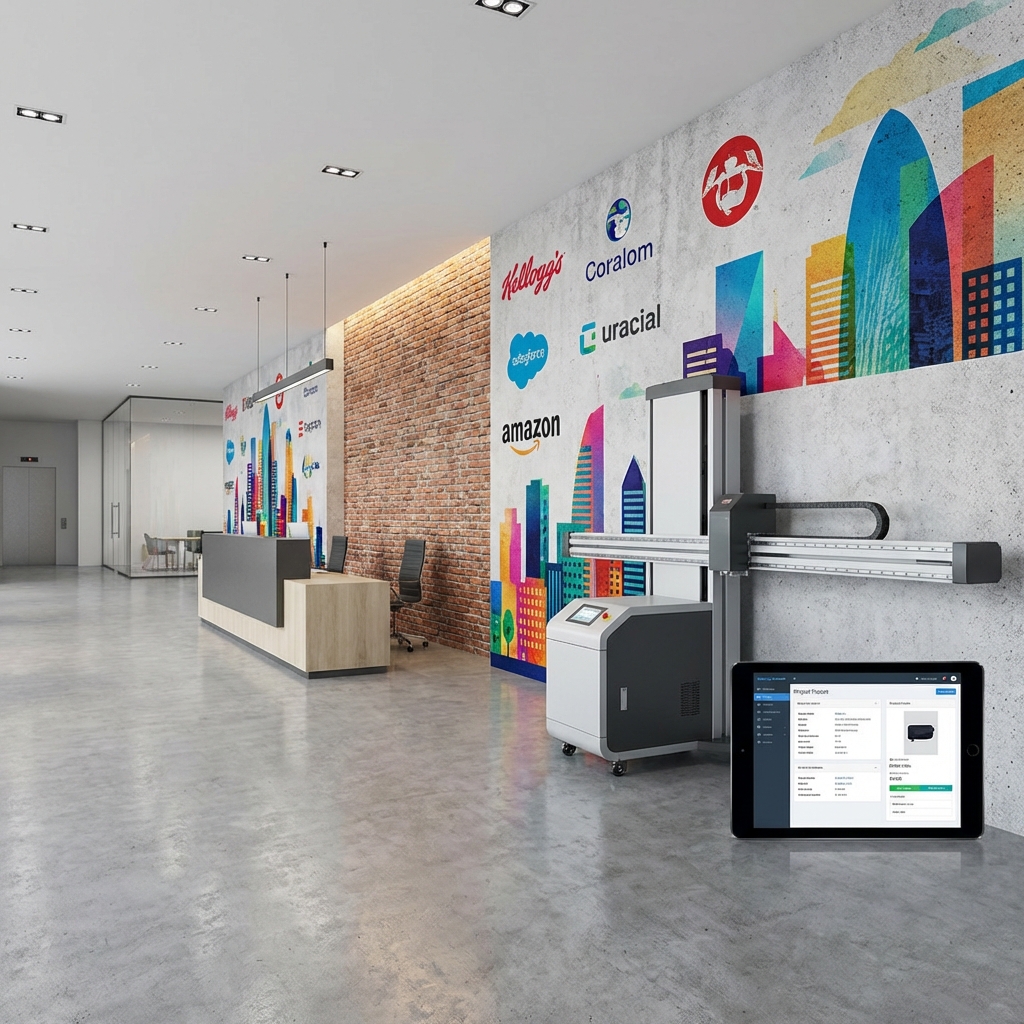
Drywall is our most common substrate. We prepare the surface, prime if necessary, and print directly. Clean installation, no additional labor required.
CMU (concrete blocks) requires light surface prep to ensure even ink adhesion, but we print successfully on CMU walls in schools and healthcare facilities constantly. The porous surface actually bonds well with our process.
Concrete and poured walls demand a primer to seal the porosity, but once prepared, they accept our graphics without issue. We’ve completed large-scale installations on parking structures, basement corridors, and industrial spaces.
Brick is more variable depending on mortar condition and surface texture. We assess each wall and recommend a primer if needed. In many heritage or renovation projects, clients prefer printing directly onto brick for authentic texture integration.
This flexibility is essential for organizations managing mixed building stock. Instead of selecting a solution that works on only one surface type, we bring one process that adapts to your facility’s reality. That consistency simplifies procurement, training, and project management across multiple properties.
Installation Speed and Minimal Disruption Advantage
Most of our installations finish in under 5 hours. A typical 800-square-foot mural goes up in a single shift, allowing hospitals to maintain operations, schools to stay open, and offices to avoid after-hours work windows.
Compare that to vinyl wraps, which take 1-2 days and require edge sealing and curing. Hand-painted murals take weeks. Wallpaper installation takes days and requires sealing and protection afterward. Construction-based alternatives demand permitting and may block areas for days or weeks.
Our process works like this:
- Surface prep (1-2 hours)—clean, minor repairs, primer if needed
- On-site printing (2-3 hours)—we bring our equipment to your wall
- Curing (minimal)—graphics are ready for light use immediately
- Cleanup (30 minutes)—we remove protection, restore access
You can schedule installations around tenant occupancy, school hours, or business operations. We print overnight in occupied buildings if that suits your schedule. Zero shipping delays, zero fabrication errors caught mid-install, and zero guesswork—our team controls the entire process on your site.
Durability and Lifecycle Cost Comparison
Lifecycle cost is where our solution creates the clearest financial advantage for organizations planning 5-10 year horizons.
A vinyl wrap typically costs $3-6 per square foot installed, but fails or requires replacement in 3-5 years (especially in high-traffic or high-moisture areas). Removal and prep for the next solution adds $0.50-1.00 per square foot. Over a decade, you’re replacing vinyl 2-3 times—that’s significant total cost.
Our direct-to-wall printing costs $2.50-5 per square foot installed and lasts 7-10 years or longer in normal commercial conditions. Our finish is cleanable, does not peel or bubble, and when it’s time to refresh, you simply paint over and reprint. No adhesive removal, no wall damage, no prep labor—that paint-over capability saves hundreds or thousands on large-scale refresh projects.
Hand-painted murals cost $5-15 per square foot and take months, making them impractical for scale. Wallpaper costs $1-3 installed but fails in 2-3 years in high-traffic environments and stains easily.
For a 5,000-square-foot hospital or school refresh, our solution typically saves 30-40% over the total cost of vinyl replacement cycles and eliminates the operational disruption of multiple removal and reinstall events.
Design Flexibility and Seam-Free Results at Architectural Scale
We print murals up to 50+ feet wide without seams. That architectural scale allows you to integrate graphics into the actual structure—floor-to-ceiling branding in a corporate lobby, wayfinding that spans a hospital corridor, or a gallery-quality mural in a museum without any visible breaks or alignment issues.
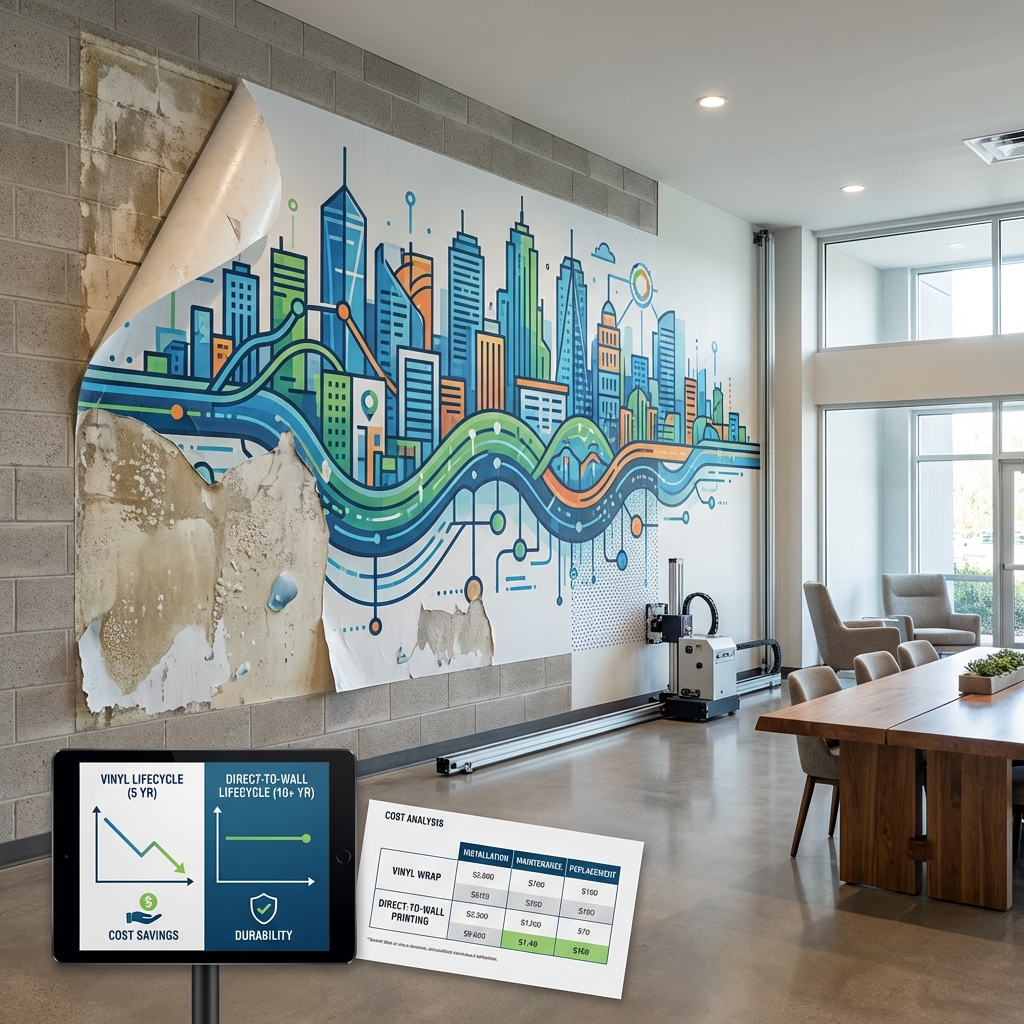
Because we print directly onto the wall, there’s no concern about panel alignment, vinyl overlap, or the visual seams that plague traditional methods. A seam-free result feels permanent and integrated, not applied.
We also print on non-wall surfaces in your studio—doors, tabletops, standees, and custom fixtures—then install them, giving you cohesive branded environments where every surface tells the same story.
Our high-resolution file preparation process ensures that your design—whether photoreal, illustrative, or data-heavy (wayfinding maps, instructional graphics, safety signage)—prints with crisp detail and color fidelity. We work with your architects, designers, and brand teams to refine files and confirm on-wall appearance before printing.
Real Applications: Branding, Wayfinding, and Institutional Graphics
We see our technology deployed across multiple use cases, each solving a specific operational need.
Corporate branding is the most common. Lobbies, conference areas, and corridors become extensions of brand identity through high-resolution color walls, logo integration, and photographic backdrops. It’s faster and more flexible than millwork or construction, and it scales across offices in different cities seamlessly.
Hospital and healthcare wayfinding integrates directional graphics, patient flow maps, and departmental signage directly into walls, reducing physical signage clutter and improving navigation without adding visual noise. We’ve mapped entire floors for major healthcare systems.
K-12 and higher education use our graphics for school identity, athletic branding, instructional content (biology diagrams, historical timelines, language learning visuals), and campus wayfinding. A university can refresh building identities or add new departmental branding without construction.
Retail and hospitality create immersive, branded environments that can be updated seasonally or with campaign changes. Multi-location rollouts remain consistent, and refreshes happen in days instead of weeks.
Museums and galleries leverage our photoreal, high-resolution capability to display artwork, historical imagery, or educational content at a scale and quality that traditional printing can’t match, without the conservation concerns of permanent installation.
Each application shares the same advantage: speed, durability, and the flexibility to change without structural commitment.
Why Our Solution Wins for Multi-Location Rollouts
Scaling across 5, 20, or 100+ locations requires repeatability, consistency, and a vendor who can manage logistics and execution in parallel.
We design and approve graphics once, then replicate them perfectly across your portfolio. Because we print on-site at each location, we adapt to local wall conditions—different CMU textures, brick types, or drywall ages—without compromising design fidelity. Your brand looks identical in your Seattle office and your Miami branch, regardless of local substrate variation.
Our subscription model allows you to schedule refreshes across multiple locations efficiently. Want to update wayfinding or seasonal branding every quarter? We plan installation windows, coordinate with local facilities teams, and execute with minimal disruption across your entire footprint.
We manage the project logistics: site surveys, file prep, coordination with your teams, and scheduling. You get predictable timelines, consistent quality, and one vendor responsible for success at every location.
For organizations with national real estate portfolios, this becomes a competitive advantage in operational efficiency and brand consistency.
The Sustainability and Performance Edge
We recognize that commercial decision-makers increasingly prioritize environmental responsibility alongside performance. Our solution excels on both counts.
Vinyl wraps and wallpaper are single-use materials that end up in landfills after removal. We reduce waste significantly by printing directly onto existing wall surfaces and using paint-over finishes at end-of-life. Our process uses lower-chemical inks compared to vinyl production, and our installation generates minimal material waste.
From a performance standpoint, our durability means fewer replacement cycles, which reduces total material consumption and installation disruption over a decade. That lifecycle efficiency compounds across multi-location portfolios—a 10,000-square-foot installation at three locations replaces what would require 6-9 traditional solutions over the same period.
Healthcare facilities and institutions with net-zero or sustainability commitments increasingly choose us for that environmental profile alongside operational benefits.
Getting Started with Your Commercial Wall Printing Project
If you’re evaluating commercial wall printing for the first time, start here:
Assess your walls and timeline. Identify the surfaces you want to upgrade, the size of the project (square footage), and your target installation window. Note the wall conditions—drywall, CMU, concrete, or brick—and any special environmental factors (moisture, temperature fluctuation, high traffic).
Clarify your goal. Are you refreshing branding, improving wayfinding, updating institutional identity, or executing a multi-location rollout? Your intent shapes design direction and scope.
Request a site survey. We visit your space, evaluate substrate condition, measure walls, and photograph existing conditions. This is how we provide accurate timelines, budget estimates, and design guidance. You get transparency before commitment.
Develop your design. Work with us, your designer, or your brand team to finalize graphics. We guide file preparation and ensure on-wall appearance matches your expectations.
Schedule installation. We coordinate timing with your operations team, confirm access and logistics, and execute on schedule. Most projects finish in a single shift or overnight window.
We’ve built our entire operation around the principle that commercial wall printing should be straightforward, reliable, and built for real-world environments. Vinyl, wallpaper, and hand-painted murals all have their place, but if you need durable, seam-free, high-resolution graphics that install quickly, scale consistently, and outperform traditional alternatives across your property portfolio—that’s what we’re built for.
Contact us today for a site assessment. We’ll evaluate your space, show you exactly how our process works on your specific walls, and help you understand why direct-to-wall printing has become the default choice for organizations that demand performance, speed, and reliability.
Contact us to learn more
Frequently Asked Questions (FAQ)
What surfaces can your direct-to-wall printing work on?
We can print directly onto drywall, CMU block, concrete, and brick without any surface preparation or adhesives. Our technology bonds the ink at the material level, so we’re compatible with both finished and unfinished surfaces across your facility. This flexibility means we can execute consistent branding across multiple buildings and wall types without delays or compatibility concerns.
How long does installation typically take, and will it disrupt our operations?
We complete most installations in under five hours, and we work in occupied buildings with minimal disruption to your daily operations. Our on-site printing approach eliminates shipping delays and fabrication errors that come with traditional vinyl or hand-painted alternatives. We coordinate timing to fit your schedule, whether that’s after hours, during off-peak times, or across a phased rollout.
How durable are these murals compared to vinyl or wallpaper, and what’s the maintenance like?
Our printed surfaces are designed for high-traffic environments and significantly outlast vinyl wall coverings and wallpaper, which typically bubble, peel, or fade within 3-5 years. We create cleanable, durable finishes that hold up in hospitals, schools, and commercial spaces with heavy use. When you’re ready to refresh or change the graphics, our paint-over-ready finishes make updates straightforward and cost-effective across your lifecycle.