Introduction: Why Direct-to-Wall Printing is Transforming Commercial Office Design
Office environments are evolving faster than most interior fit-outs can keep up. Brand updates, new teams, workplace experience initiatives, and wayfinding changes rarely line up neatly with capital improvement cycles. That’s why direct to wall printing offices have become a cornerstone of modern commercial interior strategy: they deliver architectural-scale visuals with the speed, precision, and lifecycle performance that busy organizations need.
Unlike vinyl wall coverings, wallpaper, or panel systems, commercial wall printing technology places high-resolution graphics directly on finished or unfinished surfaces—without adhesives or cumbersome seams. The result feels integrated with the architecture rather than layered on top of it. For teams charged with improving environments while keeping spaces operational, that combination of visual quality and workflow practicality is critical.
EastCoast MuralPros, a provider of next-generation direct-to-wall solutions for businesses and institutions, has pushed the category forward by pairing on-site printing with fast installation, durable finishes, and campus-wide deployment models. Offices, hospitals, schools, hospitality brands, and multi-location retailers leverage these systems to refresh spaces quickly, communicate clearly, and maintain consistent brand standards—without the maintenance baggage of vinyl or the scheduling risk of construction-heavy upgrades.
The strongest case for direct-to-wall printing in offices isn’t just about aesthetics. It’s about speed to value, predictable execution, and lifecycle efficiency. When wayfinding needs to change, a brand refresh must roll out across dozens of floors, or a tenant turnover requires a space to be market-ready by Monday, direct-to-wall printing meets that challenge with minimal downtime and maximum clarity.
Key Evaluation Criteria for Office Wall Printing Solutions
Selecting a direct-to-wall partner is a procurement and operations decision as much as a design one. The right solution balances graphic quality with speed, durability, and multi-site coordination. Use the following criteria to align stakeholders early and avoid surprises downstream:
- Installation speed and disruption: Can crews complete typical office installs in hours (not days) with minimal move/cover work? Is overnight or weekend scheduling available for occupied buildings?
- Surface compatibility: Does the system print equally well on drywall, CMU, concrete, brick, and previously painted substrates? What surface prep is required, and who owns it?
- Image quality at scale: Are photoreal, high-resolution wall printing systems truly crisp at architectural sizes, including gradients, fine lines, and small type for instructional graphics?
- Seam-free outcomes: Will the final result be a continuous, edge-to-edge visual with no panel overlaps, bubbles, or visible tiling?
- Durability and cleanability: How does the finish perform in high-traffic corridors, meeting rooms, elevator lobbies, and cafés? What cleaners are compatible?
- Paint-over readiness: Can facilities teams easily return walls to a neutral state during tenant turnover or program changes without removal labor or landfill waste?
- Wayfinding and compliance: How effectively can integrated wayfinding, safety, and instructional graphics be embedded to reduce signage clutter while maintaining clarity?
- Consistency at scale: Does the provider deliver consistent execution across multi-floor, multi-building, and multi-region rollouts? What color management and QC checkpoints are in place?
- On-site printing vs. shipped graphics: Does the approach eliminate shipping delays and fabrication errors by producing work at the wall?
- Sustainability and TCO: What lifecycle benefits are documented compared to vinyl or wallpaper (replacements, repairs, disposal, VOCs, carbon from transport)?
- Workflow and collaboration: Are there tools to help digital artists, designers, and brand teams scale their work reliably, including file prep, proofing, and approvals?
- Service model: Can you subscribe to seasonal or strategic refreshes that align to brand or facilities cycles, rather than scoping one-off murals?
Recommendation 1: Speed and Installation Efficiency for Fast-Paced Environments
For corporate real estate, facilities, and workplace teams, downtime directly impacts productivity and revenue. The first priority in choosing an office wall graphics alternative is installation speed. Direct-to-wall printing minimizes pre-fabrication and shipping dependencies by bringing the print head to the wall, not the wall to the print shop. That alone can trim days off schedule, especially when traditional vinyl programs stall due to backorders or mis-cut panels.
EastCoast MuralPros optimizes for speed and predictability with on-site production typically completed in under five hours per zone, depending on wall size and access. This timeframe includes final alignment, test passes, and full-resolution printing. Because the system is adhesive-free and seam-free, there are fewer steps that add friction—no squeegees, no re-seaming, no heat guns. For offices operating during business hours, crews can stage in off-peak windows or overnights to keep employees onsite and engaged with minimal disruption.
When evaluating providers, ask how they plan and sequence work in occupied spaces. Look for project teams who:
- Coordinate access and phasing with facilities to avoid peak traffic times.
- Provide clear site-readiness checklists (wall patching, dusting, shielding sensitive equipment, and access for lifts if needed).
- Conduct light site surveys or virtual walkthroughs upfront to confirm power access, obstructions, and floor protection.
- Build in buffer time for elevator holds, security clearance, and approvals without inflating the overall schedule.
Speed isn’t only about installation day. It’s also about avoiding friction in the weeks prior. On-site printing eliminates the “hurry up and wait” cycle that can plague vinyl or wallpaper projects, where file approvals trigger production that then triggers shipping, which can trigger reprints if something goes wrong. With direct-to-wall, adjustments to color or placement can be resolved immediately on site, reducing the need for rework and accelerating time to value.
Finally, consider how fast the approach can scale beyond a single wall. If your office network includes multiple floors, buildings, or cities, you’ll want a vendor with procedures for parallel production schedules, regionally coordinated crews, and consistent quality control. EastCoast MuralPros supports multi-site and national rollouts with standardized methods that replicate efficiently from one location to the next—helpful when corporate timelines compress around tenant improvements or brand launches.
Recommendation 2: Design Flexibility and Seam-Free High-Resolution Graphics
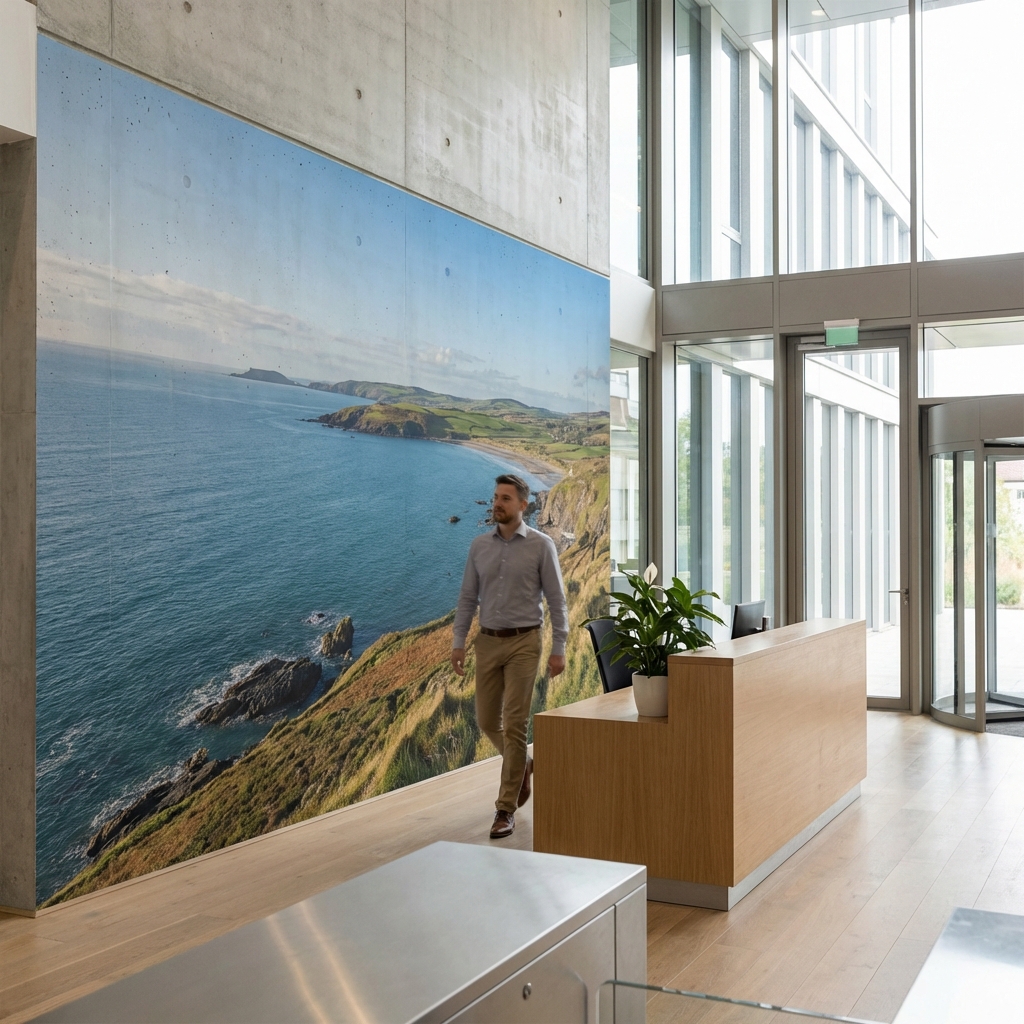
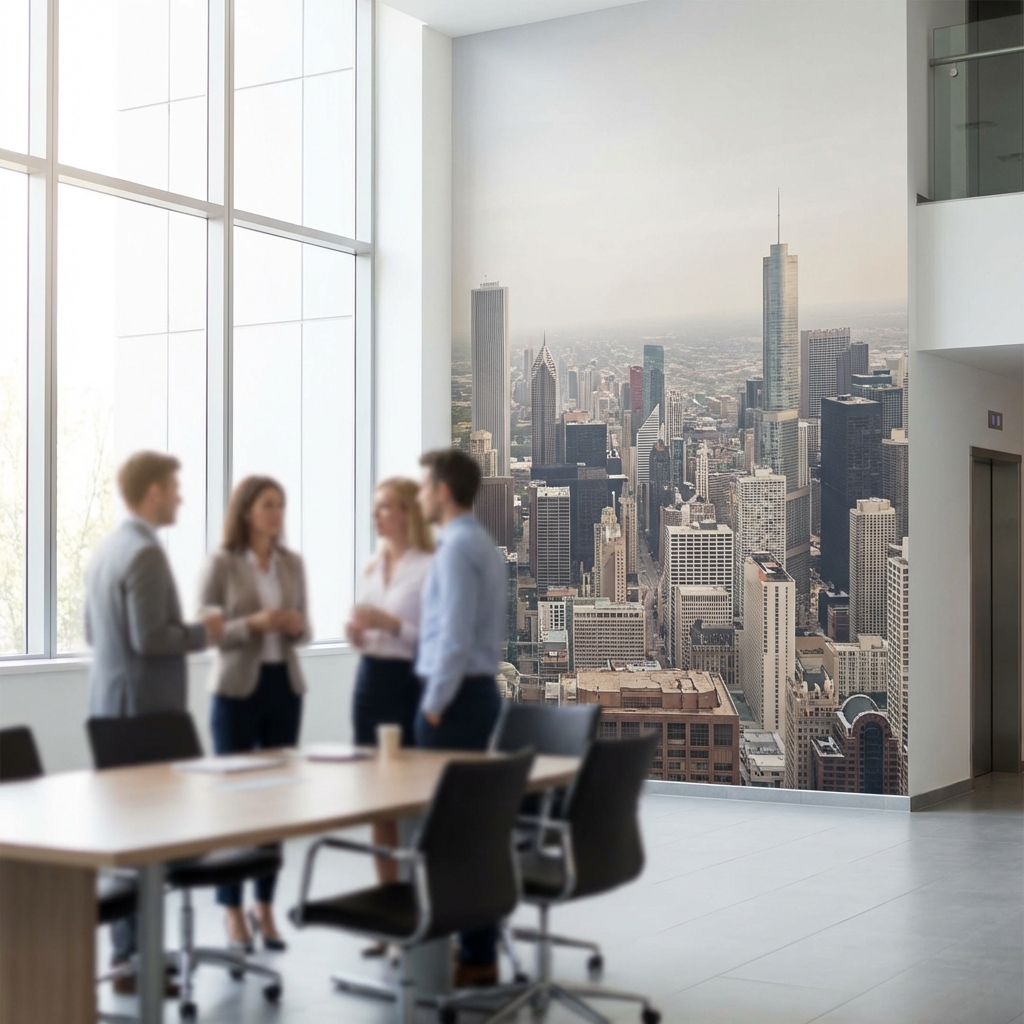
Brand storytelling in offices has become more sophisticated. Organizations need environments that communicate values, guide behavior, and enhance culture—all without creating visual clutter. Direct-to-wall printing unlocks that flexibility by delivering photoreal, high-resolution imagery at architectural scale, minus the seams and surface shine typical of vinyl. It allows rich gradients, crisp detail, and pixel-perfect typography to feel integrated into the wall, not applied to it.
Seam-free execution matters for more than aesthetics. Seams are failure points—places where edges lift, collect dirt, or become visually distracting. Adhesive-free mural printing avoids those issues while giving design teams the freedom to span long corridors or tall atriums with uninterrupted visuals. For brand moments and wayfinding, this continuity reads as intentional and permanent, even though the system remains refresh-friendly when needs change.
Design teams also benefit from robust digital workflows. EastCoast MuralPros supports collaborative tools that help digital artists, agencies, and in-house brand teams scale artwork across multiple dimensions, aspect ratios, and surfaces. This is particularly useful when designing flexible kits: a base brand story that stays consistent, with localized layers that change by floor or region. It’s far easier to proof and deploy when a vendor can preflight your files, simulate scale and placement, and then deliver consistent results at the wall.
Beyond walls, in-studio printing on doors, tables, and standees opens up a broader palette. For office environments, that means:
- Branded huddle room doors or privacy graphics without films.
- Tabletop wayfinding or touchdown guidance for activity-based workplaces.
- Standees for temporary campaigns or recruiting events that match the wall program perfectly.
Direct-to-wall printing also shines when integrating wayfinding and safety instructions directly into architecture. Corridors, junctions, and elevator lobbies benefit from clear, hierarchical graphics without reliance on protruding signs, which can add cost and crowd already tight spaces. With crisp line work and high readability, these elements become part of the space rather than accessories attached to it.
Lastly, creative risks become more feasible when the production method is reversible. Because paint-over-ready finishes are a core characteristic, teams can propose bolder looks—gradient walls, large-scale textures, or photographic storytelling—knowing that facilities can return spaces to neutral efficiently when programs, tenants, or strategies change.
Recommendation 3: Durability and Maintenance in High-Traffic Office Settings
High-traffic areas such as elevator banks, lobbies, conference centers, and café zones demand finishes that look great on day 1 and still look great on day 1,000. In office environments, scuffs, rolling luggage, cleaning protocols, and general wear can quickly expose weak points in traditional wall coverings. Direct-to-wall systems designed for durability and cleanability help reduce maintenance calls and protect brand quality long term.
EastCoast MuralPros engineers finishes for high-traffic environments so graphics are scrubbable and hold up to routine cleaning. That’s especially important in multi-tenant commercial buildings and healthcare-adjacent facilities where janitorial teams use professional-grade cleaners. If you’re comparing vendors, request documentation on compatible cleaning agents, abrasion resistance, and touch-up procedures for minor blemishes.
A few durability considerations to validate:
- Finish type: Is there a protective topcoat? How does it impact glare, color fidelity, and texture?
- Cleaning and stain resistance: Are common office scuffs removable without ghosting? Which cleaners are approved?
- Impact from furniture moves: How does the surface handle rolling chairs, utility carts, or bag contact?
- UV stability: Will exposure to natural light cause fading or discoloration over time?
- Repair protocol: If damage occurs, is spot repair feasible without panel replacement?
Direct-to-wall methods compare favorably to vinyl in these areas because there are no seams to catch or edge-lift, and no adhesive layers to yellow or fail. For facility managers concerned with lifecycle performance, that translates to fewer service tickets and lower total maintenance time.
If you’re building the business case across stakeholder groups, it may help to share a succinct overview of the direct-to-wall durability benefits. It clarifies how finish systems are designed to withstand traffic and cleaning while remaining paint-over-ready when spaces evolve.
Finally, remember that “durable” should not mean “permanent.” Paint-over readiness is a crucial feature for offices. When a lease flips or a department reconfigures, facilities teams can restore surfaces quickly, avoiding removal labor and waste associated with peeling and disposing of vinyl.
Recommendation 4: Sustainability and Lifecycle Cost Advantages Over Vinyl and Wallpaper
Sustainability goals in modern workplaces increasingly include the materials and methods used for finishes. Direct-to-wall printing offers a lifecycle-efficient alternative to vinyl and wallpaper, delivering both environmental and financial advantages without sacrificing design ambition.
Key sustainability and cost-of-ownership benefits include:
- Adhesive-free approach: Eliminates PVC-based films, adhesives, and associated off-gassing, as well as disposal of contaminated substrates during end-of-life.
- Reduced shipping and fabrication: On-site production minimizes transport emissions and the reprint risk that leads to waste.
- Longer in-service life: Durable finishes often outlast vinyl panels that may lift, bubble, or collect grime at seams, reducing replacements and maintenance cycles.
- Paint-over at end-of-life: Restoration requires standard painting rather than removal and landfill, streamlining turnover.
- Right-sized production: Because output is created at the wall, there is no excess inventory or unused panels stored and discarded later.
When you model total cost of ownership for office wall graphics alternatives, factor in:
- Initial material and labor.
- Disruption costs (lost productivity during long installs).
- Maintenance service calls over 3–5 years.
- Replacement frequency and removal labor.
- End-of-life disposal fees and environmental reporting.
In many office portfolios, direct-to-wall printing achieves a favorable TCO by minimizing replace/remove cycles and enabling faster refreshes when brand or occupancy changes occur. That speed and predictability are financial levers as much as operational ones: spaces return to service faster and marketing spend translates to in-situ impact sooner.
As sustainability reporting becomes common for corporate real estate and workplace teams, adhesive-free mural printing helps reduce embodied waste and simplifies documentation. EastCoast MuralPros’ on-site model further reduces shipping and packaging, which can be notable in multi-location programs. For teams pursuing sustainable office interior solutions, this method aligns with material reduction, lifecycle extension, and circularity goals.
Recommendation 5: Multi-Location Rollout and Consistent Brand Execution
Brand and workplace teams rarely execute a single wall in a single office. They manage floors, buildings, and regions—often under a compressed timeline. The right partner should be able to take one approved design system and reproduce it consistently across dozens of sites, adapting to wall dimensions and conditions while maintaining color accuracy and intent.
EastCoast MuralPros is structured for consistent execution across multi-location and national rollouts. The end-to-end approach includes:
- Standardized prepress: Color management and proofing workflows that lock in brand-critical tones.
- Scalable deployment: On-site printing teams who replicate methods reliably, even when sites vary (e.g., drywall on one floor, CMU in service corridors, brick in lobby areas).
- Campus-wide coordination: Tools for healthcare, higher education, and enterprise campuses to phase installations with minimal disruption.
- Documentation and QC: Centralized project tracking, wall-by-wall documentation, and punch-list procedures.
- Subscription models: Scheduled seasonal or strategic refreshes that keep experiences consistent without initiating new capital projects.
Consistency doesn’t mean homogeneity. Direct-to-wall printing supports localized content beneath a consistent brand system—regional photography, floor-specific wayfinding, or department narratives. The underlying production framework ensures these variations look like one program executed flawlessly, not a patchwork of one-off murals.
Integration with broader workplace programs is another consideration. Wayfinding, safety messaging, and instructional graphics can be integrated into walls to reduce protruding signage, especially helpful in tight corridors or where ADA clearance for mounted signs is a concern. For multi-site portfolios, consolidating this communication into the wall surface simplifies procurement, installation scheduling, and long-term maintenance.
If your rollout spans occupied buildings, ask potential vendors how they sequence work to avoid peak hours, secure approvals with property management, and handle after-hours logistics. A team experienced with corporate workplaces, healthcare environments, and education campuses will anticipate these constraints and build a schedule you can trust.
Comparison Summary: Direct-to-Wall vs. Traditional Office Wall Covering Methods
Office leaders often compare three approaches: direct-to-wall printing, vinyl/wallpaper, and hand-painted murals. Each has a place, but for high-quality, scalable, and low-disruption outcomes, direct-to-wall stands apart.
- Installation speed: Direct-to-wall is typically completed in hours, not days. Vinyl requires panel production, shipping, and panel-by-panel application. Hand-painted murals rely on individual artist schedules and extended on-site time.
- Visual quality and seams: Direct-to-wall offers seam-free, photoreal results at architectural scale. Vinyl is panel-based and can show overlaps or bubbles. Hand-painted results vary by artist and may not achieve photographic fidelity.
- Durability and cleaning: Direct-to-wall finishes are designed for high-traffic, cleanable surfaces. Vinyl edges are vulnerable to lifting and dirt. Hand-painted solutions can be beautiful but may require protective coatings and careful maintenance to avoid scuffing.
- Lifecycle and reversibility: Direct-to-wall is paint-over-ready. Vinyl requires removal and disposal; adhesives can damage paint. Hand-painted murals can require sanding/priming to restore.
- Disruption in occupied buildings: Direct-to-wall limits dust, odor, and time on site. Vinyl installs can be disruptive with panel staging and alignment. Painting requires extended on-site presence and potential odor containment.
- Multi-site consistency: Direct-to-wall excels at replicability with controlled color management and on-site calibration. Vinyl can be consistent when fabrication is flawless, but shipping errors or site conditions can derail timelines. Hand-painted murals are inherently variable.
- Sustainability and TCO: Adhesive-free, on-site direct-to-wall programs reduce PVC use and shipping waste, and lower total lifecycle costs through fewer replacements. Vinyl introduces PVC, adhesives, and disposal challenges. Hand-painting can minimize materials but often adds labor hours and protective coatings.
For organizations seeking an office wall graphics alternative that balances speed, design intent, durability, and sustainability, direct-to-wall printing represents a performance-based upgrade over traditional methods.
How to Select the Right Direct-to-Wall Solution for Your Office
Turning interest into action requires a clear selection path that includes facilities, brand, procurement, and executive stakeholders. Use this step-by-step approach to align teams and reduce risk:
- Define objectives and scope
– Identify primary outcomes: brand storytelling, wayfinding, departmental identity, visitor experience, or recruiting. – Map priority zones: elevator lobbies, reception, corridors, conference areas, cafés, wellness rooms, and touchdown spaces.
- Audit surfaces and readiness
– Document substrate types (drywall, CMU, concrete, brick) and current paint conditions. – Note access constraints (height, lifts, security zones), and plan any light patching or priming if needed.
- Align brand and design guidelines
– Confirm color standards, photography usage, typography, and readability criteria for distances typical in your corridors and lobbies. – Decide where integrated wayfinding should replace or reduce signage clutter.
- Engage vendors for proof-of-concept
– Request test prints on representative surfaces and an on-site demo if possible. – Ask for a small pilot zone to validate color accuracy, finish sheen, and cleaning performance.
- Evaluate operational fit
– Review installation schedules, overnight work capabilities, and phasing plans for occupied buildings. – Confirm that crews are trained for low-disruption installation and that safety protocols match building requirements.
- Compare lifecycle and TCO
– Ask for maintenance guidelines, paint-over procedures, and expected service life in high-traffic zones. – Model removal and refresh costs relative to vinyl/wallpaper programs.
- Validate scalability
– For multi-site portfolios, assess how the team will manage color consistency, design variation by site, and centralized approvals. – Confirm they can handle national rollouts and campus-wide sequencing.
- Decide on service model
– Consider a subscription approach for quarterly or annual refreshes tied to campaigns, hiring cycles, or leasing windows.
Questions to ask a prospective partner like EastCoast MuralPros:
- What’s your typical on-site timeline per wall or zone? How do you minimize disruption in an occupied building?
- Which surfaces are compatible, and what prep do you require?
- How do you manage color fidelity across different paints, lights, and substrates?
- What finish options exist for gloss/low-glare, and how do they impact readability for wayfinding?
- How are graphics cleaned, and what’s the recommended maintenance schedule?
- If we need to update or remove graphics, what’s the process and cost?
- What controls ensure consistent results across dozens of sites?
- Can you support integrated wayfinding and safety messages so we can reduce protruding signage?
- Do you offer a refresh subscription that aligns with our brand or leasing calendar?
Getting Started: Implementation Timeline and Budget Planning
A clear plan keeps projects moving and prevents last-minute compromises. While every office is unique, most direct-to-wall printing programs follow a predictable arc from discovery to installation.
A typical timeline for a single office or pilot area:
- Week 0–1: Discovery and scoping
– Kickoff with facilities, brand, and property management. – Define zones, objectives, and surface conditions. Gather drawings and site photos.
- Week 1–2: Site survey and test prints
– On-site walk-through to confirm access, power, and protection requirements. – Test prints on representative walls to validate finish and color under real lighting.
- Week 2–3: Design finalization and prepress
– Vendor conducts preflight, scale checks, and color proofs. – Stakeholders approve placements, messaging, and wayfinding hierarchies.
- Week 3–4: Scheduling and mobilization
– Book overnight or off-peak windows, coordinate with security and cleaning crews. – Staging plan finalized to avoid disruption.
- Install day(s): On-site printing
– Typical zones completed in under five hours, depending on size and access. – QC walk-through, documentation, and turnover to facilities.
For multi-floor or multi-location rollouts, phases can run in parallel once the system is approved. EastCoast MuralPros routinely standardizes this process for campuses and national programs so local variables don’t derail consistency.
Budget planning considerations:
- Scope drivers
– Square footage and wall height. – Surface type and any required patching/priming. – Complexity of artwork (color density, fine type, gradients). – Access constraints (lifts, security screenings, after-hours premiums). – Number of locations and phasing cadence.
- Soft costs to account for
– Internal design time or agency fees. – Coordination with property management and security. – Minor furniture moves or protective coverage in high-traffic areas.
- Savings vs. alternatives
– Reduced installation time and disruption compared to vinyl or hand-painting. – No removal labor or landfill fees at end-of-life—simply paint over. – Lower risk of reprints or shipping delays due to on-site production.
- Refresh strategies
– Leverage a subscription model for scheduled updates tied to hiring seasons, product launches, or leasing cycles. – Maintain a living brand playbook with ready-to-deploy artworks per zone type to shorten approval cycles.
How to keep approvals smooth:
- Align early with legal and compliance for safety/instructional messages.
- Share mockups at true scale so stakeholders understand readability at distance.
- Capture lighting conditions during the survey so color expectations are accurate.
- If piloting in one location, pre-plan the rollout kit (file specs, naming, placements) so success scales immediately.
Putting it together, direct to wall printing offices deliver a streamlined path from concept to impact: fast scheduling for occupied buildings, high-resolution wall printing systems that hold up in daily use, and a lifecycle-efficient method that outperforms vinyl and wallpaper on both cost and sustainability. When you need a reliable, design-forward solution that scales across portfolios without introducing new maintenance headaches, a partner like EastCoast MuralPros brings the technology, workflow, and discipline to get it done right—once, and then again wherever your brand needs to go next.
Contact us to learn more