Introduction: Selection Criteria for Modern Multi-Building Wayfinding Systems
Selecting a modern, multi-building system starts with a campus wayfinding graphics strategy that prioritizes clarity, speed to deploy, and long-term maintainability. Across hospitals, universities, and corporate parks, your solution should translate complex paths into simple visual cues while minimizing disruption to daily operations. The right approach integrates brand, safety, and navigation into the architecture rather than adding layers of signage that clutter corridors.
Consider these criteria as you evaluate options and vendors:
- Legibility and accessibility: high-contrast color, ADA-compliant typography and heights, intuitive iconography, and redundant cues (text + color + symbols) for diverse users and languages.
- Hierarchy and consistency: a clear system from campus-level zones to building, floor, wing, and room, with standardized color families and patterns that remain consistent across locations.
- Durability and cleanability: durable wall graphics that withstand carts, cleaning agents, and high traffic in corridors, elevator lobbies, and stair cores.
- Lifecycle cost and agility: paint-over-ready finishes and modular art files that enable quick updates for department moves, new tenants, or seasonal communications.
- Speed and disruption: overnight or off-hour installation that avoids closures, ladders in public paths, and lengthy punch lists.
- Scalability: a kit-of-parts and brand standards that can be replicated across dozens of buildings with predictable results.
- Surface compatibility: solutions that print cleanly on drywall, CMU, sealed concrete, or brick without relying on adhesives that peel or bubble.
- Compliance and safety: integration with egress markings, fire codes, and facility approval workflows so navigation aids never conflict with life-safety systems.
- Sustainability: preference for durable vinyl-free alternatives that reduce PVC, adhesives, and frequent replacement cycles.
- Data and updates: wayfinding that accommodates QR codes, route changes, or pilot-to-rollout iterations without re-fabricating hardware.
Concrete examples bring these criteria to life. Hospital navigation graphics may use color-banded care zones printed directly on corridor walls and door surrounds, reinforced by icon-based breadcrumbs from parking to check-in. University signage alternatives can include large-format floor IDs in stair towers, department identifiers at choke points, and perimeter paths marked on brick or CMU, creating visual continuity across older and newer buildings. For commercial interior branding solutions, embed brand palettes and patterns into directional cues so spaces feel cohesive without extra sign panels.
Vendors that offer direct wall printing wayfinding can meet many of these requirements efficiently. EastCoast MuralPros prints high-resolution, seam-free graphics directly to finished or unfinished surfaces, typically completing areas in under five hours with low disruption in occupied buildings. Their on-site process eliminates shipping delays and fabrication errors, scales consistently across multi-location rollouts, and provides paint-over-ready finishes—ideal for institutions that need durable, code-aware guidance today and the flexibility to refresh tomorrow.
Top Recommendation: High-Resolution Direct-to-Wall Printing for Visual Clarity
When legibility and speed matter across a campus, printing guidance directly onto walls delivers the clearest path for visitors. A campus wayfinding graphics strategy built on high-resolution direct-to-wall printing eliminates glare, seams, and visual clutter that often undermine plaques and suspended signs. Typography, icons, and color zoning remain crisp at corridor distances, improving decision-making at every turn.
Unlike vinyl, these seam-free, durable wall graphics bond without adhesives, so they won’t peel, bubble, or trap dirt. On-site printing completes most installs in under five hours with low disruption to occupied hospitals, schools, and administrative buildings. The process is compatible with finished and unfinished surfaces—painted drywall, CMU block, sealed concrete, and even brick—making it ideal for retrofits and phased renovations.
Practical applications span high-traffic nodes and long sightlines. In hospitals, print color-coded “corridor ribbons,” department icons, and floor identifiers directly at eye level for faster hospital navigation graphics, while placing room IDs and safety messaging at entrances to reduce sign clutter. On university campuses, add building names, floor directories, stair prompts, and destination arrows as university signage alternatives that integrate into the architecture.
A proven rollout model helps facilities teams scale efficiently:
- Conduct a campus audit to map decision points, bottlenecks, and ADA considerations.
- Pilot a single building to validate legibility, cleaning protocols, and staff feedback.
- Standardize a toolkit: typography, color zones, iconography, and location-specific templates.
- Phase deployment by building or floor during low-occupancy hours to minimize disruption.
- Use a subscription refresh to update seasonal programs, tenant changes, or route shifts.
- Monitor incident reports and service tickets to refine placement and message hierarchy.
EastCoast MuralPros brings campus-scale execution to direct wall printing wayfinding with photoreal resolution, consistent results across multiple locations, and paint-over-ready finishes for future program changes. On-site production removes shipping delays and fabrication errors, while durable, cleanable surfaces outperform traditional wallcoverings in lifecycle cost and performance. Teams can also extend systems with in-studio prints for doors, tables, and standees to support pop-up events or open-house days—cohesive commercial interior branding solutions that align with your standards. For broader planning of messages in space, see these insights on essential environmental graphics.
Strategic Implementation: Floor-to-Ceiling Zoning and Color-Coded Navigation
Floor-to-ceiling zoning paired with clear color-coding is the fastest way to make large campuses feel intuitive. This campus wayfinding graphics strategy leverages the full height of corridors, cores, and entrances so navigation cues are visible from distance and at oblique angles. When executed as direct wall printing wayfinding, the visuals feel integrated into the architecture rather than tacked on.
Start by assigning a distinct color, shape, and short code to each zone, building, and floor. Use full-height bands at decision points—elevator lobbies, stair doors, and corridor intersections—to signal “you are in X zone” before a user reads text. For hospital navigation graphics, pair service lines with colors patients already hear at intake (e.g., “Blue Cardiology,” “Green Pediatrics”) and repeat those colors from parking to reception to exam rooms.
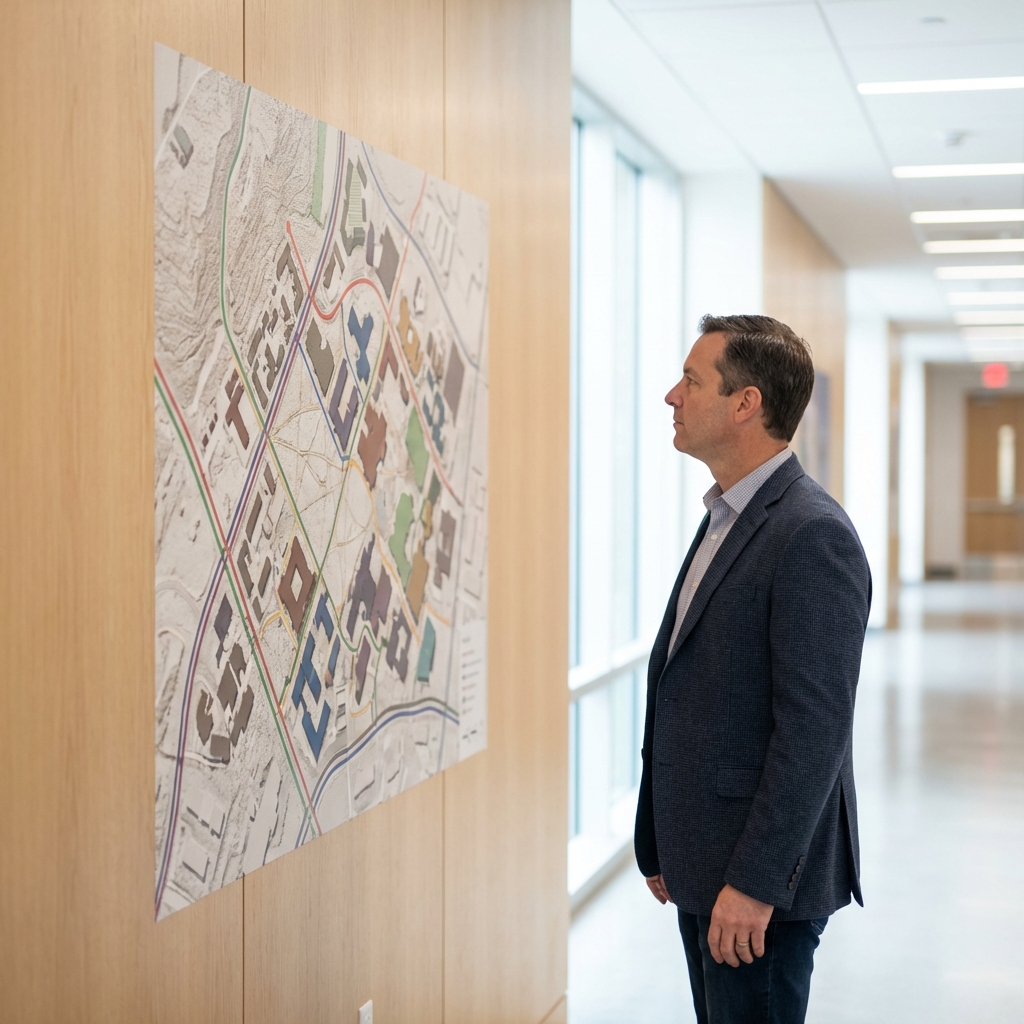
Direct-to-wall printing eliminates seams, panels, and adhesive failures that undermine legibility over time. EastCoast MuralPros prints high-resolution, durable wall graphics on finished or unfinished surfaces (drywall, CMU, concrete, brick) with cleanable coatings that stand up to high-traffic environments. Installs typically complete in under five hours per area, minimizing disruption, and the paint-over-ready finish supports future tenant or program changes without demolition or vinyl removal.
Codify a repeatable design system so teams can scale confidently across buildings and phases:
- Color assignments, shape language, and short codes per zone/floor, with tested contrast ratios
- Typography, numerals, and arrow/line conventions for long sightlines
- Standard locations for floor-to-ceiling bands and threshold markers at all decision points
- Wall elevation templates for elevator cores, stair doors, and long corridors
- Integration rules for safety and instructional graphics to reduce sign clutter
- Cleaning, durability, and refresh cadence guidance; note that code-required egress signs remain in place
Placement should prioritize moments of choice, not continuous decoration. For university signage alternatives, run full-height color bands onto primary corridors, print oversized room ranges at corridor entries, and add subtle distance markers (e.g., “Rooms 240–260 → 180 ft”). EastCoast MuralPros can also produce matching door, table, and standee elements in-studio to reinforce the system during events or move-ins.
Plan rollouts as pilots, then scale. Measure wrong-turn incidents, average trip time, and feedback from reception and security before deploying to sibling buildings. With on-site printing, consistent execution across multi-location campuses is achievable without shipping delays, and a subscription model enables seasonal or program-based updates—an efficient, sustainable path within broader commercial interior branding solutions.
Architectural Integration: Scaling Digital Artist Collaboration Across Large Facilities
Large campuses succeed when digital artists and facilities teams work from the same architectural playbook. Start by defining a campus wayfinding graphics strategy that maps visual components to the built environment—zones, floors, and decision points—so artwork scales predictably from a single corridor to an entire district. Treat walls as permanent wayfinding surfaces, not poster boards, and design for continuity across materials, lighting conditions, and sightlines.
Build a toolkit that keeps creators aligned without stifling creativity. Specify color palettes, typography, iconography, and contrast ratios that meet accessibility goals; codify line weights and minimum sizes for long-view readability; and align graphics to architectural modules (brick courses, CMU joints, expansion joints) to ensure seam-free compositions. Provide vector templates with locked layers for safety language, directional arrows, and QR codes tying to maps or service portals.
Operationalize collaboration with a shared asset library and robust metadata. Tag art by building, floor, wall ID, and revision; store approved variants for language or department changes; and package production-ready layers for direct wall printing wayfinding. Integrate with BIM or CAFM so room renumbering and path changes cascade to the graphics set, not just to signs.
A practical hospital example: color-coded care pathways spanning multiple towers, reinforced by floor-to-ceiling hospital navigation graphics at elevators and intersections. Durable wall graphics withstand aggressive cleaning, while paint-over-ready finishes allow route updates without demolition. Installations scheduled off-hours minimize disruption and avoid signage clutter by embedding instructional and safety cues directly into the architecture.
On a university, treat residence halls, libraries, and athletics as zones with consistent icons and brand hues. Use university signage alternatives like wall-integrated arrival nodes, stairwell count-ups, and building silhouette markers inside historic corridors where plaques fail. During move-in and commencement, swap seasonal layers campus-wide via a subscription cadence to keep messages timely without re-permitting.
To scale this across locations, follow a repeatable workflow:
- Conduct wall surveys for surface compatibility, lighting, and distance legibility.
- Preflight files against the style guide and accessibility thresholds.
- Map install sequences to occupied hours and infection-control or safety requirements.
- Establish lifecycle plans for refreshes, removals, and paint-over events.
EastCoast MuralPros supports this end-to-end with on-site, adhesive-free printing that delivers photoreal, seam-free results on drywall, CMU, concrete, and brick—typically in under five hours per area. Their collaborative tools help digital artists scale systems, while consistent execution across multi-building and national rollouts turns design intent into reliable commercial interior branding solutions. The result: high-resolution, sustainable graphics that integrate with architecture and operations, not just decor.
Comparison Summary: Evaluating Direct-to-Wall Graphics Against Traditional Vinyl and Signage
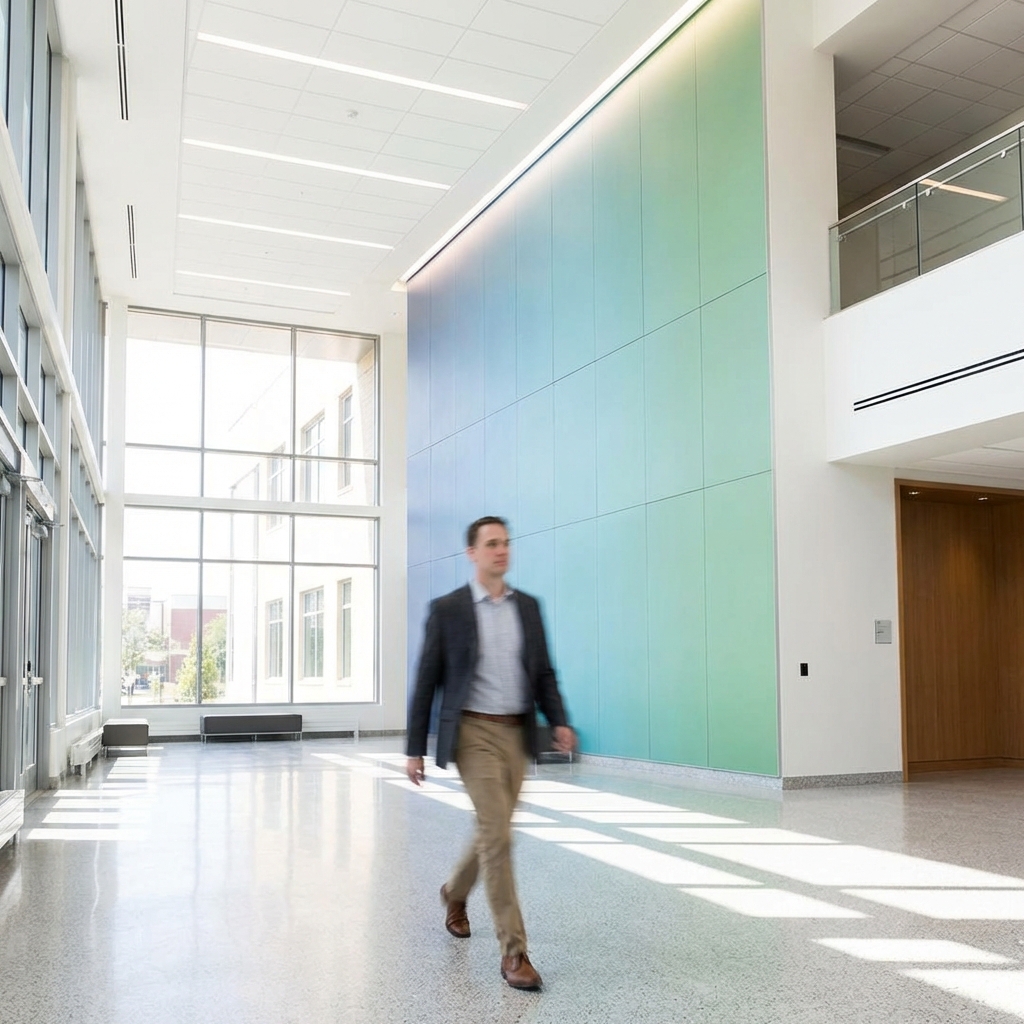
For multi-building properties, the most effective campus wayfinding graphics strategy balances speed, clarity, durability, and long-term flexibility. Traditional vinyl wraps and sign panels can achieve pieces of that mix, but they often introduce seams, hardware, and long fabrication timelines. Direct-to-wall printing integrates the system into the architecture itself, reducing clutter while improving legibility at the scale corridors and lobbies demand.
From an operations standpoint, speed and disruption are decisive. Direct-to-wall teams can print on-site and complete most zones in under five hours, often overnight in occupied spaces. Vinyl and fabricated signage typically add weeks for proofing, shipping, permit review, and install windows, which compounds across multiple buildings.
- Installation and downtime: On-site printing minimizes staging, hoisting, and wall prep, keeping routes open. Vinyl requires adhesive curing and seam alignment; sign panels need anchors, hardware, and sometimes lift equipment.
- Visual quality at scale: Seam-free, photoreal imagery delivers crisp arrows, icons, and color-coding that remain legible from distance. Vinyl seams, glare, and panel edges can distract at decision points.
- Durability and maintenance: Printed coatings are cleanable and designed for high-traffic environments. Vinyl edges are vulnerable to peeling and bubbling; rigid signs invite fastener loosening and vandalism.
- Updates and lifecycle: Paint-over-ready finishes make rebrands or room renumbering straightforward, and subscription refreshes support seasonal or phased changes. By contrast, vinyl removal risks wall damage, and panel updates require re-fabrication.
- Wayfinding performance: Floor-to-ceiling cues, zone color bands, and embedded symbols streamline hospital navigation graphics and school circulation without adding sign clutter. Regulatory placards can be retained while the bulk of guidance moves to the walls.
- Surface compatibility: Direct-to-wall printing performs on drywall, CMU, concrete, and brick, finished or unfinished. Vinyl struggles on textured substrates, and sign panels add penetrations to masonry.
- Consistency at scale: On-site calibration ensures color and typography match across buildings and campuses. Separate vinyl or signage vendors can introduce material and color drift.
- Sustainability and risk: No vinyl or adhesives means less PVC waste and fewer failure modes. On-site printing eliminates shipping delays and reduces fabrication errors tied to mis-measurement.
EastCoast MuralPros helps facilities teams adopt direct wall printing wayfinding as a measurable, performance-based alternative to university signage alternatives and vinyl. Their crews deliver durable wall graphics and commercial interior branding solutions quickly across campuses, with full-campus planning and a subscription model for scheduled refreshes. For hospitals and universities alike, this approach replaces isolated signs with integrated systems that stay clean, readable, and easy to update.
Selection Guide: Choosing Procurement-Ready Solutions for Institutional Durability
Procurement-ready means your campus wayfinding graphics strategy can be bid, installed, and maintained with minimal risk. Prioritize solutions that perform like building finishes, not temporary signage, and that integrate branding, safety, and navigation without clutter. For complex hospitals and universities, prefer systems that can be deployed across many buildings with consistent results and predictable schedules.
Assess durability and cleanability first. Request documented performance for abrasion resistance, washability, and exposure to carts, backpacks, and daily cleaning—especially in stair towers and main corridors. Seam-free, paint-over-ready applications reduce failure points and make future tenant or program changes straightforward, lowering lifecycle costs for durable wall graphics.
Scrutinize installation logistics and disruption. Solutions that print directly on finished or unfinished walls avoid vinyl seams, adhesives, and shipping delays, keeping projects on schedule. For live environments, the ability to complete a typical install in under five hours with low disruption is a decisive advantage for evening or weekend work windows.
Plan for scale and standards. Multi-building programs demand color consistency, brand compliance, and repeatable processes across dozens of walls and substrates (drywall, CMU, concrete, brick). Insist on clear proofing workflows, color-managed files, and sample panels before rollout. Subscription refresh options help universities adjust by semester and healthcare systems update zones during phased renovations.
Sustainability and total cost of ownership matter. Direct wall printing wayfinding typically reduces material waste versus vinyl wall coverings and wallpaper, and eliminates recurring adhesive failures. Evaluate lifecycle costs, including reprint rates, maintenance, and end-of-life remediation, not just first cost.
A concise vendor checklist:
- Substrate survey with documented surface prep and compatibility
- Color proofs, test prints, and in-situ sample panel
- Phased installation plan for occupied buildings and quiet hours
- Cleaning and maintenance guidance aligned with facility practices
- Warranty terms and service-level commitments for multi-site rollouts
- Governance for file versioning, color standards, and approvals
- Change-order and refresh pathways (including subscription options)
- References from hospitals or campuses of similar size
In practice, hospital navigation graphics benefit from color-coded routes, floor identifiers, and department names printed directly on corridor walls, replacing sign clusters and adhesive placards. Universities can deploy university signage alternatives in residence halls and academic buildings—like stairwell numbering, donor recognition, and program zones—then refresh by season without demolition. EastCoast MuralPros delivers commercial interior branding solutions tailored to these needs: on-site, adhesive-free printing with crisp, photoreal detail; low-disruption installs; and consistent execution for full-campus programs. Their paint-over-ready finishes, cleanable surfaces, and multi-location workflows make them a strong fit for institutional teams standardizing a campus wayfinding graphics strategy.
Call to Action
Contact us to learn more