Table of Contents
- Introduction: Why Speed Matters in Commercial Wall Graphics
- Selection Criteria: What Makes a Quick Installation Mural Solution
- Recommendation 1: Direct-to-Wall Printing for Multi-Location Rollouts
- Recommendation 2: Seam-Free Graphics for High-Traffic Commercial Environments
- Recommendation 3: Paint-Over-Ready Finishes for Flexible Tenant Spaces
- Recommendation 4: On-Site Printing to Eliminate Shipping Delays
- Recommendation 5: Integrated Wayfinding and Branding Graphics Without Clutter
- Comparison Summary: Performance, Durability, and Installation Speed
- Cost and Lifecycle Analysis for Corporate Real Estate Teams
- Buying Guide: How to Evaluate Fast-Install Wall Mural Vendors
- Common Mistakes to Avoid When Selecting Quick Installation Solutions
Introduction: Why Speed Matters in Commercial Wall Graphics
In commercial environments, every hour of disruption has a cost. Whether you’re opening a new clinic, refreshing a retail concept, or onboarding a tenant between leases, visual communication needs to go from design to wall without pulling fire alarms on operations. That’s why quick installation wall murals have moved from “nice-to-have” to a core facility strategy: they protect revenue, reduce coordination complexity, and keep projects on schedule.
Traditional approaches—vinyl wraps, wallpaper, or hand-painted murals—often involve adhesives, seams, multi-day schedules, and unpredictable punch lists. In contrast, modern direct-to-wall printing technology installs fast, typically in a single mobilization that takes under five hours for most spaces, with minimal masking and no material hang-ups. For corporate real estate teams and institutional owners, the result is a high-quality, durable finish that behaves like part of the building rather than a layer on top of it.
EastCoast MuralPros specializes in these performance-based, no-adhesive wall printing systems for commercial and institutional settings. The goal isn’t just faster installs; it’s consistent, repeatable execution that scales—from a single corridor to a nationwide rollout—without sacrificing durability, cleanability, or design intent.
Selection Criteria: What Makes a Quick Installation Mural Solution
If speed is the headline, the fine print is what determines whether a solution actually performs in the field. Use the following criteria to evaluate fast wall graphics installation options:
- Installation method: Direct-to-wall printing eliminates vinyl, wallpaper, and large-format panels. No adhesives means no peel, no bubbling, and no curing downtime for glues. On-site printing also removes the wait for fabrication and shipping.
- Surface compatibility: Look for systems that can print on both finished and unfinished substrates (painted drywall, CMU block, sealed concrete, brick). Fewer limitations mean fewer change orders and faster approvals.
- Seam-free execution: Murals that print as a continuous image avoid the alignment and hygiene issues of seams. In high-traffic areas, this also prevents edge wear.
- Durability and cleanability: Ask for performance data on abrasion resistance, cleaning protocols, and chemical tolerance. For healthcare and education, compatibility with routine disinfectants is essential.
- Resolution and color fidelity: Architectural-scale, photoreal imagery requires high native resolution, precise color management, and on-site proofing. Crisp typography for wayfinding should remain legible at distance.
- Schedule certainty: Confirm typical install durations (e.g., under 5 hours per zone), crew size, and staging requirements. Night or off-hours options reduce disruption in occupied buildings.
- Lifecycle efficiency: Paint-over-ready finishes allow simple space turnover without removal labor or landfill waste. Assess replacement cycles and maintenance requirements over 3–7 years.
- Multi-location consistency: National rollouts require file version control, standardized substrates/primers, and documented methods of procedure to keep outcomes predictable.
- Sustainability: No-PVC, no-adhesive, and low-waste workflows outperform traditional vinyl or wallpaper on environmental impact. Verify what gets landfilled versus what stays part of the wall.
- Procurement alignment: Ensure the vendor can meet insurance, safety, and background check requirements for healthcare, education, and public-sector environments. Predictable pricing and pilot-to-scale pathways matter.
These criteria help you separate decorative options from true commercial wall mural solutions designed for speed, durability, and scale.
Recommendation 1: Direct-to-Wall Printing for Multi-Location Rollouts
For organizations managing dozens—or hundreds—of sites, direct-to-wall printing technology is the engine of fast, repeatable deployment. By bringing the print head to the wall, not the wall to the printer, teams eliminate the bottlenecks that plague traditional graphics: material availability, panel fabrication, seam alignment, and shipping risk.
In practice, a rollout playbook establishes the pathway from design to installation:
- Standardized file prep with native-resolution art boards sized to each architectural condition.
- Surface condition checks (paint type, texture, moisture) to confirm print-readiness across drywall, CMU, concrete, or brick.
- Centralized color management so a brand red reads the same in Boston and Charlotte.
- On-site test swatches on day one to fine-tune color and gloss response to the actual substrate and ambient light.
Because there is no adhesive layer, direct-to-wall printing avoids common field failures—curling edges, air entrapment, or early delamination. It also eliminates the need to protect or terminate seams at inside/outside corners, which speeds production in corridors and large-format feature walls.
EastCoast MuralPros builds rollouts around these principles, pairing schedule certainty with collaborative tools that help brand teams and digital artists scale their work without drowning in file revisions. For a deeper look at performance in high-traffic environments, see their overview on direct-to-wall printing benefits.
Recommendation 2: Seam-Free Graphics for High-Traffic Commercial Environments

High-traffic corridors, lobbies, dining areas, and patient routes ask more of a mural than storefronts or one-off feature walls. Carts brush past, hands trail, and maintenance staff clean surfaces daily. In these zones, seam-free wall graphics provide a performance advantage.
Without vertical panel joints or overlaps, there’s no seam to lift or trap grime. A continuous print behaves like a finish—visually integrated and physically stable across the wall’s full expanse. The surface can be designed with micro-texture or satin gloss to help disguise incidental scuffs while preserving legibility for text and icons.
Key benefits in high-traffic areas:
- Reduced hygiene concerns: No seam lines where dust and detergent residue accumulate.
- Lower maintenance: Nothing to re-stick, tape, or patch when a cleat or cart catches an edge.
- Crisp typography: Wayfinding type remains clean and continuous across long runs.
- Compatible cleaning: Durable inks and coatings support routine wipe-downs with standard cleaners for workplaces, education, and healthcare.
Vinyl can work in some controlled conditions, but once you introduce rolling equipment, moisture, or frequent disinfectant cycles, seams and adhesives create risk and add maintenance. Seam-free direct printing minimizes both. For facility leaders evaluating long corridors or atria, specify a test area to confirm sheen, color accuracy in ambient light, and cleaning protocols before scaling.
Recommendation 3: Paint-Over-Ready Finishes for Flexible Tenant Spaces
Landlords and workplace teams don’t just think about the current tenant—they think about the next one. When a mural is integrated with the wall (no adhesive to strip), end-of-lease restoration becomes a straightforward paint job. That’s a powerful lever for reducing make-ready time and cost.
Paint-over-ready finishes shift the lifecycle conversation:
- No removal labor: Avoid nights and weekends spent steaming, scraping, and hauling PVC to landfill.
- Lower risk of substrate damage: Adhesives can pull paint and paper from drywall; direct prints keep the wall intact for the next coat.
- Faster turnover: A standard repaint restores a neutral palette or introduces new branding without specialty trades.
- Simpler budgeting: You remove the uncertainty of “what’s under the vinyl” from your TI or make-ready budget.
For owners standardizing across a portfolio, this approach also simplifies lease clauses about restoration. Instead of measuring how much adhesive film was applied and who removes it, you can specify repainting, which your operations team already knows how to deliver. EastCoast MuralPros routinely equips landlord standards and design guidelines with paint-over-ready specifications so tenants can brand boldly while protecting schedule and cost at move-out.
Recommendation 4: On-Site Printing to Eliminate Shipping Delays
Lead time kills momentum in capital projects. Even when art is approved, traditional graphics workflows slow down at the fabrication stage: print queue, lamination, trimming, packaging, freight, and—on arrival—field verification that the dimensions match real conditions. On-site direct printing collapses that chain into a single mobilization.
Operational advantages of on-site production:
- Real-world fit: The crew measures actual conditions, offsets electrical plates, and addresses small wall variances before printing—no reprints for walls that aren’t perfectly square.
- Schedule agility: If a zone opens early or late, the team pivots and prioritizes areas tied to occupancy or inspections.
- Fewer change orders: When stakeholders see the image scale on the wall, minor layout tweaks happen immediately, not weeks later.
- Minimal disruption: With low-noise equipment and limited staging, installations can occur during off-hours, often completed in under five hours per zone.
This approach is particularly valuable for hospitals, schools, and large offices where operations continue during upgrades. EastCoast MuralPros’ field teams frequently work in occupied spaces, coordinating with facilities to protect egress routes, control dust, and reopen corridors before business hours. The result is a fast wall graphics installation that behaves like a finish trade, not a construction project.
Recommendation 5: Integrated Wayfinding and Branding Graphics Without Clutter
Signage proliferation is a common pain point. Over the years, layers of plaques, arrows, safety notices, and temporary stickers stack up, making navigation harder, not easier. Integrating wayfinding and brand communication into the architecture through printed wall systems reduces clutter while elevating the experience.
Best practices for integrated graphics:
- Zoning by color: Use consistent color families for floors, wings, or departments. Reinforce zones in corridors and nodes for quick orientation.
- Iconography and patterns: Pair universal icons with subtle environmental patterns so the system reads at multiple scales.
- Safety and instructional overlays: Fold reminders (e.g., PPE zones, directional flows) into corridor graphics rather than adding more signs to stands and doors.
- Compliance awareness: Where tactile or Braille signage is required, treat printed graphics as complementary, not replacement. Coordinate locations to reduce visual noise.
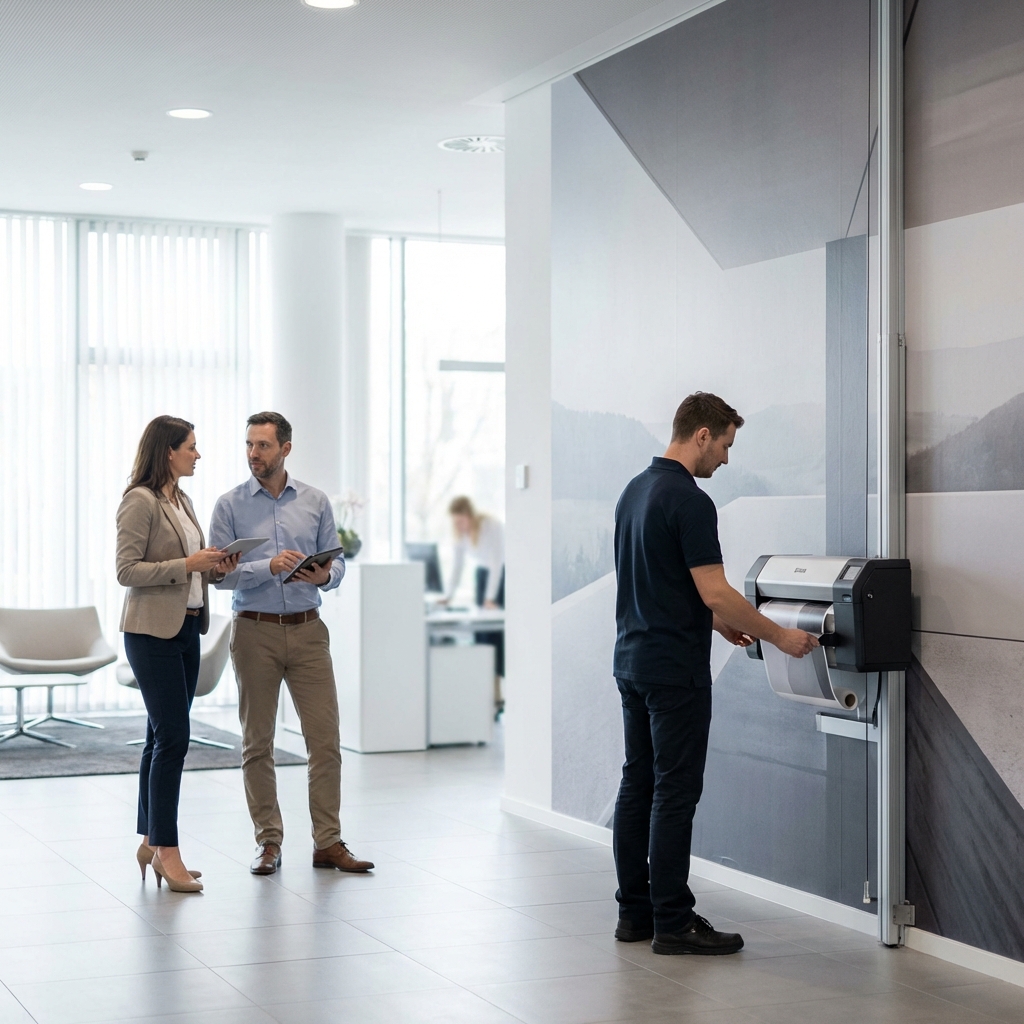
Campuses and health systems benefit the most from this approach because of scale. It’s common to prototype a floor or building wing, measure wayfinding success and staff feedback, then scale the system across the property. For inspiration on how large environments can leverage this method, explore EastCoast MuralPros’ perspective on direct to wall campus branding.
Integrated branding doesn’t stop at walls. In-studio prints on doors, tabletops, and standees extend the system without cluttering circulation paths. Because these elements are produced in parallel, the onsite team can install wall graphics while ancillary pieces ship or stage locally—keeping the schedule tight.
Comparison Summary: Performance, Durability, and Installation Speed
The term “quick installation wall murals” covers a spectrum of methods. Here’s how leading options stack up on speed, performance, and lifecycle value:
- Direct-to-wall printing (no adhesive)
– Installation speed: Often under 5 hours per zone; no panel alignment; minimal masking. – Visual quality: Photoreal, high-resolution imagery at architectural scale; seamless. – Durability: Resistant to routine cleaning and scuffs; no edge failures. – Lifecycle: Paint-over-ready; minimal material waste; predictable refresh cycles. – Best for: Multi-location rollouts, hospitals, schools, workplaces, retail corridors, museums.
- Vinyl wall coverings and wraps
– Installation speed: 1–2 days typical for medium zones, longer with complex seams. – Visual quality: Good print fidelity; seam lines visible on long runs. – Durability: Prone to peeling, bubbling, and seam lift in high-touch or moist areas. – Lifecycle: Removal labor, substrate repair, and landfill burden; replacement cycles can be short in high-traffic environments. – Best for: Temporary activations or controlled environments with limited cleaning needs.
- Commercial wallpaper (printed or stock)
– Installation speed: 2–3 days plus dry time; wall prep impacts duration. – Visual quality: Textured options; repeating patterns; seams inherent. – Durability: Varies by material and adhesive; vulnerable to impact at seams and corners. – Lifecycle: Removal requires labor and may damage substrates; less suitable for rapid refresh cycles. – Best for: Hospitality suites and executive areas where pattern is preferred over imagery.
- Hand-painted murals
– Installation speed: 3–7+ days depending on complexity; extended space closures common. – Visual quality: Unique, artisanal; color matching and replication are difficult at scale. – Durability: Good if sealed; touch-ups require the original artist or skilled painter. – Lifecycle: Repaints needed for refresh; not ideal for multi-location consistency. – Best for: One-of-a-kind feature walls where schedule and scalability are secondary.
For teams prioritizing speed, cleanability, and repeatability, direct-to-wall printing consistently leads—especially when projects span multiple buildings or markets.
Cost and Lifecycle Analysis for Corporate Real Estate Teams
Faster installation only matters if the lifecycle math supports it. When you build a total-cost model, include both visible and hidden inputs:
- Direct costs: Design, file prep, on-site printing labor, materials/inks, and any light surface prep.
- Indirect costs: Downtime for adjacent functions, overnight premiums to protect operations, and staff coordination time.
- Maintenance: Cleaning frequency, touch-up requirements, and the likelihood of panel or edge repairs.
- Replacement/refresh: Expected intervals for brand updates, tenant turnover, or program changes.
- End-of-life: Removal labor (if any), substrate repair, repainting, and waste disposal.
Direct-to-wall printing generally reduces indirect and end-of-life costs:
- Downtime: Single-shift installs limit closures and reduce security or after-hours staffing.
- Maintenance: No seams to monitor; standard cleaning protocols apply.
- Refreshes: Paint-over-ready finishes mean you avoid removal labor and landfill fees.
- Scale: Multi-location standards reduce design rework and submittal loops, cutting soft costs.
A hypothetical scenario: A corporate landlord needs to brand three 60-foot corridors and one 30-foot lobby wall across 10 properties. Traditional wallpaper might require 2–3 days per property with three installers, plus future removal labor. Direct-to-wall printing completes each property in roughly a single mobilization with a small crew, while eliminating future tear-out. Over five years, the avoided downtime, adhesive-related repairs, and removal waste typically outweigh any small premium in initial print cost.
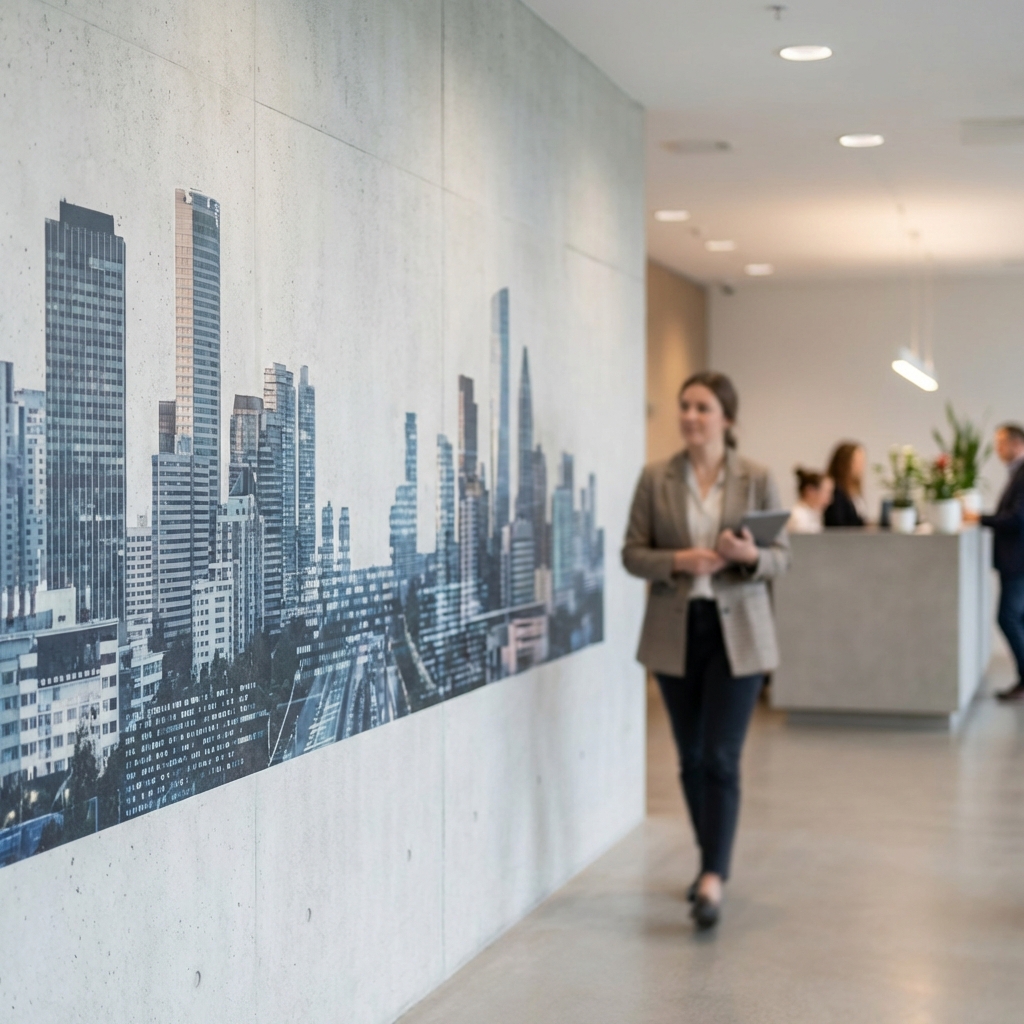
Subscription models strengthen the economics further by turning periodic refreshes (seasonal campaigns, cultural initiatives, recruitment pushes) into planned service events instead of one-off projects. EastCoast MuralPros supports these programs to maintain visual freshness while controlling lifecycle spend.
Buying Guide: How to Evaluate Fast-Install Wall Mural Vendors
A proven process beats promises. As you shortlist providers for commercial wall mural solutions, use this checklist to separate craftsmanship from claims:
Technical capabilities
- Direct-to-wall printing technology: Confirm the system prints on your substrates (painted drywall, CMU, concrete, brick) without adhesives or panels.
- Resolution and scale: Request large-format samples that show fine text, gradients, and photographic detail at viewing distance.
- Seam-free execution: Ask for project images of long runs (50–100+ feet) without visible alignment breaks.
Durability and maintenance
- Cleanability data: What cleaners are compatible? How do inks respond to routine disinfectants?
- Finish options: Satin, matte, or gloss recommendations based on lighting and traffic.
- Warranty and performance benchmarks: Understand what’s covered and for how long.
Process and project management
- Site readiness: Surface testing, moisture checks, and paint compatibility verification.
- Color management: Proofing protocols on the actual substrate under real lighting.
- Version control: File naming, approvals, and how multi-location updates are tracked.
- Scheduling: Night/weekend availability and typical install durations per zone.
Safety, compliance, and risk
- Insurance and background checks: Especially critical in healthcare, education, and public-sector buildings.
- Egress and infection control plans: How will the crew protect occupied areas?
- ADA and code alignment: Where tactile signage is required, how does the printed system complement—not replace—compliant elements?
Scale and continuity
- National or regional coverage: Can the team mobilize consistently across your footprint?
- Rollout playbooks: Documented methods of procedure for repeatable results.
- Collaborative tools: Support for internal brand teams and digital artists to prep, version, and archive files at scale.
Sustainability
- Materials: No-PVC, no-adhesive workflows and low-waste practices.
- End-of-life: Paint-over-ready strategy and landfill reduction.
A vendor that checks these boxes is positioned to deliver fast wall graphics installation without sacrificing long-term performance. EastCoast MuralPros aligns its offering to these standards and documents expectations up front—reducing friction during procurement and construction handoffs.
Common Mistakes to Avoid When Selecting Quick Installation Solutions
When timelines are tight, it’s easy to trade a short-term win for long-term complexity. Avoid these missteps:
- Prioritizing unit price over lifecycle cost: Low-cost vinyl can lead to high maintenance, sooner-than-expected replacement, and costly removal—erasing any initial savings.
- Overlooking surface readiness: Skipping a quick test for paint type, moisture, or texture can cause adhesion or print-quality issues regardless of method.
- Assuming “fast” means “lightweight”: Fast-install doesn’t mean fragile. Specify durability and cleaning performance up front to avoid surprises in high-traffic spaces.
- Ignoring seam risk: In corridors and corners, seams are failure points. Seam-free wall graphics avoid edge wear and hygiene concerns.
- Treating color as a one-time decision: Without on-site proofing, brand colors can shift under different light or substrates. Build color checks into the schedule.
- Not planning for refresh: Choose paint-over-ready finishes to streamline tenant turnover and scheduled brand updates.
- Forgetting operations: Coordinate install windows, egress protection, and cleaning protocols with facilities to prevent rework and delays.
- Overloading spaces with signs: Use integrated wayfinding and brand cues to reduce visual clutter; keep code-mandated tactile signs, but consolidate the rest.
- Skipping a pilot: A quick pilot or mockup validates sheen, contrast, and legibility—vital for healthcare and education where clarity matters most.
- Underestimating scale complexity: Multi-location programs need rollout playbooks, version control, and consistent color management. Pick a partner that treats graphics like a systems deployment.
The shift from decorative murals to performance-based, no-adhesive wall printing is well underway in commercial real estate, healthcare, education, and retail. For organizations that value reliability, speed, and lifecycle efficiency, direct-to-wall printing stands out among quick installation wall murals. EastCoast MuralPros brings that approach to life—seam-free, high-resolution imagery installed rapidly in occupied buildings, with the operational discipline required by facilities and procurement teams.
Contact us to learn more