Table of Contents
- Introduction: Why Commercial Spaces Need Better Wall Graphics Solutions
- What Is Direct-to-Wall Printing and How Does It Work?
- Direct-to-Wall vs. Vinyl Wall Coverings: Key Differences and Performance
- Direct-to-Wall vs. Wallpaper: Durability, Maintenance, and Cost Comparison
- Speed and Installation: Getting Results in Hours, Not Days
- Design Flexibility and Customization at Architectural Scale
- Sustainability Benefits: A Cleaner Alternative to Traditional Wall Solutions
- Applications Across Commercial and Institutional Environments
- Cost-Effectiveness Over the Lifecycle of Your Spaces
- Case Studies: Real-World Results for Multi-Location Rollouts
- Implementation and Process: From Design to Installation
- Conclusion: Why Organizations Are Switching to Direct-to-Wall Technology
Introduction: Why Commercial Spaces Need Better Wall Graphics Solutions
Every square foot of a commercial or institutional interior communicates something—brand, culture, wayfinding, safety, or simply a sense of place. Yet the tools many teams rely on to communicate at scale haven’t kept pace with operational realities. Traditional vinyl wall coverings bubble, peel, or fail at seams. Wallpaper looks dated or scuffs quickly. Construction-heavy upgrades are slow, costly, and often impossible to schedule without disrupting operations.
Facilities leaders, workplace teams, and administrators are under pressure to do more, faster—refresh environments in days rather than weeks, standardize results across multiple sites, and ensure durability in high-traffic areas. Direct-to-wall printing services address these needs by producing high-resolution, adhesive-free wall graphics on-site, at architectural scale, with minimal disruption. It’s a performance-based alternative that accelerates schedules, lowers lifecycle costs, and brings design-forward precision to environments where predictability and durability matter.
EastCoast MuralPros helps organizations make that shift. The company’s approach is engineered for busy, occupied buildings—healthcare systems, higher education, corporate offices, museums, hospitality, and retail—where downtime is expensive and quality can’t be compromised.
What Is Direct-to-Wall Printing and How Does It Work?
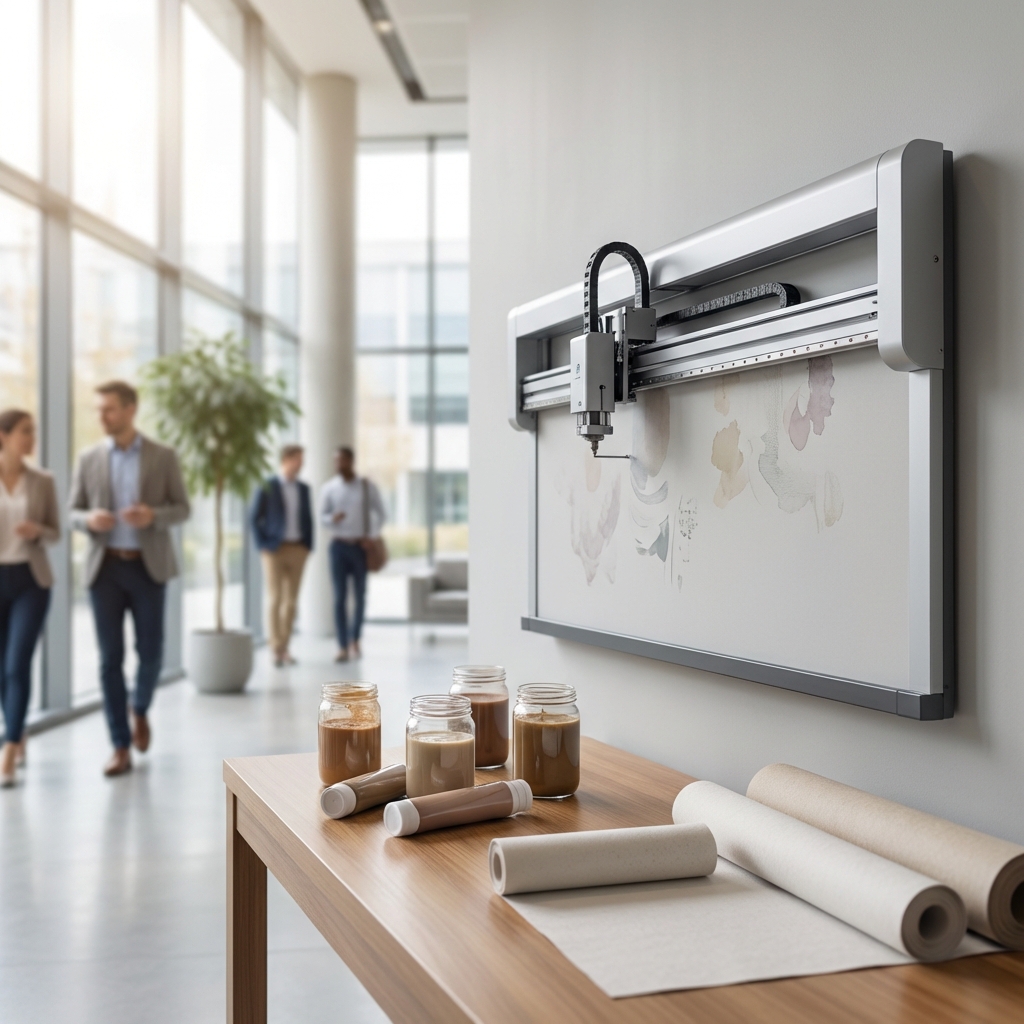
Direct-to-wall printing is an on-site production method that prints digital artwork, branding, or wayfinding directly onto surfaces—no vinyl, wallpaper, or adhesives required. Instead of fabricating graphics in advance and shipping panels to a site, a mobile wall printing system is set up in your space and calibrated to your wall, producing a seam-free image that reads like part of the architecture.
Here’s how the process typically comes together:
- Site evaluation: Walls are assessed for material, flatness, and finish (e.g., drywall, CMU, concrete, or brick). Minor surface prep—patching and spot sanding—ensures a consistent print base.
- File preparation: Designers supply high-resolution files. A prepress review checks scale, color targets, and legibility at distance.
- On-site calibration: The wall printer aligns to vertical and horizontal references and runs small test patches so stakeholders can approve color, density, and finish.
- Production: The system prints directly to the wall in precise passes, delivering high-resolution mural printing with crisp detail across continuous surfaces.
- Cure and protection: Once printing is complete, the energy-efficient curing process hardens the ink system. The result is a cleanable, abrasion-resistant finish that can be painted over in the future if programs or tenants change.
Because there are no adhesive films or panel seams, the final look feels integrated, not applied. EastCoast MuralPros routinely prints on finished and unfinished surfaces and can accommodate architectural elements such as recesses, columns, and radius walls, avoiding many of the constraints that complicate panel-based graphics.
For teams that manage content at scale, direct-to-wall printing services also include digital tools to streamline collaboration. Artists and brand teams can scale their work across floors, buildings, and markets without worrying about panelization or matching seams. The result is faster approvals, predictable outcomes, and consistent quality from site to site.
Direct-to-Wall vs. Vinyl Wall Coverings: Key Differences and Performance
Vinyl wall coverings are familiar, but their failure modes are too: edge lift, trapped dust, bubbles, and visible seams that telegraph through graphics. Adhesives can vary by wall finish, temperature, and humidity, and even a well-installed vinyl job can be compromised by routine cleaning, cart impacts, or building movement.
Direct-to-wall changes the equation:
- Adhesive-free installation: No glue variables, no off-gassing concerns, and no panel edges to snag or collect grime.
- Seam-free at scale: Imagery reads as one continuous surface—ideal for brand walls, donor recognition, or museum-grade photorealism without tile lines.
- Durable, cleanable surface: The integrated finish resists routine abrasion and can be cleaned with non-abrasive detergents, supporting strict maintenance protocols in healthcare, education, and high-traffic corridors.
- Broad surface compatibility: Drywall, CMU, concrete, and brick are all viable. Textured or unfinished substrates that challenge vinyl adhesion become opportunities rather than risks.
- Predictable lifecycle: Eliminating film and adhesive layers reduces the most common points of failure and extends the useful life of the graphics.
Vinyl’s logistics also add time and cost. Files are panelized and queued for fabrication; panels must ship, be stored, and staged; misprints or shipping damage push schedules. With on-site wall printing technology, production happens in the space. There are no panels to miscut or replace, and corrections can be made in real time.
For an environmental and waste comparison, see EastCoast MuralPros’ analysis of direct-to-wall vs vinyl.
Direct-to-Wall vs. Wallpaper: Durability, Maintenance, and Cost Comparison
Wallpaper brings pattern and texture but rarely holds up to institutional realities. It scuffs, stains, and frays at seams; moisture and cleaning chemicals accelerate aging; and replacement often requires extensive removal, wall repair, and downtime. Even specialty wallpapers marketed for “commercial” use can show wear within a year in hallways, lobbies, and classrooms.
Direct-to-wall printing services address those weaknesses:
- Higher durability under routine cleaning: The print layer sits closer to the substrate and doesn’t rely on paper or textile backings that absorb stains or delaminate.
- Lower maintenance costs: No seams to re-roll, no lifted corners to re-adhere, and fewer call-backs for “cosmetic emergencies.”
- Paint-over-ready: When it’s time to refresh, walls can be spot-repaired and repainted without stripping adhesives or scraping residues—saving labor and eliminating disposal of bulky wallpaper waste.
- Fewer lifecycle disruptions: Upgrades can be staged overnight or between shifts. Schools can rebrand during a long weekend. Hotels can update floors one night at a time without blocking rooms for days.
From a cost perspective, wallpaper’s apparent material savings are often offset by installation complexity, repairs, and recurring replacement cycles. Direct-to-wall avoids those compounding costs and preserves schedule certainty—two advantages that frequently outweigh any line-item difference in the initial spec.
Speed and Installation: Getting Results in Hours, Not Days
Commercial timelines don’t bend for graphics. Whether you’re in a tenant turnover, a pre-opening sprint, or a compliance update, the deliverable is the same: get it done fast and get it right. Direct-to-wall production is built for speed without sacrificing finish quality.
What a typical engagement looks like:
- Prepress and approval: Digital proofs and scaled elevations are shared in advance for sign-off. If needed, a small in-situ swatch is printed days before the main installation to validate color.
- Scheduling around operations: Work takes place before or after business hours, on weekends, or during low-occupancy windows. Negative air or dust control is not required because there’s no sanding or adhesive application during print.
- On-site setup and print: Crews arrive with mobile equipment, protect adjacent surfaces, and calibrate quickly. Most single-wall installations are completed in under five hours, including quality control.
- Immediate turnover: The print cures as it’s produced, minimizing wait times. Areas can reopen promptly, and normal cleaning routines resume as scheduled.
On-site production also eliminates the biggest schedule risks associated with off-site fabrication: shipping delays, lost panels, and reprints. EastCoast MuralPros’ teams are structured to handle multi-wall sequences and multi-location routes efficiently, keeping brand and wayfinding programs on track across complex portfolios. For a deeper look at durability benefits that enable faster turnarounds, see these benefits of direct-to-wall printing.
Design Flexibility and Customization at Architectural Scale
Brand systems increasingly demand content that flexes by location and purpose. Direct-to-wall printing technology supports that flexibility with high-resolution, photo-true output that scales cleanly—no visible pixels or stitch artifacts—across long corridors and large feature walls.
Key capabilities for designers and brand teams:
- Photoreal imagery at scale: From museum-grade reproductions to campus hero walls, details remain crisp at close range and legible from distance.
- Seamless gradients and typography: Smooth color transitions and razor-sharp type hold together across large fields without banding or panel breaks.
- Integrated wayfinding and safety graphics: Arrows, zone markings, and instructional content can be placed exactly where they’re needed—on walls, columns, or structural elements—reducing reliance on protruding signs and minimizing visual clutter.
- Multi-location variation with brand consistency: Centralized color targets ensure core brand elements match across sites while messaging and imagery localize per market or program.
- Artist collaboration at scale: Digital artists can translate studio work into architectural installations without relearning production constraints. EastCoast MuralPros provides file setup guidance and proofing support to maintain artistic intent in built spaces.
- Cross-surface solutions: Pair on-site wall work with in-studio printed elements—doors, tables, standees, and other fixtures—to unify experiences from arrival through destination.
The output can be tuned for context—subtle matte finishes in patient areas, richer saturation in hospitality environments, or ultra-crisp linework for education and labs. Because there are no seams, patterns read as designed and photographic compositions remain uninterrupted, even across complex geometries.
Sustainability Benefits: A Cleaner Alternative to Traditional Wall Solutions
Environmental performance is a procurement priority—and adhesives, PVC films, and short replacement cycles create a lot of material waste. Direct-to-wall printing services reduce lifecycle impacts in several ways:
- No adhesives or PVC films: Eliminating adhesive-backed materials avoids plasticized substrates and the emissions associated with their manufacture and disposal.
- Minimal offcuts and packaging: On-site production limits scrap to protective masking and floor coverings; there are no pallets of panels, foam cores, or tubes to discard.
- Fewer shipments: Printing happens where the wall is, cutting transportation emissions and eliminating re-shipments from misprints or damages.
- Longer service life, less landfill: Reduced seam failures and edge delamination translate to fewer rip-and-replace cycles.
- Paint-over end-of-life: When it’s time for a refresh, standard paint covers the old image—no adhesive removal, no chemical strippers, and no dumpsters of torn vinyl or wallpaper.
These gains compound at scale. On a multi-building campus or a national retail program, the difference in landfill-bound waste is substantial. EastCoast MuralPros’ review of direct-to-wall vs vinyl outlines how material elimination and shipping reductions add up to measurable ESG wins without compromising performance.
Applications Across Commercial and Institutional Environments
Direct-to-wall printing thrives where durability, speed, and design quality must coexist. Common applications include:
- Healthcare systems and medical facilities
– Zone identification, patient-friendly graphics, and infection-control reminders integrated into corridor and room walls – Donor recognition in lobbies without mounting hardware or adhesive panels that can catch contaminants – Cleanable finishes compatible with non-abrasive hospital-grade cleaners
- Colleges, universities, and K–12
– Athletics branding on gym walls and concourses that resists scuffing from equipment and foot traffic – Wayfinding, building IDs, and program storytelling across academic buildings and residence halls – Campus-wide refreshes coordinated during summer or break periods
- Corporate workplaces and commercial real estate
– Brand storytelling, culture walls, and project showcases in lobbies and collaboration zones – Landlord turnkey suites and model floors with fast, paint-over-ready marketing graphics during lease-up – Instructional graphics that delineate zones, adjacencies, and circulation without signage clutter
- Retail chains and multi-location brands
– Seasonal campaigns, category backdrops, and queue management visuals that update on a predictable subscription cycle – Consistent color and typography across regions with localized promos or community-specific art
- Hospitality and hotels
– Corridor and elevator lobby art programs refreshed by floor or wing overnight – Guest-facing maps, amenity markers, and brand statements that withstand luggage impacts and frequent cleaning
- Museums and cultural institutions
– Exhibition-scale photoreal wall art, didactics, and timelines without panel seams – Rapid re-skins between shows, preserving wall integrity for the next curation
- Public-sector and institutional owners
– Safety, instructional, and wayfinding graphics integrated into public buildings without hardware or protruding signage
Because the technology is compatible with finished and unfinished surfaces—drywall, CMU, concrete, brick—it adapts readily to existing conditions. And for programs that extend beyond walls, EastCoast MuralPros’ in-studio printing covers elements like doors, tables, and standees, aligning the full visitor journey.
Cost-Effectiveness Over the Lifecycle of Your Spaces
A durable graphic is valuable, but predictable lifecycle costs are what drive portfolio decisions. Direct-to-wall printing frequently reduces total cost of ownership across several line items:
- Installation labor: On-site printing eliminates panel handling, alignment, seaming, and adhesive management. Setup and production are streamlined and repeatable.
- Shipping and logistics: No pallets of panels, fewer packaging materials, and no rush reprints after damaged deliveries.
- Surface remediation: Without adhesives, end-of-life refreshes don’t require stripping, scraping, or heavy wall repair. Paint-over readiness accelerates turnover between occupants or program cycles.
- Maintenance and call-backs: Seam-free graphics eliminate common failure points. Routine cleaning with non-abrasive detergents keeps surfaces presentable without early replacement.
- Downtime and disruption: Work is scheduled around operations, reducing revenue loss or productivity hits from blocked corridors, closed rooms, or extended shutdowns.
- Standardization at scale: Consistent execution across multiple locations lowers variance, simplifying procurement and budgeting.
Consider a simplified scenario. A multi-building campus plans to upgrade 40 corridor feature walls. With vinyl or wallpaper, the institution budgets for panel fabrication, shipping, adhesive install, touch-ups, and an anticipated 3–5 year refresh cycle that includes removal and wall repair. Direct-to-wall reallocates much of that spend: initial installation is faster, maintenance calls drop, and the next refresh is a paint-over plus a new print. Over two refresh cycles, total program cost typically declines—while speed and visual quality increase.
For teams that need predictable cadence and cost, EastCoast MuralPros also supports subscription-based refreshes. Seasonal or strategic updates are planned across the calendar, spreading costs while keeping environments aligned to evolving brand and program needs.
Case Studies: Real-World Results for Multi-Location Rollouts
Healthcare system, five-hospital network A regional healthcare provider needed to update wayfinding language and safety graphics across five hospitals and several outpatient clinics. Traditional signs added clutter, and prior vinyl overlays had begun to peel where carts brushed corners. Direct-to-wall printing integrated instructional arrows, department markers, and calming artwork directly onto walls at key decision points. The team scheduled overnight prints by floor, completing dense areas before morning rounds. Facilities leads reported fewer maintenance tickets for edge lift and more consistent cleaning outcomes in the first year post-installation.
National retail refresh, 120 stores A specialty retailer sought a fast, brand-consistent refresh across 120 locations before peak season. Past rollouts had been slowed by shipping delays and panelized misfits in older stores. With on-site production, crews moved market to market on a planned route, printing hero walls, fitting room corridors, and queue backdrops from centrally approved files. Color targets were locked for consistency, while promotional panels varied by region. Stores remained open, with work occurring before opening or after close. The brand achieved a unified look nationwide without reprint waste and reduced install time per location.
University campus storytelling, 14 buildings A university communications team wanted to humanize academic spaces with student portraits, research visuals, and donor stories—without committing to permanent walls that would require demolition later. Direct-to-wall printing delivered photoreal images in science buildings, libraries, and residence halls. Over two years, content rotated seasonally in select buildings using a subscription plan. Because refreshes were paint-over-ready, the campus avoided the removal costs and debris associated with wallpaper or vinyl, maintaining a living narrative across endpoints that evolved with each academic cycle.
Multi-tenant office upgrade, landlord-led A property owner prepared several floors for lease-up and needed a consistent, high-quality aesthetic across corridors and elevator lobbies. Traditional build-outs would have involved millwork, panel graphics, and permitting delays. Direct-to-wall printing created a coordinated visual program—subtle textures, directional identifiers, and brand-neutral art—installed floor by floor between showings. When tenants signed, the landlord reprinted select walls with tenant branding without removing substrates or hardware, compressing move-in timelines and reducing turn costs.
Implementation and Process: From Design to Installation
EastCoast MuralPros structures engagements for clarity and speed. A typical process includes:
1) Discovery and scoping
- Discuss goals, site conditions, schedules, and risk tolerances.
- Review floor plans and identify walls, corridors, and key wayfinding nodes.
- Align on whether you’ll print on finished or unfinished surfaces (drywall, CMU, concrete, brick).
2) Design coordination and file prep
- Provide high-resolution art and brand assets; ECP shares templates and scaling guidelines.
- Select finishes and color targets; prepare localized variations if required (languages, room IDs, promotions).
- Receive digital proofs and scaled elevations for approval.
3) Pre-install validation
- Optional on-site swatch printing for color and finish validation in your actual lighting.
- Confirm schedule windows (overnight, weekend, or off-hours) and access logistics.
4) Surface preparation
- Facilities or ECP completes minor patching or spot sanding as needed.
- Walls are cleaned and masked at floor/base where appropriate; adjacent finishes are protected.
5) On-site printing
- Technicians set up mobile equipment, calibrate to wall geometry, and run test panels.
- Production proceeds in coordinated passes; crew monitors quality continuously.
- Typical single-wall installations complete in under five hours.
6) Quality control and turnover
- Final inspection against proofs; any micro-adjustments printed immediately.
- Handover includes care guidelines for routine cleaning and spot touch-ups.
7) Program scale and subscription options
- For multi-site rollouts, ECP standardizes color management and documentation to ensure consistent execution nationwide.
- Subscription programs set a cadence for seasonal or strategic refreshes, with art swaps scheduled to minimize disruption.
Procurement teams can expect complete documentation—insurance, safety plans, and compliance details—along with transparent scheduling. For occupied buildings, work plans are coordinated to limit noise and foot-traffic interference, and spaces reopen quickly thanks to rapid curing.
Conclusion: Why Organizations Are Switching to Direct-to-Wall Technology
The demand on today’s interiors is unrelenting: communicate clearly, look exceptional, withstand constant use, and evolve without downtime. Direct-to-wall printing services meet that mandate with a combination of speed, quality, and lifecycle efficiency that vinyl and wallpaper can’t match. Adhesive-free, seam-free, and paint-over-ready, the approach integrates brand, wayfinding, safety, and storytelling into the built environment—at the pace operations require.
EastCoast MuralPros partners with facilities teams, designers, and administrators to deliver high-resolution, durable wall printing solutions across single buildings and national portfolios. By moving production on-site, standardizing execution, and aligning to your schedule, the team helps you reduce waste, cut maintenance, and keep your spaces current without disruption.
If your organization is evaluating alternatives to vinyl wall coverings and wallpaper, this is the moment to modernize your approach. Direct-to-wall printing turns walls into high-performing, brand-forward surfaces—reliably, repeatedly, and at scale.
Contact us to learn more