
Table of Contents
- Introduction: The Rise of Sustainable Commercial Wall Graphics Solutions
- What Is Direct-to-Wall Printing Technology?
- Understanding Traditional Vinyl Wall Coverings and Their Limitations
- Environmental Impact Comparison: Direct-to-Wall vs. Vinyl
- Installation Speed and Operational Disruption: Key Differences
- Durability, Maintenance, and Lifecycle Cost Analysis
- Aesthetic Quality and Design Flexibility Across Both Methods
- Sustainability and Waste Reduction: A Detailed Breakdown
- Decision Framework: When to Choose Direct-to-Wall Printing
- Decision Framework: When Vinyl Wall Coverings Still Make Sense
- Conclusion: Selecting the Right Solution for Your Commercial Space
Introduction: The Rise of Sustainable Commercial Wall Graphics Solutions
Commercial interiors are under pressure to communicate more, change faster, and waste less. Across campuses, clinics, offices, and retail networks, teams are seeking sustainable commercial wall graphics that deliver durable impact without the lifecycle headaches of traditional materials. As procurement and facilities groups evaluate options, two approaches dominate the conversation: direct-to-wall printing and vinyl wall coverings.
The market’s direction is clear. Decision-makers want eco-friendly wall graphics that reduce disruption, meet strict brand requirements, and scale across multi-site portfolios. They also need predictable timelines, cleanable finishes, and a pathway to refresh content without adding to landfill. EastCoast MuralPros is part of this shift, offering next-generation, adhesive-free printing designed for occupied buildings and rapid rollouts. The goal is performance—graphics that look integrated with the architecture and hold up under real-world wear—delivered with less waste and less downtime.
This article provides a neutral, detailed comparison of vinyl wall coverings vs direct-to-wall printing, focusing on sustainability, speed, durability, cost, and design flexibility. It concludes with decision frameworks to help you choose the right method for your space, brief, and operations.
What Is Direct-to-Wall Printing Technology?
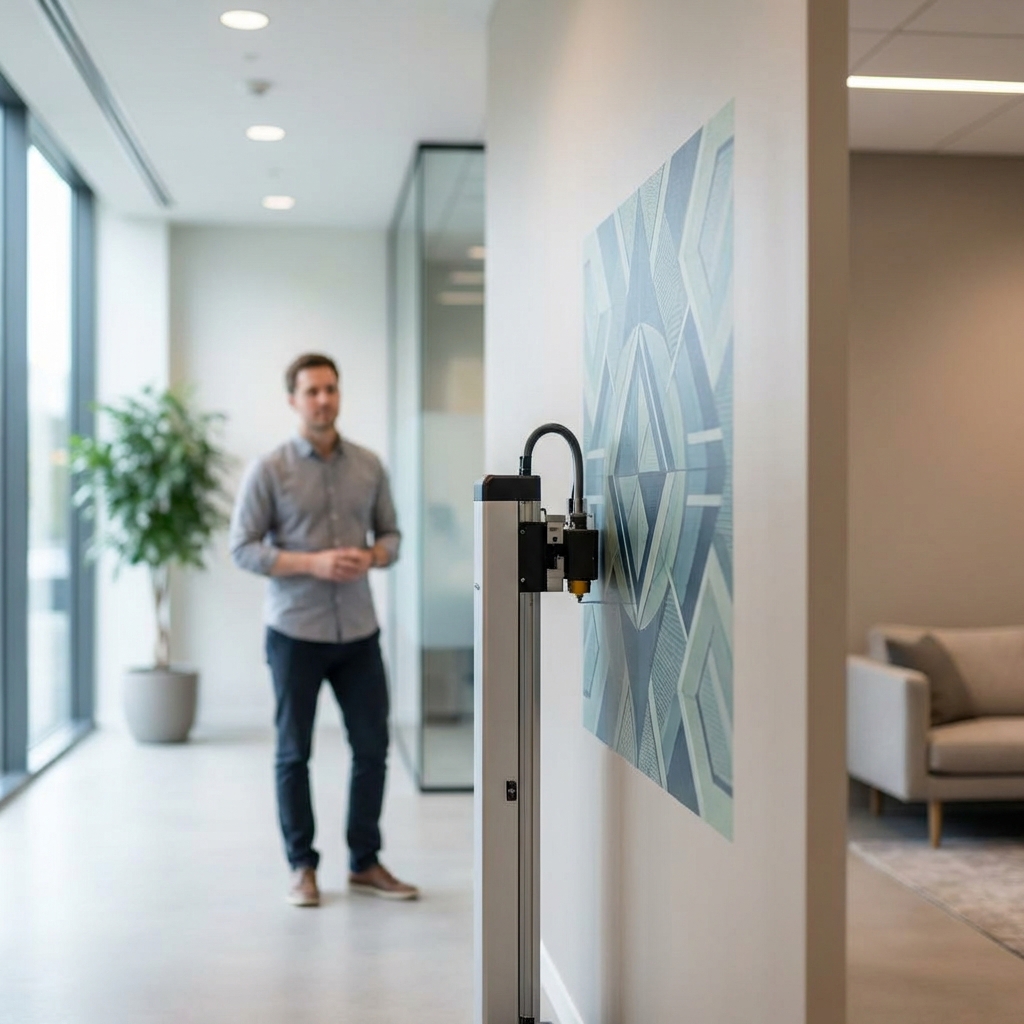
Direct-to-wall printing is a mobile, high-resolution printing process that brings a color-managed, UV-LED or similar curing print engine directly to your finished or unfinished wall. Instead of producing graphics off-site and installing them with adhesives, the printer images your artwork in place, curing each pass to bond the ink system to the substrate. The result is a seam-free, architectural-scale mural without vinyl, paste, or panels.
What this means in practice:
- No adhesives or PVC—graphics are printed directly on drywall, CMU, sealed concrete, brick, or similar finished/unfinished surfaces.
- High-definition output—photoreal imagery, crisp typography, and fine lines at architectural scale.
- Fast, low-disruption installation—large feature walls often completed in under five hours, even in occupied spaces.
- Cleanability built in—durable, non-tacky surfaces that stand up to routine wiping and high-traffic maintenance cycles.
- Paint-over-ready—when it’s time to change tenants or programs, walls can be primed and repainted rather than stripped, reducing labor and waste.
EastCoast MuralPros deploys this approach for durable commercial interior branding and wayfinding, including full-campus solutions for schools and hospitals. Their teams print on-site to avoid shipping delays and fabrication errors and offer in-studio printing for doors, tables, and standees to match environmental graphics. They also provide collaborative tools that help digital artists scale their work from concept to building-wide systems, ensuring consistent execution across multi-location and national rollouts.
Understanding Traditional Vinyl Wall Coverings and Their Limitations
Vinyl wall coverings, including printable vinyl graphics and commercial wallpaper, have long been the default for branded interiors. Typically made from PVC or PVC blends with acrylic or rubber-based adhesives, they are produced off-site, shipped in panels, and installed with careful alignment. The visibility of seams varies by product and wall geometry, but most installations require panelization and trimming.
While vinyl allows for vivid prints and a range of surface textures, facilities teams navigate familiar issues:
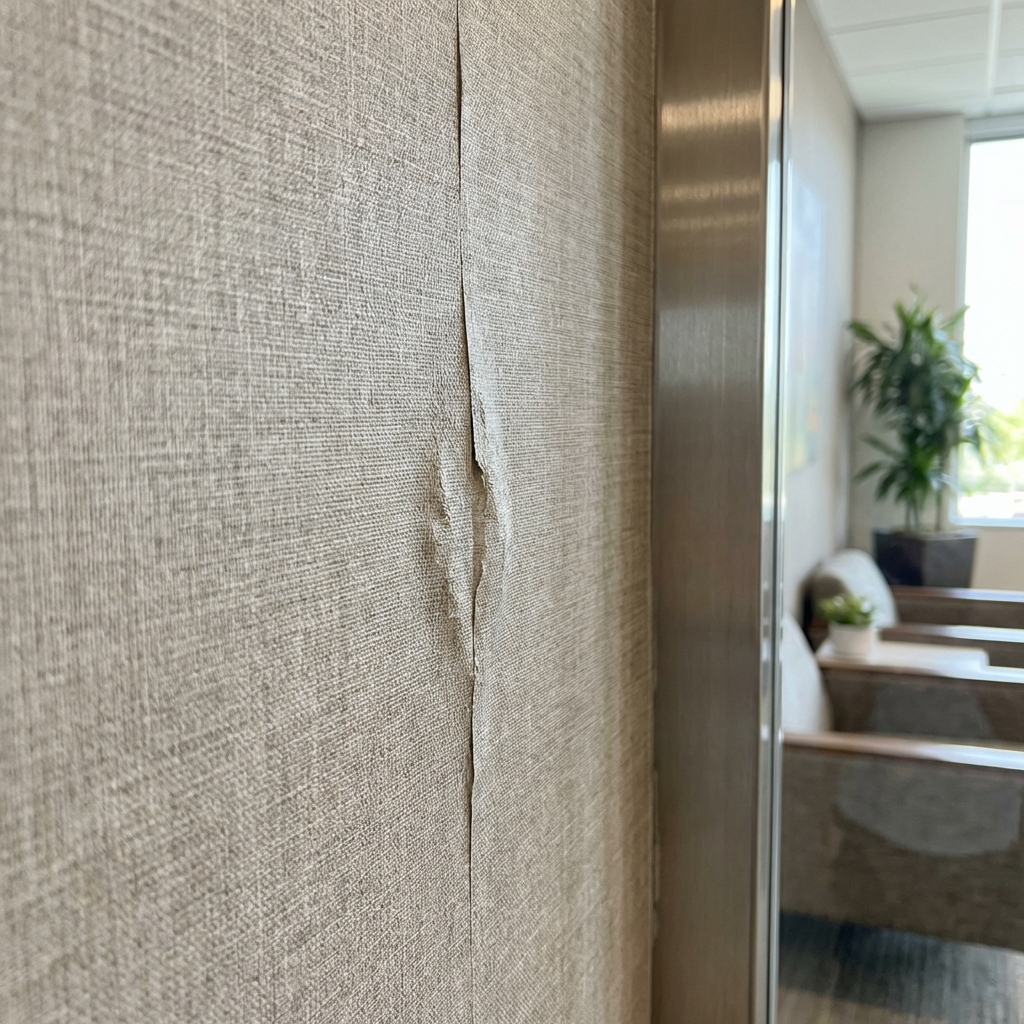
- Adhesive challenges—peeling and bubbling caused by humidity changes, surface contamination, or incompatible paints and primers.
- Seams and edge wear—panel edges can lift, collect dirt, and create maintenance lines in high-traffic zones.
- Substrate sensitivity—wall prep is critical; curing times for new paint, skim coats, and priming regimes add schedule risk.
- Odors and off-gassing—some films and adhesives introduce smells during installation, complicating work in clinical, hospitality, and office environments.
- Removal and replacement—stripping vinyl can damage walls, require patching, and take entire areas offline. Disposal typically sends PVC to landfill or incineration due to limited recycling options.
For many applications, vinyl still meets performance and budget goals, particularly where a specific texture or specialty film is required. But the cumulative impact of adhesives, panel seams, and replacement cycles has led teams to evaluate seam-free wall printing alternatives that can reduce risk and waste over time.
Environmental Impact Comparison: Direct-to-Wall vs. Vinyl
Sustainability evaluation starts with the full lifecycle—materials, manufacturing, installation, use and maintenance, and end-of-life.
Materials and manufacturing:
- Vinyl/PVC films are petrochemical products. They often include plasticizers and stabilizers and rely on acrylic or rubber-based adhesives. Release liners, cores, shrink-wrap, and cardboard packaging add one-time-use waste.
- Direct-to-wall uses no vinyl and no adhesives. Consumables are limited to inks and occasional masking materials for protection during printing. Energy usage is concentrated on-site for curing and motion control.
Transportation and logistics:
- Vinyl systems require shipping of rolls or panels and, for large projects, palettes and crating. Multi-location rollouts multiply that footprint.
- On-site printing reduces freight by delivering only the printer, inks, and minimal consumables. There is no re-shipping for reprints caused by measuring errors or panel damage because the image is created in place.
Installation waste and VOCs:
- Vinyl creates trim, panel offcuts, liner waste, and packaging waste. Some products off-gas during and immediately after install.
- Direct-to-wall generates negligible solid waste and, with UV-LED or similar curing, produces low odor and minimal VOCs. There are no adhesive fumes.
Use-phase and maintenance:
- Vinyl seams and edges can trap dirt, requiring more frequent edge cleaning or partial replacements. Harsh cleaners may haze the surface over time.
- Direct-to-wall finishes are designed for routine wipe-downs in high-traffic environments, including education and healthcare. Because the image is integrated with the substrate, there are no seams to manage.
End-of-life:
- Most vinyl goes to landfill or incineration; PVC combustion produces problematic byproducts, and true recycling remains rare for printed and adhesive-backed films.
- Direct-to-wall murals are paint-over-ready. A single layer of primer and paint typically returns the wall to white, avoiding removal labor and disposal of synthetic films.
For a deeper dive into waste and lifecycle considerations, EastCoast MuralPros has published a comparison of direct-to-wall vs vinyl sustainability. Their sustainability page also details a No Vinyl/PVC stance and related practices: Sustainable wall printing.
Installation Speed and Operational Disruption: Key Differences
Project schedules often decide the method. Direct-to-wall printing compresses lead times by eliminating off-site fabrication, color proof shipping, and panel staging. For many feature walls and corridors, teams can image, cure, and sign off on the completed mural in under five hours. Overnight or early-morning shifts keep clinics, schools, and workplaces open, a critical advantage in occupied buildings with narrow maintenance windows.
Contrast that with vinyl:
- Site measure and substrate testing
- Off-site panel production and curing/de-gassing
- Shipping, staging, and acclimation
- Multi-hour or multi-day installation—including layout, panel alignment, and trimming
- Punch list for bubbles, seams, and edge detailing
On-site printing removes friction from that chain. There are no panels to crease or reprint and no last-minute courier delays. A change in artwork or a field adjustment can be made immediately without discarding printed material. In healthcare and education, the absence of adhesive odors and rapid cure times help facilities avoid patient or student relocations. Retail and hospitality teams benefit from short closures and predictable reopenings that align with staffing and marketing calendars.
For multi-floor or multi-campus rollouts, the advantage compounds. Crews move from wall to wall and building to building with consistent equipment and profiles, producing uniform results without the variability introduced by multiple fabricators or shipping environments.
Durability, Maintenance, and Lifecycle Cost Analysis
Durability hinges on impact resistance, cleanability, and how a graphic fails when it reaches end-of-life. Seam-free, direct-to-wall graphics remove the highest-risk failure points—panel edges and overlaps—so there is no perimeter to curl and no seams to trap dirt. The cured surface is designed for routine cleaning with common detergents and, in many cases, hospital-grade disinfectants. This characteristic makes it suitable for corridors, waiting areas, cafeterias, and locker rooms.
Vinyl can also be durable, especially heavier commercial wallcoverings. Yet wear frequently starts at seams and corners, where carts, backpacks, or rolling equipment catch edges. In humid spaces or where paint systems are incompatible with adhesives, panels may lift or bubble. Maintenance teams then face spot fixes, which are usually visible due to panel-to-panel color shifts or sheen differences.
Lifecycle cost drivers include:
- Installation labor and downtime: Direct-to-wall reduces closures and repeat visits, improving cost certainty.
- Maintenance cycles: Fewer seam-related touch-ups translate to lower soft costs for facility teams.
- Replacement strategy: With direct-to-wall, refreshes are as simple as printing a new design or priming and painting over the old one. Vinyl requires removal, wall repair, and reinstallation.
- Risk and rework: On-site imaging eliminates shipping damage and fit errors. Vinyl projects sometimes encounter mismatched panels, out-of-spec trims, or field conditions that force reprints.
While exact costs vary by market, scope, and substrate, organizations piloting direct-to-wall often report lower total cost of ownership over three to five years. EastCoast MuralPros supports strategic refresh planning through a subscription model that aligns content updates with budget cycles and occupancy changes, smoothing expenses and reducing waste compared with episodic tear-outs.
Aesthetic Quality and Design Flexibility Across Both Methods
Designers increasingly demand photoreal clarity, consistent color across large spans, and typography that reads cleanly at distance. Direct-to-wall printing reproduces fine detail at scale, with precise registration across the entire surface and around architectural obstacles. Because the image is continuous, there are no panel seams crossing faces, which is especially important in galleries, museums, and executive spaces where raking light would otherwise reveal joints.
Beyond wall faces, direct-to-wall’s compatibility with finished and unfinished surfaces allows creative integration:
- Exposed CMU or brick: imagery remains crisp while the native texture reads through the print, adding depth without extra materials.
- Corners, niches, and door frames: imagery can continue seamlessly around these elements without panel trimming.
- Integrated systems: wayfinding, safety, and instructional graphics can be printed directly where needed, reducing signage clutter and providing sustainable signage solutions.
Vinyl still offers advantages when a specific texture (e.g., textiles, acoustical backings) or a metallic, reflective, or specialty film effect is required. But for most brand environments and educational or healthcare programs, direct-to-wall achieves the design intent with fewer visual compromises. EastCoast MuralPros complements wall graphics with in-studio printing on doors, tables, and standees, so accent elements can match the wall palette and typography without resorting to mixed suppliers or uncoordinated finishes.
For brand and experience teams, the ability to produce seam-free wall printing alternatives that hold crisp edges on letterforms and fine wayfinding icons reduces visual noise and improves legibility. Consistent color management across multi-location rollouts ensures campuses and networks read as one system, not a patchwork.
Sustainability and Waste Reduction: A Detailed Breakdown
Procurement teams evaluate sustainability in terms of waste streams, chemical profiles, and operational efficiencies that prevent rework. Direct-to-wall printing reduces or eliminates several categories of waste:
Material inputs:
- No vinyl or PVC, no adhesive-backed films, and no release liners.
- Minimal packaging—inks travel with the printer; there are no cores, plastic wrap, or panel cartons to discard.
- Fewer field consumables—less masking, no paste or adhesive removers.
Installation and rework:
- No panel misprints to re-order or scrap due to minor field changes.
- No panel alignment rejects, which commonly occur when site conditions force layout shifts.
- On-site color adjustments reduce the need for approved color strikes to be printed, shipped, and stored.
Use-phase:
- Seamless surfaces collect less grime along edges, often reducing the frequency of targeted edge-cleaning cycles.
- Durable finishes withstand standard cleaning protocols without specialized solvents that add chemical load to janitorial programs.
End-of-life:
- Paint-over-ready walls avoid the tear-off and disposal of synthetic films. Labor hours shift from removal to a quick prep-and-paint routine.
- Reduced landfill contribution compared with periodic vinyl replacement cycles.
Operational efficiency is a sustainability lever in itself. By installing quickly and accurately, facilities avoid extended closures, after-hours premiums, and rework. National and multi-campus owners benefit from repeatable execution that reduces wasted travel and duplicated site visits. EastCoast MuralPros documents these practices in their Sustainable wall printing overview, outlining commitments like No Vinyl or PVC, low-disruption workflows, and lifecycle-efficient strategies that align with ESG reporting.
Decision Framework: When to Choose Direct-to-Wall Printing
Direct-to-wall printing is particularly strong when operations, speed, and sustainability are decisive. Choose it when:
- You need speed and schedule certainty.
– Feature walls or corridors must be completed in a single shift. – Occupied buildings require quiet, odor-minimized work with minimal area closures.
- You want eco-friendly wall graphics with a low waste profile.
– Avoiding PVC, adhesives, and liner waste is a priority. – Paint-over-ready finishes align with turnover and renovation cycles.
- You require durable commercial interior branding for high-traffic zones.
– Seam-free surfaces resist edge wear and simplify cleaning. – Hospital, education, and public environments demand cleanable, non-tacky finishes.
- You manage complex, multi-wall or multi-location rollouts.
– On-site printing eliminates shipping variability and fabrication errors. – Consistent color and quality matter across campuses or national networks.
- Your surfaces vary or include unfinished materials.
– Drywall, CMU, concrete, and brick are within scope; texture can enhance the final look. – Niche areas, corners, and architectural elements should be integrated without panel seams.
- You plan seasonal or strategic refreshes.
– Subscription models smooth budgets, accelerate approvals, and reduce waste relative to periodic tear-outs. – Collaborative tools let digital artists scale content and update systems efficiently.
Sectors where these criteria commonly apply include healthcare systems, K–12 and higher education, corporate workplaces, cultural institutions, retail and hospitality, and public-sector owners seeking performance-based alternatives to wallpaper and vinyl.
Decision Framework: When Vinyl Wall Coverings Still Make Sense
There are scenarios where vinyl remains a pragmatic choice:
- Specialty finishes are non-negotiable.
– You need a specific tactile texture, metallic sheen, reflective film, or other specialty surface that direct-to-wall ink systems cannot replicate.
- Extremely short-term or event-only usage.
– Temporary graphics under 60–90 days where rapid removal without painting is required, and the environmental tradeoffs are acceptable.
- Severe substrate damage or future demolition.
– When walls are compromised and slated for major renovation, a heavy vinyl can mask imperfections for the interim period.
- Strict system compatibility or code requirements.
– A specific tested wallcovering assembly may be mandated by existing specifications, warranty constraints, or compliance pathways.
- Unique environmental exposures.
– Some industrial, wet, or chemical environments may call for niche films engineered for those conditions.
These cases are the exception rather than the rule for most institutional and commercial programs, but they are real. A side-by-side pilot on representative walls can confirm performance against your specific substrates, cleaning chemicals, lighting, and traffic patterns before scaling.
Conclusion: Selecting the Right Solution for Your Commercial Space
Choosing between vinyl wall coverings and direct-to-wall printing is ultimately about aligning method to mission. If your organization values sustainable commercial wall graphics, low-disruption installation, and long-term lifecycle efficiency, direct-to-wall provides a compelling, performance-based alternative. It delivers seam-free imagery at architectural scale, integrates wayfinding and instructional graphics without signage clutter, and avoids the removal-and-disposal cycle that burdens facilities and landfills.
Vinyl remains useful for niche effects or short-term needs, but for durable, design-forward programs that must scale reliably, on-site printing reduces risk and complexity. EastCoast MuralPros supports this approach with fast installations typically completed in under five hours, consistent multi-location execution, and collaborative workflows that help designers and digital artists translate vision into built environments. Whether you are refreshing a single corridor or orchestrating a full-campus rollout, the right choice is the one that safeguards uptime, delivers the desired experience, and minimizes waste over the life of the space.
If your next project prioritizes eco-friendly wall graphics, consider piloting direct-to-wall printing on a representative area. The results—visually, operationally, and environmentally—often speak for themselves.
Contact us to learn more