Introduction: Why Installation Speed Matters for Commercial Spaces
In commercial and institutional facilities, time is not abstract—it is occupancy, revenue, safety, and experience. Every hour a corridor is shut or a conference area is taped off for wall work has a ripple effect on patients, students, employees, and guests. That is why fast installation office murals have become a strategic lever for facilities, real estate, and brand teams under pressure to refresh spaces without prompting a construction project.
The choice of method has real consequences for schedule certainty. Traditional approaches—vinyl wall wraps, wallpaper, or hand-painted murals—often require multi-day sequences that involve measurement, fabrication, shipping, and extended onsite labor. Newer direct-to-wall technologies compress that timeline into a single, tightly controlled onsite session, delivering quick office wall graphics with minimal disruption.
For organizations planning multi-floor or multi-location rollouts, commercial mural installation speed is inseparable from risk management. Shorter installs mean fewer occupant impacts and a higher likelihood that work completes in off-hours or in narrow maintenance windows. This article explores direct-to-wall printing vs vinyl through the lens of speed, durability, lifecycle costs, and scale—so you can choose the right method for your facility.
Overview of Direct-to-Wall Printing Technology
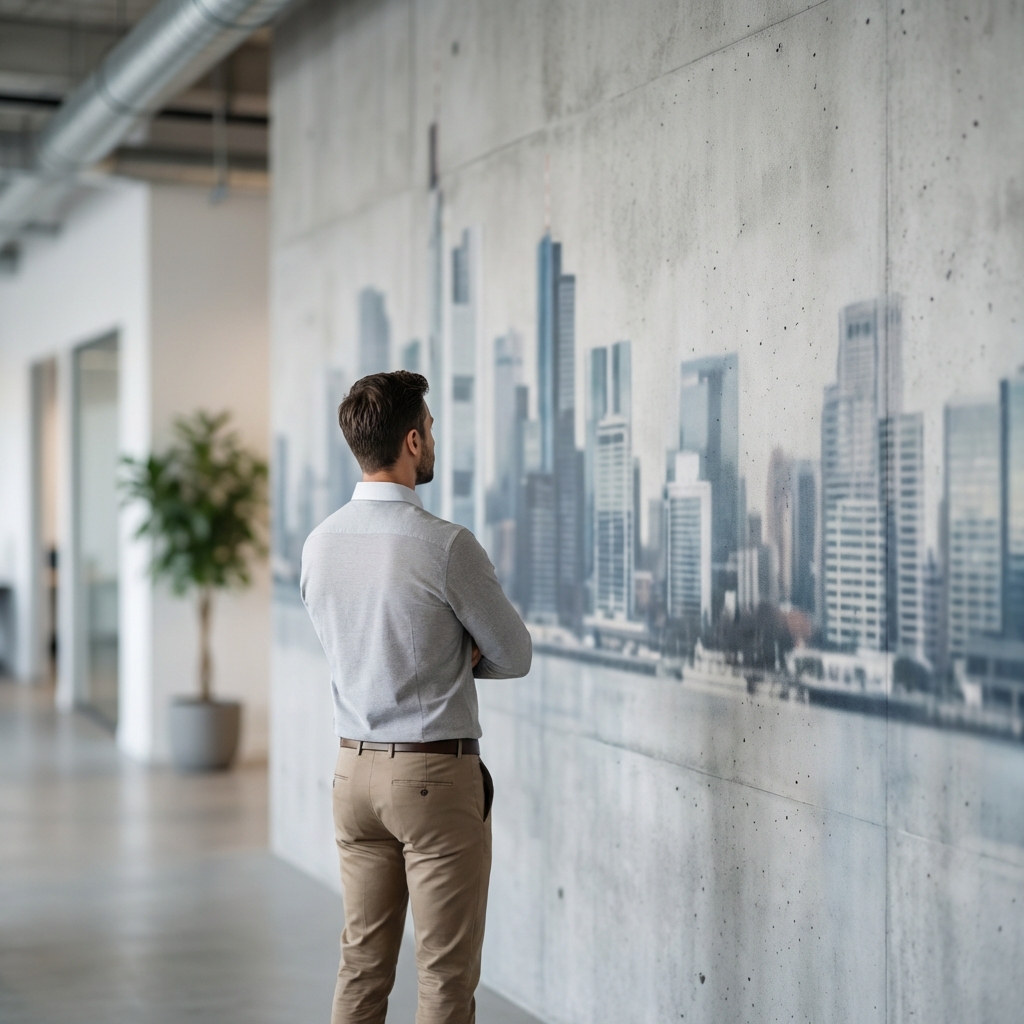
Direct-to-wall printing is exactly what it sounds like: instead of printing onto vinyl or paper and then adhering a graphic to the wall, a mobile print unit lays high-resolution imagery directly onto the surface. For commercial use, these systems deliver photoreal output at architectural scale with precise color control and crisp micro-detail—ideal for brand storytelling, wayfinding, safety communication, and museum-grade visuals.
Because the image is printed in place, there are no seams or panel overlaps to align or conceal. The result is seam-free wall printing that feels integrated with the architecture rather than applied to it. There is no adhesive, no wallpaper paste, and no panel lifting risk. When needs change, the surface is typically paint-over-ready, which simplifies refresh cycles compared with removing films or panels.
EastCoast MuralPros deploys this technology as a performance-based alternative to vinyl and wallpaper for commercial interiors. Typical installations complete in under five hours per wall, depending on size and complexity. On-site printing eliminates shipping delays and reduces fabrication errors, while low-disruption workflows keep spaces usable in occupied buildings—crucial for healthcare, campuses, and corporate workplaces.
The approach is versatile. Direct-to-wall systems handle finished and unfinished substrates such as drywall, CMU, concrete, and certain brick applications; and in-studio printing extends the same visual quality to doors, tabletops, and standees. For design teams and digital artists, collaborative file-prep tools scale one-of-a-kind artwork across multiple walls or locations without losing fidelity.
Overview of Vinyl Wall Wraps and Traditional Methods
Vinyl wall wraps remain a familiar solution: a graphic is printed offsite on a PVC or polymer film, often laminated for protection, then shipped and installed as a series of vertical panels. Installers align seams, smooth bubbles, and trim edges around outlets, corners, and baseboards. This approach can yield strong results on smooth, painted drywall and is widely supported by sign shops and print vendors.
However, panelized installation introduces complexity. Seams can telegraph in raking light, and adhesive performance may vary based on paint chemistry, humidity, and surface texture. Over time, edges can curl or collect dust, and replacing damaged sections requires reprinting and reinstalling individual panels—sometimes across an entire wall to maintain color match and panel alignment.
Traditional murals—hand-painted or custom wallcoverings—bring their own constraints. Painted murals can be remarkable but often require days of onsite work, staging, and specialty labor. Custom wallpaper relies on accurate field dimensions, panelization, and paste application; it introduces seams and can be slow to remove for future refreshes. For teams seeking quick office wall graphics with predictable schedules, these timelines can be difficult to accommodate.
In many procurement-driven evaluations, the question is no longer “what looks better,” but “what delivers more reliable performance with less disruption.” That is where the direct-to-wall model differs: it is an execution system as much as a visual medium.
Installation Timeline: Direct-to-Wall Printing vs. Vinyl Wraps
Commercial mural installation speed is a combination of pre-production efficiency and onsite execution. Both matter.
What direct-to-wall typically looks like:
- Site read: A brief surface review and dimension check; wall conditions are documented and any minor patch/paint touch-ups are identified.
- File prep: Artwork is scaled to architectural dimensions, color-managed, and queued by zone.
- Day-of install: The print unit is positioned, leveled, and calibrated. Test swatches confirm adhesion and color. The high-resolution design is printed directly on the wall, and the area reopens—often on the same shift.
For many corporate and institutional walls, EastCoast MuralPros completes printing in under five hours, including setup and cleanup. Because there is no adhesive cure or panel installation, the work fits well into off-hours or short access windows. That compression is a key reason direct-to-wall delivers fast installation office murals without extended downtime.
What vinyl typically looks like:
- Survey and measurement: Field verify dimensions and conditions.
- Fabrication: Print, laminate, and panelize. Depending on ink and shop workflows, outgassing or cure time can add a day. Errors here can trigger reprints.
- Shipping and staging: Pack, ship, receive, and stage panels onsite.
- Installation: Panel alignment, seam management, bubble removal, and trimming around devices and details. Large walls can require 1–2 days or more.
- Post-work: If edge-lifting occurs in days 1–3, a return visit may be necessary.
Even when everything goes right, vinyl is a multi-step sequence that spreads across days and dependencies. Direct-to-wall compresses those steps into a single, integrated visit—reducing schedule risk, change-order potential, and occupant disruption.
Surface Compatibility and Preparation Requirements

Surface realities drive outcomes. A technology that adapts to more surfaces, with less prep, shortens schedules and widens the range of viable locations.
Direct-to-wall printing excels on:
- Drywall and gypsum board with standard commercial paints
- CMU block and sealed concrete
- Certain brick and lightly textured substrates
- Previously painted surfaces that are clean, dry, and intact
Preparation is typically straightforward: wipe-downs to remove dust, minor patching or priming if needed, and localized masking where overspray control is prudent. Because there is no film, the system tolerates subtle texture without telegraphing seams. For programmatic installs, a test print on each substrate type confirms color and adhesion behavior before rollout.
Vinyl wraps prefer smoother, sealed surfaces. Challenges often arise with:
- Low-VOC or stain-resistant paints that inhibit adhesion
- Textured walls (heavy orange peel, CMU, or brick) where full contact is impossible
- Moisture-prone areas where edges may lift
- High-abuse zones with frequent edge contact, such as corridor corners
To mitigate risk, vinyl prep can include detergent cleaning, denatured-alcohol wipe-down, specialized primers, and, in some cases, skim-coating to reduce texture. These steps add cost and time, and still may not eliminate long-term adhesion variables. By contrast, direct-to-wall’s ability to print on finished and unfinished surfaces reduces the need for substrate modification and helps preserve existing wall assemblies.
Durability and Maintenance Comparison
Durability is where lifecycle performance is won or lost. For high-traffic environments—healthcare corridors, student commons, retail back-of-house, public-sector facilities—graphics must withstand contact, cleaning, and time.
Direct-to-wall durability characteristics:
- Seam-free surfaces that won’t bubble or lift at panel edges
- Cleanable finishes appropriate for routine facility maintenance
- High-resolution imagery that resists abrasion under typical use
- Paint-over-ready when a refresh is needed, avoiding removal labor
In practical terms, the lack of seams reduces both visible wear lines and the accumulation of grime at panel joints. For facilities teams, standard cleaning protocols are usually sufficient; avoid harsh solvents unless verified in a test area. For a deeper look at performance in high-traffic settings, see EastCoast MuralPros’ overview of the top benefits of direct-to-wall printing.
Vinyl durability characteristics:
- Protective laminates help resist scuffs but introduce edge lines
- Adhesive edges are vulnerable to contact, humidity shifts, and cleaning tools
- Repairs often require panel replacement; color shift between lots can be visible
- Removal at end-of-life can leave adhesive residue or damage paint
Long corridors, stair towers, and elevator lobbies illustrate the difference. Vinyl seams at 52–60-inch intervals create multiple potential failure points in high-touch zones. A direct-to-wall graphic, once cured, behaves like integrated wall finish—durable office wall solutions without panel management overhead. That reliability is especially valued in clinical environments and K–12 campuses where resilience and cleanability are non-negotiable.
Cost Efficiency: Long-Term Lifecycle Analysis
Total cost of ownership includes far more than the initial install. When evaluating direct-to-wall printing vs vinyl, consider all the steps you pay for—and the steps you avoid.
Cost drivers favoring direct-to-wall:
- No film, laminate, or paste—fewer materials to procure, stock, and ship
- On-site printing eliminates freight, packaging waste, and reprint logistics
- Faster installs reduce labor hours and after-hours premiums
- Seam-free execution lowers failure points and service calls
- Paint-over refreshes avoid removal labor and wall repairs
Cost drivers that can increase vinyl lifecycle spend:
- Panel fabrication, lamination, packaging, and freight
- Installer hours for panel alignment, edge finishing, and cutouts
- Return visits for edge issues in the first days after install
- End-of-life removal, residue remediation, patching, and repainting
- Reprints to correct color shift or damaged panels mid-life
Where the math widens is at scale. If you operate a portfolio—multi-site healthcare, higher ed campuses, corporate hubs, or retail chains—schedule compression and fewer failure points compound into significant savings. EastCoast MuralPros also supports subscription models for seasonal or strategic refreshes, aligning predictable spend with planned brand or wayfinding updates. By turning a capital-intensive, sporadic mural program into an operational cadence, facilities and brand teams gain cost control and schedule certainty.
Design Quality and Visual Resolution
Quality is not just pixel count—it is how the graphic reads from three feet to thirty feet, how light grazes a surface, and how small type stays legible at eye level.
Direct-to-wall strengths:
- Photoreal, high-resolution imagery at architectural scale
- Crisp small text and barcodes for integrated wayfinding and instructional graphics
- Seam-free fields avoid panel breaks that interrupt imagery under raking light
- Matte, integrated finishes reduce glare compared with some laminated films
These attributes enable a wider design vocabulary. For example:
- Branded storytelling walls that transition smoothly around reveals and soffits
- Integrated safety graphics and directional cues without signage clutter
- Gallery-caliber reproductions in museums and cultural spaces, where fidelity and scale matter
Vinyl’s strengths lie in repeatable color from a calibrated print shop and an extensive material ecosystem. Yet panel seams can challenge photographic murals, tight typographic grids, or gradients that traverse multiple panels. Glossier laminates can also create specular highlights that distract in daylight-filled spaces. When brand and wayfinding must operate together and read cleanly across architectural elements, on-site precision printing reduces variables.
Scalability for Multi-Location Rollouts
Large organizations need a method that travels well—both literally and operationally. The ability to install consistently across different surfaces, schedules, and building types separates a pilot project from a reliable program.
Direct-to-wall advantages for scale:
- On-site printing eliminates shipping delays and reduces missing/incorrect panel risk
- Consistent execution across varied substrates—drywall in HQ, CMU in a clinic, sealed concrete in a stadium concourse
- Centralized file prep and color management; test swatches confirm results before full print
- Low-disruption installation suitable for occupied buildings, preserving business continuity
- Full-campus solutions for schools and hospitals where corridors, classrooms, and labs cycle through limited access windows
EastCoast MuralPros also supports collaborative tools for digital artists and design teams, enabling one master visual system to adapt to multiple wall sizes and constraints. For landlords and asset managers with frequent tenant turnovers, paint-over-ready finishes streamline make-ready work and sustain program momentum.
Vinyl can scale, but logistics multiply: larger shipments, more staging, more waste, and higher exposure to fabrication errors. Deviations between paint types or wall textures across sites create variable adhesion outcomes, adding risk to national rollouts. The more locations you add, the more schedule simplicity and substrate adaptability matter.
Environmental Impact and Sustainability
Sustainability is no longer an afterthought in material selection; it is central to procurement criteria and brand commitments. The environmental calculus should count inputs, waste, transport, and end-of-life.
Direct-to-wall environmental benefits:
- No PVC film or adhesive layers entering the waste stream
- On-site printing cuts freight, packaging, and panel waste from trims
- Seam-free execution reduces failure-driven replacements and service calls
- Paint-over refresh supports lifecycle efficiency without material removal
Vinyl and wallpaper introduce:
- PVC or polymer films and adhesives that often end in landfill
- Panel trimmings and liner paper waste at both print shop and jobsite
- Freight-related emissions and packaging materials for each shipment
- Removal labor, adhesive residue cleanup, and repaint cycles at end-of-life
While material chemistries vary by product line, the structural differences are clear: the direct-to-wall method minimizes consumables and transportation, focusing environmental performance on a durable, integrated finish. For a deeper comparison, EastCoast MuralPros outlines key tradeoffs in this article on direct-to-wall vs vinyl, emphasizing waste reduction and lifecycle advantages.
When to Choose Direct-to-Wall Printing for Your Office
Choosing a method should begin with priorities. If your team values speed, durability, and scale without construction, direct-to-wall likely aligns. If your need is ultra-short-term, peel-and-stick decals may suffice. Use the following checklist to decide:
Choose direct-to-wall when:
- You need fast installation office murals with minimal downtime
- Seam-free wall printing is preferred for photographic or gradient-heavy designs
- Your portfolio includes mixed substrates (drywall, CMU, concrete, brick)
- Durability, cleanability, and paint-over refresh ease are top priorities
- You plan multi-location or full-campus rollouts with tight access windows
- You want integrated wayfinding, safety, and instructional graphics without signage clutter
Consider vinyl or alternatives when:
- You need removable, short-term promotions measured in weeks
- The surface is not suitable for direct-printing and cannot be prepared in time
- You require specialty films (e.g., textured specialty finishes) for unique effects
Implementation notes for facility teams:
- Coordinate light-access windows if you need daylight color-matching on critical brand walls
- Bundle multiple spaces in the same shift to maximize onsite efficiency
- Use standardized file conventions across your brand and wayfinding systems to accelerate approvals
- Plan for high-traffic edges (e.g., cart paths) with protective corner guards if physical impacts are expected, regardless of graphic method
EastCoast MuralPros helps organizations convert pilot corridors or lobbies into enterprise programs, offering subscription options for planned seasonal or strategic refreshes. That predictability supports procurement, reduces emergency spend, and keeps the environment current without construction disruption.
Conclusion: Making the Right Choice for Your Facility
The comparison between direct-to-wall printing vs vinyl is ultimately a comparison of process risk. Vinyl depends on multi-step fabrication and panel installation with seams and adhesives. Direct-to-wall compresses the workflow into a single onsite action that is faster, cleaner, and easier to maintain—an advantage that compounds across a portfolio.
If your organization is focused on commercial mural installation speed, lifecycle durability, and high-resolution, design-forward results, direct-to-wall delivers quick office wall graphics that behave like integrated finishes. The seam-free look supports brand storytelling and wayfinding without the failure points of panelized media, and paint-over-ready surfaces simplify future changes for tenants or programs.
For healthcare systems, campuses, corporate workplaces, hospitality, retail, museums, and public-sector facilities, the balance of speed, quality, and cost is decisive. Fast installation office murals are not a niche feature; they are an operational strategy. EastCoast MuralPros brings consistent execution across multi-location and national rollouts, enabling durable office wall solutions that scale with confidence—on your schedule, in your spaces, and without the disruption of traditional methods.
To explore suitability for your walls and timelines, review your surface conditions, define your access windows, and align your artwork with the intended viewing distances. With the right planning and a method built for speed and quality, your next mural is not a construction project—it is a smooth operational event that quietly upgrades the experience of your facility.
Contact us to learn more