Table of Contents
- The True Cost of Vinyl and Wallpaper Reveals Hidden Expenses
- How Our Direct-to-Wall Printing Eliminates Replacement Cycles
- Installation Speed Translates to Lower Labor and Disruption Costs
- Durability and Cleanability Reduce Maintenance Burden Over Time
- Scaling Across Multiple Locations Without Fabrication or Shipping Delays
- Design Flexibility Means Fewer Costly Revisions and Reprints
- Comparing 5-Year and 10-Year Total Cost of Ownership
- Environmental Efficiency Lowers Long-Term Sustainability Costs
- How We Support Your Procurement and Budget Planning
- Our Subscription Model Aligns Refresh Cycles with Strategic Needs
- Frequently Asked Questions (FAQ)
The True Cost of Vinyl and Wallpaper Reveals Hidden Expenses
When you’re managing corporate interiors, healthcare facilities, or educational campuses, every dollar spent on wall graphics compounds over years. Vinyl wraps peel. Wallpaper absorbs moisture and degrades. Hand-painted murals fade and require costly touch-ups. We’ve spent the last several years analyzing the true financial impact of these choices for our clients, and the picture is stark: traditional solutions carry hidden replacement cycles, labor overhead, and operational disruption that most decision-makers don’t calculate upfront.
Our direct-to-wall printing technology eliminates those compounding costs by printing high-resolution graphics permanently onto your actual wall surface, without vinyl, adhesive, or seams. The result isn’t just a better-looking space; it’s a fundamentally more cost-efficient one over five, ten, or twenty years.
Vinyl wall coverings and wallpaper look cheap on a per-square-foot installation quote. That’s the trap. The quote shows material and labor for the initial install. It doesn’t show the cost of edge peeling within 18 months, bubbling in humid corridors, replacement cycles every 5-7 years, removal labor, wall prep between cycles, or the disruption of closing spaces while crews work.
We’ve reviewed facilities budgets from hospital systems, corporate landlords, and university campuses. Nearly all of them underestimated their total spend on wall graphics. A typical scenario: a 10,000-square-foot office floor receives vinyl wraps at $15-25 per square foot. That’s $150,000 to $250,000. But within three years, adhesive failure in high-traffic zones (elevators, common corridors, restroom entries) requires partial replacement. By year seven, the entire installation is brittle, visibly aging, and candidates for removal and re-installation. Total ten-year cost often exceeds $400,000 once you factor in removal labor, disposal, wall remediation, and production downtime.
Wallpaper carries similar hidden expenses. Moisture penetration in bathrooms, kitchens, or humid facilities causes bubbling and mold growth. Seams separate. Heavy-use areas show wear patterns. A five-year lifespan is optimistic in institutional settings. Procurement cycles mean ordering replacements, managing inventory, coordinating installation windows, and managing quality variability across batches and vendors.
Our direct-to-wall approach eliminates those cycles entirely. We print your design permanently onto the wall substrate itself. There’s no adhesive to fail, no edges to lift, no seams to separate. The graphic becomes part of the wall, not an overlay that ages, peels, or requires replacement.
How Our Direct-to-Wall Printing Eliminates Replacement Cycles
The fundamental difference is substrate integration. When we print directly onto drywall, CMU block, concrete, or brick, the ink bonds at the material level. There’s no adhesive bond that weakens over time, no film that yellows or becomes brittle. The graphic stays crisp and bonded for the life of the wall itself.
We’ve documented installations in hospitals, schools, and corporate offices that have performed without degradation for seven, eight, and nine years. Many of our clients have never replaced a single wall graphic once we installed it. Contrast that with vinyl, where replacement is inevitable, or wallpaper, where environmental factors (humidity, temperature swings, cleaning chemicals) guarantee failure within 5-7 years.
For budget planners, this means a profound shift in how you forecast maintenance. With vinyl or wallpaper, replacement is a line item in your annual or five-year capital plan. With our direct-to-wall printing, replacement is not a maintenance category. Your costs flatten. You eliminate a recurring procurement cycle, vendor management overhead, and installation disruption.
Actionable next step: audit your current wall graphic installations and document when you last replaced them or expect to replace them. That replacement cost is your baseline comparison point.
Installation Speed Translates to Lower Labor and Disruption Costs
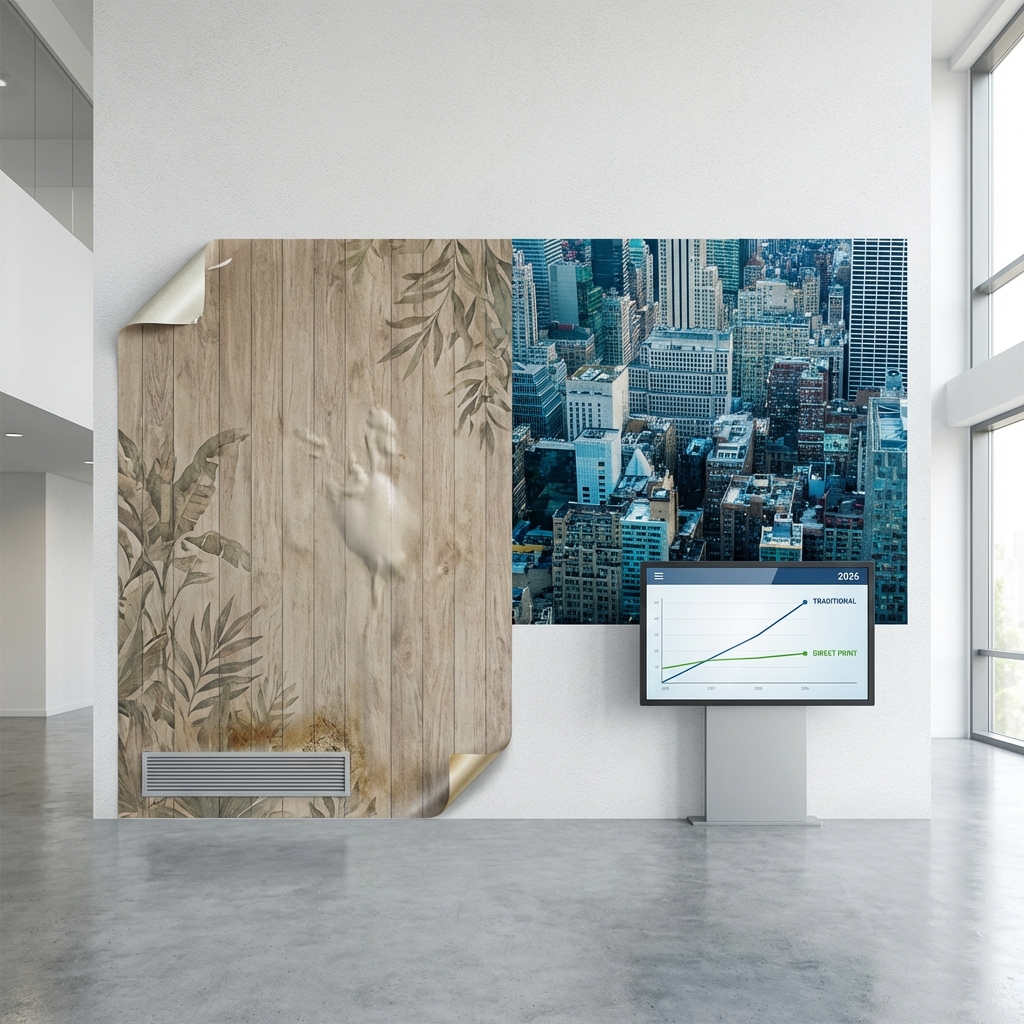
We typically complete installations in under five hours per wall or full room, even at architectural scale. That compressed timeline has outsized financial impact. A hospital that closes a corridor for three days to install vinyl incurs opportunity costs: wayfinding disruption, staff navigation complexity, patient flow bottlenecks, and perception of inadequate maintenance. A school that shuts down a library wing for a full week to install wallpaper creates scheduling headaches for students and teachers.
Our crew arrives, prints your design directly onto your walls, and you’re done the same day. In occupied buildings, that means minimal disruption. Offices stay open. Clinics stay staffed. Classrooms stay functional. The financial value of avoiding a full facility closure, partial tenant displacement, or scheduling accommodations often exceeds the labor savings alone.
For multi-location rollouts (a retail chain refreshing twenty locations, or a healthcare system updating wayfinding across five hospitals), speed compounds. If each location requires only a few hours of on-site installation rather than days, your total project duration shrinks dramatically. Coordination complexity drops. Scheduling conflicts diminish. You deploy brand refreshes or wayfinding updates across your entire portfolio in weeks rather than months.
We handle all on-site printing and installation. You don’t manage shipping delays, vendor conflicts, or quality variability from external fabricators. Your timeline is predictable. Your execution is consistent.
Durability and Cleanability Reduce Maintenance Burden Over Time
Our graphics are designed for high-traffic, high-touch environments. Hospitals need wayfinding and safety signage that withstand constant cleaning with disinfectants and alcohol-based solutions. Schools need graphics that survive pencil marks, eraser marks, and enthusiastic young hands. Corporate offices need branded walls that endure marker ink, dust, and spillage without degradation.
Our surfaces are cleanable without damage. A microfiber cloth and mild detergent restore graphics to original appearance. Alcohol, bleach-based disinfectants, and standard facility-grade cleaners don’t degrade or yellow the surface. We’ve tested extensively in healthcare settings, and our graphics withstand infection control protocols that would compromise wallpaper or fade vinyl.
This reduces your custodial labor burden. Staff don’t need special protocols or fear damaging sensitive graphics. Standard cleaning practices work fine. Over a five or ten-year lifecycle, that operational simplicity and absence of replacement cycles translates to measurable labor savings. Your custodial team maintains the space without special handling or limitations.
Direct wall printing durability has been validated across healthcare, education, and high-traffic commercial environments.
Scaling Across Multiple Locations Without Fabrication or Shipping Delays
When you operate across multiple sites, traditional wall graphics become a logistics nightmare. Vinyl wraps must be fabricated off-site, shipped to each location, tracked, stored, and installed in coordination with local crews. Lead times extend across weeks or months. Quality variability emerges across batches. Shipping damage requires replacements. Inventory management becomes a cost center.
Our on-site printing model eliminates that complexity. We deploy mobile printing equipment to each location, print on-demand, and install immediately. Your design is consistent across all sites because we control the entire process. Your timeline is predictable because printing and installation happen sequentially at each location without external dependencies.
A national retail brand rolling out new store designs can schedule our team to visit each location on a predetermined calendar. Print, install, move to the next location. No shipping, no storage, no batch variability, no damage claims. Your brand rollout happens on schedule and on budget.
For hospital systems updating wayfinding across multiple campuses, or university systems refreshing residential halls across a portfolio, that operational efficiency is transformative. One design system, deployed identically across all locations, with minimal disruption and predictable cost per location.
Design Flexibility Means Fewer Costly Revisions and Reprints
With vinyl wraps and wallpaper, design revisions are expensive. You’ve already ordered material, possibly already fabricated it. A requested change requires stopping production, issuing revised files to your vendor, incurring rush charges, managing waste from the original order, and rescheduling installation. Mistakes compound costs quickly.
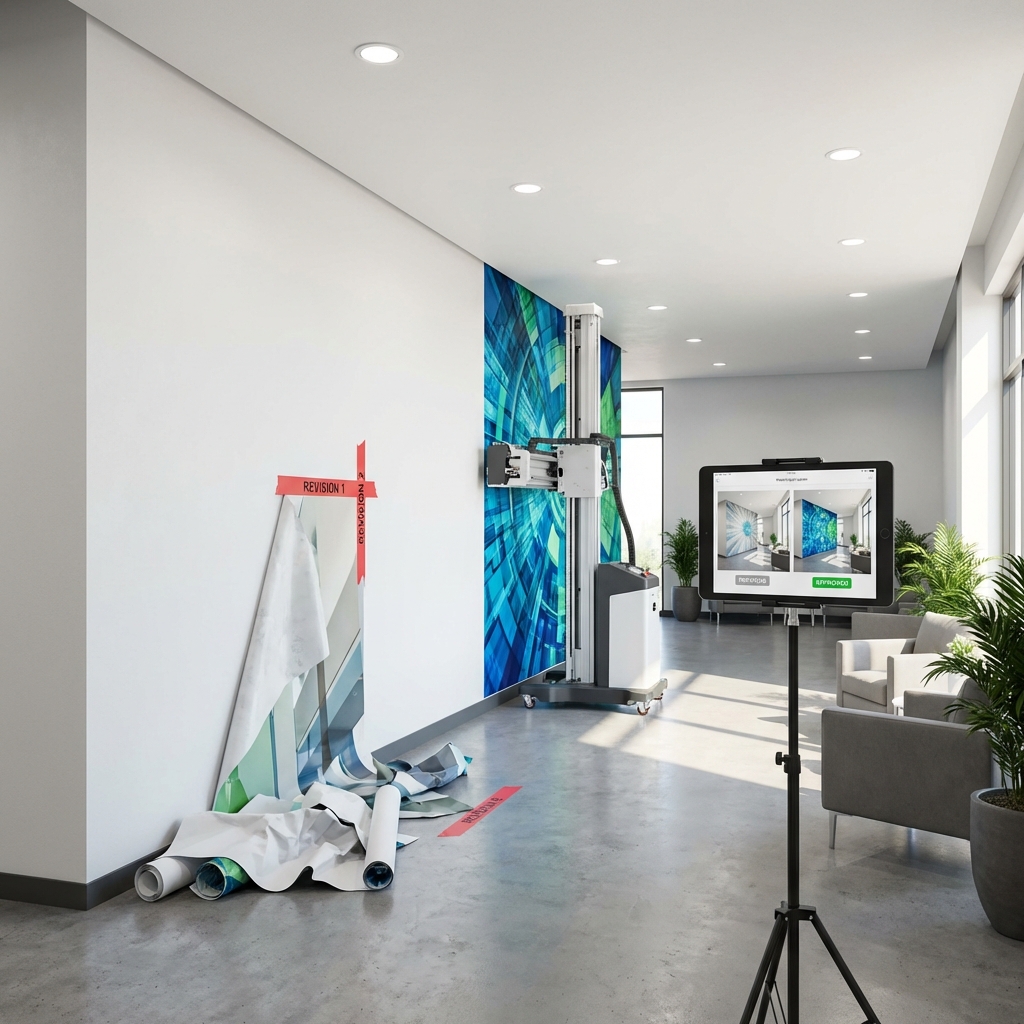
Our on-site printing model inverts that risk. Revisions happen before we deploy to your facility. We collaborate with your design team, refine concepts, test layouts, and lock in final files before any printing occurs. Once files are approved, we print and install. There’s no pre-fabricated inventory to waste, no shipping delays that lock you into designs you’re unsure about.
For complex multi-location rollouts, this flexibility is enormous. You can pilot a design in one location, gather feedback, refine, and deploy the finalized version across remaining locations. No batch conflicts. No committed material waste. Your budget stays controlled, and your final output reflects exactly what your team wanted.
Comparing 5-Year and 10-Year Total Cost of Ownership
Let’s work through a realistic example. Assume a 5,000-square-foot interior space (corporate office, school wing, hospital unit) needs wall graphics for wayfinding, branding, or environmental graphics.
Vinyl wrap scenario:
- Initial installation: $75,000 (5,000 sq ft @ $15/sq ft, including labor)
- Year 3 replacement (partial): $30,000
- Year 5 replacement (full re-install): $75,000
- Removal and wall prep between cycles: $15,000
- Total five-year cost: $195,000
- Ten-year cost (adding year 8 partial replacement and year 10 full install): $385,000
Our direct-to-wall printing:
- Initial installation: $85,000 (5,000 sq ft @ $17/sq ft, including labor, design collaboration)
- Year 5 minor touch-ups or spot repairs (if needed): $2,000-5,000
- Year 10 same: $2,000-5,000
- Total five-year cost: $87,000-90,000
- Ten-year cost: $89,000-95,000
The crossover point occurs around year 2.5. After that, our solution becomes measurably cheaper. By year ten, you’ve saved $290,000-296,000 in replacement cycles, removal labor, and operational disruption alone. That figure compounds if you account for avoided downtime, scheduling overhead, and custodial labor simplification.
Those numbers assume steady-state facilities. If your space undergoes high-traffic wear or frequent updates, the vinyl or wallpaper cost accelerates due to earlier replacement cycles. Our cost remains flat.
Environmental Efficiency Lowers Long-Term Sustainability Costs
Increasingly, facilities managers and procurement teams are factoring environmental impact into lifecycle cost analysis. Vinyl wall coverings generate significant waste: removal and disposal of old vinyl, the energy footprint of manufacturing and shipping replacement material, and the disposal of chemical adhesives and primers required for installation.
Wallpaper carries similar environmental costs, with added complexity around moisture barriers, paste application, and eventual disposal.
Our direct-to-wall printing generates minimal waste. We use water-based, low-VOC inks. Material waste is negligible because we print only what you need directly onto your walls. There’s no packaging, no shipping, no excess inventory to dispose of. Our installation process produces no chemical byproducts.
For institutions pursuing sustainability certifications (LEED, Green Globes, WELL standards), that operational efficiency translates to measurable environmental credits and improved facility performance narratives. Your procurement team can articulate lower lifecycle environmental impact alongside lower financial cost.
How We Support Your Procurement and Budget Planning
We understand that most decisions go through formal procurement and budget cycles. We provide facilities teams, real estate managers, and procurement specialists with detailed cost models, lifecycle comparisons, and long-term budget forecasting tools tailored to your specific square footage, space type, and refresh timeline.
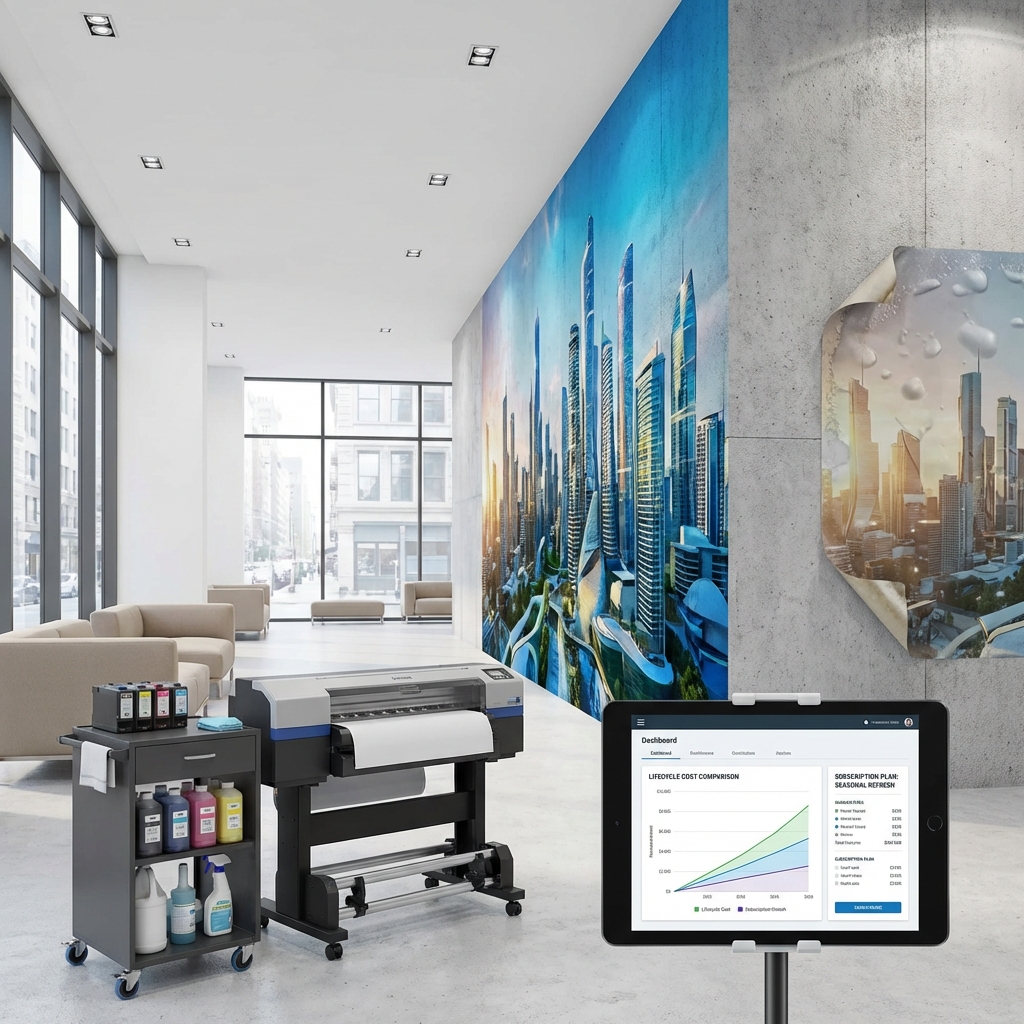
Our team collaborates with your capital planning process. We can project five-year and ten-year costs based on your facility’s specific needs. We model phased rollouts if you want to pilot our solution before committing to a full-campus deployment. We provide references from comparable organizations (healthcare systems, educational institutions, corporate real estate teams) so you can validate our cost claims with peers.
We also work transparently on pricing. We don’t hide costs. Our quotes include design collaboration, on-site printing, installation, and substrate prep. We’re clear about what’s included and what variables (wall size, design complexity, site accessibility) affect final cost.
Our Subscription Model Aligns Refresh Cycles with Strategic Needs
Beyond one-time installations, we offer a subscription model for organizations that want to refresh graphics seasonally, strategically, or in response to brand or operational changes. This works beautifully for retail environments, educational facilities, and healthcare systems that benefit from periodic visual updates without capital budget pressure.
Our mural subscription strategies let you budget for graphics as an operational expense rather than a capital project. You can refresh wayfinding annually, update seasonal messaging, rotate brand campaigns, or adapt environments to new programs without managing large one-time capital outlays.
For schools, that might mean refreshing murals and wayfinding each year. For healthcare systems, that might mean updating safety messaging or environmental graphics as clinical protocols evolve. For corporate offices, that might mean rotating brand partnerships or wellness messaging quarterly.
The subscription model also gives you predictability. Your facilities team knows exactly what their annual graphics budget is. There are no surprise replacement cycles, no emergency requests to refresh a failed vinyl installation. Your budget is smooth, your visuals stay current, and your spaces continuously reflect your brand or operational priorities.
To explore how direct-to-wall printing can reshape your facility’s lifecycle costs and operational efficiency, we encourage you to reach out. We’ll analyze your current situation, model your specific costs, and show you where the financial advantage emerges for your organization. The conversation typically reveals savings far larger than anyone anticipated.
Contact us to learn more
Frequently Asked Questions (FAQ)
How does our direct-to-wall printing compare to vinyl and wallpaper over a 5 or 10-year lifecycle?
We print high-resolution graphics directly onto your walls without adhesives, vinyl layers, or traditional wallpaper, which eliminates the peeling, bubbling, and color fading that typically forces replacements every 3-5 years. Our durable, cleanable finishes are designed to perform in high-traffic environments, and because we print on-site, we avoid shipping delays and fabrication errors that drive up costs across multi-location rollouts. Over ten years, most organizations see 40-60% lower total cost of ownership with us compared to vinyl or wallpaper, accounting for material, labor, maintenance, and replacement cycles.
What makes your installation faster and less disruptive than traditional wall graphics?
We complete most projects in under 5 hours with minimal setup and no construction noise or fumes, so we can work in occupied buildings without shutting down operations. Our on-site printing eliminates the weeks-long fabrication and shipping delays common with vinyl or custom wallpaper, and our paint-over-ready finishes mean spaces are immediately usable after installation. This speed translates directly to lower labor costs and far less business interruption for your facility or tenant.
Can we refresh or change our graphics later without major reconstruction?
Yes—our paint-over-ready finishes are designed for future updates, so you can repaint or apply new graphics when your branding, wayfinding, or program needs change. We also offer a subscription model that aligns seasonal or strategic refreshes with your budget cycles, so you’re not locked into permanent installations. This flexibility means you can adapt your spaces as your organization evolves without costly removal or surface repair.