Table of Contents
- Introduction: The Need for Speed in Corporate Interior Design
- What Is Direct-to-Wall Printing Technology and How Does It Work
- Why Traditional Vinyl and Wallpaper Fall Short for Corporate Environments
- Installation Speed: Completing Professional Wall Graphics in Under 5 Hours
- Durability and Maintenance: Long-Term Performance in High-Traffic Spaces
- Cost and Lifecycle Efficiency Compared to Alternatives
- Multi-Location Rollouts and Brand Consistency at Scale
- Wayfinding and Safety Graphics Without Installation Disruption
- Design Flexibility: From Photo-Real Imagery to Custom Branding
- Real-World Applications: Corporate, Healthcare, and Institutional Case Studies
- Conclusion: Transforming Corporate Interiors with Next-Generation Wall Technology
Introduction: The Need for Speed in Corporate Interior Design
Fast Corporate Office Wall Printing: Speed, Quality, and Durability Without Downtime
Corporate interiors now shift as quickly as the businesses they house. Rebranding cycles have shortened, hybrid work has redefined floor plans, and leadership teams expect spaces to communicate clearly with employees and visitors—without compromising the daily operation of the business. The result: organizations need fast interior wall upgrades that deliver visual impact and measurable durability, all with minimal disruption.
Fast corporate office wall printing has emerged as a practical answer to these pressures. By bringing commercial direct-to-wall printing equipment on site, teams can transform a lobby, corridor, café, or meeting zone in hours instead of days. There are no adhesive films to align, no panel seams to hide, and no risk of shipping delays. The work finishes between shifts, before lunch service, or overnight—then the area reopens, clean and on schedule.
EastCoast MuralPros focuses on this exact use case: high-resolution, adhesive-free, seam-free wall graphics installed quickly and consistently across single sites or multi-location portfolios. For facilities directors, corporate real estate leaders, workplace teams, and procurement groups weighing the cost and risk of conventional overlays, direct-to-wall printing brings architectural-quality visuals into the operational reality of an occupied building.
What Is Direct-to-Wall Printing Technology and How Does It Work
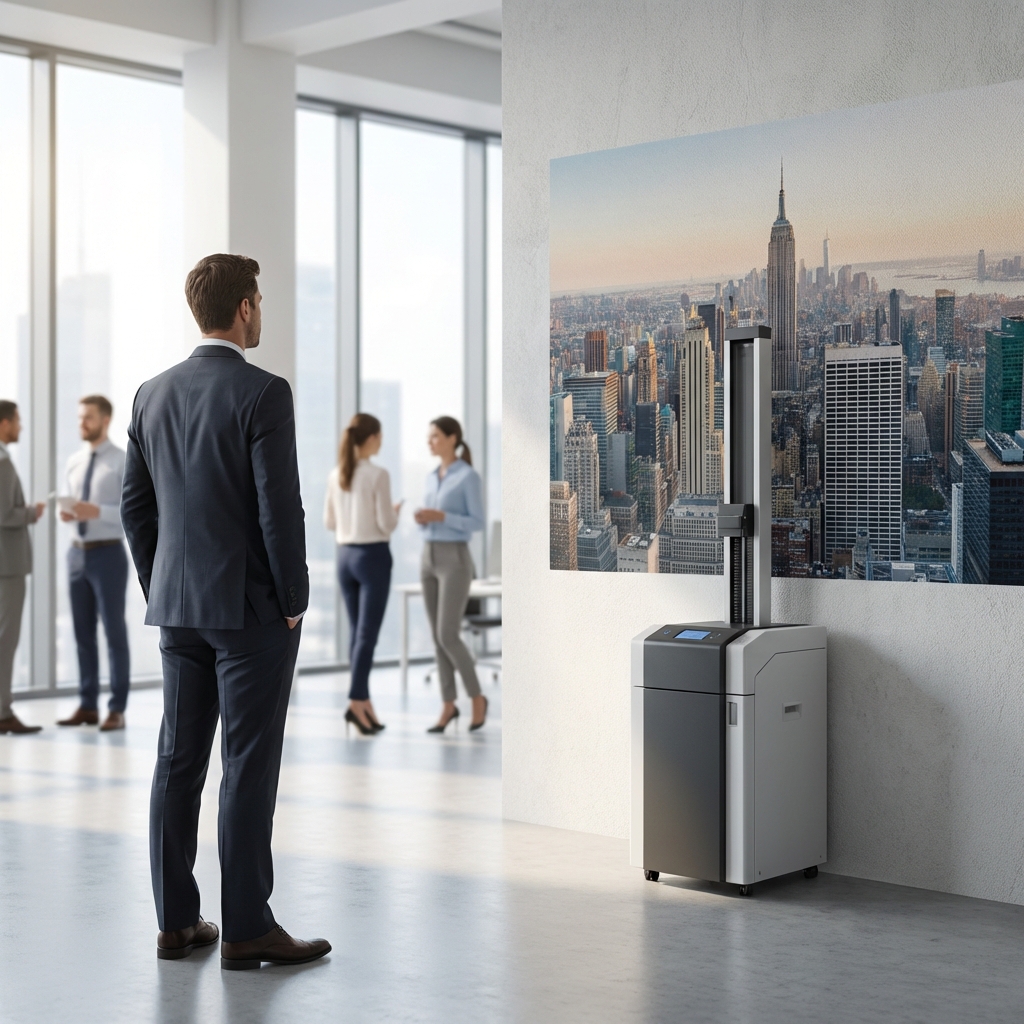
Direct-to-wall printing is a mobile, high-precision process that prints artwork and branding directly onto building surfaces. Instead of fabricating and shipping vinyl or wallpaper, a technician brings a compact, rail-mounted printer to the site and produces the final image in place.
A typical project follows a disciplined, low-disruption workflow:
- Site assessment: Verify wall composition (painted drywall, CMU, sealed concrete, brick), inspect finishes, and confirm access and clearances.
- Surface preparation: Dusting or light cleaning. No adhesives or panels. No off-gassing adhesives in the space.
- Color proofing: Digital proof approvals, spot-color targets for brand-critical hues, and test swatches as needed.
- On-site calibration: The printer aligns to wall plumb and level, ensuring edge-to-edge accuracy and crisp detail at architectural scale.
- Live printing and curing: UV-curable inks are jetted in micro-droplets and cured instantly with integrated lamps, creating a durable, cleanable finish.
- Quality check and handoff: Inspect every zone, spot-correct if needed, and reopen the space.
Because the image is built directly on the substrate, the result is seam-free and integrated. The printing head rides close to the surface and can navigate common interior conditions: baseboards and door frames, columns, reveals, and changes in elevation. For corporate offices, this yields crisp logotypes, photographic murals, fine text, and wayfinding systems that look designed into the architecture—not applied onto it.
Technical advantages that matter in day-to-day operations:
- Adhesive-free: No bubbling or edge lift, and no adhesive residue to remove later.
- Compatible surfaces: Performs on painted drywall, CMU block, sealed concrete, and even brick with the right pre-checks.
- Instant set: UV curing eliminates long cure windows and reopens areas quickly.
- Architectural resolution: Photo-real detail and sharp microtype for instructional graphics or branded storytelling.
- Cleanability: The cured ink film is engineered for high-traffic environments and routine maintenance cycles.
For large properties and campuses, on-site production also eliminates the risks tied to off-site fabrication: lost shipments, mismatched panels, and layout surprises that are only discovered at install.
Why Traditional Vinyl and Wallpaper Fall Short for Corporate Environments
Vinyl wall coverings and wallpaper have been go-to options for decades, but they carry operational drawbacks that are hard to ignore when speed, reliability, and lifecycle cost are primary drivers.
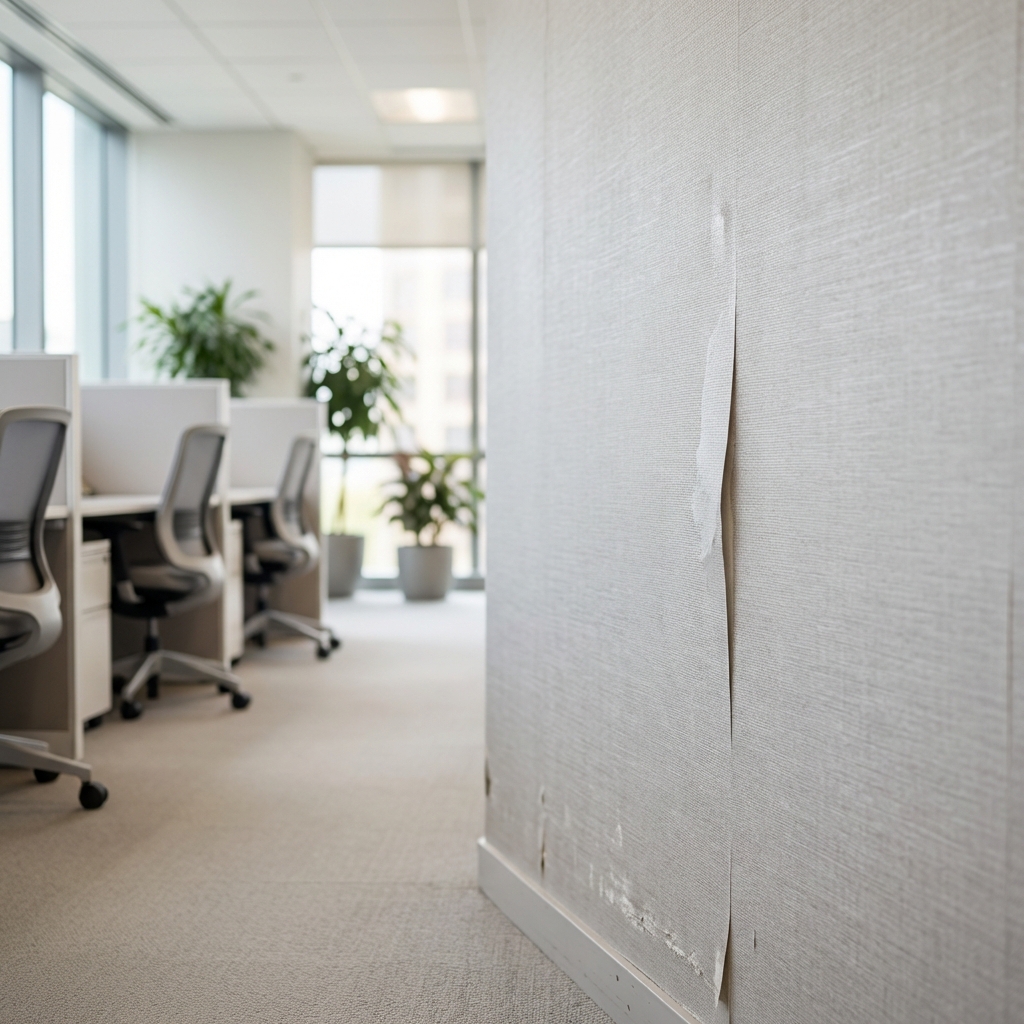
- Seams and edges: Panels introduce visible seams that can distract from visual narratives and open pathways for wear. In high-traffic corporate corridors, edges often show abuse first.
- Adhesive failure: Humidity, thermal cycling, and substrate variability lead to bubbling or peeling—the exact problems facilities teams spend time and money chasing.
- Installation complexity: Panel alignment across long runs requires large staging areas, extensive masking, and perfection under pressure. Missed alignments trigger do-overs and delays.
- Change management costs: Removing adhesive-backed materials takes labor, risks wall damage, and often leads to patching and repainting before any new graphics can be installed.
- Waste and lead time: Fabrication, packaging, and shipping add waste to schedules and budgets. Errors discovered at install usually mean re-ordering and waiting.
- Limited environmental profile: Adhesives and PVC-based products raise sustainability and disposal concerns that many organizations now actively avoid.
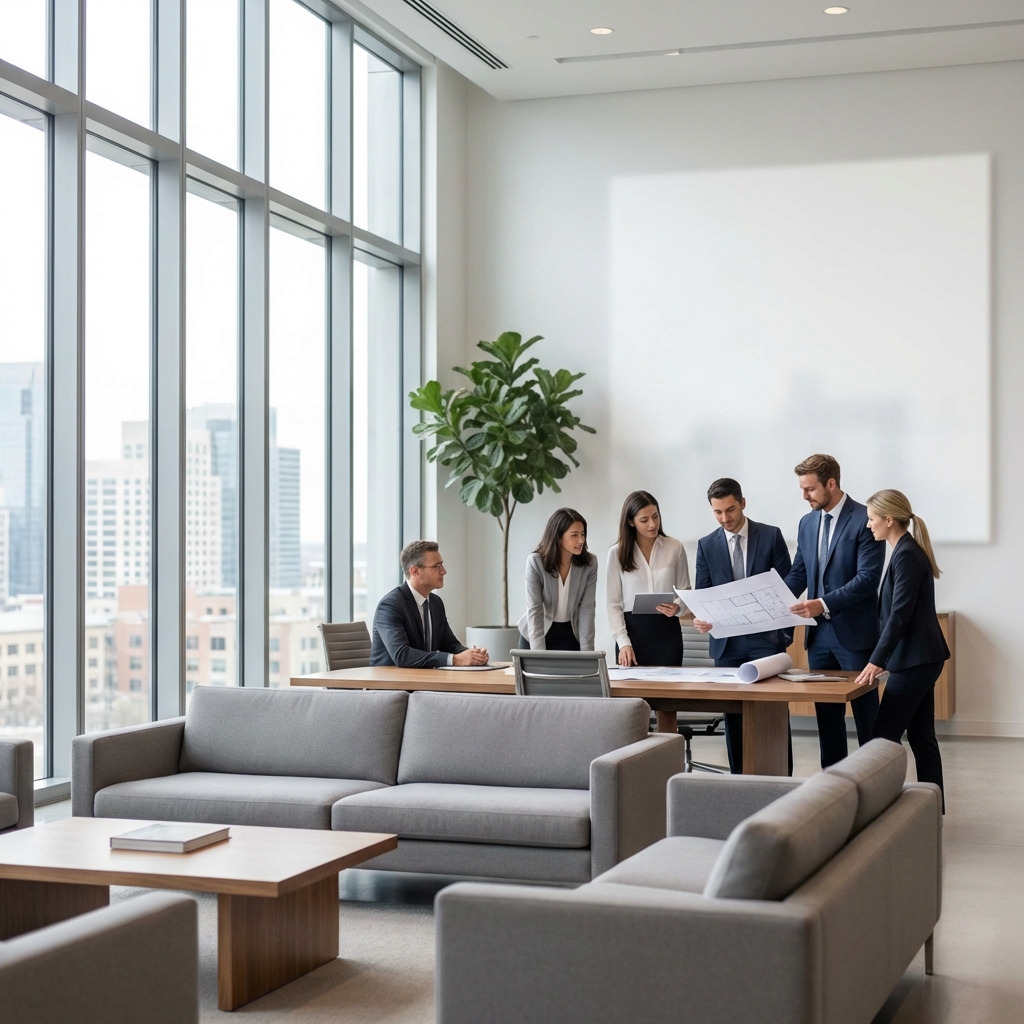
For a deeper look at lifecycle impacts, see EastCoast MuralPros’ overview of direct-to-wall printing vs vinyl. The key takeaway for corporate teams is practical: if you can eliminate seams, adhesives, and shipping steps—and still achieve brand-true color and durability—you reduce disruption and total cost while gaining schedule certainty.
Installation Speed: Completing Professional Wall Graphics in Under 5 Hours
Speed is the point. A successful fast corporate office wall printing program converts downtime from days to hours. Direct-to-wall printing is engineered to do exactly that, with predictable scheduling even in occupied buildings.
What makes under-5-hour installs feasible:
- Minimal prep: With clean, paint-ready walls, prep is often limited to dusting and protecting adjacent finishes. No panel layout or adhesive staging.
- Efficient staging: Compact, mobile equipment sets up in minutes and needs only a small footprint.
- Instant curing: UV-curable inks dry as printed, so no wait time before reopening the area to traffic.
- No shipping windows: Art is finalized digitally; production happens on-site with the approved file. Fabrication delays disappear.
A sample overnight schedule for a reception and adjacent corridor:
- 6:30 p.m. – Walkthrough, wall wipe-down, tape off base where required.
- 7:00 p.m. – Printer calibration, color check, test swatch on a corner.
- 7:30–10:30 p.m. – Live printing, zone by zone. Team keeps the path of travel clear.
- 10:30–11:00 p.m. – Final inspection, micro touch-ups if needed, light cleanup.
- 11:00 p.m. – Barriers removed. Lobby ready for morning opening.
Because installation does not involve sanding, cutting panels, or aerosol adhesives, it is a low-disruption activity. Noise levels remain modest, and there’s minimal odor thanks to instant-curing inks. For corporate offices with conference schedules, café service, or tenant traffic, this means reliable windows for quick wall graphics installation—before work hours, between events, or in phased weekend blocks that eliminate operational friction.
Durability and Maintenance: Long-Term Performance in High-Traffic Spaces
Corporate, healthcare, higher-education, and hospitality environments require finishes that look good and clean easily under real use. Direct-to-wall printing produces a cured ink film designed for abrasion resistance, color stability, and routine cleaning.
Practical durability attributes:
- Abrasion resistance: The cured layer stands up to incidental scuffs from carts, chairs, luggage, or backpacks in corridors and lobbies.
- Cleanability: Marks and smudges can typically be removed with non-abrasive, common cleaners. No lifted seams and no edges to catch cleaning tools.
- Colorfastness indoors: Brand colors, gradients, and image detail retain integrity over the typical lifecycle of a corporate interior wall paint system.
- Integrated with the wall: Because the artwork is not a film, there’s no plastic sheen or edge to peel or delaminate—an advantage in high-touch zones and corners.
In facilities with more rigorous protocols, such as clinics or labs, direct-to-wall graphics support frequent wipe-down cycles without the adhesive creep that plagues many films. For teams evaluating clinical corridors or patient-facing areas, EastCoast MuralPros provides additional guidance and examples in its overview of healthcare wall printing.
Maintenance over time is straightforward:
- Routine cleaning: Incorporate murals into standard janitorial specs; use soft cloths and non-scratching pads.
- Spot repairs: If a gouge occurs, localized touch-ups can be made on site without removing large areas of material.
- Future changes: When it’s time for a brand refresh or new program, paint-over-ready finishes allow the wall to be primed and recoated like any painted surface.
The net effect is a durable, professional-grade graphic system that behaves like part of the building—resilient in service and predictable to maintain.
Cost and Lifecycle Efficiency Compared to Alternatives
Initial install price matters, but lifecycle cost is where many organizations realize the true delta between options. Direct-to-wall printing concentrates value where it reduces friction and ongoing spend.
Cost and efficiency drivers:
- No shipping or re-fabrication: On-site production eliminates freight, crating, and replacement cycles triggered by shipment damage or misprints.
- Faster return to service: Less downtime means fewer after-hours premiums and no lost operational days for the space.
- Fewer failure points: No seams or adhesives means fewer tickets to address bubbling, peeling, or edge damage—common lifecycle costs with vinyl.
- Lower end-of-life costs: When the graphic must change, teams can paint over the cured image after standard prep. No adhesive removal, no substrate tear-out, and no landfill-bound panels.
- Scale economics: Standardized color profiles, art prep workflows, and installation protocols reduce project management time across multi-site rollouts.
For procurement teams modeling a 3–5 year horizon, it’s also useful to consider programmatic refreshes. EastCoast MuralPros offers subscription models that bundle creative updates and scheduled on-site printing windows. This approach levels spend, simplifies approvals, and ensures environments stay current—seasonal campaigns in retail, recruitment cycles in higher ed, quarterly culture themes in corporate workplaces—without large, sporadic capital hits.
When compared to labor-intensive panel installs or construction-heavy upgrades, direct-to-wall printing often enables more square footage of impact per dollar, with fewer coordination headaches and a cleaner sustainability profile.
Multi-Location Rollouts and Brand Consistency at Scale
Modern brands must show up consistently across offices, clinics, stores, and campuses. Rolling out a program to ten, fifty, or several hundred locations requires more than good art—it requires dependable process control.
Key enablers of consistent execution:
- Color management: ICC profiles and device calibration lock in brand-critical hues and skin tones. Spot colors are validated with swatches and readings before full production.
- File governance: Centralized digital asset management ensures each location prints the right version, with localized content where appropriate.
- Standard operating procedures: Repeatable wall prep, printer setup, and QA checklists cut variation and lift quality across crews and geographies.
- National scheduling: Coordinated calendars enable teams to hit lease-up dates, rebranding milestones, or seasonal campaigns without slippage.
- Single-point accountability: One vendor responsible for art preflight, on-site production, and post-install QC simplifies procurement and reduces change-order risk.
EastCoast MuralPros works with enterprise facilities and brand teams to define templates that scale—global lobby statements with localized photography, floor-specific wayfinding systems, or spirit walls that adapt to culture cues in each market. Because production happens in the space itself, field conditions (brick, block, drywall) don’t derail the schedule; the workflow anticipates variability while the color and content remain consistent.
The outcome is continuity at scale: the same visual standard appears in a flagship headquarters, a satellite workplace, and a new lease-up—on time, without re-fabrication cycles or panel mismatches.
Wayfinding and Safety Graphics Without Installation Disruption
Wayfinding and safety communications work best when they are visible, legible, and unobtrusive to the architecture. Direct-to-wall printing supports these goals by integrating information into the building envelope.
Advantages in operational settings:
- Clutter-free communication: Print directional arrows, floor numbers, queue markers, and instructional icons directly on walls, columns, and CMU in stairwells—no plastic placards to mount or replace.
- High legibility: Crisp microtype and sharp edges keep small copy readable; large-format numerals and pictograms remain clean at a distance.
- Rapid updates: When routes change or new zones open, teams can deploy quick wall graphics installation in off-hours to update circulation systems without metal signage lead times.
- Durable in hard-use areas: Stair towers, loading corridors, and service paths benefit from a scuff-resistant image that does not delaminate at edges.
- Integrated safety messaging: Reinforce PPE areas, hand-washing zones, or emergency instruction without adding protruding hardware to tight spaces.
Organizations also gain control over aesthetic cohesion. Because the same printing process produces wayfinding, branding, and experiential art, facilities avoid a patchwork of mismatched finishes. The building reads as a single, intentional system—clearer for users and easier to maintain.
Design Flexibility: From Photo-Real Imagery to Custom Branding
Direct-to-wall printing gives designers and brand teams a wide creative runway without the production constraints of seams, film thickness, or panel joins. If you can design it, it can likely be rendered at scale directly on the wall.
Capabilities that expand the design toolkit:
- Photo-real imagery: High-resolution landscapes, product photography, and portraits retain fine detail and smooth gradients at full-height spans.
- Vector precision: Logos, type, and intricate linework reproduce sharply, preserving brand standards and legibility in complex diagrams.
- Pattern continuity: Without seams, long corridors can carry continuous patterns, tonal textures, or gradients that would be cumbersome—or impossible—with panelized materials.
- Localized content: Create families of graphics that vary by floor, city, or business unit while maintaining a consistent brand language across the portfolio.
- Materials mix: Compatible with painted drywall, CMU, sealed concrete, and brick, so feature treatments can cross from lobby to stairwell to café without a material change.
- Paint-over-ready endgame: Build for the future. When priorities shift, walls can be primed and repainted without removing vinyl, adhesives, or hardware.
Beyond walls, EastCoast MuralPros supports in-studio printing for doors, tabletops, and standees—useful for cohesive campaigns spanning fixed architecture and portable elements. For digital artists and creative partners, collaborative tools and preflight support help adapt art libraries to architectural scale quickly, enabling content to evolve without re-engineering every asset.
The net effect for brand and workplace teams: more options, fewer compromises, and clearer control over the balance between timeless architecture and timely messaging.
Real-World Applications: Corporate, Healthcare, and Institutional Case Studies
Fast interior wall upgrades succeed when they match the realities of a space. The following scenarios illustrate how organizations deploy commercial direct-to-wall printing for impact and operational ease.
Corporate headquarters refresh A regional headquarters needed to replace aging vinyl murals in a reception zone and café. The team scheduled work after hours: prep began at 6:30 p.m., printing ran from 7:30 to 10:45, and the space reopened before the morning rush. The result delivered a seam-free brand wall in the lobby, a photographic story panel in the café, and a series of small-format values statements that carried through a corridor—no adhesives, no panel joins, and no construction barriers. Facilities cited two benefits: the work avoided weekend staffing premiums, and the paint-over-ready finish set them up for a quarterly culture update without removal costs.
Healthcare system wayfinding upgrade A multi-site healthcare provider needed durable wayfinding and calming imagery across patient corridors. With infection-control constraints and frequent cleaning protocols, panel edges and adhesive failure had been recurring pain points. Direct-to-wall printing allowed staff to update route markings, department identifiers, and nature-themed art prints on CMU block and painted drywall during evening windows. The finish stood up to standard wipe-down routines and sharply improved legibility. Teams reviewing clinical environments can explore additional considerations in EastCoast MuralPros’ guidance on healthcare wall printing.
University campus orientation A university facing an accelerated move-in week needed a full-campus graphic system: residence hall identity treatments, admissions wayfinding, and student services messaging. By prioritizing high-traffic nodes and staging print crews across buildings, the school replaced outdated posters and mixed signage with integrated wall graphics over two evenings and a Saturday morning. The work avoided permit triggers associated with mounted signage and allowed summer conference operations to continue until the installation window. Post-orientation, the subscription model scheduled seasonal updates for admissions and athletics storytelling without new capital requests.
Retail brand rollout A retail brand with dozens of locations planned a brand refresh with localized photography. Traditional graphics would have required coordinating multiple fabricators, shipping windows, and in-store panel installs. With direct-to-wall printing, stores received standardized color targets, a space plan, and a small overnight install window. Wall types varied—painted drywall in malls, CMU in older sites—but the process accommodated both. Over six weeks, the chain executed a consistent look with fewer service calls, no freight delays, and no visible seams behind merchandise displays.
Museum exhibition graphics A museum sought photoreal, temporary exhibition walls with curatorial text applied directly to the gallery space. Direct-to-wall printing delivered high dynamic range imagery, fine serif typography, and unobtrusive interpretive graphics that complemented the art. After the show closed, crews prepped and painted over the walls for the next exhibition, eliminating the labor of stripping vinyl and patching wall damage.
These projects share a pattern: quick wall graphics installation, brand-consistent color and type, low operational friction, and a clear plan for what happens next—whether that’s cleaning, maintenance, or timely refreshes.
Conclusion: Transforming Corporate Interiors with Next-Generation Wall Technology
Fast corporate office wall printing realigns interior branding with how modern organizations operate. By printing directly on surfaces, teams gain speed, precision, and resilience without bringing adhesives or seams into the building. Facilities reopen on time. Brand colors land accurately. Wayfinding reads clearly. And when priorities change, walls can be primed and repainted without costly removal cycles.
For corporate real estate leaders, facilities managers, procurement teams, and designers, the implications are straightforward:
- Schedule certainty: Under-five-hour installations are realistic and repeatable across portfolios.
- Professional-grade performance: Durable, cleanable finishes withstand high-traffic use and routine maintenance.
- Lifecycle control: Lower failure rates, simpler updates, and better sustainability than panelized or adhesive solutions.
- Design freedom: From photo-real imagery to wayfinding, everything integrates with the architecture—seam-free and brand-true.
- Scalable systems: Standardized color, file governance, and national scheduling keep multi-location programs on track.
EastCoast MuralPros delivers a performance-based alternative to vinyl wall coverings and wallpaper that aligns with how commercial interiors are planned, built, and maintained today. When the goal is to move fast without sacrificing quality or durability, commercial direct-to-wall printing is a reliable, lifecycle-efficient solution that turns walls into a strategic asset—on your timeline and without downtime.
Contact us to learn more