
Table of Contents
- Why Healthcare Facilities Struggle With Traditional Wall Solutions
- The Cost of Downtime in Patient Care and Operations
- How Direct-to-Wall Printing Transforms Healthcare Interiors
- Our Installation Process: Speed Without Compromise
- Durability Built for High-Traffic Medical Environments
- Wayfinding and Safety Graphics That Scale Across Campuses
- Cost-Efficiency Over the Full Lifecycle
- Seamless Integration With Your Facility's Timeline
- Getting Started With Your Healthcare Graphics Project
- Frequently Asked Questions (FAQ)
Why Healthcare Facilities Struggle With Traditional Wall Solutions
Healthcare facilities face a singular challenge that most other commercial spaces don’t: downtime isn’t just an inconvenience—it affects patient care, staff workflow, and operational revenue. When we work with hospitals, medical centers, and health systems, we hear the same frustration repeatedly: traditional wall solutions require extended installation windows, create dust and noise in occupied spaces, and often fail prematurely in high-moisture, high-traffic environments.
We’ve spent years solving this problem for healthcare teams across the East Coast. Our direct-to-wall printing technology eliminates the adhesives, vinyl bubbling, and extended timelines that plague older wall covering methods. Instead, we print durable, high-resolution graphics directly onto your walls in under 5 hours—often while your facility remains operational. Here’s how we approach healthcare wall graphics installation, and why it’s become the preferred alternative for facilities teams managing complex interior refresh projects.
Healthcare environments demand solutions that vinyl wall coverings and traditional wallpaper simply can’t deliver. Patient rooms, corridors, clinical spaces, and administrative areas all experience heavy foot traffic, frequent touch contact, chemical cleaning protocols, and temperature and humidity fluctuations that degrade standard wall treatments within 18 to 36 months.
Vinyl wraps bubble and peel around edges, especially near doorways and high-touch zones. Wallpaper absorbs moisture and harbor bacteria in humid clinical environments. Hand-painted murals require skilled artists and weeks of on-site work. All of these solutions also require invasive surface preparation, adhesive application, and multiple installation days—meaning area closures, air-quality concerns, and operational disruption.
We’ve documented dozens of cases where healthcare facilities invested in vinyl solutions only to find peeling and separation within two years, forcing costly emergency replacements. The root problem isn’t the product—it’s the mismatch between the tool and the environment. Healthcare spaces need something that adheres cleanly to any substrate, installs in hours, handles moisture and cleaning chemicals, and delivers photoreal clarity at architectural scale.
That’s precisely what we designed our platform to do.
The Cost of Downtime in Patient Care and Operations
A single wall project in a hospital isn’t just an aesthetic decision—it’s an operational event. If installation requires a 48-hour room closure, a corridor shutdown, or noise and dust during clinical hours, the ripple effects are immediate: patient flow interrupted, staff relocated, cleaning protocols disrupted, and departmental schedules thrown off.
We’ve calculated the real cost: a typical hospital closure window costs $3,000 to $15,000 per hour in rescheduled appointments, staffing adjustments, and operational overhead. A renovation that stretches from 24 hours to 5 days can easily exceed $200,000 in indirect costs before materials and labor are even factored in.
Our installation process turns this equation upside down. Because we print directly onto finished walls without adhesives, solvents, or extended curing times, we typically complete projects in under 5 hours. Many of our healthcare clients schedule installations during off-peak hours or between shift changes, allowing departments to resume full operations the same day. No extended closures. No air-quality concerns from adhesive fumes. No cleanup delays.
What to do next: Calculate your current closure cost by multiplying your facility’s hourly operational footprint (lost appointments, staff redirects, equipment downtime) by the number of days a traditional wall project would require. Compare that against our 5-hour installation window. Most healthcare teams find the time savings alone justify exploring our approach.
How Direct-to-Wall Printing Transforms Healthcare Interiors
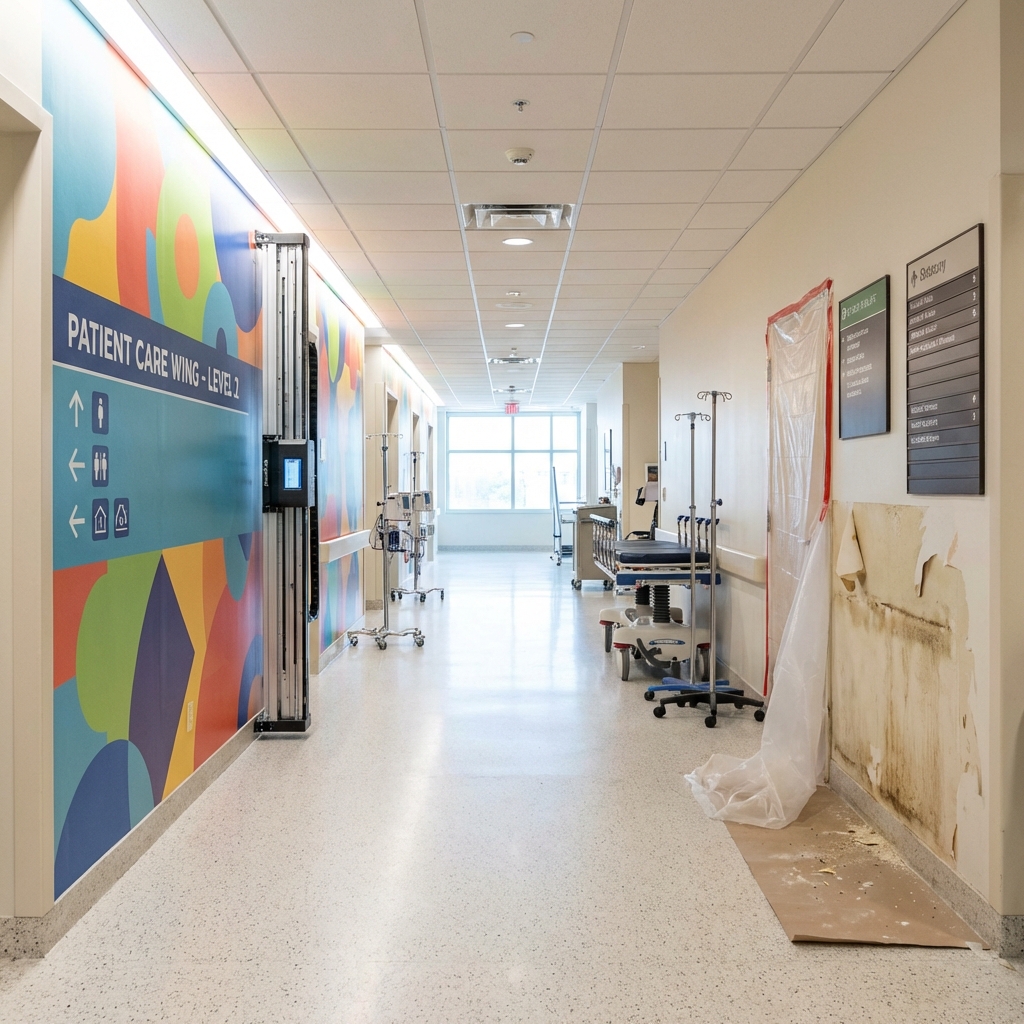
Direct-to-wall printing uses inkjet technology to apply pigment-based inks directly into the substrate—whether that’s drywall, CMU, concrete, or brick. The ink bonds at the molecular level, creating a permanent finish that doesn’t peel, bubble, or separate. There’s no adhesive layer to fail, no thermal stress from temperature fluctuations, and no off-gassing.
For healthcare facilities, this changes everything. We can print wayfinding graphics that remain crisp and legible for 10+ years. We can create patient-calming environments with photoreal nature imagery or institutional branding without worrying about edge failure. We can produce instructional graphics, safety signage, and directional markers across entire floors or campuses with pixel-perfect consistency.
One regional medical center we worked with needed to rebrand all signage across a 400-bed facility without construction. In 12 days, we printed 2,400 linear feet of wayfinding, departmental identification, and safety graphics directly onto existing corridor walls. The project required zero permits, zero adhesive disposal, and zero disruption to clinical operations. The durability specification: the client’s cleaning staff confirmed the graphics withstand daily chemical cleaning without degradation.
Our process also accommodates unfinished or damaged surfaces that most wall coverings would reject. Concrete basement walls, weathered CMU in older wings, textured drywall in support areas—we can prime and print them without costly pre-treatment or substrate replacement.
Our Installation Process: Speed Without Compromise
We approach each healthcare project with a structured methodology designed to minimize risk and maximize speed. Here’s how it works in practice.
Planning and substrate assessment: Our team conducts an on-site walkthrough to evaluate wall conditions, moisture levels, traffic patterns, and access requirements. We photograph the existing surfaces and outline any repairs needed before printing. For healthcare facilities, this also includes identifying areas where cleaning protocols, patient movement, or equipment storage might affect access or timing.
Design and digital proofing: You work with our design team to finalize graphics, wayfinding layouts, and safety messaging. We use high-resolution digital mockups so you see exactly what the finished installation will look like, at actual scale, on your actual walls. Revisions are fast because we’re working digitally—no physical samples, no printing delays.
Pre-installation prep: In the week before installation, our team completes minor substrate repairs, prime coats, and final surface cleaning. Most healthcare installations require a controlled environment—typically 50-85% humidity and 65-75 degrees Fahrenheit. We monitor conditions and schedule the install window when those parameters are met.
On-site installation: Our crew arrives with mobile printing equipment. Depending on wall area, we typically deploy 2 to 3 technicians per location. The printing process itself takes 2 to 4 hours for most projects; curing and touch-up add another 1 to 2 hours. Installation in occupied spaces requires noise control and dust containment, which we manage with barriers and air filtration. Most healthcare clients see full operational readiness the same day.
Quality assurance and handoff: Before we leave, we verify color accuracy, inspect for any finish imperfections, and provide your team with care and maintenance guidelines. Typically, light-duty traffic can resume immediately; normal cleaning protocols can begin after 24 hours.
Durability Built for High-Traffic Medical Environments
Healthcare walls endure stresses that standard commercial spaces don’t: frequent hand contact from patients and staff, daily chemical sanitization, hospital-grade cleaning agents, moisture from humid clinical areas, and institutional equipment movement. Our finishes must survive all of that while remaining hygienic and visually sharp.
We specify paint-grade, solvent-resistant inks that resist moisture, UV exposure, and aggressive cleaning chemicals—including bleach-based disinfectants common in healthcare settings. We’ve tested our finishes against hospital cleaning protocols and confirmed they withstand 500+ full-strength sanitization cycles without color loss, clarity degradation, or surface breakdown.
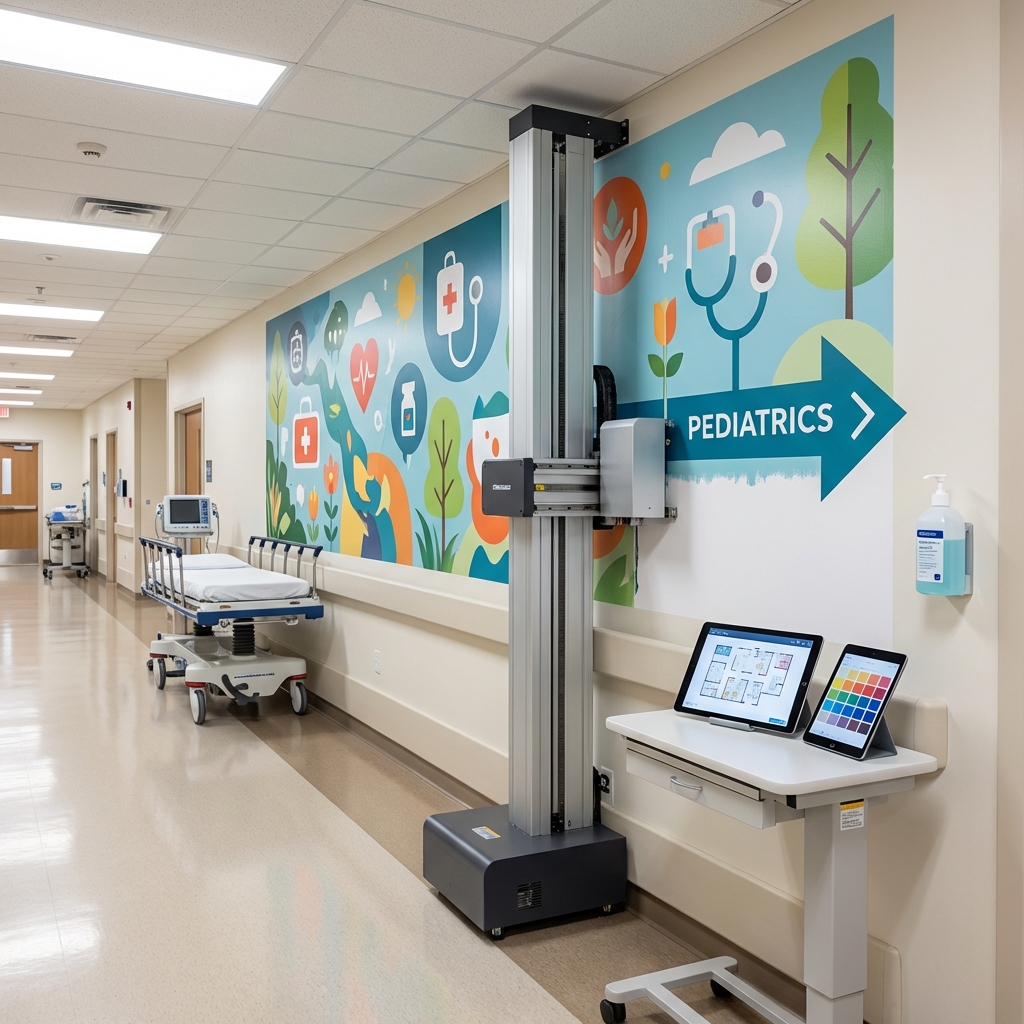
The finish itself is cleanable and repairable. If a small section gets scuffed or marked, we can touch it up without reprinting the entire wall. If a department needs to update graphics three years down the line, we can selectively overprint sections without removing the original graphics. This modularity is critical in healthcare, where clinical needs and departmental budgets often shift.
We’ve also designed our finishes to be paint-over-ready. If your facility repurposes a space or changes departmental use, you can prime and paint directly over our graphics without removing them. No adhesive residue. No substrate damage. The wall is ready for its next life, whether that’s fresh paint or new graphics.
Wayfinding and Safety Graphics That Scale Across Campuses
Large health systems and multi-building medical centers face a coordination challenge: ensuring consistent wayfinding, safety messaging, and branding across dozens of locations, each with different layouts, wall conditions, and operational schedules. Traditional methods require managing multiple vendors, ensuring color matching across buildings, and coordinating lengthy installation windows.
We’ve built our process to handle campus-scale rollouts. Once we finalize the graphics template—directional signage, departmental markers, emergency exit information, hand hygiene reminders—we can replicate it across unlimited locations with pixel-perfect consistency. Our on-site printing capability means we’re not dependent on fabrication timelines or shipping delays. We arrive, print, and finish.
One large teaching hospital asked us to standardize wayfinding across a 5-building complex over a 6-week period. We coordinated installation schedules around clinical rotations, clinical trials, and facility maintenance. Each building received consistent color, typography, and messaging despite different wall substrates and architectural conditions. The result: patients and visitors navigated the complex more efficiently, and the coordinated visual language reinforced the institution’s brand and professionalism.
Safety and instructional graphics are another critical use case. Infection control reminders, hand-washing signage, equipment operating instructions, and emergency procedures can be printed directly into wall graphics, eliminating the clutter of individual signs and vinyl decals. Your facilities team manages messaging from one central template; we handle consistency and installation.
Cost-Efficiency Over the Full Lifecycle
The initial cost of a direct-to-wall installation is competitive with vinyl wall coverings, but the real savings emerge over time. Vinyl solutions typically require replacement every 18 to 36 months due to peeling, bubbling, and degradation. Each replacement cycle requires removal (often messy), adhesive disposal, substrate repair, and reinstallation downtime. We’ve seen healthcare facilities spend $8,000 to $15,000 annually just replacing failing wall coverings in high-traffic zones.
Our finishes remain durable for 10+ years in typical healthcare environments. That means no mid-lifecycle replacement costs, no recurring disposal fees, and no repeated installation disruptions. Even accounting for occasional touch-up or selective reprinting, the total cost of ownership is 40% to 60% lower than recurring vinyl replacements.
We’ve also eliminated substrate damage from adhesive removal. Vinyl wall coverings, when finally removed, often leave residue or pull gypsum board facing, requiring costly wall repairs before new finishes can be applied. Our graphics exist on the wall surface; removing them involves basic cleanup, not substrate reconstruction.
For budget-conscious health systems managing aging facilities, this efficiency matters. It means capital budgets stretch further, and multi-year maintenance schedules become more predictable. A single 5,000-square-foot wayfinding project, installed once and refreshed selectively over a decade, costs less than three vinyl replacement cycles.
Seamless Integration With Your Facility’s Timeline
Healthcare operations run on tight schedules. Surgical suites, emergency departments, patient care floors, and diagnostic centers can’t accommodate unpredictable delays or extended disruptions. We work within those constraints by treating installation scheduling as a critical operational requirement, not an afterthought.
Before we commit to a date, we work with your facilities and operations teams to identify the optimal installation window. For some healthcare clients, that’s a weekend morning. For others, it’s during a known low-traffic period or between shift changes. We’re flexible because we know our 5-hour window is the entire project—there’s no follow-up, no curing delays, no secondary disruption.
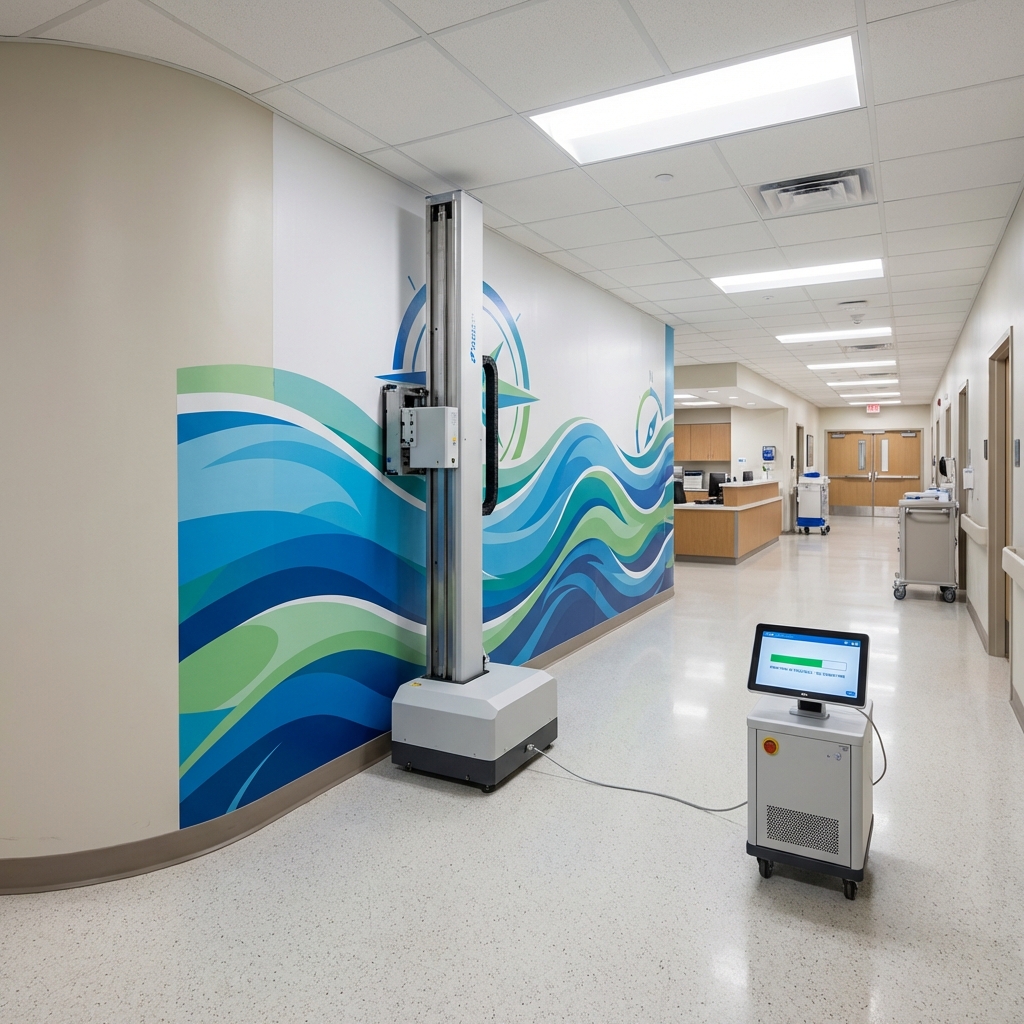
We also front-load communication. You’ll receive a detailed project timeline 4 weeks prior to installation, including equipment delivery, crew arrival, production estimates, and full operational readiness. If conditions change—a clinical emergency, unexpected facility maintenance, staffing challenges—we can reschedule with minimal notice. Our mobile printing setup doesn’t require permanent infrastructure or extended site prep.
For campus-wide projects, we coordinate with your capital projects or facilities team to sequence installations around clinical calendars, administrative events, and departmental transitions. Most healthcare clients appreciate that we’re thinking operationally, not just artistically.
Getting Started With Your Healthcare Graphics Project
If your facility is evaluating wall graphics solutions and downtime is a concern, here’s our recommended next step. Schedule a brief consultation with our team to walk your specific spaces, discuss your goals—whether that’s wayfinding, branding, patient experience, or safety messaging—and understand the timeline and cost implications.
We’ll conduct a substrate assessment, provide detailed installation estimates, and show you examples of completed healthcare projects. You’ll see the speed and durability firsthand. We’ll also explain how our approach differs from vinyl, wallpaper, and hand-painting, so you can make an informed decision.
Most healthcare teams are surprised by the combination of speed, durability, and operational fit. We’ve become the preferred solution for facilities teams managing complex interior projects without construction budgets or lengthy disruption windows. Your team deserves that same advantage.
Reach out to us at https://eastcoastmuralpros.com to schedule your consultation. We’ll help you plan a graphics solution that works with your operational reality, not against it.
Contact us to learn more
Frequently Asked Questions (FAQ)
How quickly can we install wall graphics in an occupied healthcare facility?
We typically complete installations in under 5 hours, which means your team can schedule the work during off-peak hours or between shifts without disrupting patient care or operations. Our on-site direct-to-wall printing process eliminates shipping delays and fabrication errors that plague traditional vinyl or hand-painted solutions. We coordinate closely with your facilities team to identify the optimal installation window for your specific workflow.
What surfaces in our hospital can we print directly onto?
We can print directly onto drywall, CMU, concrete, brick, and finished surfaces throughout your facility without requiring special prep or adhesives. This compatibility means we work seamlessly with your existing architecture, whether you’re updating a patient corridor, emergency department, or administrative wing. If your space undergoes future renovations or tenant changes, our paint-over-ready finishes make refreshes straightforward and cost-effective.
How do your graphics hold up in high-traffic medical environments?
We design our finishes specifically for the demands of healthcare settings, creating durable, cleanable surfaces that withstand frequent sanitization, foot traffic, and equipment movement. Unlike wallpaper or vinyl that peel and bubble over time, our direct-to-wall printing integrates into the wall itself, reducing lifecycle maintenance and replacement cycles significantly. We’ve built this durability into wayfinding, safety signage, and instructional graphics that need to perform reliably across multi-building campuses.