
Introduction: Why Installation Speed Matters for Commercial Spaces
In commercial and institutional environments, time is tied directly to revenue, safety, and experience. Every day a corridor is closed, a storefront sits behind barricades, or a lobby is wrapped in caution tape, the cost accumulates—lost sales, frustrated tenants, anxious patients, or missed branding opportunities. That’s why commercial mural installation timing has become a core metric for facilities and brand teams, on par with quality, durability, and cost.
Speed isn’t just about putting graphics on a wall quickly. It’s about certainty: knowing your schedule won’t slip due to fabrication delays, overnight shipping misses, or adhesives that won’t cooperate on textured substrates. For hospitals and schools, timing ensures critical wayfinding is in place before occupancy changes. For multi-location brands, synchronized timelines across sites are essential for launches and seasonal rollouts.
EastCoast MuralPros focuses on accelerating outcomes without compromising longevity or visuals. Using direct-to-wall printing rather than vinyl or wallpaper, installations are often completed in a single shift, with photoreal results that look integrated into the architecture. For teams seeking quick mural installation methods that stand up to high traffic, the pace of delivery can be the difference between hitting a launch date and deferring a project entirely.
Traditional Mural Installation Methods and Their Timelines
Before evaluating faster options, it helps to set expectations for established approaches. Traditional methods vary widely in both process and duration.
- Hand-painted murals: Artistic, semi-permanent, and fully custom. Timelines range from 3–10 days for a single wall, and several weeks for large environments. Add design development, mockups, and approvals, and the full project window often spans 4–8 weeks. Drying time and building access restrictions can stretch schedules further.
- Vinyl wall wraps: Typically 1–3 days of installation for a medium-size wall or corridor set, plus 2–3 weeks for print production, trimming, paneling, and shipping. Installers must seam and align panels, smooth bubbles, and navigate outlets, windows, and radius corners. Texture, humidity, and wall paint can complicate adhesion, adding to mural installation duration.
- Custom wallpaper or wallcoverings: Similar to vinyl for production and shipping, with installation that requires paste application, careful panel alignment, cleanup, and cure time. Depending on wall conditions and the number of panels, install can run 1–4 days per area.
- Rigid panel systems (e.g., acrylic or aluminum composite): Fabrication, crate preparation, and shipping can take 2–5 weeks. On-site installation requires mounting hardware, drilling, and sometimes union coordination. Expect multiple days per area, plus potential patch and paint on removal.
While these methods can deliver strong results, they introduce delays in the form of off-site production, shipping, staging, and sequencing. For organizations prioritizing mural installation speed, the dependency chain is the primary cause of slippage—especially in occupied buildings or projects with limited access windows.
Direct-to-Wall Printing Technology: A Faster Alternative
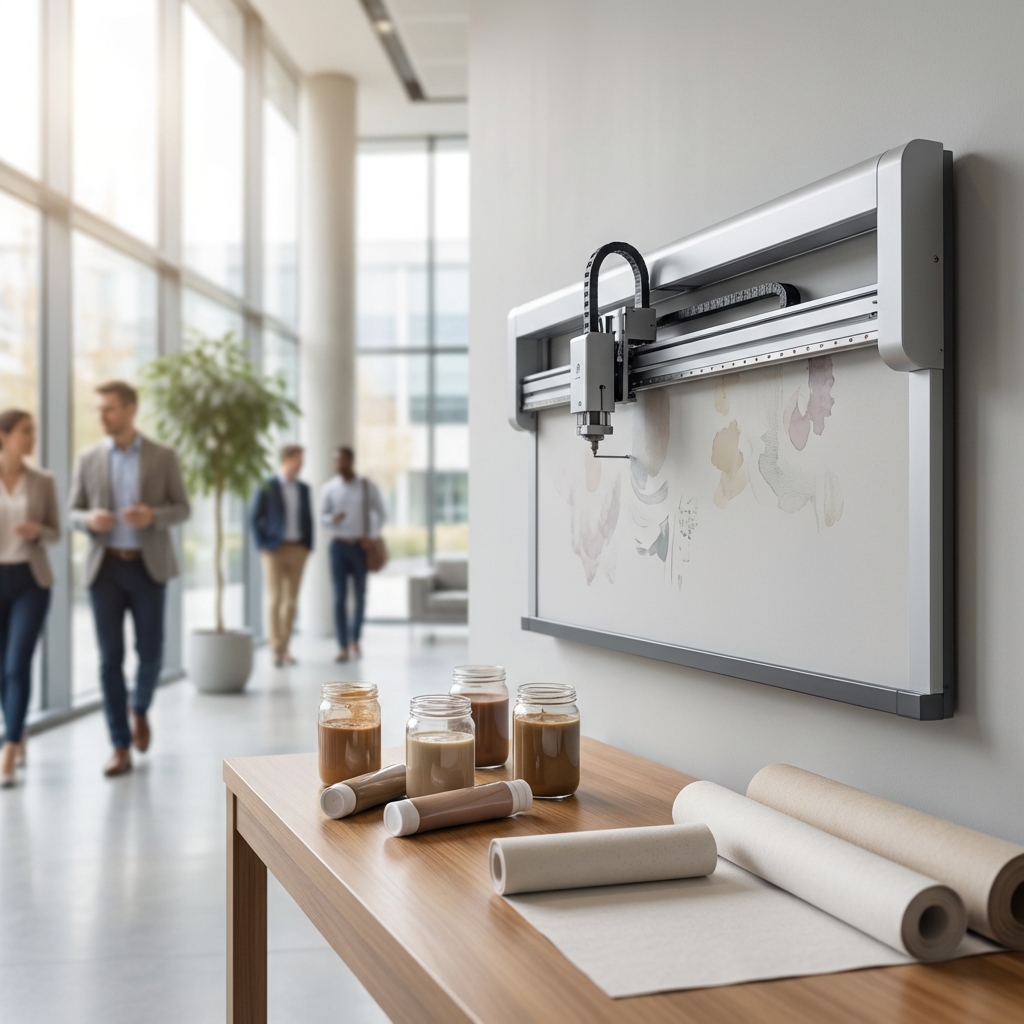
Direct-to-wall printing moves the “fabrication” step on site. A specialized printer traverses the wall and prints high-resolution imagery directly onto finished or unfinished surfaces—no vinyl, paste, or rigid panels. The approach reduces variables that typically slow projects: no shipping, no panel seaming, and no adhesive cure windows.
Key advantages that compress timelines:
- Install typically completed in under 5 hours for a standard wall, even in occupied spaces.
- Seam-free graphics at architectural scale—no panel alignment or edge lifting to manage.
- Compatible with drywall, CMU, concrete, and brick, avoiding the prep required for vinyl adhesion on textured substrates.
- Durable, cleanable finishes designed for high-traffic environments, with paint-over-ready surfaces to simplify future changes.
- On-site printing eliminates shipping delays and fabrication errors, cutting days or weeks from the commercial wall graphics timeline.
- Predictable execution across multiple locations; the same art and color profile can be replicated site-to-site with consistency.
EastCoast MuralPros pairs this technology with collaborative tools that help digital artists and internal design teams scale their work. For campuses, hospitals, and multi-location rollouts, direct-to-wall offers a performance-based alternative to wallpaper and vinyl that’s faster, more sustainable, and easier to maintain over the lifecycle. For readers evaluating environmental impact, see this overview of direct-to-wall printing vs vinyl.
Typical Installation Timeline: From Concept to Completion
Even the fastest method benefits from a clear sequence. Below is a representative timeline for direct-to-wall projects run by teams like EastCoast MuralPros, followed by a comparison for vinyl/wallpaper.
Direct-to-wall printing: a compressed, predictable path
- Discovery and scoping (1–3 business days)
– Confirm goals, wall count, surfaces, timeline constraints, and stakeholder approvals. – Identify wayfinding or safety graphics that must meet code or brand standards.
- Site survey and preflight (2–5 business days, concurrent with discovery)
– Field measurements, photos, surface assessment, lift access planning, and power needs. – If remote, teams gather as-builts and client photos, then validate during mobilization.
- Design and asset preparation (3–10 business days)
– Art direction, layout, scaling to architectural dimensions, and color targeting. – Facilities mapping for outlets, hardware, and obstructions; file preflight to avoid on-site surprises. – Internal approvals from brand, legal, and EHS as needed.
- Pilot proof or swatch (optional, 2–5 business days)
– On-wall test print or removable swatch to confirm color under real lighting. – Often skipped when brand colors and renderings are already standardized.
- Scheduling and mobilization (1–3 business days)
– Coordinate access windows (nights/weekends), staging area, and protection of adjacent finishes. – Lock in security clearances, badging, or union notifications when applicable.
- Installation/printing (under 5 hours per standard wall; 1–2 shifts for multi-wall zones)
– The printer images directly to the surface; no adhesives or panel seams. – Immediate area turnover; corridors and rooms can reopen promptly.
- Closeout and documentation (same day or next business day)
– Final photos, color notes for future replication, maintenance guidance, and asset archiving for refresh cycles.
In many cases, the entire concept-to-completion schedule can be completed in 1–3 weeks—often faster than the production lead time alone for vinyl.
Vinyl/wallpaper: typical timeline with more dependencies
- Discovery and site survey: 1–2 weeks.
- Design and file prep: 1–2 weeks, often with more templating for seams and overlaps.
- Print production and finishing: 2–3 weeks.
- Shipping and staging: 3–7 days, with potential crate or carrier delays.
- Installation: 1–4 days depending on panel count, height, and conditions.
- Rework: extra time if panels are damaged or color variance appears on install.
When project windows are tight, direct-to-wall printing de-risks the schedule by collapsing production and installation into the same step and location.
Factors That Affect Mural Installation Duration
A realistic plan accounts for variables beyond square footage. The following factors influence the mural installation duration for any method, including direct-to-wall.
- Surface readiness: Highly textured CMU and brick are compatible with direct-to-wall, but wet paint, dust, or flaking surfaces can slow setup. If patching or priming is required, add 24–72 hours for cure time.
- Vertical access: Walls over 12–14 feet may need scissor lifts or scaffold. Securing equipment, moving furniture, and protecting floors add time to mobilization.
- Occupancy and access windows: Hospitals, schools, and hotels often require night or weekend work. Narrow windows compress on-site time but can extend the total calendar (more shifts to complete the same scope).
- Security and compliance: Badging, background checks, or union coordination can add days before mobilization. Wayfinding and safety graphics may require code or internal review.
- Environmental conditions: Temperature and humidity affect adhesive products more than direct-to-wall, but both methods benefit from stable conditions and dust control.
- Artwork readiness: Complex composites, photo retouching, or multi-language layouts add design time. Direct collaboration tools reduce back-and-forth and keep the commercial wall graphics timeline on track.
- Change orders: Late content changes or scope additions (e.g., adding elevator doors or columns) may require rescheduling or a second mobilization.
- Multi-surface add-ons: Printing on doors, tables, or standees (in studio) is fast, but shipping or separate delivery windows for those items should be planned in parallel.
Well-managed projects anticipate these variables early, then stage work in a way that keeps printing windows clean and uninterrupted.
Multi-Location Rollouts and Scaling Installation Timelines
Scaling from a single feature wall to dozens of sites introduces coordination challenges that can derail a good plan. The right methods and processes keep momentum without sacrificing consistency.
Strategies that maintain speed across locations:
- Standardize a kit of parts: Lock typography, brand colors, image aspect ratios, and layout rules to minimize redesign per site. Archive approved files and ICC color profiles for reuse.
- Parallelize surveys and preflight: Use a combination of remote measurement packets and targeted in-person surveys. Validate critical dimensions on arrival before the first pass.
- Wave-based scheduling: Sequence clusters of sites by geography and access constraints. Assign dedicated crews to regions to minimize travel days and keep a predictable cadence.
- Consistent equipment and color management: Direct-to-wall printing reproduces the same asset consistently from store to store or building to building, removing the “batch variance” common with panelized systems.
- On-site fabrication logic: Because printing happens at the wall, there’s no dependency on freight. This removes a major cause of schedule slippage in national programs.
- Subscription model for refreshes: For seasonal campaigns or phased brand evolution, a subscription cadence sets decision and production checkpoints well ahead of install windows.
EastCoast MuralPros supports full-campus solutions for education and healthcare, and multi-location brand rollouts for retail, hospitality, and workplace. For higher education leaders exploring whole-environment branding, see this resource on campus branding with direct-to-wall printing.
Minimizing Downtime in Occupied Buildings and Facilities
For occupied environments, the best speed is quiet speed—fast installation paired with minimal disruption. Direct-to-wall installations excel here because they eliminate adhesives, panel cutting, and most of the handling that generates noise and dust.
Practical tactics to reduce impact:
- Night and weekend shifts: Schedule around visiting hours, class schedules, or retail peaks. Reopen corridors each morning with no lingering odors or tape barricades.
- Clear wayfinding staging: For healthcare and schools, integrate safety and instructional graphics into the wall plan to reduce signage clutter and avoid freestanding sign obstructions.
- Compact footprints: The printer, ink, and protection materials fit a modest staging area. Crews can work in tight corridors without blocking egress.
- Low VOC and cleanable surfaces: Finishes are designed for high-traffic environments and regular cleaning protocols. No paste buckets or solvents are needed on site.
- Paint-over-ready finishes: When tenant or program needs change, walls can be quickly painted—no panel removal or adhesive residue to remediate.
- Infection control and EHS alignment: Coordinate with facility protocols for dust control and equipment sanitization. Direct-to-wall avoids the heavy cutting and trimming that complicate ICRA compliance.
With fewer moving parts and a shorter on-site presence, facility teams can maintain operations while achieving a substantial visual upgrade.
Cost Implications of Installation Speed and Efficiency
Commercial mural installation timing directly influences total project cost. Faster, more predictable installs reduce labor hours, cut downtime, and avoid rework—especially when the production and installation steps happen together on site.
Where savings typically accrue:
- Labor and access: Shorter shifts and fewer mobilizations reduce overtime, off-hours premiums, and security escort time. Work is often completed in a single visit per area.
- Freight and staging: On-site printing eliminates crates, shipping fees, and receiving logistics. There’s no panel damage in transit and no need for conditioned storage.
- Rework avoidance: Seam-free imaging removes panel alignment issues and adhesive failures. Color consistency improves because the same device images all content under the same conditions.
- Lifecycle and maintenance: Direct-to-wall finishes are durable and cleanable, with lower failure rates in high-traffic corridors than applied films. When it’s time to update, paint-over-readiness avoids costly tear-outs.
- Opportunity cost: Fewer closed hours for lobbies, corridors, or stores means less revenue loss or operational friction. In healthcare and education, smoother circulation and clearer wayfinding have measurable service benefits.
- Programmatic value: Subscription-based refreshes spread costs predictably over time and prevent the spike-and-scramble cycle that leads to higher rush fees and missed windows.
When evaluating alternatives to wallpaper and vinyl, include the soft costs tied to schedule risk. The cheapest material on a per-square-foot basis can become the most expensive option if it extends timelines, triggers rework, or underperforms in the field.
Case Study: Real-World Installation Timelines Across Industries
Below are representative scenarios illustrating how direct-to-wall printing compresses schedules compared to traditional methods. Timings are typical, not edge cases, and presume standard site readiness.
- Healthcare corridor wayfinding (regional hospital)
– Scope: 12 walls across two floors; integrated wayfinding arrows, ICON sets, and donor recognition elements. – Timeline: Survey and approvals in 1 week; print/install over two consecutive nights (6–7 hours per night) to avoid patient disruption. – Outcome: No barricades; nurses stations remained open. Cleanable finishes aligned with infection control protocols.
- University student center rebrand (R1 campus)
– Scope: Entry lobby feature wall (40 feet), stair landing graphics, and event calendar wall with QR-enabled wayfinding. – Timeline: Design and asset prep in 7 business days; one on-site night shift (8 hours) for all areas; next-morning walkthrough complete. – Outcome: Graphics live before orientation week, avoiding the common crunch created by panel shipping delays. – Resource: For campus-scale strategies, review campus branding with direct-to-wall printing.
- Corporate HQ level set (multi-tenant tower)
– Scope: Six elevator lobbies, two collaboration zones, and a long corridor with a photoreal cityscape at architectural scale. – Timeline: Floor-by-floor sequencing over three evenings; 4–5 hours per floor. No lift beyond standard platform ladders. – Outcome: Tenant operations continued uninterrupted; security and after-hours logistics handled in a single mobilization per floor.
- Retail brand refresh (50-location program)
– Scope: Feature wall mural and fitting room graphics per store; standardized layouts with localized lifestyle photography. – Timeline: Wave deployment—10 stores per week for five weeks; under 5 hours per store. No freight staging or sign-off on deliveries required. – Outcome: National launch date met; consistent color across markets. No reprints due to shipping or handling.
- Museum feature gallery (art and artifacts)
– Scope: Photoreal background imagery and interpretive text integrated into architectural walls, including a gently curved surface. – Timeline: One-week design iteration; weekend install (10 hours total) including a color swatch review under exhibit lighting. – Outcome: Seam-free visuals that match curatorial standards without interrupting gallery circulation.
In each example, direct-to-wall printing shortened or eliminated the slowest phases of the traditional process—off-site production, shipping, panel staging, and rework—while delivering the design-forward, high-resolution results these environments require.
Comparing Installation Speed: Murals vs. Vinyl, Wallpaper, and Paint
When teams ask, “How fast can murals be installed?” the answer depends on the method and the variables discussed earlier. The ranges below reflect typical commercial conditions.
- Direct-to-wall printing
– On-site time: Under 5 hours per standard wall; 1–2 shifts for multi-wall zones. – Full project window: Often 1–3 weeks from discovery to completion, depending on design approvals and access.
- Vinyl wall wraps
– On-site time: 1–3 days per area for panel alignment and adhesion, longer for complex surfaces. – Full project window: Commonly 4–6 weeks including print production and shipping.
- Custom wallpaper/wallcovering
– On-site time: 1–4 days per area due to paste application and panel seaming. – Full project window: 4–7 weeks with production, shipping, and cure considerations.
- Hand-painted murals
– On-site time: 3–10 days for a single wall; more for large programs. – Full project window: 4–8+ weeks including design development and drying time.
- Rigid panels or plaques
– On-site time: 1–3 days for layout, drilling, and finishing; sometimes requires union labor. – Full project window: 3–6 weeks due to fabrication and freight.
Many organizations choose a hybrid, using direct-to-wall printing for large fields of imagery and integrated wayfinding, then supplementing with dimensional elements where needed. The goal is to balance mural installation speed with the desired tactile or layered effect—without introducing avoidable delays.
Scheduling Best Practices for Commercial Mural Projects
Regardless of method, disciplined scheduling keeps momentum and protects launch dates. The following practices consistently reduce schedule risk:
- Establish a decision calendar: Define approval checkpoints for layout, color, and content. Assign single-point contacts for facilities, brand, and operations.
- Front-load the site survey: Even a short virtual survey with good photos speeds layout and preflight. Confirm wall composition (drywall, CMU, brick), obstructions, and access routes.
- Lock file specs early: Set pixel density based on final dimensions and viewing distance; preflight fonts, linked images, and color profiles. This avoids last-minute file repair.
- Pilot where risk is high: For critical color matches or unique textures, test a small on-wall sample ahead of full production.
- Sequence by impact: Prioritize entry and high-traffic areas first, back-of-house last. In occupied buildings, secure off-hours windows and align with cleaning schedules.
- Align equipment and access: Reserve lifts or ladders, confirm power, and define a small staging zone with floor protection and cable management.
- Keep a clean change process: Document scope changes and their schedule impact immediately. Use version control to prevent installing the wrong file.
- Plan for contingencies: Hold a buffer shift at the end of each wave—especially in multi-location programs—to absorb surprises without pushing the next site.
- Close out with data: Photograph completed walls, capture final color settings, and log exact dimensions. These records accelerate future refreshes or repairs.
- Think lifecycle from day one: Choose finishes that are durable and cleanable. Where turnover is common, plan graphics that can be painted over quickly without remediation.
Teams that adopt these practices find they can consistently hit tight windows, even during peak seasons and fiscal year-end projects.
Conclusion: Planning Your Commercial Mural Installation Timeline
Commercial mural installation timing influences everything from occupant experience to program cost and brand perception. Traditional methods deliver strong results but often trade speed for process steps—off-site production, shipping, panel seaming, and cure windows. Direct-to-wall printing compresses those steps into a single on-site action, producing photoreal, seam-free imagery at architectural scale with minimal disruption.
For facilities, procurement, and brand teams facing real deadlines—tenant turnover, semester starts, clinical expansions, national rollouts—the ability to install in under a day per area changes what’s possible. With careful scoping, disciplined approvals, and wave-based scheduling, organizations can upgrade environments quickly and predictably, without the risk profile of adhesives or the downtime of paint.
EastCoast MuralPros supports fast, durable, and scalable installations across corporate, healthcare, education, hospitality, retail, and cultural spaces. If your next project demands reliable speed, evaluate direct-to-wall printing as a performance-based alternative to vinyl wall coverings and wallpaper—and build your schedule around an installation window measured in hours, not weeks.
Contact us to learn more