Table of Contents
- The Cost and Complexity of Traditional Wall Covering Procurement
- Why Adhesive-Based Solutions Create Operational Headaches
- What We've Learned About Enterprise-Grade Wall Graphics
- Our Direct-to-Wall Printing Approach: How It Changes Procurement
- Speed, Quality, and Consistency Across Multi-Location Rollouts
- Evaluating Durability and Total Lifecycle Cost
- Installation Without Disruption to Occupied Spaces
- Designing for Change: Paint-Over Ready Graphics
- How Our Procurement Process Works
- Scaling from Pilot to Full Deployment
- Frequently Asked Questions (FAQ)
The Cost and Complexity of Traditional Wall Covering Procurement
When you’re managing facilities across multiple locations or overseeing a major interior refresh, wall graphics procurement becomes a logistical puzzle. Vinyl wraps peel at the seams. Wallpaper absorbs stains and requires frequent replacement. Hand-painted murals don’t scale. We’ve spent years helping enterprise teams navigate this decision, and we’ve learned that the right printing technology transforms not just the space, but your entire procurement workflow.
Adhesive-free wall graphics represent a fundamental shift in how institutions approach commercial interiors. We print directly onto your wall surface, eliminating vinyl layers, adhesives, and the operational headaches that come with them. This article walks you through what we’ve learned about procuring durable, high-quality wall graphics at scale, and how our direct-to-wall approach simplifies the entire process.
Traditional wall coverings carry hidden costs that often surprise procurement teams. You’re not just paying for the material itself. There’s substrate preparation (often extensive surface repair), fabrication lead times that stretch 6-12 weeks, shipping delays, installation labor that can last days or weeks, and inevitable callbacks when panels bubble or seams separate.
We’ve reviewed procurement files from dozens of enterprise clients, and the pattern is consistent: a $50,000 vinyl project becomes $85,000 once you factor in site prep, labor contingencies, and the cost of occupied-building downtime. Wallpaper adds similar friction with moisture concerns, frequent staining in high-traffic corridors, and replacement cycles that run 3-5 years in healthcare or hospitality settings.
The real complexity emerges when you’re rolling out wall graphics across five campuses or a national retail chain. Consistency becomes nearly impossible. One vendor’s color rendering differs from another’s. Seam placement creates visual breaks. Installation timing becomes hard to coordinate across locations. Each refresh requires a new RFP cycle, new vendor evaluation, new lead times.
Our direct-to-wall approach eliminates much of this overhead. No shipping means no delay buffers. No adhesive means no substrate failure modes. No fabrication means we respond to your timeline, not a manufacturing calendar.
Why Adhesive-Based Solutions Create Operational Headaches
Adhesive-based wall coverings fail in predictable ways, especially in high-traffic, high-humidity environments. Vinyl edges lift at corners and doorways. Seams separate as the adhesive loses grip over months or years. Wallpaper absorbs moisture behind the covering, creating mold and delamination. We’ve documented installations where vinyl lasted 18 months before bubble-back repairs became necessary, only to fail again within another year.
The operational cost is what makes this truly painful. A failing mural in a hospital corridor or school hallway demands immediate attention. You can’t ask a healthcare facility to close a patient wing for three days while you remove and reinstall wall coverings. You can’t leave wayfinding graphics peeling during a campus tour season.
Adhesive solutions also create environmental waste. When vinyl reaches end-of-life, it goes to a landfill. There’s no recovering the material, and disposal falls on your facilities team. Wallpaper removal is labor-intensive and generates dust containment hazards in occupied buildings.
Procurement teams underestimate adhesive-based durability risk because the initial cost looks reasonable. The true expense emerges when lifecycle replacements, emergency repairs, and business disruption multiply over time.
What We’ve Learned About Enterprise-Grade Wall Graphics
Working with institutional and corporate teams over the past several years has taught us that successful wall graphics procurement hinges on three non-negotiable requirements: predictability, durability, and the ability to scale without compromise.
Predictability means you know exactly what your walls will look like before installation begins, and that installation completes within a defined window. It means one team can specify graphics in one location and know that another team executing thousands of miles away will deliver identical results. Variability is the enemy of enterprise procurement.
Durability matters most in spaces where you can’t afford failure. High-traffic corridors in schools, patient areas in hospitals, retail floors in flagship stores, and wayfinding systems across campuses must remain intact and vibrant for years. A solution that requires replacement every 18-24 months is not enterprise-grade, no matter how attractive the initial cost.
Scaling demands that your vendor can handle simultaneous rollouts across multiple sites without quality degradation. The fifth campus installation should look as crisp and precise as the first. Lead times shouldn’t spike when you go from one location to ten.
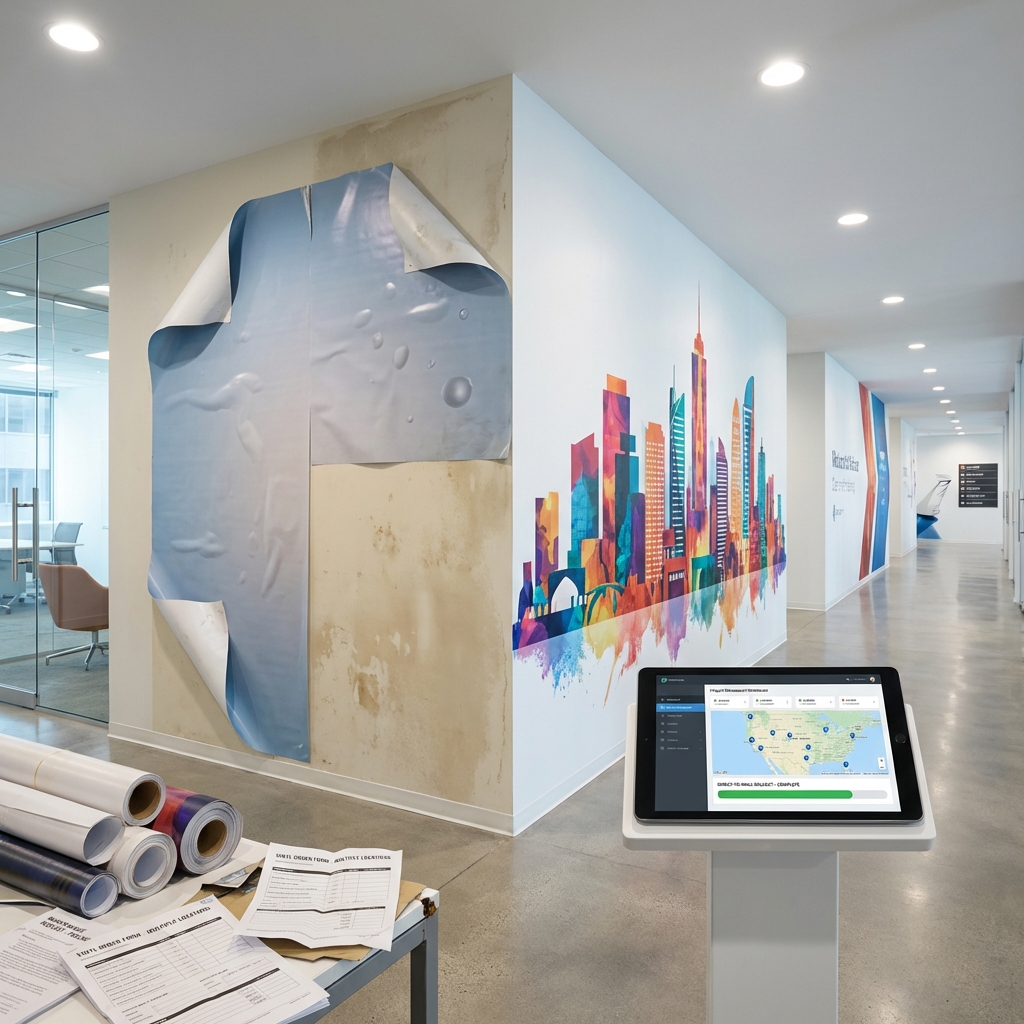
Our direct-to-wall printing technology delivers on all three. We print at high resolution directly onto your wall substrate, creating a permanent graphic layer that’s bonded through our print chemistry, not mechanical adhesives. No seams. No edges. No panels to align. The result is an image that’s truly part of the wall.
Our Direct-to-Wall Printing Approach: How It Changes Procurement
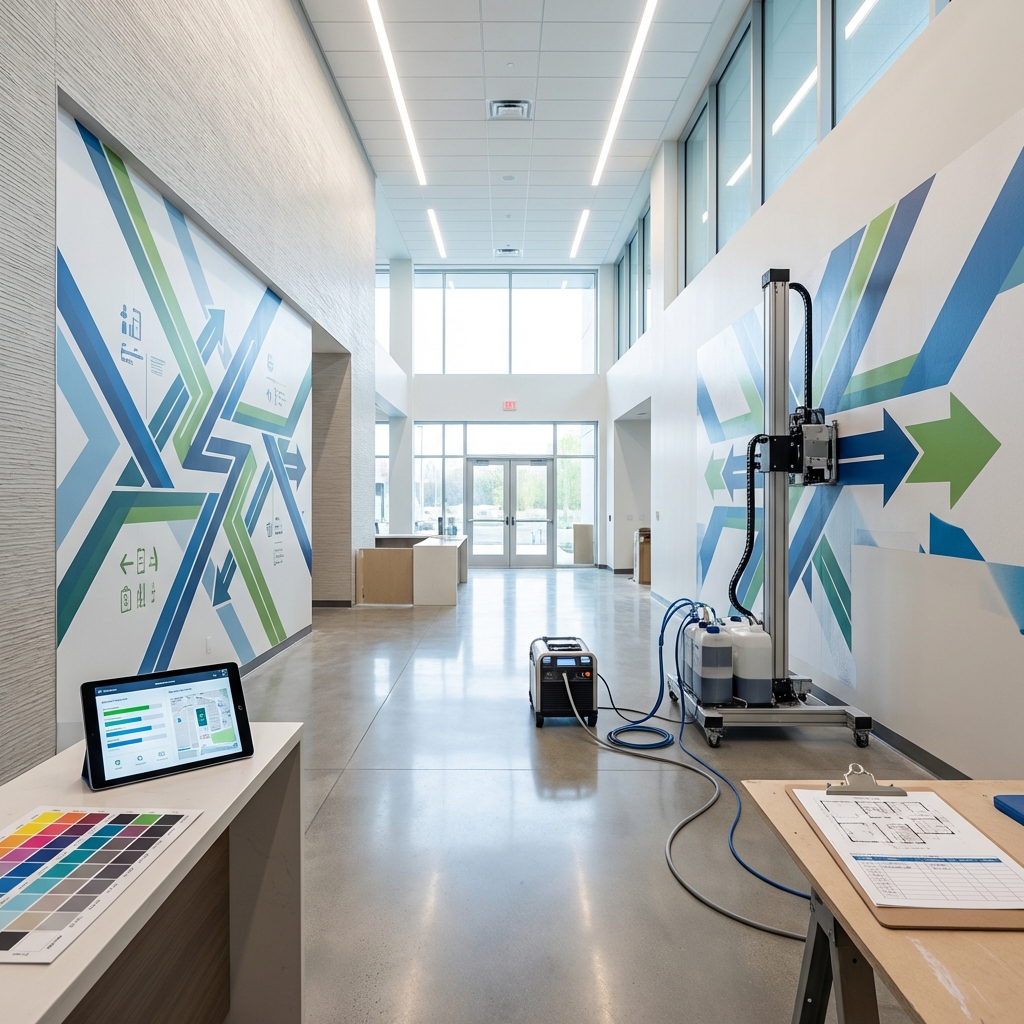
Direct-to-wall printing eliminates entire categories of procurement variables. We prepare your wall substrate on-site, assess surface conditions in real time, and print graphics using our proprietary technology. The image cures within hours, and your space is ready for occupancy the same day.
Here’s what changes for you as a procurement decision-maker:
Lead time collapses. We typically complete installation in under five hours per wall, depending on size. Once you approve designs and we schedule the work, we show up and execute. No waiting for fabrication shops to finish other jobs first. No shipping windows. No buffer stock.
Quality becomes consistent across locations. Our on-site printing means color accuracy, resolution, and detail are identical whether you’re printing in Boston or Atlanta. Every location receives the same visual experience. For multi-location brands and national rollouts, this consistency is worth far more than the cost.
Substrate compatibility expands. We print directly onto drywall, CMU (concrete masonry units), concrete, and brick without requiring primer or special surface treatment. Many existing walls are ready to print immediately. This reduces your pre-installation prep cost and timeline.
Sustainability shifts in your favor. No vinyl manufacturing. No adhesive chemistry. No end-of-life landfill waste. The wall itself becomes the final medium. This aligns with ESG commitments many enterprises now track for their real estate portfolios.
Speed, Quality, and Consistency Across Multi-Location Rollouts
When you’re rolling out wall graphics across a five-campus school system or a national retail footprint, consistency and schedule certainty become your top operational priorities. We’ve managed rollouts involving 40+ locations, and our process is built to deliver identical quality and predictable timelines across all of them.
Start with a collaborative design phase. We work with your design team or architecture partners to establish master specifications. We create a design guideline document that accounts for wall dimensions, lighting conditions, architectural details, and brand requirements specific to each location. This becomes your single source of truth.
Next, we prepare site-by-site installation schedules. Rather than asking all locations to wait for a central fabrication facility, we work with your facilities team to identify optimal installation windows. This might mean campus A goes live in March, campus B in April, based on your operational calendar. We’re coordinated, not forced into a single go-live date.
On-site printing means each location receives fresh, high-resolution imagery printed to exact specifications. There’s no degradation from shipping, handling, or storage. The moment our team arrives, we assess substrate condition, make any final adjustments, and execute. This reduces deployment risk and eliminates the “dead stock” problem that plagues traditional vinyl projects.
For a 50-wall retail rollout we completed last year, we installed graphics across 12 locations over 16 weeks, with zero rework required. That kind of consistency compounds the value of your investment over time.
Evaluating Durability and Total Lifecycle Cost
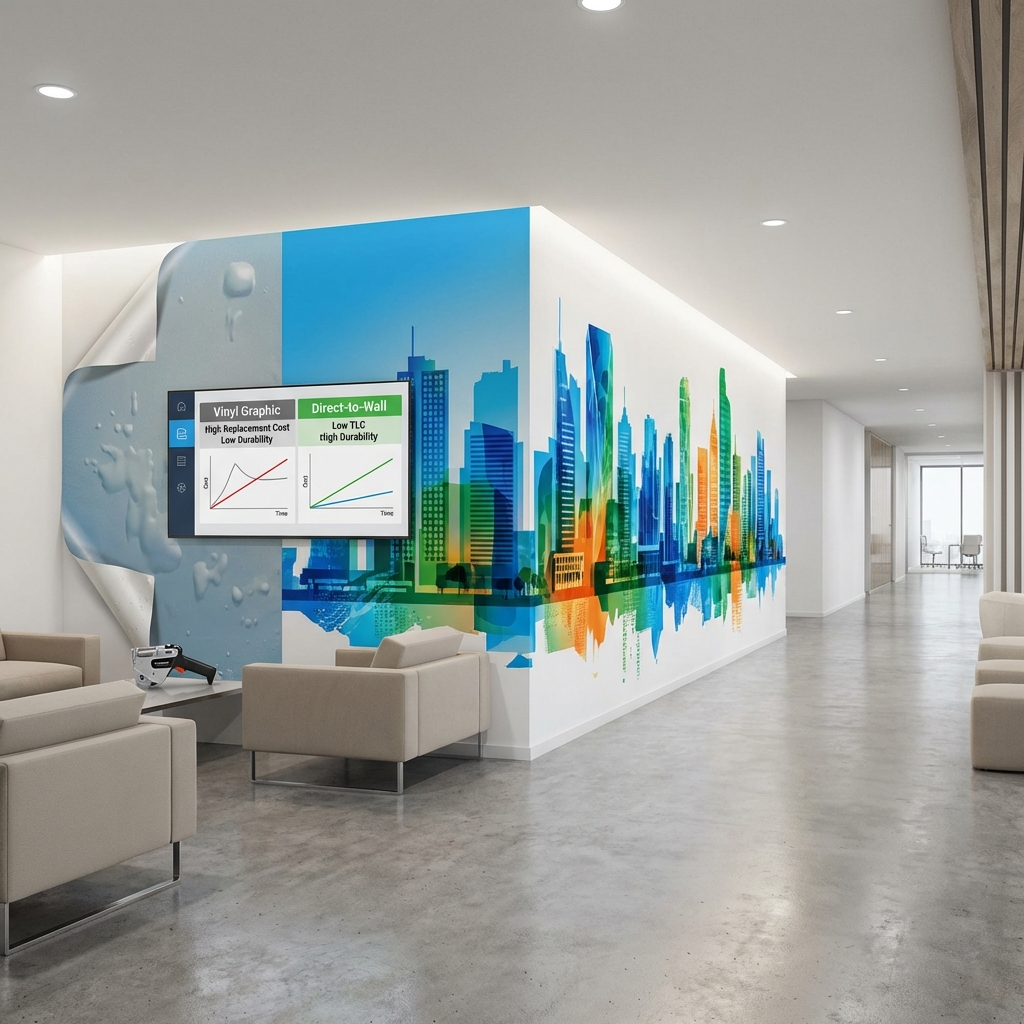
Total lifecycle cost (TLC) is the metric that separates enterprise-grade solutions from cost-cutting shortcuts. Many procurement teams focus only on installation cost, then wonder why replacement costs spike unexpectedly.
Our direct-to-wall graphics are engineered for durable, high-traffic environments. The surface is cleanable with standard facility-care products, designed to withstand daily contact, and resistant to staining. We’ve documented installations in healthcare corridors, school hallways, and retail floors operating at full quality for 10+ years without replacement or significant maintenance.
Compare this to vinyl, which typically shows visible wear within 3-5 years in high-traffic settings. Wallpaper degrades faster in humid environments. Hand-painted murals require periodic touch-up and are susceptible to vandalism.
To evaluate durability for your specific environment, ask your graphics vendor:
- What’s the expected lifespan in your specific use case (patient wing vs. executive office vs. retail)?
- What maintenance regimen does the surface require, and what are the annual labor costs?
- Are there any substrate failure modes or edge-lift risks you should monitor?
- If damage occurs (a mark, a small tear), what’s the repair cost and process?
For direct-to-wall durability, maintenance is straightforward: standard cleaning with appropriate products. We provide a care guide specific to your environment.
When you model TLC over a 10-year window, most clients find that direct-to-wall printing delivers 30-40% lower total cost than vinyl-based solutions, even when the installation cost appears higher upfront. The calculator shifts when you eliminate replacement cycles, reduce downtime, and avoid callbacks.
Installation Without Disruption to Occupied Spaces
Occupied buildings demand installation approaches that minimize disruption. You can’t close hospital corridors, school hallways, or retail floors for days while contractors work. We’ve engineered our process for low-disruption, same-day installation in active environments.
Our team typically arrives early morning or after hours, assesses the wall substrate, performs any necessary prep work, prints the graphics, and completes curing within the same shift. For most walls, this means 3-5 hours of active on-site work.
We manage containment and dust control to healthcare and institutional standards. We coordinate with your facilities team to identify optimal installation windows. We use portable equipment and don’t require major staging areas. For a 500-bed hospital that needed corridor wayfinding graphics updated, we executed across 24 walls with zero patient impact or facility disruption.
The speed also means less exposure to environmental conditions. Temperature and humidity fluctuate less during a single shift than across a multi-day installation. This improves curing quality and reduces the risk of surface defects.
Designing for Change: Paint-Over Ready Graphics
Enterprise spaces evolve. Programs shift. Tenants change. Lease terms end. A wall graphic that can’t adapt to future needs becomes a sunk cost liability.
Our graphics are paint-over ready. If your space needs to change, your facilities team can simply paint over the existing graphic. There’s no removal process, no surface damage, no environmental waste. The wall returns to blank canvas status, and you’re free to repaint or print new graphics.
This flexibility is especially valuable in healthcare (where departments reorganize), education (where campus wayfinding updates with enrollment), and commercial real estate (where tenant transitions happen regularly). You’re not locked into a permanent decision; you’re making a durable, interim choice that leaves the door open.
For a university system we work with, this paint-over capability meant they could refresh wayfinding graphics every 3-4 years as campus layouts changed, without worrying about removing old vinyl or managing disposal. The cost of repainting is negligible compared to the value of adaptability.
How Our Procurement Process Works
We’ve streamlined our procurement intake to fit institutional workflows. Here’s what your team can expect:
1. Initial Discovery Call: We learn about your space, scope, timeline, and procurement requirements. This typically takes 30 minutes and helps us establish baseline feasibility and rough timeline.
2. Site Documentation and Design Brief: You provide photos of walls, architectural details, and any specific constraints. We create a design brief that outlines substrate conditions, print specifications, and installation logistics.
3. Collaborative Design Phase: Your design team or our studio collaborates on artwork, layout, and color proofing. We iterate until you approve the final design.
4. Formal Proposal and Specification: We provide a detailed quote, installation schedule, maintenance guidelines, and project specifications. This becomes your procurement documentation for budget approval and vendor contracts.
5. Pre-Install Coordination: We confirm access, scheduling, and any facility coordination requirements. Your team identifies contacts, restrictions, and optimal installation windows.
6. On-Site Installation: Our team executes according to schedule. We provide real-time communication and document completion with photos and performance notes.
7. Post-Install Support: We follow up on durability, care protocols, and any questions your team has during the first months of operation.
Our average procurement cycle from discovery to installation is 8-12 weeks, depending on design complexity and your approval timeline. This is significantly faster than traditional vinyl projects, which often stretch 14-20 weeks.
Scaling from Pilot to Full Deployment
Many enterprise clients start with a pilot program. You install graphics in one high-traffic area, evaluate durability and impact over 3-6 months, then decide whether to scale. This approach mitigates risk and builds internal confidence in the technology.
We’ve supported dozens of pilot-to-full-scale transitions, and the pattern is consistent: early pilots succeed, stakeholder confidence increases, and the business case for scaling becomes obvious. A hospital that pilots wayfinding graphics in one patient wing typically expands to three wings within 12 months. A school district that tests it in the main administrative building moves to 8-10 locations.
When scaling, a few best practices accelerate deployment:
- Establish master design standards early so all locations feel cohesive.
- Pre-qualify all potential wall substrates at each site to avoid surprises.
- Coordinate installation scheduling with your facilities calendar (avoid peak times like student move-in or major renovations).
- Train your facilities team on care and maintenance so they’re confident supporting the graphics long-term.
- Capture performance data from early installations to inform decisions about expansion priorities.
For a national retailer that scaled from 3 pilot stores to 47 locations, this structured approach meant zero installation rework and deployment completed 6 weeks ahead of schedule.
We make it straightforward to grow from a single location to enterprise scale. Your initial vendor relationship with us carries over without renegotiation or requalification. Lead times don’t spike. Quality remains consistent. The procurement process you refined during your pilot becomes your template for every subsequent phase.
If you’re evaluating alternatives to vinyl, wallpaper, or construction-heavy interior upgrades, we’re here to walk through your specific requirements. Reach out with your space details, timeline, and scope, and we’ll help you understand how direct-to-wall printing fits your enterprise procurement workflow.
Contact us to learn more
Frequently Asked Questions (FAQ)
What makes our direct-to-wall printing different from vinyl wraps or wallpaper?
We print graphics directly onto your walls using high-resolution printing technology, which eliminates adhesives, backing materials, and seams entirely. Unlike vinyl, our solution won’t peel, bubble, or age visibly over time, and it’s much more sustainable since there’s no waste from backing or failed installations. We also finish surfaces in a way that lets you paint over them when your space or branding needs change, making lifecycle costs predictable and manageable.
How quickly can we install graphics across multiple locations?
We typically complete installation in under five hours per wall or space, and because we print on-site, we eliminate shipping delays and fabrication errors that slow down traditional vendors. For multi-location rollouts, our team maintains consistent execution across every site, so you get uniform results at scale without coordinating with multiple vendors or managing inventory. We work in occupied buildings with minimal disruption, so your operations keep running while we work.
What surfaces can you print on, and will it work in our existing building?
We’re compatible with finished and unfinished drywall, CMU block, concrete, and brick, so we work in nearly any commercial or institutional environment you have. Our process doesn’t require surface prep, special primers, or construction, which means we can install in spaces exactly as they are without adding project complexity or cost.