Table of Contents
- The Wayfinding Crisis in Complex Spaces
- Why Traditional Signage Clutters Rather Than Clarifies
- Our Direct-to-Wall Approach to Seamless Navigation
- How We Integrate Wayfinding Into Architectural Surfaces
- Design Flexibility Across Multi-Location Rollouts
- Installation Speed Without Operational Disruption
- Durability and Maintenance in High-Traffic Environments
- Real-World Wayfinding Systems We've Deployed
- Comparing Direct-to-Wall to Vinyl and Signage Alternatives
- Getting Started With Your Wayfinding Strategy
- Frequently Asked Questions (FAQ)
The Wayfinding Crisis in Complex Spaces
Large institutions and multi-floor commercial buildings face a persistent problem: visitors get lost, staff spend time giving directions, and the physical environment becomes less welcoming. In hospitals, universities, and corporate campuses, poor wayfinding translates directly into frustration, operational overhead, and a diminished sense of place.
The root cause isn’t a lack of direction. It’s clutter. Traditional signage systems proliferate across walls, floors, and corridors—each new department or renovation cycle adds another set of directional signs, floor markers, or illuminated directories. Over time, spaces become visually chaotic, individual signs lose effectiveness through sheer noise, and visitors feel overwhelmed rather than guided.
We’ve watched this unfold across dozens of institutional projects. Facilities teams install new signage to address confusion, but without a coordinated strategy, they end up with redundant, conflicting, or outdated markers that actually worsen navigation. The result: capital spending that doesn’t solve the underlying problem.
Why Traditional Signage Clutters Rather Than Clarifies
Standard directional signage approaches rely on discrete physical objects: metal frames, plastic inserts, vinyl decals, or standalone kiosks. Each adds visual weight and requires its own installation, maintenance, and eventual replacement cycle.
The problems compound quickly:
- Proliferation over time. Each renovation, new tenant, or program change spawns new signs. Rarely does anyone remove old ones.
- Inconsistent design and messaging. Without a coordinated system, signage styles, fonts, and color schemes vary by floor or building, weakening the overall navigational experience.
- High visibility cost. Signs demand shelf space and attention; they compete visually with architecture and branding rather than enhance them.
- Maintenance burden. Vinyl decals peel, plastic inserts crack, and frames corrode. Replacing individual signs across a large campus is labor-intensive and disruptive.
- Limited flexibility. Once installed, traditional signage is expensive to modify. Floor numbering changes, department relocations, or brand updates require physical replacement.
We wanted a better option. One that lets spaces remain visually integrated while still delivering clear, durable navigation.
Our Direct-to-Wall Approach to Seamless Navigation
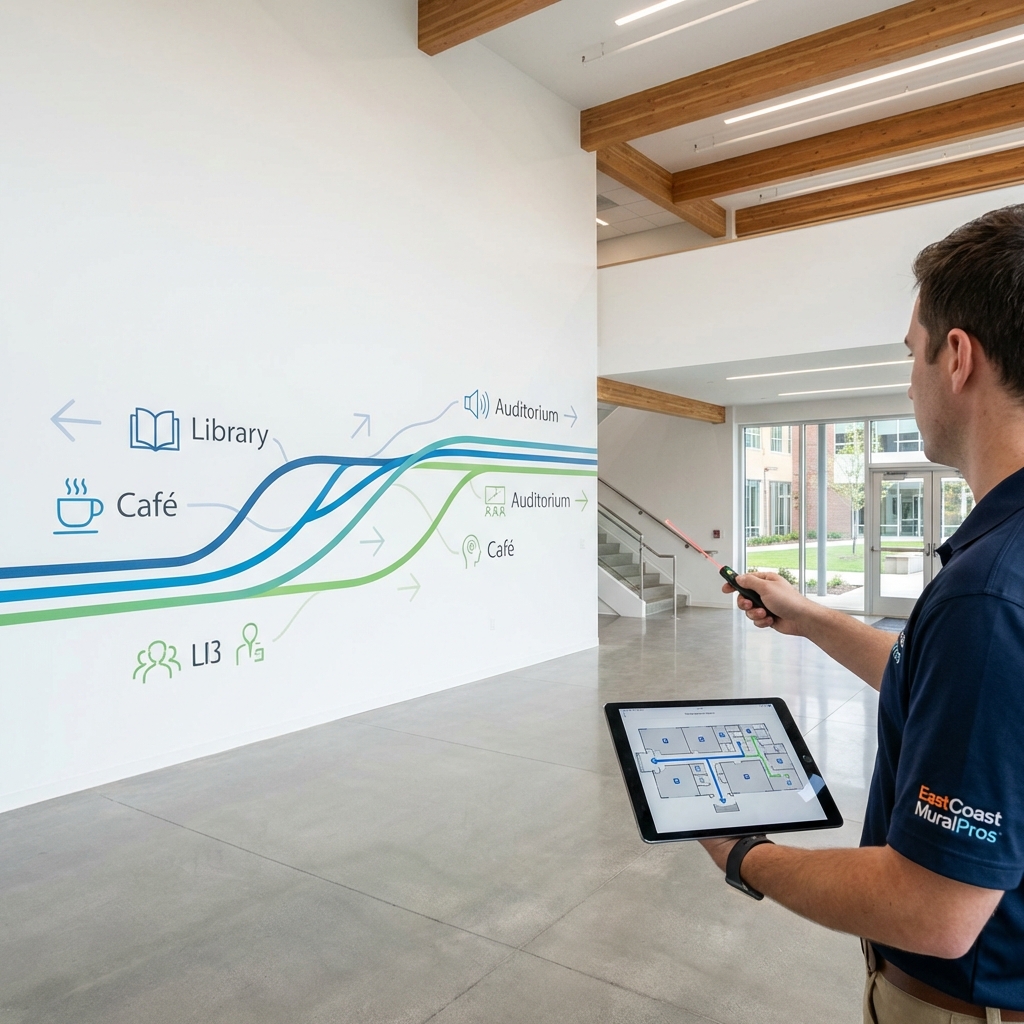
Our solution is to print wayfinding graphics directly onto architectural surfaces—walls, columns, and stairwells—using our high-resolution direct-to-wall printing technology. The result is integrated, paint-like finishes that feel part of the building rather than layered onto it.
Here’s what that means in practice:
- Seam-free graphics at architectural scale. We print directional arrows, floor identifiers, department names, and maps as continuous wall graphics. No frames, no separate objects, no visual clutter.
- Photoreal, crisp detail. Our technology delivers resolution sharp enough to include maps, wayfinding diagrams, and instructional graphics without pixelation or loss of clarity.
- Unified visual language. We design a single coherent wayfinding system that scales across every floor, building, and campus location. Consistency builds intuition and speeds navigation.
- Paint-over capability. If a department relocates or a program changes, we simply repaint the wall and install new graphics. No adhesive residue, no substrate damage, no lengthy removal process.
We’ve deployed this approach in hospitals where visitors previously relied on staff for directions, universities where new students struggled with multi-building campuses, and corporate offices where floor numbering or departmental organization had shifted repeatedly.
How We Integrate Wayfinding Into Architectural Surfaces
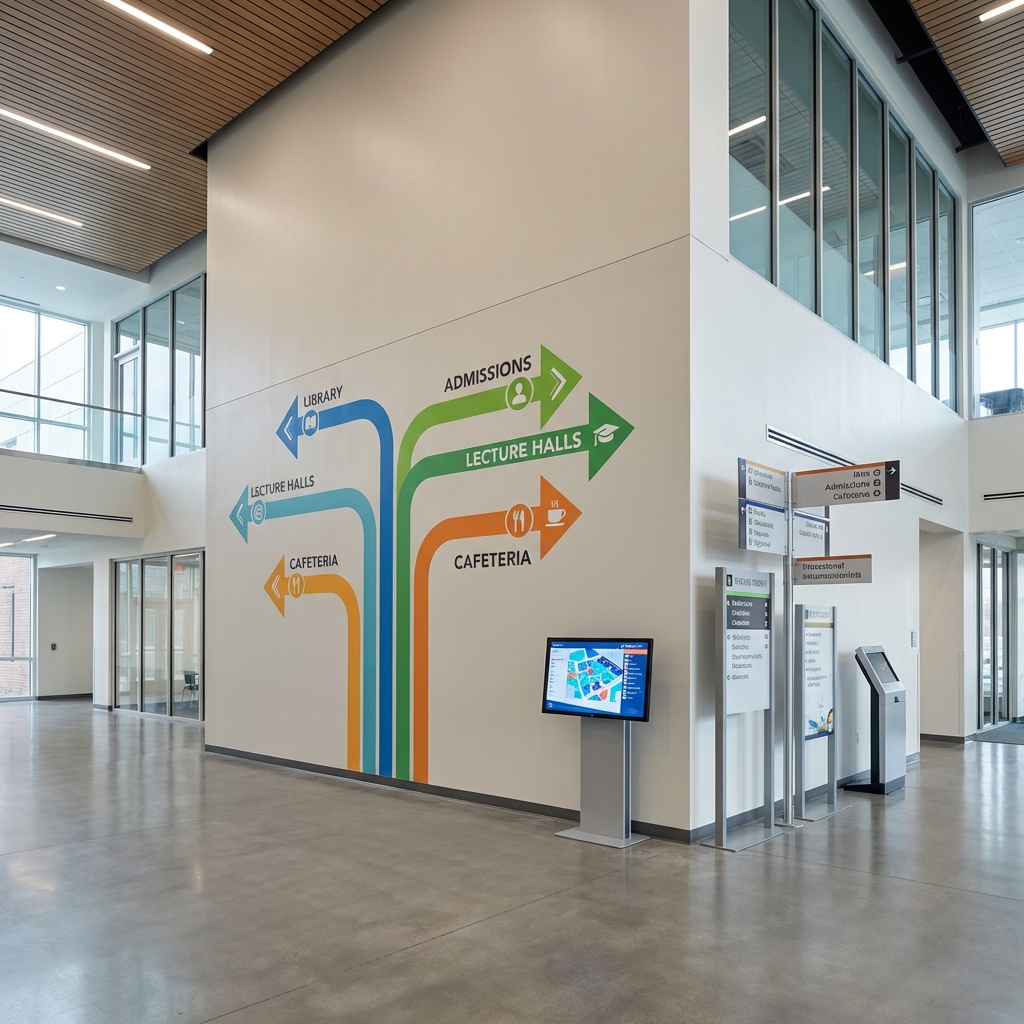
Integration requires careful design and site assessment. We don’t simply apply directional graphics to any wall; we select substrates, angles, and content placement to maximize effectiveness while respecting architectural intent.
Our process starts with a site audit:
- Visitor flow mapping. We observe and document common navigation patterns: entry points, decision points (where visitors typically hesitate or turn), and destination clusters.
- Substrate evaluation. We assess wall conditions, finishes, lighting, and sightlines from typical visitor perspectives. A directional arrow is useless if it’s hidden by shadow or glare.
- Content hierarchy. We determine what information appears at each location: building maps at entries, floor identifiers in stairwells and elevators, department-specific wayfinding near cluster destinations.
- Design iteration with stakeholders. We work with facilities, security, branding, and operations teams to align wayfinding with existing signage codes, ADA requirements, and brand guidelines.
Once approved, we print directly onto the prepared wall surface. The graphics cure into a durable, cleanable finish that integrates visually with the surrounding architecture. Unlike vinyl wraps or adhered signage, there are no edges, seams, or overlays to detract from the space.
Design Flexibility Across Multi-Location Rollouts
One of our strongest capabilities is scaling wayfinding systems across multiple buildings, campuses, or national rollouts while maintaining design consistency and local flexibility.
A mid-Atlantic university system we partnered with illustrates this. Each campus had different architecture, floor layouts, and departmental structures. We created a master wayfinding template that included standardized color palettes, typography, arrow designs, and information hierarchy. Then, for each location, we customized content, substrate placement, and graphic orientation to fit local conditions.
The outcome: visitors instantly recognized the wayfinding system when they moved between campuses, yet each location felt appropriately customized. Printing onsite meant we could respond to late design changes, correct errors on the fly, and maintain schedule certainty.
Key advantages of this approach:
- Parallel production and installation. We don’t wait for one location to finish before starting another. Multiple teams and printing setups work simultaneously.
- Local design authority. Each campus manager can approve content and positioning without delaying broader rollout timelines.
- Version control and consistency. All graphics derive from a single master file, reducing brand drift and installation errors.
- Rapid iteration. If stakeholders request design changes mid-project, we adjust the master file and implement updates across remaining locations without starting from scratch.
Installation Speed Without Operational Disruption
We typically complete wayfinding installations in under 5 hours per wall or corridor section, far faster than traditional signage installation or renovation-based approaches. More importantly, we minimize disruption in occupied facilities.
Here’s why speed matters in a hospital or university setting: every hour of disruption compounds operational costs. Corridors need to remain passable, visitor flow patterns persist, and staff cannot relocate operations mid-project.
Our approach addresses this:
- Compressed installation windows. We coordinate with facilities teams to print and finish walls during off-peak hours—early mornings, weekends, or scheduled maintenance windows.
- No substrate preparation delay. Unlike vinyl systems requiring days of wall priming and drying, our direct-to-wall process begins immediately after surface cleaning and light sanding.
- Minimal equipment footprint. We use handheld printing systems and local power sources rather than large construction equipment, cranes, or scaffolding that would shut down floor sections.
- Same-day or next-day completion. Most wayfinding installations, including design approval, printing, and curing, are finished before normal operations resume.
Our team typically includes two technicians per site. One manages equipment and printing; the other handles substrate prep, quality checks, and stakeholder communication. This lean crew model means lower labor costs and less interference with normal facility operations.
Durability and Maintenance in High-Traffic Environments
Wayfinding graphics must survive thousands of foot strikes, wheeled traffic, frequent cleaning, and years of use. We design our systems to handle these stresses without degradation.
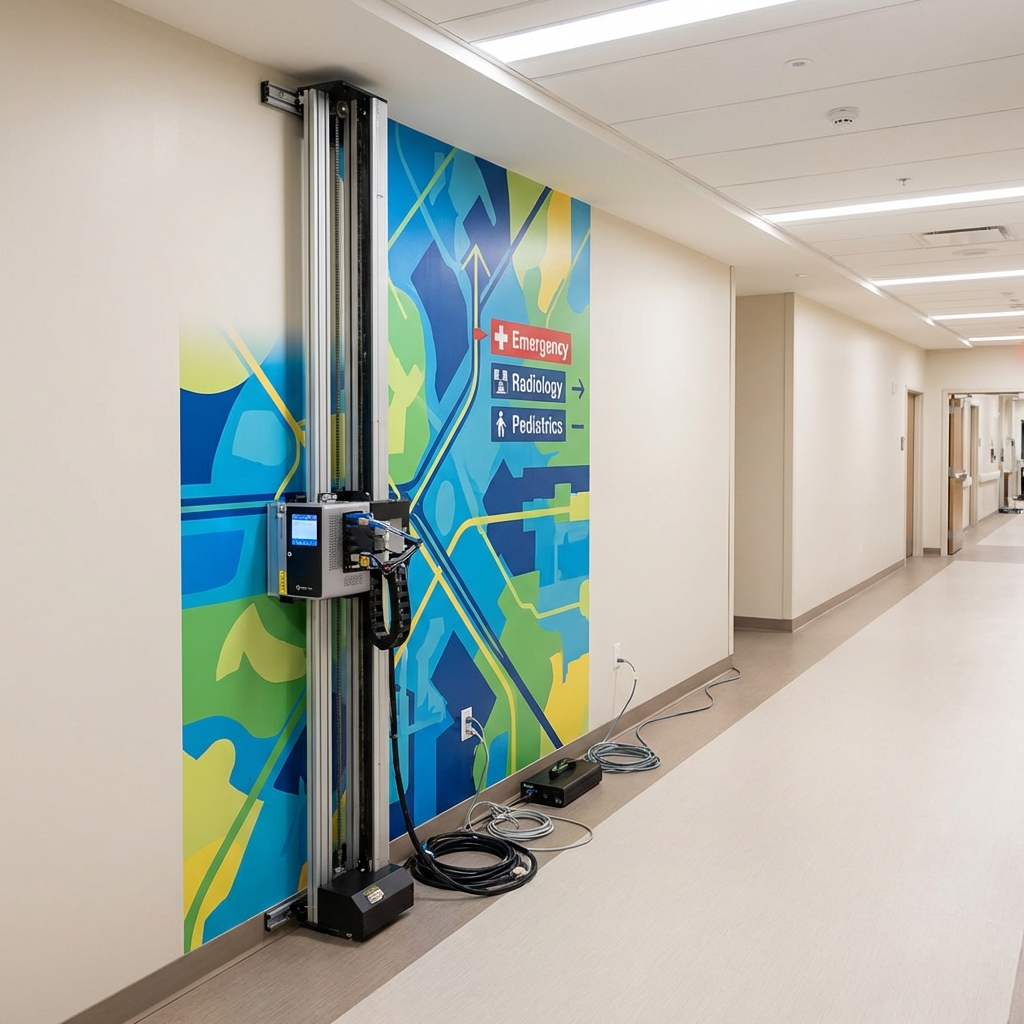
Our direct-to-wall finish is inherently durable:
- Scratch and scuff resistance. The cured surface resists marks from wheels, carts, and foot traffic without requiring special protective coatings.
- Cleanable and sanitizable. In healthcare and institutional settings, wayfinding often receives frequent cleaning or disinfection. Our surfaces tolerate alcohol, bleach-based cleaners, and mechanical scrubbing without fading or peeling.
- No adhesive failure. Because we print directly onto the wall rather than adhering separate materials, there are no seams to separate, edges to curl, or adhesive to degrade.
- Fade and UV stability. Indoor applications experience minimal UV exposure, but our inks are formulated to resist ambient light degradation over 7-10+ years.
Lifecycle efficiency is a core competitive advantage. A traditional vinyl or fabric-based wayfinding system typically requires replacement every 3-5 years. Our direct-to-wall graphics can remain effective for 7-10 years or longer, with maintenance limited to routine cleaning.
When refresh time arrives, the process is straightforward: apply a primer or paint-over coating, sand lightly, and print fresh graphics. No adhesive removal, no substrate damage, no environmental waste from failed vinyl or plastic.
Real-World Wayfinding Systems We’ve Deployed
We’ve implemented comprehensive wayfinding systems for hospitals, universities, and multi-tenant office complexes. Two examples illustrate the diversity of applications and outcomes.
Case 1: Mid-Atlantic Teaching Hospital. A 600-bed facility struggled with visitor confusion across four connected buildings and a basement level. Patient family members frequently became lost, requiring staff to provide directions, diverting clinical personnel from patient care. We designed a color-coded wayfinding system using our direct-to-wall technology. We printed building identifiers, floor maps, and directional arrows on stairwell walls, corridor junctions, and elevator lobbies. The system was installed over a 10-day period with minimal impact to operations. Post-installation surveys showed a 34% reduction in visitor requests for directions and a marked improvement in patient satisfaction scores related to facility accessibility.
Case 2: Large Public University. A sprawling campus with 40+ buildings and inconsistent signage created onboarding challenges for new students. We created a cohesive wayfinding system featuring custom building logos, consistent directional language, and campus maps printed at key entry points and intersections. We used a phased rollout across 15 major buildings over four months. The unified visual system became a campus branding asset, reinforcing institutional identity while improving navigation. Facilities reduced annual signage maintenance spending by 28% and eliminated the need for a dedicated signage procurement and replacement cycle.
Both projects benefited from our ability to integrate wayfinding with broader branding and space design. We didn’t simply add signs; we elevated the visual environment while solving a functional problem.
Comparing Direct-to-Wall to Vinyl and Signage Alternatives
We often encounter organizations that have invested in vinyl wraps, adhered signage, or traditional metal-frame systems. It’s worth understanding how our approach compares across key dimensions.
Installation time: Vinyl requires days of wall prep, primer application, and drying between coats. Our direct-to-wall process completes in hours.
Substrate compatibility: Vinyl works best on smooth, non-porous surfaces. Our technology handles drywall, concrete, brick, and CMU equally well, adapting to the actual substrate of most facilities.
Modification and flexibility: Vinyl removal requires heat guns, chemical solvents, and manual scraping, creating hazardous waste and substrate damage. We simply paint over and reprint, a fraction of the cost and complexity.
Long-term maintenance: Vinyl peeling and bubbling is endemic after 2-3 years in high-traffic environments. Our direct-to-wall graphics remain stable across longer lifecycles with routine cleaning as the only maintenance requirement.
Cost per square foot over lifecycle: While vinyl installation may appear cheaper initially, lifecycle costs (removal, replacement, disposal, labor) make direct-to-wall printing more economical over 7-10 years.
For a deeper analysis, we’ve published a detailed comparison of direct wall versus vinyl approaches that addresses durability, maintenance, and cost in occupied facilities.
Getting Started With Your Wayfinding Strategy
If you’re responsible for navigation, space design, or facility management at a multi-building institution or large commercial property, here’s how to move forward:
Step 1: Audit your current wayfinding. Document existing signage, observe visitor navigation patterns, and gather feedback from staff and users. Identify decision points where wayfinding fails or clutter accumulates.
Step 2: Define scope and priorities. Determine which buildings, floors, or corridors need wayfinding most urgently. Establish budget and timeline constraints.
Step 3: Brief your design partners. Share architectural plans, existing brand guidelines, ADA compliance requirements, and stakeholder contacts. The more detail we have, the faster we move.
Step 4: Schedule a site visit. We’ll assess substrates, lighting, sightlines, and operational constraints. This 2-3 hour visit informs cost and timeline estimates and surfaces potential complications before design begins.
Step 5: Design and approve. We’ll deliver mockups, digital renderings, and detailed specifications for stakeholder review. We typically revise once or twice before moving to production.
Step 6: Install and validate. We’ll execute installations on your schedule, coordinate with facilities and operations teams, and perform quality checks before sign-off.
Our team has completed hundreds of wayfinding installations and can guide you through each phase. We’re particularly skilled at managing projects in occupied facilities where downtime constraints are tight and coordination overhead is high.
Wayfinding doesn’t have to mean clutter. By integrating directional graphics into architectural surfaces through direct-to-wall printing, we create navigation systems that feel part of the space rather than imposed upon it. The result is faster installation, longer lifecycle, lower total cost, and spaces where visitors naturally find their way. Reach out to us at https://eastcoastmuralpros.com to discuss your wayfinding goals.
Contact us to learn more
Frequently Asked Questions (FAQ)
How quickly can we install wayfinding graphics across a multi-building campus without disrupting daily operations?
We typically complete installations in under 5 hours per wall, which means we can roll out comprehensive wayfinding systems across multiple buildings during off-hours or phased schedules that fit your operational calendar. Our on-site direct-to-wall printing eliminates shipping delays and fabrication errors, allowing us to coordinate installations that work around your staff, students, or visitors. For large campuses, we plan staging around your specific needs—whether that’s weekend work, evening installations, or coordinated rollouts across phases.
What makes our wayfinding graphics more durable than vinyl signage or traditional wall decals in high-traffic areas?
We print directly onto your existing architectural surfaces (drywall, concrete, brick, or CMU) using a proprietary process that creates a sealed, cleanable finish designed for heavy use. Unlike vinyl, our graphics don’t peel, bubble, or degrade from repeated cleaning or contact, and they integrate seamlessly with the wall itself rather than sitting on top of it. We’ve deployed these systems in hospitals, K–12 schools, and major healthcare facilities where they withstand years of daily traffic and frequent sanitization.
Can we update wayfinding graphics if our campus layout, departments, or signage needs change?
Yes. Our paint-over-ready finishes mean your walls are prepared for future changes without requiring surface removal or remediation. When you need to refresh directions, update floor maps, or accommodate program changes, we simply paint over the previous graphics and install new designs, which costs significantly less than replacing vinyl or traditional signage systems. This flexibility is especially valuable for growing institutions and multi-location organizations managing ongoing space evolution.