Introduction: Why Institutional Wall Branding Matters
Institutional Wall Branding Services: Modern Solutions for Schools and Healthcare
In schools, hospitals, and other large campuses, walls do more than hold up the building. They direct patients and visitors, communicate safety information, reinforce culture, and set the tone for how people experience a place. Institutional wall branding services transform those high-traffic surfaces into working assets—clear, durable, and aligned with your mission.
When done well, wall systems reduce cognitive load, calm stressful environments, help people navigate quickly, and keep branding consistent across departments and locations. In fast-moving institutions where facilities teams are asked to do more with less, the right approach delivers results without disruption to operations, long closures, or maintenance headaches. That’s where today’s direct-to-wall printing for institutions provides a practical advantage over vinyl wall coverings, wallpaper, and traditional painted murals.
EastCoast MuralPros specializes in high-definition, adhesive-free commercial wall graphics alternatives that meet the scheduling, durability, and compliance demands of education and healthcare. With on-site printing, seam-free execution at architectural scale, and finishes you can paint over in the future, these solutions set a new baseline for performance and predictability.
Understanding Institutional Wall Branding vs. Traditional Methods
Institutional wall branding spans the full spectrum of visual communication in a building—brand expressions, values and donor recognition, wayfinding and department IDs, safety and instructional graphics, and temporary campaigns or seasonal messaging. The expectation isn’t just aesthetics; it’s reliability, legibility, and integration with daily operations.
Traditional options present tradeoffs:
- Painted murals deliver artistry but can be slow to execute, hard to replicate, and challenging to refresh at scale.
- Wallpaper and vinyl wraps can introduce seams, bubbles, adhesive residue, and edge failures, especially in high-touch corridors and humid environments.
- Panel-based systems require fabrication, shipping, and mechanical fasteners—more material, more time, more points of failure.
By contrast, direct-to-wall printing places photoreal artwork and typography straight onto drywall, CMU, concrete, or brick—without adhesives or seams. The result feels integrated into the architecture instead of sitting on top of it. It’s a performance-based alternative to vinyl wall coverings and wallpaper designed for institutions that need speed, cleanliness, and consistency.
If you’re assessing options for durability, waste, and installation risk, this overview of direct-to-wall printing vs traditional vinyl highlights key differences in sustainability and lifecycle outcomes.
Key Benefits of Direct-to-Wall Printing Technology
Direct-to-wall printing combines production-grade precision with field-ready installation. The technology is engineered for institutional schedules and demands, delivering quality and throughput without the complexity of adhesive films or large-format panels.
What sets it apart:
- Seam-free at architectural scale: Murals and supergraphics run uninterrupted across long corridors and large walls—no cutlines or alignment worries.
- High-definition results: Photoreal imagery, tight type, and crisp details stand up to close viewing at admissions desks, nurses’ stations, and reception areas.
- Adhesive-free, integrated finish: Graphics become part of the wall surface, eliminating edge failures and adhesive maintenance.
- Fast turnaround: Typical wall installations are completed in under five hours, minimizing downtime for busy departments.
- On-site printing: No shipping delays or fabrication errors; adjustments are made on location, with real walls and lighting conditions.
- Surface compatibility: Prints bond to finished and unfinished surfaces, including drywall, CMU, concrete, and brick—expanding your design options.
- Cleanable and durable: Built for high-traffic corridors and public spaces; accommodates frequent wipe-downs and routine cleaning.
- Paint-over-ready: When programs change or tenants turn over, walls can be primed and repainted—no demo, no residue, no re-skim.
- Repeatable and scalable: The same result can be achieved across multiple facilities, ensuring brand consistency campus-wide or nationwide.
- Wayfinding integration: Instructional and safety graphics integrate with brand elements, reducing signage clutter without sacrificing clarity.
For institutions, these benefits translate into speed, cost control, and lower operational risk. Facilities teams get predictable outcomes, and design teams get creative headroom without logistical constraints.

Applications Across Schools, Hospitals, and Large Institutions
Because direct-to-wall printing works on a range of surfaces and finishes, it adapts to nearly every programmatic need across large campuses. The approach scales from single pilot walls to full-building and multi-site rollouts.
In healthcare environments:
- Wayfinding supergraphics at elevator cores, corridor junctures, and department entrances reduce confusion and cut visitor travel time.
- Calming, evidence-informed imagery in patient rooms and infusion areas supports a therapeutic milieu without introducing seams or edges that collect dirt.
- Clear, integrated safety and instructional content—hand hygiene, PPE zones, sharps protocols—stays visible amid busy clinical workflows.
- Cleanable finishes withstand hospital-grade cleaning routines in high-touch areas like waiting rooms and nurses’ stations.
In K–12 and higher education:
- Mascot walls, mission statements, and college/career pathways transform corridors and commons into culture-rich spaces.
- STEM and CTE labs use oversized diagrams, periodic tables, and process infographics to turn walls into teaching tools.
- Athletics and recreation centers get high-energy, photoreal features without vinyl seams that peel under humidity and heavy use.
- Donor recognition and alumni narratives add prestige to entry sequences and advancement spaces.
For public-sector, corporate, and cultural institutions:
- Municipal buildings and transit hubs deploy large-scale, legible directional systems that age gracefully.
- Corporate campuses integrate brand, safety, and compliance graphics without partitions or panel tracking systems.
- Museums and galleries achieve exhibition supergraphics with crisp type and photographic depth—ideal where seamless, non-reflective imagery is essential for visitor immersion.
For a deeper dive into planning campus-wide programs, see this perspective on campus branding with wall printing.
Design, Customization, and Scalability for Multi-Location Rollouts
Institutional branding isn’t a one-off mural—it’s a repeatable system. Direct-to-wall printing supports that system with a design process built for accuracy, versioning, and governance at scale.
Key practices that help large teams succeed:
- Standards-driven artwork: Establish type hierarchies, contrast ratios, color usage, and minimum sizes for wayfinding and safety content. Templates help local teams make updates without drifting from brand.
- Color management and device calibration: ICC profiles and device-specific calibration keep color consistent across substrates and locations, from drywall in one building to CMU in another.
- Site-specific versioning: Content can be localized—department names, room numbering, language translations—while maintaining a consistent design language.
- Visual mockups and sampling: On-site test prints confirm legibility and color in actual lighting, reducing surprises at turnover.
- Data-backed rollout planning: Create a wall-by-wall scope (with photos, dimensions, substrate notes) to organize phased deployments across facilities.
EastCoast MuralPros supports multi-location programs with:
- Consistent execution across regional and national rollouts.
- A subscription model for seasonal or strategic refreshes—ideal for academic calendars, donor cycles, and service-line campaigns.
- Collaborative tools to help digital artists scale their work, including review workflows, wall mapping, and asset libraries.
- In-studio printing for complementary elements—doors, tables, and standees—to extend campaigns into touchpoints beyond walls.
- Full-campus solutions that align branding, wayfinding, and safety graphics without overloading spaces with hardware signage.
By front-loading standards and logistics, institutions reduce rework, protect budgets, and shorten the path from concept to installation.
Installation Speed and Minimal Disruption to Operations
Institutions can’t pause for construction-heavy upgrades. Direct-to-wall printing is designed to happen around your operations—often in a single shift—with predictable setup and cleanup.
What to expect from a typical installation:
- Rapid setup, rapid finish: Most wall segments are completed in under five hours, including alignment and protective measures for adjacent finishes.
- Low-disruption methods: No adhesives, panel seams, or mechanical fasteners; equipment is compact and quiet enough for occupied buildings.
- After-hours and phased scheduling: Work can occur nights or weekends to keep corridors open, with barricades and dust control where needed.
- On-site adjustments: Because printing happens on the actual surface, teams can fine-tune color and scale in situ, avoiding fabrication re-runs or shipping delays.
- Pre-install surveys: A site walk confirms substrate readiness (drywall, CMU, concrete, brick), lighting conditions, and access routes for safe, efficient staging.
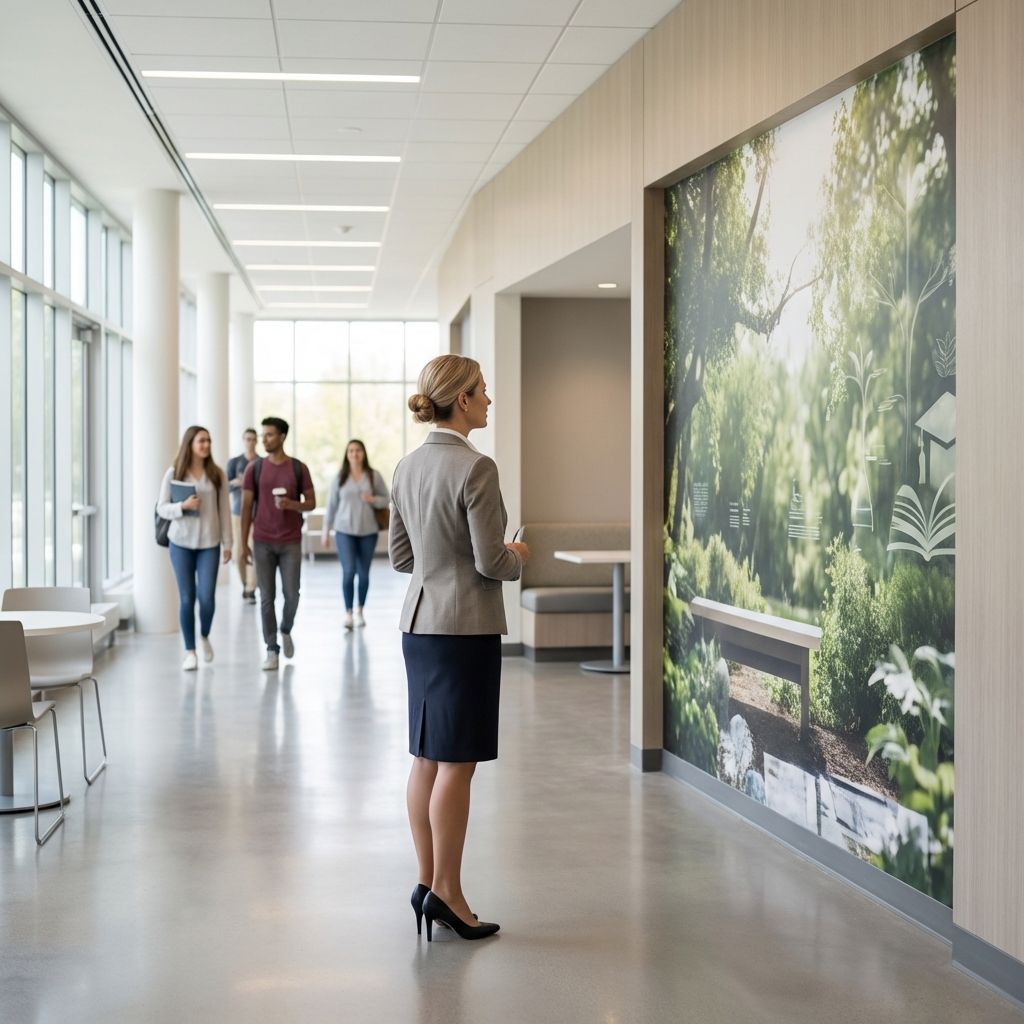
For healthcare environments, installers align with infection-prevention protocols—PPE, containment, and clean handoffs to facilities staff. In schools, crews coordinate around school-day flow, testing windows, and event calendars. The result is a low-friction process that upgrades the environment without shutting it down.
Durability, Maintenance, and Lifecycle Cost Advantages
Long-term performance is where institutional wall branding services must earn their keep. Direct-to-wall systems are engineered for the realities of high-traffic environments: carts, backpacks, frequent cleanings, and constant wayfinding needs.
How durability shows up over time:
- No seams to fail: Seam-free execution removes the most common failure points found in vinyl and wallpaper, reducing peel-backs, edge lifts, and corner damage.
- Cleanable finishes: Surfaces stand up to routine cleaning and disinfecting, preserving legibility and appearance in critical areas.
- UV and abrasion resistance: Graphics maintain color and fidelity under ambient light and daily wear.
- Paint-over-ready: When departments shift or tenants turn, the wall can be primed and repainted—no adhesive residue, no demo, no landfill-bound panels.
From a total-cost-of-ownership perspective, institutions gain:
- Fewer replacements: No adhesive delamination or panel damage to force early change-outs.
- Lower maintenance calls: Eliminating seams and edges reduces the need for touch-ups.
- Predictable refresh cycles: A subscription model allows planned updates for academic years, brand changes, or rotating exhibits—without re-specifying hardware or replacing substrate systems.
- Reduced contingency: On-site printing and short install windows minimize schedule risk and associated costs.
Compared to adhesive vinyl or wallpaper, the combination of durability and paint-over flexibility drives better lifecycle economics and less operational friction.
Sustainability and Environmental Considerations
Sustainability in large facilities comes down to materials, logistics, and replacement cycles. Direct-to-wall printing advances all three.
Material efficiency:
- Adhesive-free, vinyl-free approach: Eliminates PVC films and pressure-sensitive adhesives that often end up in landfills after short service lives.
- No panel backers: Avoids composite boards, trims, and mechanical hardware that add embodied carbon and complicate disposal.
Logistics:
- On-site printing: Reduces shipping-related emissions and packaging waste tied to fabricated panels or large vinyl rolls.
- Right-first-time execution: Field adjustments cut the risk of reprints and scrap.
Lifecycle:
- Paint-over-ready surfaces: When it’s time to refresh content, there’s no tear-off waste or substrate replacement. A simple repaint resets the wall for the next program.
- Longer service life: Seam-free, integrated graphics resist the failure modes common with adhesive systems, reducing the overall volume of material cycling through facilities.
For institutions working toward decarbonization and waste reduction goals, these attributes offer measurable advantages over common commercial wall graphics alternatives. If you’re comparing options through an environmental lens, the analysis of direct-to-wall vs traditional vinyl provides useful context.
Real-World Use Cases: Wayfinding, Safety, and Brand Integration
Institutions get the most value when brand, navigation, and safety information work together. Direct-to-wall printing enables clear hierarchies and crisp legibility—without adding sign clutter or hardware to already-busy environments.
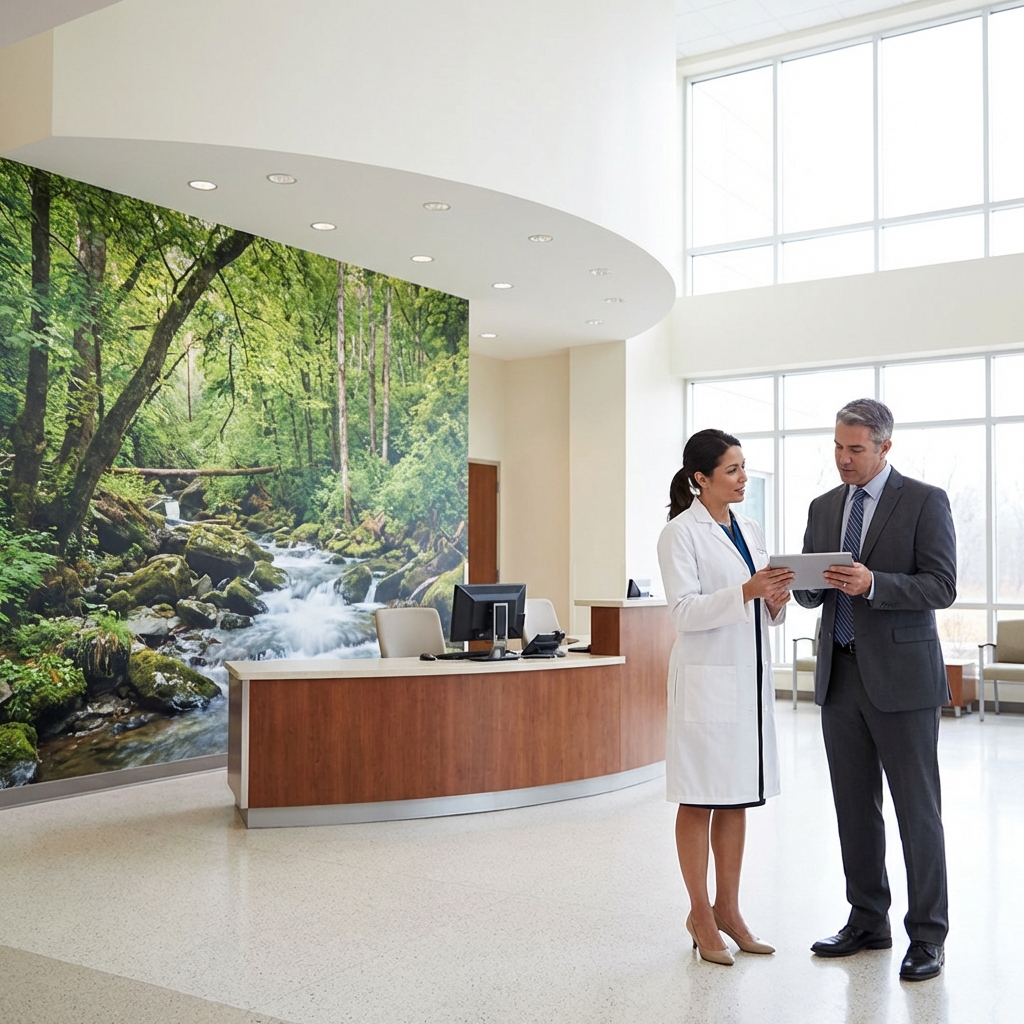
Examples that deliver:
- Hospital wayfinding cores: Oversized level IDs, color-coded wings, and department names printed directly at elevator lobbies reduce “Where am I?” questions and speed up throughput.
- Safety and infection control: Hand hygiene prompts, isolation zone markers, and PPE visuals live on the walls where they’re needed, surviving frequent wipe-downs.
- Emergency information: Evacuation routes and area-of-refuge identifiers integrate with brand elements while maintaining high-contrast readability.
- Pediatric and behavioral health: Soothing photo landscapes or playful, non-overstimulating patterns create supportive atmospheres without fragile decorative elements.
- K–12 learning walls: Math operators on stair risers, phonics in corridors, or historical timelines along media centers turn circulation zones into learning opportunities.
- University identity: Donor narratives, research impact stats, and athletics heritage unify spread-out departments with a shared story.
- Museums and cultural venues: Exhibition supergraphics and large-format labels maintain crisp type and deep tonal range—ideal for galleries that need immersive, seam-free visuals.
Integration strategies that help:
- Contrast and hierarchy: Clear size steps between directional cues, room IDs, and supportive text keep information scannable from a distance.
- Zone color logic: Assign a color to each floor or service line and apply it consistently to corridor graphics and department entries.
- Minimal hardware: Use direct-to-wall for large, persistent content; reserve physical signs for code-required plaques, changeable inserts, or tactile/raised characters.
The net effect is a visual system that serves operations, safety, and brand cohesion simultaneously—without the maintenance overhead of layered sign programs.
Choosing the Right Wall Branding Partner for Your Institution
Selecting a provider is as much about process and reliability as it is about print quality. The right partner understands institutional constraints and builds a program to match.
Evaluation criteria to consider:
- Institutional experience: Demonstrated work in healthcare, education, public-sector, or corporate campuses with references to match.
- Surface expertise: Proven results on drywall, CMU, concrete, and brick, including transitions and edge conditions.
- Color and quality control: Device calibration, color targets, substrate testing, and sample approvals to ensure consistent outcomes.
- Infection prevention and safety: Familiarity with healthcare protocols, background checks, safety training, and documentation readiness.
- Project governance: Clear scopes, wall-by-wall mapping, shop drawings or marked-up elevations, and change management.
- Schedule performance: Capacity for after-hours work, phasing, and multi-site coordination; proven ability to complete walls in under five hours where feasible.
- Sustainability approach: Adhesive-free methods, paint-over-ready finishes, and logistics that minimize waste and shipping.
- Service model: Ability to support pilots that scale to permanent systems, with subscription options for planned refreshes.
EastCoast MuralPros brings these capabilities together for commercial and institutional teams seeking durable interior branding solutions:
- Direct-to-wall printing technology with high-resolution, photoreal results—seam-free and adhesive-free.
- Full-campus solutions for schools, hospitals, and multi-building owners, with consistent execution across locations.
- A subscription model for seasonal or strategic refreshes and tools that help digital artists scale their work.
- In-studio printing for complementary program elements like doors, tables, and standees to round out campaigns.
- Low-disruption, on-site printing that eliminates shipping delays and fabrication errors while maintaining schedule certainty.
If you’re exploring multi-location rollouts or evaluating alternatives to vinyl and wallpaper, a short pilot can validate legibility, cleanability, and workflow fit before scaling.
Conclusion: Future-Proofing Your Institutional Spaces
Institutional wall branding services are most valuable when they solve operational problems as well as design goals. Direct-to-wall printing gives facilities and brand teams a dependable path to seam-free institutional graphics that look integrated, install quickly, and hold up under real-world use.
For schools and healthcare systems, the benefits are tangible: faster projects with minimal disruption, cleanable and durable finishes, fewer maintenance calls, and a paint-over-ready path to future change. For multi-location owners and public-sector institutions, on-site printing and standards-driven execution deliver predictable results at scale—without the waste or risk tied to adhesive films and panels.
As you plan upcoming renovations, wayfinding upgrades, or campus-wide refreshes, consider an approach that pairs creative freedom with operational discipline. EastCoast MuralPros helps organizations move from concept to consistent, high-performing environments—on a timeline that works for occupied buildings and on a lifecycle that protects budgets and sustainability goals.
To explore how direct-to-wall printing for institutions could support your next rollout, visit EastCoast MuralPros and start a conversation with a team built for complex, multi-site environments.
Contact us to learn more