
Table of Contents
- Why K-12 Schools Are Moving Beyond Vinyl and Wallpaper
- The Real Cost of Traditional Wall Solutions in Educational Settings
- Our Direct-to-Wall Printing Approach Solves Campus Scaling Challenges
- KPI 1: Installation Speed and Campus Disruption Reduction
- KPI 2: Durability and Maintenance Cost Per Square Foot
- KPI 3: Design Consistency Across Multi-Building Rollouts
- KPI 4: Student and Staff Engagement Through Wayfinding Graphics
- KPI 5: Lifecycle Cost and Replacement Cycle Efficiency
- How to Structure Your Pilot Program for Measurable Results
- Scaling from Pilot to Campus-Wide Implementation
- Frequently Asked Questions (FAQ)
Why K-12 Schools Are Moving Beyond Vinyl and Wallpaper
K-12 districts managing multi-building campuses face a unique challenge: how to refresh spaces, reinforce brand identity, and improve wayfinding across dozens of locations without disrupting instruction or blowing through maintenance budgets. We’ve worked with hundreds of schools and learned that the most successful campus transformations start with a focused pilot program and clear metrics to guide scaling decisions.
This guide walks you through five essential KPIs we track when K-12 clients test our direct-to-wall printing approach, and how to structure your pilot so results translate into confident, district-wide rollouts.
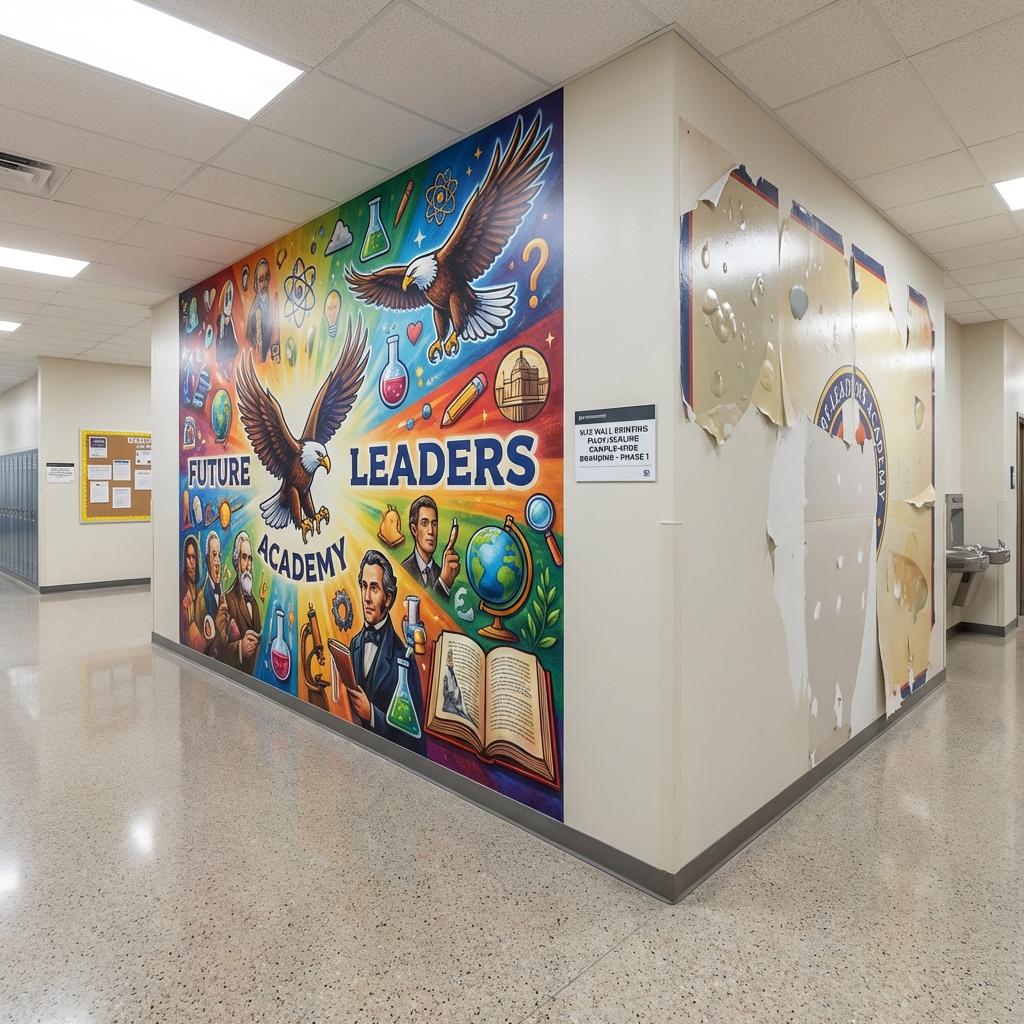
Vinyl wall coverings and traditional wallpaper dominated school interiors for decades because they were affordable upfront and familiar to procurement teams. But schools operate differently than retail spaces. Hallways see constant foot traffic, lockers get slammed, wayfinding graphics get ignored because they blend into clutter, and when lease terms change or renovation budgets shift, ripping out old vinyl and reapplying new material creates downtime and waste.
Over the past few years, we’ve noticed K-12 decision-makers asking tougher questions: Why does our vinyl bubble at corners after two years? How do we print a consistent brand identity across a sprawling campus without managing dozens of vendors? Can we refresh a hallway in a single afternoon without closing the school?
These questions led districts to us. Our direct-to-wall printing method prints photorealistic graphics directly onto walls without adhesives, vinyl backing, or seams. For schools, this means faster installation, longer-lasting visuals, and the flexibility to refresh designs without heavy removal costs or environmental waste.
The Real Cost of Traditional Wall Solutions in Educational Settings
Most facilities managers calculate wall covering costs as an initial purchase price plus occasional touch-up labor. That math breaks down in schools.
Vinyl wall coverings typically cost $3 to $8 per square foot installed. Wallpaper runs $2 to $6 per square foot. Both require skilled installers and 2-4 weeks of lead time if ordered off-site. But the hidden costs accumulate quickly: bubbling and peeling in high-traffic corridors force replacement within 5-7 years; removal labor is labor-intensive and generates significant waste; and procuring identical reprints years later means design files may be lost, colors may not match, or products may be discontinued.
We worked with a mid-sized suburban district managing 12 buildings. They had refreshed main hallway graphics with vinyl wraps five years prior at approximately $45,000 (installed). By year six, edges were curling in three buildings, bubbles had appeared near entrance doors, and their procurement team couldn’t source matching graphics for a phased refresh. The replacement cost and installation downtime during the school year forced them to defer the project.
When we quoted a direct-to-wall alternative for the same hallway square footage, the per-foot cost was competitive, but the lifecycle math shifted dramatically: no removal waste, no adhesive failure, no compatibility issues with future refreshes, and a durable, cleanable surface rated for high-traffic environments. Over a 10-year cycle, lifecycle costs dropped by roughly 35 percent.
Our Direct-to-Wall Printing Approach Solves Campus Scaling Challenges
Our process starts on-site. We assess substrate conditions (drywall, CMU, concrete, or brick), prep the surface, and then use industrial-grade printing technology to apply high-resolution graphics directly to the wall. No vinyl sheets, no adhesive layers, no panels to align. The result is a seamless, paint-over-ready finish that’s durable, cleanable, and ready for the next iteration whenever your campus needs change.
For K-12 environments, this approach delivers three immediate advantages:
Speed. Most installations complete in under 5 hours per 500 square feet, allowing schools to refresh spaces during staff workdays or after-school hours without closing buildings.
Consistency. We manage all design files, color calibration, and technical specifications across multiple locations, so a wayfinding system looks identical in Building A and Building C.
Flexibility. Because our finish is paint-over-ready, future tenants, program changes, or seasonal updates don’t require expensive removal or replacement cycles.
KPI 1: Installation Speed and Campus Disruption Reduction
Measure this as hours of on-site labor and installation time per 1,000 square feet, plus any operational downtime during installation.
During a pilot, schedule graphics for a hallway segment during a low-traffic window: perhaps a summer refresh or a mid-day installation on a non-instructional day. Track the actual start and completion time, including substrate prep. We typically move at 150-250 square feet per hour depending on wall condition and design complexity.
Compare this against your current vinyl or wallpaper process. If your last project required 3-5 days of installation plus 2-3 weeks of lead time and fabrication, you’re looking at nearly a month of planning and coordination. Our on-site process compresses that into a single day visit, with no off-site fabrication or shipping delays.
Actionable takeaway: Request a time study from us for your pilot hallway. We’ll schedule an on-site walk-through, measure the wall, assess substrate condition, and provide a firm installation window. You’ll know before the pilot begins how much time we need and whether installation fits your school calendar.
KPI 2: Durability and Maintenance Cost Per Square Foot
This metric tracks how well graphics withstand daily use and what maintenance demands arise over time.
Vinyl coverings in high-traffic school hallways typically show visible wear within 3-5 years: edge curling, surface scratching, and color fading in areas exposed to sunlight. Maintenance usually means patching or full replacement.
Our direct-to-wall prints are designed for durability in institutional settings. The substrate is sealed, cleanable, and resistant to scuffing and minor abrasion. We’ve had graphics in active school hallways for 7+ years with minimal degradation. Maintenance is simple: damp cloth cleaning and occasional touch-ups if the surface experiences heavy localized contact.
During your pilot, assign one staff member to document any surface marks, fading, or damage every 90 days for the first year. Track maintenance time and materials cost. Compare this log against your historical vinyl maintenance records. Most schools we work with report 40-60 percent reduction in maintenance labor and replacement materials over a three-year cycle.
Actionable takeaway: Baseline your current maintenance costs. Pull maintenance logs from your last vinyl installation project: how many service calls per year? What materials were used? What was the labor cost? We’ll help you forecast the same metrics for our surface so you can model the comparison.
KPI 3: Design Consistency Across Multi-Building Rollouts
Scaling graphics across a 12-building campus requires iron-clad consistency in color, resolution, alignment, and messaging. This KPI measures how closely each installation matches the original design specification.
When vinyl or wallpaper is ordered from multiple fabricators or installed by different teams, small variances emerge: color shifts between production batches, slight misalignments at seams, or graphics that don’t match archived design files because vendors have discontinued materials.
We own the design-to-installation pipeline. Once we finalize your wayfinding system, campus identity graphics, or departmental branding with you, we store the master files, calibrate our equipment to match your brand colors, and execute every installation from the same specification. Whether it’s Building 1 or Building 12, the result is identical.
During your pilot, we’ll document the design specifications in writing, photograph the finished installation from multiple angles and distances, and provide you with a detailed installation report. Use that as your baseline. When you scale to additional buildings, we’ll deliver the same level of specification adherence.
Actionable takeaway: Create a simple design audit checklist with your team: color accuracy (use a color reference card if needed), alignment tolerances, and resolution quality. Walk your pilot installation and compare it against the original design brief. That process will show you exactly what “specification adherence” looks like and what to expect in future rollouts.
KPI 4: Student and Staff Engagement Through Wayfinding Graphics
The best wayfinding system is one people actually use. This KPI measures whether your new graphics reduce confusion, improve traffic flow, or increase engagement with branded messaging.
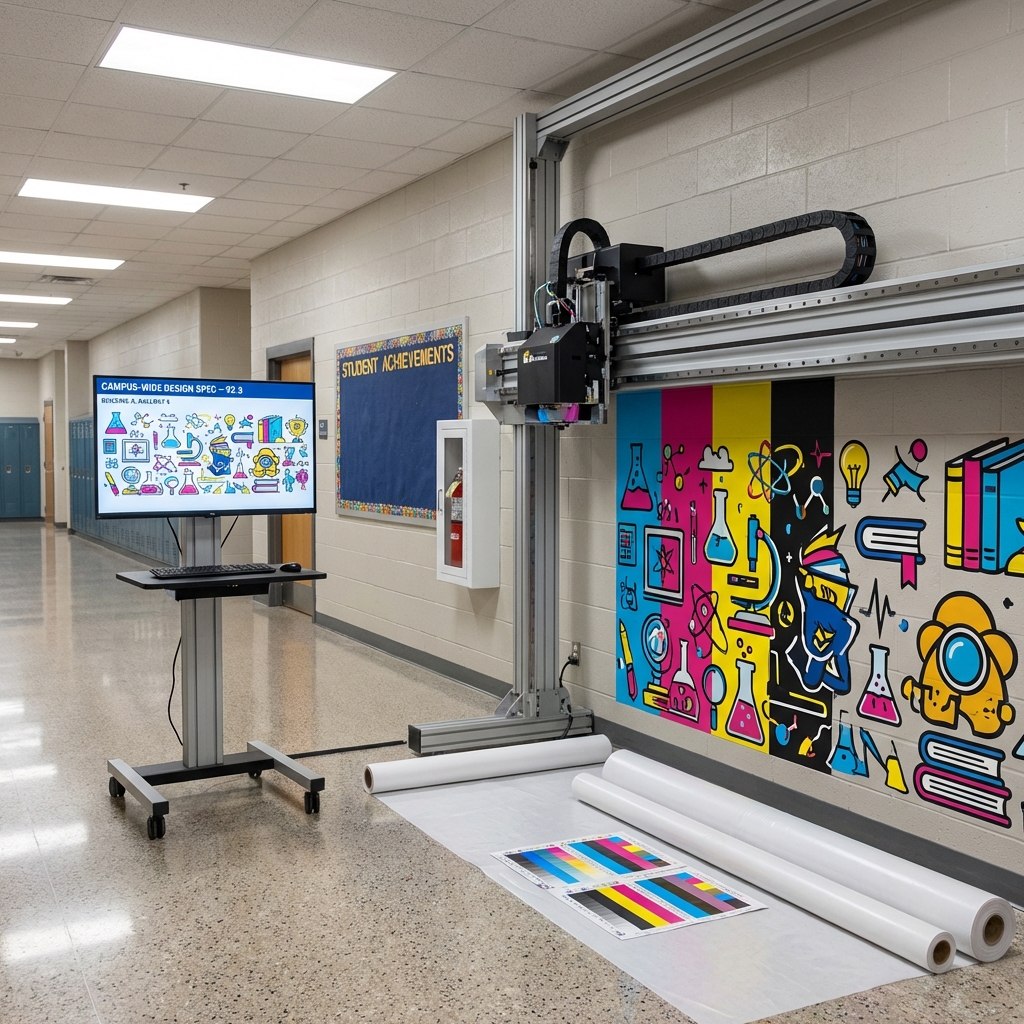
Schools often use wayfinding to direct visitors to main offices, reduce hallway congestion during passing periods, or highlight program areas (STEM labs, arts studios, athletics). Traditional vinyl or wallpaper wayfinding can get lost in visual clutter or fade into familiarity after a few weeks.
Our high-resolution, photoreal graphics command attention and integrate into the architecture in a way that feels intentional and professional. Color, scale, and placement all matter. During your pilot, set a simple baseline: count foot traffic patterns before the new graphics go up, then document changes 30, 60, and 90 days after installation. Ask staff and students informally whether they notice the new graphics and whether they find navigation easier.
We’ve worked with schools where a refreshed main hallway sign system reduced visitor check-in delays and improved student understanding of building layout. Measurable changes, though often small, add up across a campus.
Actionable takeaway: Assign one staff member to conduct a brief, informal survey of 10-15 students and staff members 60 days after your pilot installation. Ask: “Did you notice the new graphics? Were they helpful? Any suggestions?” Compile responses and include them in your pilot report. Qualitative feedback often matters as much as quantitative metrics when pitching campus-wide investment to your board.
KPI 5: Lifecycle Cost and Replacement Cycle Efficiency
This is the metric that typically drives long-term budget decisions. Calculate total cost of ownership (TCO) over 10 years: material, installation, maintenance, replacement cycles, and waste disposal.
Vinyl wall coverings typically need full replacement every 6-8 years. Wallpaper every 5-7 years. Each cycle means procurement, fabrication lead time, installation labor, and disposal of old material.
Our direct-to-wall solution is designed to last 10+ years with minimal maintenance. When a refresh is needed, we don’t remove the existing graphic; we paint over it with a primer-sealer and print the new design directly onto the wall. No removal labor, no waste, no adhesive or seam failures.
Build a simple spreadsheet for your pilot hallway: initial cost, annual maintenance cost, replacement year, replacement cost, and total 10-year spend. Model it three ways: your current vinyl process, a hypothetical wallpaper refresh, and our direct-to-wall approach. You’ll see the TCO advantage become clear around year 5-6 when vinyl replacement would typically kick in.
Actionable takeaway: Ask us for a detailed TCO model for your pilot space. We’ll input square footage, your district’s labor rates, and a realistic maintenance schedule. That document becomes your business case for scaling to the full campus.
How to Structure Your Pilot Program for Measurable Results
A successful pilot requires clear scope, baseline metrics, and a defined decision point.
Phase 1: Planning (Weeks 1-2)
Work with your team to identify a pilot space: ideally a high-traffic hallway or main entry area that represents the type of graphic you want to scale (wayfinding, branding, or general ambiance). Define scope in square footage and design specifications. Agree on the five KPIs above and how you’ll measure them. Get sign-off from facilities, administration, and any relevant instructional leadership.
Phase 2: Baseline Documentation (Week 3)
Before we install anything, photograph the existing wall. Document current maintenance frequency and costs. Establish a color reference if you’re testing brand consistency. Get a count of foot traffic or observe how long it takes visitors to navigate the space. This baseline is essential for comparison.
Phase 3: Design & Install (Weeks 4-6)
We work with your team on final design approval, then schedule on-site installation. Expect one day for prep and printing, all completed during a low-disruption window. Photograph the finished installation from multiple angles.
Phase 4: Monitoring (Weeks 7-26)
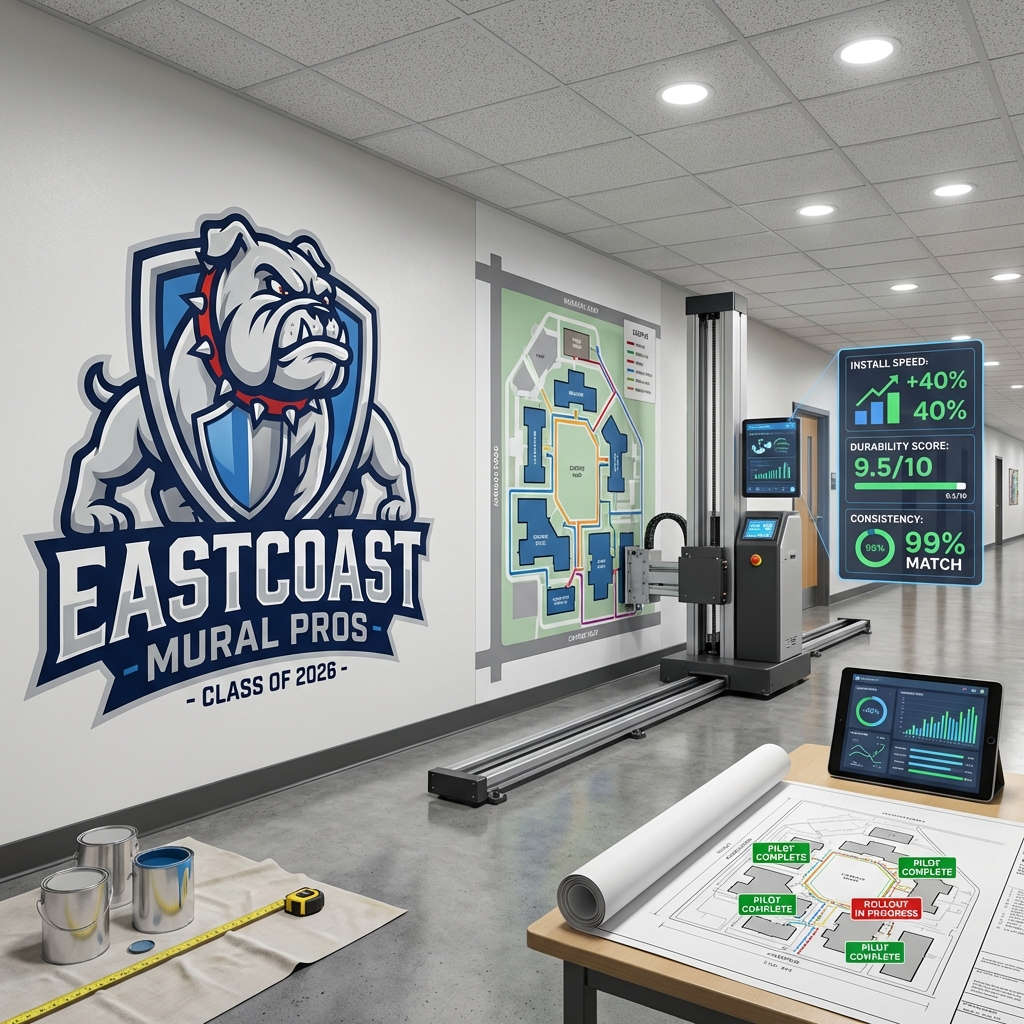
Over the next five months, track maintenance calls, photograph the surface quarterly, conduct brief staff surveys at 60 and 90 days, and document any observed changes in space usage or engagement.
Phase 5: Analysis & Decision (Week 26+)
Compile your findings into a pilot report. Include photos, cost comparison, KPI results, and staff feedback. Present to your board or executive team with a clear recommendation: proceed to multi-building rollout, refine the approach and run a second pilot, or adjust scope.
Scaling from Pilot to Campus-Wide Implementation
If your pilot results support scaling, the next phase moves quickly.
Once you’ve validated approach, cost, and outcomes in one location, rolling out across your campus becomes a matter of logistics and scheduling. We manage design standardization, so every building gets identical brand execution. You manage scheduling to minimize disruption: perhaps one building per quarter, or a summer blitz across multiple locations.
Most districts scale from a single-building pilot to full campus implementation within 12-18 months. Costs typically decline on a per-square-foot basis as volume increases, and your procurement process becomes streamlined because you’re working with one vendor managing all design files and specifications.
We’ve also developed a subscription model for schools that want seasonal refreshes or strategic updates without full replacements. Spring semester could feature different wayfinding or motivational graphics than fall, all managed through our refresh protocol.
The metric-driven approach you establish during your pilot becomes your roadmap for scaling. You’ll know your baseline costs, your realistic timeline, and your quality standards. That confidence transforms a one-off refresh into a sustainable, campus-wide strategy.
Start your pilot conversation with us today. We’ll walk you through your specific campus, answer technical questions, and provide a detailed scope and timeline for your pilot space. The data you gather will inform every decision that follows.
For further reading: Direct-to-wall durability.
Contact us to learn more
Frequently Asked Questions (FAQ)
How quickly can we install wall graphics across multiple buildings during a school year without disrupting classes?
We typically complete installations in under five hours per wall or space, allowing us to work around class schedules, lunch periods, or after-school hours. Our on-site, direct-to-wall printing process eliminates fabrication delays and shipping errors, so we can coordinate installation across multiple buildings within days rather than weeks. This means your facilities team doesn’t need extended closures or construction timelines to refresh campus branding and wayfinding.
What maintenance and durability standards should we track during a pilot program?
We recommend measuring cost per square foot over time by tracking cleaning cycles, touch-ups, and replacement frequency. Our surfaces are designed for high-traffic environments and can be cleaned with standard institutional products without degradation. Most schools find our graphics outperform vinyl and wallpaper by 2-3 years, which significantly reduces both labor hours and material costs in your lifecycle budget.
How do we ensure consistent branding across multiple school buildings when rolling out campus-wide?
We handle design execution and installation directly, which eliminates the variation that typically occurs when coordinating multiple vendors or manual installation teams. Our collaborative tools let your design and communications teams review mockups before we print, and we maintain digital records of every installation so future refreshes match your original specifications exactly. This consistency matters for brand recognition, wayfinding clarity, and procurement accountability across your district.