Introduction: The Evolution of Commercial Interior Branding
Large scale interior branding has moved from a decorative afterthought to a core lever for shaping how people navigate, work, learn, and recover inside buildings. What once relied on periodic paint jobs, vinyl wall coverings, or heavy signage has evolved into a strategic system that aligns brand, operations, and occupant experience. The shift has been accelerated by new production methods—especially high-resolution, direct-to-wall printing that makes commercial wall graphics faster to deploy, more durable in high-traffic use, and more faithful to the original design intent at architectural scale.
For facilities directors, brand and workplace teams, and institutional administrators, this transformation solves long-standing constraints: long install timelines, disruptive construction, and graphics that age poorly. Direct-to-wall technology reduces downtime to hours rather than days, delivers crisp continuity across complex surfaces, and creates a paint-over-ready finish for the next program cycle or tenant. Providers like EastCoast MuralPros have helped organizations treat walls as dynamic infrastructure—enabling seasonally refreshed campaigns, integrated wayfinding, and multi-location rollouts with predictable results.
The industry’s pivot is not just about printing bigger, faster, or at higher resolution. It’s a rethinking of the full lifecycle: design, installation, maintenance, refresh, and end-of-lease transitions. As a result, large scale interior branding is now a performance-based alternative to vinyl wall coverings and wallpaper, offering measurable advantages in speed, durability, sustainability, and total cost of ownership.
Understanding Large Scale Interior Branding and Its Business Impact
Large scale interior branding is the coordinated use of environmental graphics—murals, brand storytelling walls, wayfinding systems, departmental markers, and instructional graphics—applied at building or campus scale. It blends brand environment design with operational objectives, ensuring each wall communicates something purposeful: a promise to customers, a point of pride for staff, a direction to reduce confusion, or a safety cue that keeps people moving confidently.
Done well, interior branding solutions become a durable asset that advances business goals:
- Increase the perceived quality of a property during lease-up or renovation.
- Align multi-location teams with consistent values and visual standards.
- Improve patient, student, and visitor confidence by clarifying pathways and zones.
- Reduce construction and maintenance budgets by upgrading finishes without demolition.
- Shorten project schedules and keep facilities occupied during installs.
Organizations increasingly measure the ROI of commercial wall graphics through occupancy rates, net promoter scores, wayfinding error reduction, time-on-task improvements in workplaces, and facilities KPIs tied to downtime and maintenance. The key is designing a system that scales: standardizable templates, color-managed artwork libraries, and print methods that deliver the same result across drywall, CMU, concrete, and brick—across one floor or an entire regional portfolio.
EastCoast MuralPros supports this system-level approach with high-resolution wall printing that is seam-free at architectural scale, compatible with finished and unfinished surfaces, and coordinated through collaborative tools that help digital artists and design teams extend a single idea across hundreds of linear feet.
Traditional Methods vs. Modern Direct-to-Wall Printing Technology
Traditional options—vinyl wall coverings, wallpaper, painted murals, and panel systems—each have merits, but they introduce familiar risks:

- Vinyl and wallpaper involve adhesives that can bubble, peel, or trap dust at seams. Removal is labor-intensive and often damages substrates.
- Hand-painted murals depend on individual craft and time. While beautiful, they’re slower to deploy at scale and harder to replicate consistently across locations.
- Panelized systems and applied signage add physical depth and hardware, which can clutter sightlines, complicate cleaning, and necessitate penetrations or permits.
Modern direct-to-wall printing addresses these constraints by placing high-resolution imagery directly onto the wall surface without vinyl, paper, or adhesives. On-site printers ride flush to the wall and deliver photoreal clarity that holds up across long corridors, multi-story atriums, and angled or imperfect surfaces. Because there are no seams, graphics read as part of the architecture rather than an overlay, freeing designers to craft panoramic narratives, oversized typography, and continuous gradients that wouldn’t survive as tiled vinyl.
Operationally, direct-to-wall printing reduces failure modes. There’s no substrate shrinkage, no cut-and-splice alignment during install, and minimal shipping. On-site production means final adjustments happen where they matter—in the actual lighting, architectural context, and substrate condition—reducing rework and schedule risk. For teams vetting options, this short read compares sustainability and waste profiles in more detail: Direct-to-wall printing vs vinyl.
Providers like EastCoast MuralPros typically complete installations in under five hours per wall section, with low disruption suitable for occupied buildings. The result is a performance-based alternative that preserves design intent, speeds delivery, and streamlines the total lifecycle—from first install through eventual refresh or turnover.
Key Applications Across Industries: Healthcare, Education, and Corporate
Different sectors adopt large scale interior branding for distinct reasons, but the impact is similar: clearer communication, stronger affinity, and more effective use of wall real estate.
Healthcare
- Zoning and wayfinding: Color-coded wings, floor identities, and clearly marked destinations reduce anxiety for patients and families.
- Positive distraction: Photoreal, nature-forward imagery lowers perceived wait times and supports a calming patient experience.
- Hygiene and maintenance: Seam-free graphics are easier to clean than applied panels or dimensional lettering and avoid adhesive edges that trap residue.
Education (K–12 and Higher Ed)
- Campus identity: Mascots, mottos, and milestones unify buildings that were constructed in different eras—without permits or construction.
- Instructional graphics: STEM corridors, donor recognition walls, and code-compliant safety messaging integrate function with inspiration.
- Full-campus refreshes: Direct-to-wall technology enables coordinated updates across residence halls, gyms, cafeterias, and academic buildings within semester windows. For a deeper dive into this approach, see this perspective on campus branding with high-res printing.
Corporate and Workplace
- Brand storytelling: Lobbies, customer corridors, and executive floors present a cohesive narrative—history timelines, product showcases, and vision statements—at architectural scale.
- Culture and values: Departmental markers and values walls support onboarding and reinforce cross-functional alignment.
- Agile updates: A subscription model allows seasonal or strategic refreshes tied to product launches, recruiting cycles, or leadership priorities.
Beyond these core sectors, museums and cultural institutions use high-resolution wall printing for exhibitions that demand crisp detail and accurate color reproduction—without adding temporary walls or adhesive graphics. Hospitality brands and retail chains leverage the same capabilities to localize experiences while maintaining national standards across multi-location portfolios.
Design Considerations for Seam-Free, Architectural-Scale Graphics
Great large scale interior branding is as much about technical preparation as it is about visual impact. Effective design-to-production workflows consider how artwork reads at 10 feet and at 100 feet—and how it will interact with doors, corners, lighting, and substrates.
Key considerations for design teams include:
- Resolution and viewing distance: Match pixel density to the intended viewing range. Photoreal imagery demands higher effective DPI for close-quarters corridors than for atrium features.
- Color management: Establish brand color conversions for CMYK or specialized ink sets early. Proof on representative substrates to validate neutrals, skin tones, and brand-critical hues.
- Seam-free composition: Design panoramas and typography to flow across long runs without breaks. Direct-to-wall printing rewards continuous gradients, large-scale textures, and edge-to-edge imagery.
- Architectural alignment: Reserve quiet zones where handrails, fire pulls, or door frames may interrupt content. Use mullions and reveals as intentional graphic breaks or visual anchors.
- Substrate readiness: Drywall, CMU, concrete, and brick each accept ink differently. Confirm surface prep, porosity, and finish sheen during surveys to ensure crisp edges and consistent color.
- Legibility and hierarchy: For wayfinding and instructional content, size type for ADA-compliant legibility at expected distances. Balance color contrast and ambient glare from overhead lighting.
- Durability specs: For high-touch zones, design with abrasion in mind. Include protective topcoats or select ink systems as needed for heavy cleaning protocols.
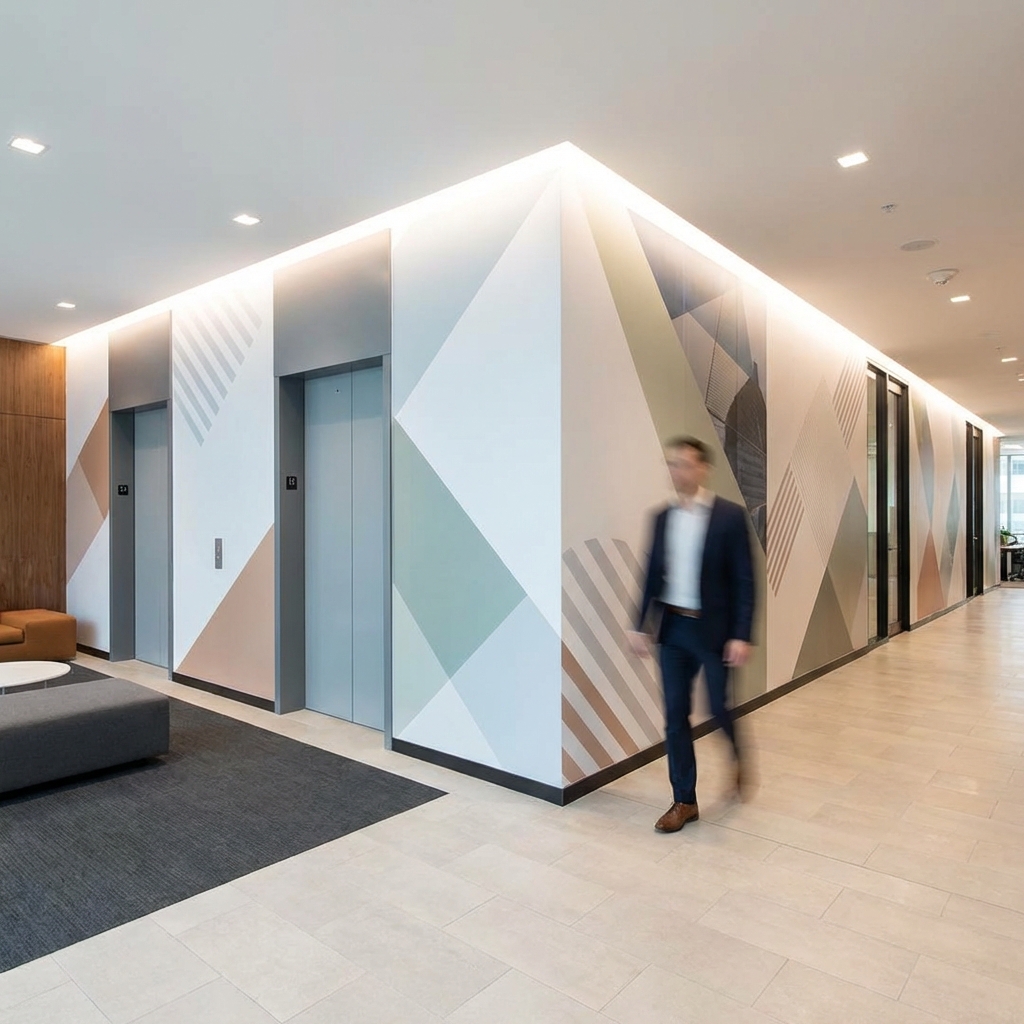
EastCoast MuralPros frequently collaborates with architects, interior designers, and digital artists to scale a single concept across multiple surfaces. Tools for templating, versioning, and preflight checks help artists adapt one artwork package for corridors, stair towers, and open offices without starting from scratch. When projects also require branded objects, in-studio printing on doors, tables, and standees aligns portable elements with the permanent wall system—keeping the environment cohesive even as uses evolve.
Installation Speed and Operational Efficiency in Occupied Buildings
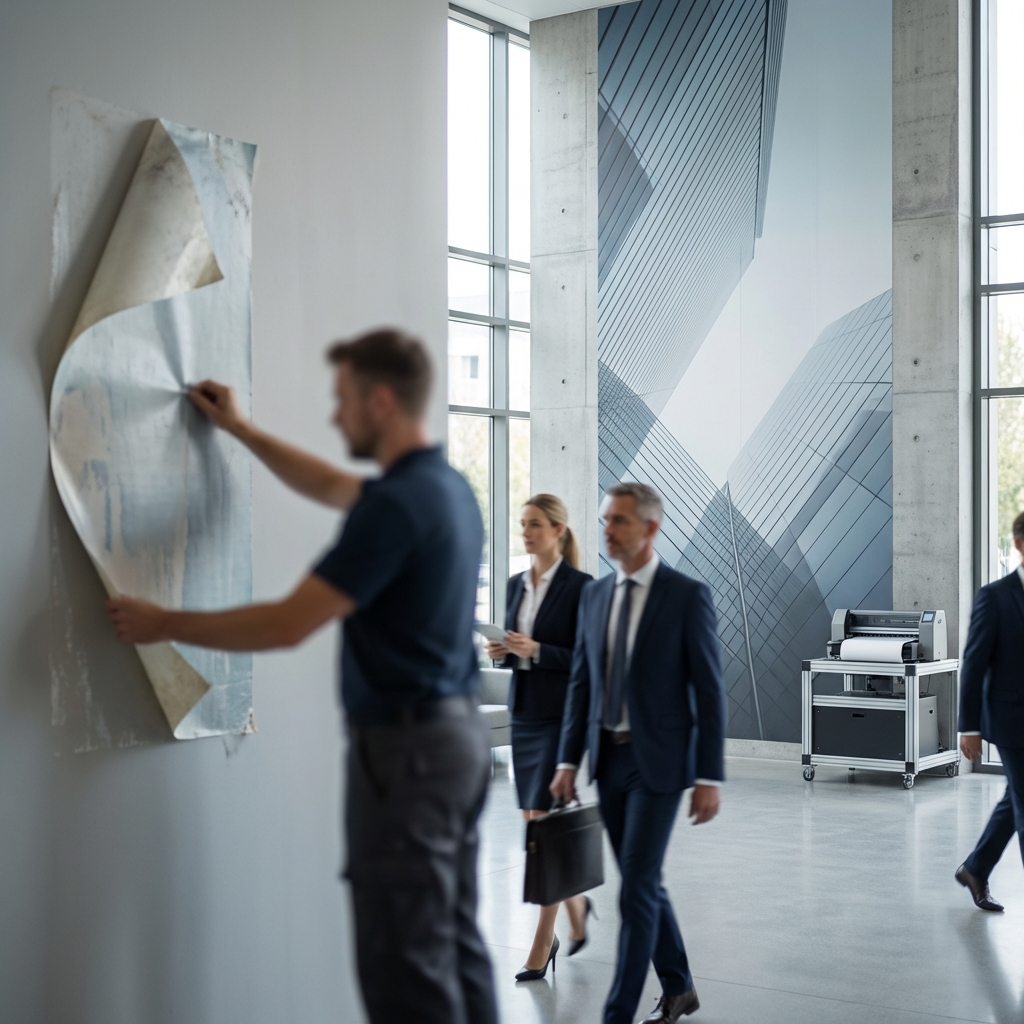
For organizations with limited tolerance for disruption, installation methodology matters as much as the final image. Direct-to-wall printing minimizes impact by eliminating adhesive application, seam-cutting, and panel alignment that typically stretch installs across multiple days. In most cases, a standard wall section can be surveyed, masked, printed, and finished in under five hours—often scheduled during off-hours so spaces remain open.
Critical practices that protect schedules and operations include:
- Pre-install surveys: Verify dimensions, obstructions, substrate conditions, and power access. Document lighting conditions to anticipate color perception differences.
- On-site proofing: Calibrate color and sharpness in the real environment, reducing the risk of reprints that delay turnover.
- Mobile staging: Printers and finishing kits are designed to roll through occupied corridors and tight back-of-house routes with minimal footprint.
- Clean work zones: No adhesive odors, minimal dust, and tape removal immediately after print keep spaces patient-, guest-, and student-ready.
- Safety and compliance: Technicians coordinate with facilities and infection-control protocols in healthcare environments, including interim life safety measures for active units.
Because printing is on-site, shipping delays and fabrication errors largely disappear from the critical path. Communication loops are shorter too: facilities teams can sign off on color and placement in minutes, and change orders that once required re-manufacturing can often be addressed same day. EastCoast MuralPros structures crews and equipment to scale across multiple floors or buildings in parallel—allowing campuses and portfolios to hit tight milestones without overtime surprises.
Durability, Maintenance, and Lifecycle Cost Benefits
Graphic longevity drives total cost of ownership, especially in high-traffic corridors, lobbies, and education and healthcare settings where cleanability is nonnegotiable. Direct-to-wall systems produce durable, cleanable surfaces designed for constant contact—resisting abrasion from carts, backpacks, and routine wipe-downs. Without seams or edges, there are fewer failure points, and routine cleaning doesn’t lift a corner or create dirt-catching gaps.
From a lifecycle perspective, direct-to-wall printing streamlines replacements and end-of-lease transitions:
- Paint-over-ready: When programs change or tenants turn over, surfaces can be prepped and painted without the time and expense of adhesive removal.
- Targeted refreshes: Because the wall itself is the substrate, updating one zone doesn’t require color-matching a discontinued vinyl lot or re-tiling an entire run.
- Consistency across substrates: Standardized ink and coating profiles deliver similar performance on drywall, CMU, concrete, and brick, simplifying maintenance planning.
- Fewer emergency calls: No delamination, bubbling, or seam creep that requires night or weekend service visits.
Facilities and procurement teams often compare lifecycle curves by factoring not just the installed cost, but also scheduled refreshes, labor for removal, surface repair, and occupant disruption. For many environments, direct-to-wall printing reduces total cost over a three- to seven-year horizon, especially where messaging evolves. EastCoast MuralPros supports warranty-backed performance standards and maintenance guidelines so operations teams know exactly how the system will behave under real-world conditions.
Sustainability Advantages Over Vinyl and Wallpaper Solutions
Sustainability is now a procurement requirement, not a marketing afterthought. Large scale interior branding that avoids PVC-based vinyl and aggressive adhesives immediately reduces material footprint and end-of-life waste. Direct-to-wall printing eliminates rolls of backing paper, transfer tape, and the frequent overage that accompanies panel-based installations. Because production happens on-site, freight emissions from shipping bulky, pre-printed rolls to every location drop as well.
Other sustainability advantages include:
- Lower landfill burden: No adhesive-backed substrates to remove and discard during refresh cycles.
- Longer service life: Durable surfaces reduce replacement frequency, cutting cumulative resource use.
- Streamlined prep and dematerialization: Printing directly to walls means fewer additional materials—no panels, no mounting hardware, fewer fasteners.
- Efficient refreshes: Paint-over transitions reduce chemical strippers, heat guns, or solvent-based adhesive removal.
Organizations pursuing ESG commitments can document these avoided impacts across portfolios, tying design decisions to measurable reductions in waste and greenhouse gas emissions. For a detailed comparison of environmental considerations, EastCoast MuralPros outlines trade-offs and waste streams here: Direct-to-wall printing vs vinyl. The result is a solution that aligns brand environment design with institutional sustainability frameworks without sacrificing image quality or speed.
Multi-Location Brand Consistency and Rollout Strategies
Scaling large scale interior branding across many sites hinges on repeatability. Multi-location brands, healthcare systems, and school districts need consistent execution regardless of local wall conditions or installer preferences. That starts with a governance model and continues through detailed production protocols.
Recommended practices for consistent rollouts:
- Standardized libraries: Centralize approved art, templates, color targets, and typography treatments for all use cases—lobbies, corridors, stairwells, and patient zones.
- Substrate playbooks: Define preparation, primer, and finish requirements for drywall, CMU, concrete, and brick. Include adhesion and porosity tests where relevant to coatings.
- Color management: Use device profiles and on-site calibration steps so neutrals, brand colors, and skin tones match across regions and lighting types.
- Field verification: Require annotated photos and dimension checks before releasing final art. A short virtual walk-through reduces change orders after crews arrive.
- Phased scheduling: Stagger sites to balance seasonal occupancy patterns—academic breaks, tenant turnovers, and healthcare unit rotations.
- Reporting: Document before/after, SqFt delivered, time-on-site, and punch-list resolution for facilities and capital projects records.
EastCoast MuralPros supports national rollouts with mobile teams, redundant equipment, and a subscription model for scheduled refreshes—helping brand and workplace leaders treat their interior branding systems as a living asset. For organizations planning pilot-to-portfolio journeys, a phased approach—pilot one building, codify lessons, then scale—often delivers the best balance of speed and quality.
Wayfinding and Instructional Graphics Integration
When wayfinding and interior branding compete for space, clarity suffers. Direct-to-wall printing allows these layers to be designed as a single system: a visual language that guides, informs, and inspires without adding sign clutter. The seamless surface means colors, typography, and iconography can be scaled precisely to distance and viewing angles—critical in long hallways, elevator lobbies, and entry sequences.
Principles for integrated wayfinding and instructional graphics:
- Visual hierarchy: Reserve top contrast and largest scale for primary directions; use secondary tones for departmental cues; apply tertiary elements for storytelling.
- Zone-based color: Assign distinct palettes to floors, wings, or service lines so visitors receive continuous confirmation they are in the right place.
- Accessibility: Size type and pictograms for expected viewing distances; ensure contrast ratios meet or exceed accessibility guidelines; manage glare from overhead fixtures.
- Safety and compliance: Place code-required instructions at eye level and along egress routes; integrate ADA, fire, and infection-control messaging where people naturally pause.
- Update strategy: Plan changeable layers—like policy updates or temporary detours—into areas with straightforward paint-over-and-reprint access.
For hospitals, clinics, and campuses, printing directional arrows, department markers, and safety pictograms directly to the wall eliminates the adhesive edges and mechanical fasteners that collect dirt or loosen over time. In schools and museums, integrated interpretive graphics, donor recognition bands, and exhibit labels read as part of the architecture, while photoreal imagery retains crisp detail at scale—critical for galleries and educational displays.
Conclusion: Future-Proofing Your Interior Branding Investment
The future of large scale interior branding favors solutions that are fast, durable, and adaptable—without trading away image quality or operational control. High-resolution direct-to-wall printing has matured into a reliable, lifecycle-efficient alternative to vinyl wall coverings and wallpaper, addressing the core needs of facilities, procurement, and brand teams: schedule certainty, durability, and consistency at scale.
For organizations stewarding commercial interiors and institutional environments, a future-proof approach includes:
- Selecting a technology that is seam-free, adhesive-free, and paint-over-ready.
- Designing with scalability in mind—standard templates, color-managed libraries, and substrate playbooks.
- Treating branding and wayfinding as one integrated system to reduce clutter and confusion.
- Using on-site printing to eliminate shipping delays, minimize disruption, and resolve issues in real context.
- Planning refresh cycles via subscription or scheduled updates to keep experiences aligned with evolving programs.
EastCoast MuralPros helps teams implement these strategies across healthcare, education, workplaces, hospitality, retail, and cultural institutions. By aligning design ambitions with execution reality—and focusing on durability, maintenance, and sustainability from day one—organizations can transform walls into an adaptable platform that delivers measurable value year after year. In a market that rewards speed, reliability, and strong brand environments, direct-to-wall printing is not just a new production method; it’s a smarter way to invest in the spaces people depend on.
Contact us to learn more