
Table of Contents
- Why Healthcare Facilities Are Moving Beyond Traditional Wall Coverings
- The True Cost of Vinyl and Wallpaper in Medical Environments
- How Direct-to-Wall Printing Solves Your Procurement Challenges
- Durability and Cleanability in High-Traffic Healthcare Spaces
- Scaling Wall Graphics Across Multi-Campus Hospital Systems
- Installation Speed Without Disrupting Patient Care
- Sustainable Design That Reduces Lifecycle Waste
- Wayfinding and Branding Integration in Medical Facilities
- Performance Metrics That Matter to Your Budget
- Getting Buy-In From Your Leadership and Procurement Teams
- Frequently Asked Questions (FAQ)
Why Healthcare Facilities Are Moving Beyond Traditional Wall Coverings
Healthcare administrators and facilities directors face a distinct challenge: walls in hospitals, clinics, and medical office buildings endure constant traffic, frequent cleaning cycles, and strict infection-control protocols. Traditional vinyl wall coverings and wallpaper weren’t designed for these conditions, which is why we’re seeing a decisive shift toward performance-based alternatives.
The reason is straightforward. Vinyl and wallpaper applications in medical environments fail faster and more visibly than in corporate or hospitality settings. You see peeling at seams, discoloration from repeated sanitizing, bubbling in humid areas, and adhesive breakdown. Each failure triggers emergency repairs, lost staff time, and a worn appearance that undermines patient confidence and institutional branding.
We work with facility leaders across the East Coast who’ve made the same observation: the cost of managing deteriorating wall coverings exceeds the investment in a durable solution from the start. What began as a cost-saving decision becomes a cycle of replacement and maintenance that drains both budget and operational bandwidth.
Your procurement team likely faces pressure to contain expenses while maintaining professional aesthetics. The good news is that sustainable, high-performance wall graphics now exist as a legitimate procurement category, with measurable durability, cost predictability, and environmental advantages over traditional materials.
What to do next: Audit your current wall covering inventory across one campus or facility. Document the age, condition, and maintenance schedule of vinyl or wallpaper installations. You’ll have concrete baseline data to justify exploring alternatives.
The True Cost of Vinyl and Wallpaper in Medical Environments
When we evaluate total cost of ownership with our healthcare clients, we typically find that vinyl and wallpaper carry hidden expenses that don’t appear in the initial purchase quote.
Vinyl wall coverings installed in healthcare settings average a 5-7 year lifecycle, but many fail functionally within 3-4 years in high-traffic corridors, patient rooms, and clinical areas. Wallpaper performs even worse in humid environments like bathrooms and kitchen areas, often lasting only 2-3 years before moisture infiltration causes peeling or mold growth. The culprits include:
- Adhesive breakdown from temperature fluctuations and humidity cycling
- Seam separation caused by cleaning chemicals and water exposure
- Surface discoloration from alcohol-based hand sanitizers and quaternary ammonia disinfectants
- Mechanical damage from bed rails, gurneys, carts, and foot traffic
Beyond material replacement, your facilities team incurs labor costs for installation, substrate preparation, and quality control across each cycle. In a 200-bed hospital with 50+ clinical areas that need wall coverings, a full refresh can consume 2-4 weeks of staff coordination, temporary disruption, and material handling.
There’s also the waste stream. Vinyl and wallpaper removal generates significant disposal volume; these materials don’t biodegrade and often end up in landfills. For healthcare systems with sustainability commitments or ESG reporting requirements, this creates both environmental liability and messaging friction.
We’ve worked with procurement teams that calculated their true cost per linear foot across a 10-year period and discovered they were spending 40-60% more than they initially budgeted, once labor, downtime, and waste removal were included.
What to do next: Request a lifecycle cost analysis from your current vendor. Ask specifically for labor hours, removal costs, and re-installation timelines. Document the actual lifespan of installations in your most demanding spaces (ICU, ER, surgical recovery). You’ll have the real numbers to justify exploring alternatives.
How Direct-to-Wall Printing Solves Your Procurement Challenges
We use direct-to-wall printing technology, which means we apply high-resolution graphics directly onto your wall surface using industrial inkjet printing. There’s no vinyl, no adhesives, and no pre-fabricated panels to manage. The ink bonds to the wall substrate itself, creating a seamless, durable graphic that’s part of the architecture.
This approach eliminates many procurement headaches immediately:
No adhesive failures. Because we’re not relying on adhesive to maintain the bond between material and wall, we avoid the breakdown cycle that plagues vinyl and wallpaper. The graphic stays put.
Seam-free at architectural scale. We print directly onto walls regardless of dimension or geometry. A 50-foot corridor receives a single continuous image with no seams, pattern breaks, or alignment issues. This alone improves the professional appearance dramatically compared to vinyl panels or wallpaper strips.
Substrate flexibility. Our process works on drywall, concrete, CMU block, brick, and finished surfaces. You don’t need to prep the wall down to bare material or worry about substrate compatibility. This reduces pre-installation assessment time and cost.
Installation speed. Most healthcare mural projects install in a single shift or overnight, with minimal staffing and zero adhesive curing time. You print in the morning; the space is ready to use the same day or next morning.
Custom content without tooling delays. Traditional vinyl requires screen setup, tooling, and fabrication timelines measured in weeks. We generate files from your digital artwork or photography and print on-site within days. This means procurement cycles compress from months to weeks.
We serve health systems that previously managed wall coverings through reactive maintenance. They now use direct-to-wall printing as a strategic tool for wayfinding, branding, infection-control messaging, and environmental design. The shift from “managing failure” to “designing space” changes how procurement evaluates wall graphics.
What to do next: Request a site assessment from our team. We’ll photograph your highest-traffic clinical areas, assess substrate condition, and provide a performance comparison against your current vinyl or wallpaper program. No cost, no obligation.
Durability and Cleanability in High-Traffic Healthcare Spaces
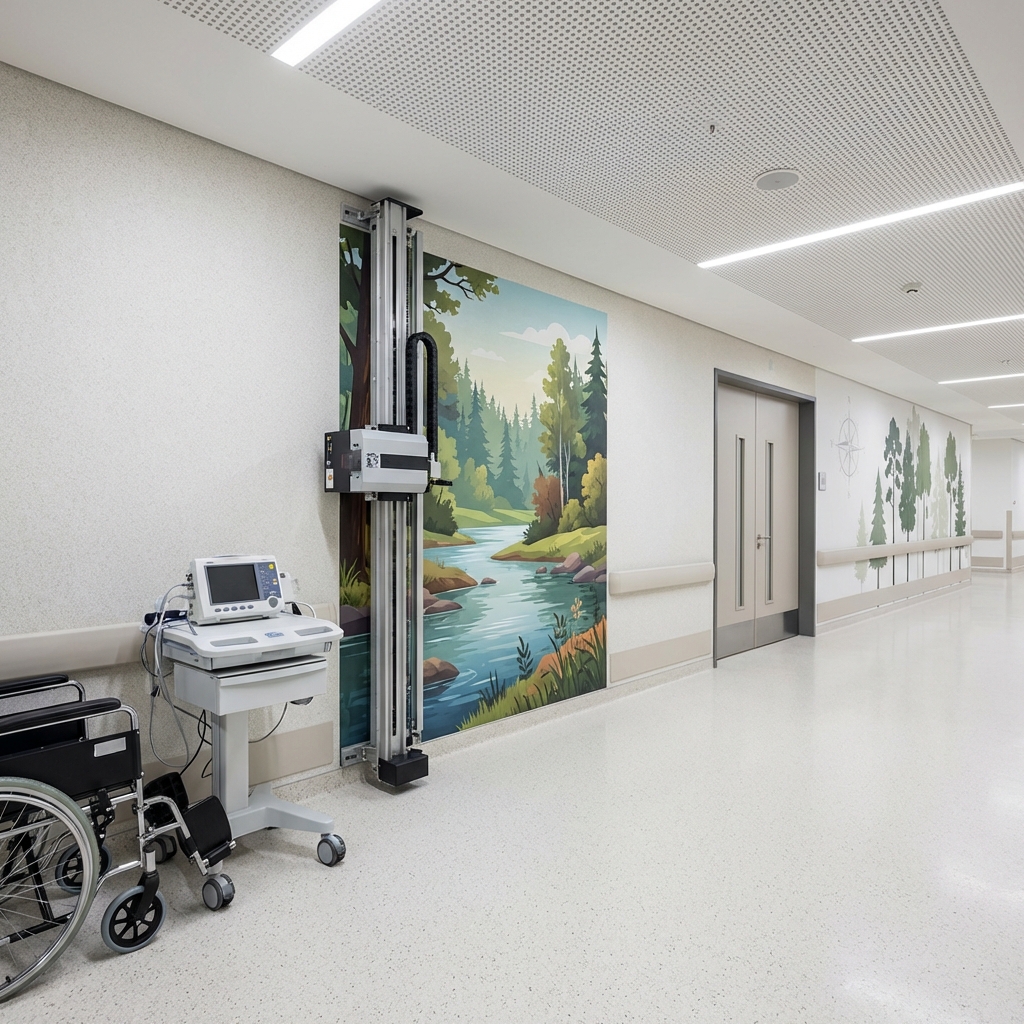
Healthcare environments demand wall surfaces that tolerate aggressive cleaning protocols. Our direct-to-wall graphics are engineered for this reality.
The ink we use bonds molecularly to the wall substrate, creating a surface that withstands hospital-grade disinfectants, including alcohol-based sanitizers, quaternary ammonia solutions, and hypochlorite cleaners. Unlike vinyl, which can degrade or discolor with repeated chemical exposure, our graphics maintain color accuracy and surface integrity through thousands of cleaning cycles.
We design all graphics with a paint-over-ready finish. This means when you eventually refresh the space or lease to a new tenant, you simply paint over the graphic with standard latex or acrylic paint. No removal, no adhesive residue, no substrate damage. This flexibility is a major advantage in healthcare renovation cycles and lease transitions.
Cleanability testing we conduct follows ASTM D3359 (adhesion testing) and D4157 (abrasion resistance) standards. Our graphics consistently achieve durability ratings comparable to architectural paint finishes. In practical terms, this means a custodial team can scrub the surface with a soft-bristle brush and standard hospital cleaner without degrading the image quality or adhesion.
We’ve installed graphics in surgical recovery units, intensive care areas, and emergency departments where infection control is non-negotiable. The feedback is consistent: the graphics maintain appearance through aggressive cleaning regimens that would destroy vinyl or wallpaper within months.
One measure that matters operationally: replacement frequency. You’ll move from a 3-5 year refresh cycle to a 10+ year lifecycle, with no intermediate repairs or touch-ups. Your maintenance team stops treating wall coverings as a recurring failure risk and manages them as permanent architectural features.
What to do next: Request a sample substrate from your facility. We’ll print a test image and provide it to your environmental services team for cleaning validation. Let them verify performance using actual hospital-grade cleaning products.
Scaling Wall Graphics Across Multi-Campus Hospital Systems
Multi-location healthcare systems face a distinct procurement challenge: consistency across campuses while managing independent facility budgets, timelines, and substrate conditions.
We specialize in systems-level deployments. Whether you’re rolling out wayfinding graphics across six facilities or refreshing patient-facing branding across a 15-campus network, we manage the design standardization, file preparation, and installation scheduling so each location meets the same quality and timeline targets.
Our process includes:
Centralized asset management. Your creative team develops graphics once. We store all design files, color standards, and layout specifications in a shared digital system that our technicians reference during installation. This eliminates the guesswork and variation that comes from emailing files between locations.
Local installation with remote oversight. We deploy installation teams to each campus on a coordinated schedule. Our project managers track progress in real-time using photo documentation and progress reporting, so your leadership sees consistent quality and on-time delivery across all locations simultaneously.
Substrate mapping and pre-assessment. Before scheduling installations, we visit each facility and document wall conditions, dimensions, and any substrate concerns. This prevents surprises during installation and allows us to flag any location-specific prep work in advance.
Procurement alignment. We work directly with your capital projects or procurement teams to align budget, timeline, and scope across multiple facilities. A single master contract and invoice simplifies your accounting and vendor management compared to managing individual vendors at each location.
Healthcare systems we’ve worked with have deployed 50+ murals across multiple states on a synchronized timeline, with zero installation delays and unified branding. The alternative—managing separate vinyl or wallpaper vendors across multiple locations—typically adds 20-30% cost variance and schedule slippage.
What to do next: If you manage multiple facilities, request a portfolio walk-through focused on system-level deployments. We’ll show you case studies of multi-location rollouts and discuss how we’d approach your specific network of campuses.
Installation Speed Without Disrupting Patient Care
Healthcare facilities operate 24/7. Any wall covering project must complete without compromising patient safety, staff workflow, or clinical operations.
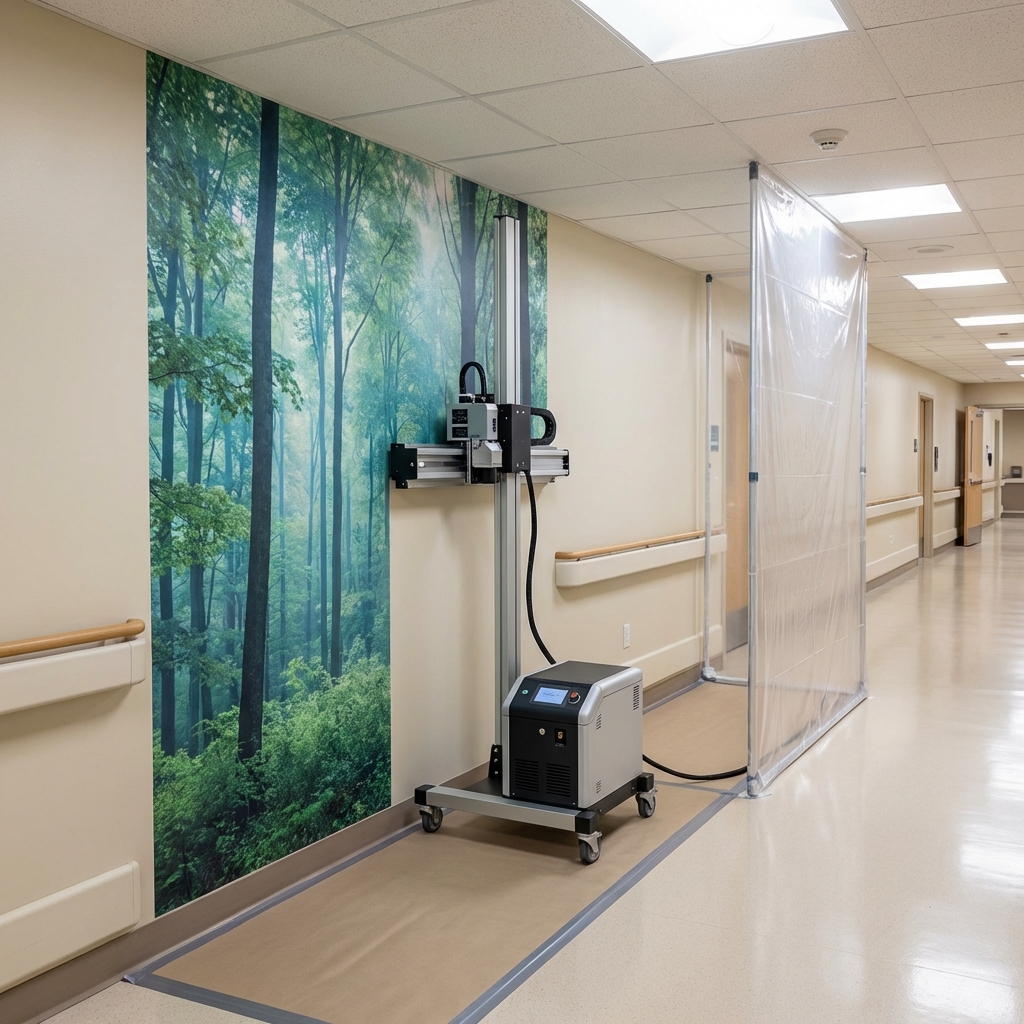
Our direct-to-wall printing approach solves this constraint entirely. Most murals install in 4-6 hours, with no curing time, no adhesive volatilization, and no occupancy restrictions. You can schedule installation during off-peak hours (evenings, weekends, or early mornings) and have the space fully operational immediately afterward.
Contrast this with vinyl installation, which typically requires 1-2 days of labor per wall, plus 24-48 hours of adhesive curing before the space can be used normally. Wallpaper requires similar timelines plus wall preparation and stripping of old materials. In clinical environments, this translates to room closures, rerouted foot traffic, or disrupted patient care protocols.
Our project management approach for occupied facilities emphasizes zero-disruption installation. We coordinate with your facilities director to identify optimal installation windows. For patient-facing areas, we often work during evening or weekend hours. For clinical corridors or administrative spaces, we schedule during low-traffic periods and manage foot traffic around our work zone.
We also handle substrate preparation on-site. If a wall needs cleaning or minor prep, our team manages it as part of the installation process. This eliminates the need for your facilities staff to prepare surfaces days in advance, which simplifies scheduling and reduces the overall project footprint.
A typical installation timeline for a healthcare facility looks like:
- Design and file approval (1-2 weeks)
- On-site substrate assessment and walk-through (1 day)
- Installation (4-6 hours in a single shift)
- Quality verification and photo documentation (same day)
From procurement sign-off to completion, we’ve delivered projects in as little as 3-4 weeks, compared to 8-12 weeks for vinyl wall covering systems that require fabrication, shipping, and extended installation windows.
What to do next: If you have a specific space or timeline in mind, share it with our team. We’ll map an installation schedule that works around your clinical calendar and minimize any operational friction.
Sustainable Design That Reduces Lifecycle Waste
Healthcare systems increasingly face sustainability reporting requirements and ESG commitments. Your procurement team likely has pressure to reduce environmental impact across capital projects, including wall coverings.
Traditional vinyl and wallpaper create measurable waste at end-of-life. A single wall covering replacement project in a 200-bed hospital generates 500-800 pounds of material destined for landfill disposal. Multiply this across a decade of facility management, and the waste stream becomes a real line item in both disposal costs and environmental impact reporting.
Direct-to-wall printing dramatically reduces lifecycle waste:
No pre-fabricated material. We print only what you need, directly onto your walls. There’s no excess inventory, no shipping waste, and no material offcuts.
Paint-over capability. When the graphic reaches end-of-life (10+ years), you paint over it with standard interior latex or acrylic paint. The wall surface remains intact; no removal, no demolition, no waste. Compare this to stripping vinyl or wallpaper, which generates significant disposal volume and substrate damage requiring repair or replacement.
Water-based ink chemistry. We use water-based industrial inks that are non-toxic, low-VOC (volatile organic compounds), and safe for occupied healthcare spaces. No adhesive fumes, no off-gassing, no air quality concerns during or after installation.
Substrate preservation. Because we’re not applying adhesive or relying on mechanical fasteners, we don’t damage the wall itself. This extends the serviceable life of the substrate and reduces the frequency of drywall replacement or repair cycles.
For healthcare systems tracking environmental impact, direct-to-wall printing typically delivers a 60-80% reduction in lifecycle waste compared to vinyl and wallpaper programs over a 20-year period. We can provide environmental impact data and lifecycle assessment documentation to support your sustainability reporting.
What to do next: If ESG reporting or sustainability commitments influence your procurement decisions, ask for our lifecycle impact analysis. We’ll compare waste generation, material volumes, and disposal costs across your current program and a direct-to-wall printing alternative.
Wayfinding and Branding Integration in Medical Facilities
Healthcare environments are notoriously difficult to navigate. Patients, visitors, and staff spend energy finding departments, clinics, and treatment areas. Poor wayfinding increases stress, delays patient arrival, and strains front-desk resources.
Traditional wayfinding relies on multiple signage systems: wall-mounted signs, floor decals, vinyl stickers, and printed directional graphics. These create visual clutter and often fail to integrate with the architectural environment.
We approach wayfinding as integrated wall graphics. Instead of bolting additional signage to walls, we print directional information, color-coding systems, and instructional graphics directly into the wall surface. This accomplishes several things simultaneously:
Reduces signage clutter. A single integrated graphic replaces multiple discrete signs, creating a cleaner, more professional appearance that supports the healing environment.
Improves wayfinding effectiveness. Large-scale, high-resolution graphics embedded in wall surfaces are more noticeable and intuitive than small signage. Patient navigation times improve, and front-desk staff report fewer repetitive directions.
Unifies branding. We coordinate wayfinding graphics with your institutional color standards, typography, and design language. The result is a cohesive environmental branding system that reinforces organizational identity.
Integrates safety and compliance messaging. Infection-control protocols, hand-washing instructions, and emergency procedures can be incorporated into wayfinding graphics without creating redundant signage systems.
Supports departmental identification. Different clinical areas can have color-coded or symbol-based graphic systems that help patients and staff quickly identify departments, patient floors, and functional zones.
A typical healthcare wayfinding project involves mapping your facility flow, identifying decision points where signage fails, and designing integrated graphics that guide movement while reinforcing branding. We’ve deployed this approach in urgent care networks, multi-floor medical office buildings, and hospital campuses with measurable improvements in patient satisfaction and staff efficiency.
What to do next: Conduct a wayfinding audit of your largest facility. Have a family member unfamiliar with the space try to navigate to a specific department without asking for directions. Document where confusion occurs. This identifies the highest-impact locations for integrated wall graphics.
Performance Metrics That Matter to Your Budget
Procurement decisions ultimately rest on financial performance. We measure direct-to-wall printing performance using metrics that procurement teams actually care about: cost per linear foot, total cost of ownership, installation labor, and lifecycle durability.
Here’s how the numbers typically work:
Initial cost comparison. Direct-to-wall printing costs roughly 15-25% more per linear foot than vinyl wall covering at the point of purchase. However, this difference disappears once you account for labor, substrate preparation, adhesive, and installation equipment.
Total cost of ownership. Over a 10-year period, direct-to-wall printing typically costs 40-50% less than a vinyl wall covering program, because you avoid replacement labor, adhesive costs, disposal, and the management overhead of repeated vendor coordination. A 2,000 square foot installation might cost $8,000-$12,000 for direct-to-wall printing but require $15,000-$20,000+ in vinyl costs when labor and replacement cycles are included over the same period.
Labor efficiency. Most direct-to-wall installations require 2 technicians and 4-6 hours of labor. Vinyl installations typically require more technicians, longer timelines, and substrate preparation work. Over a full facility refresh, labor time (and cost) favors direct-to-wall printing significantly.
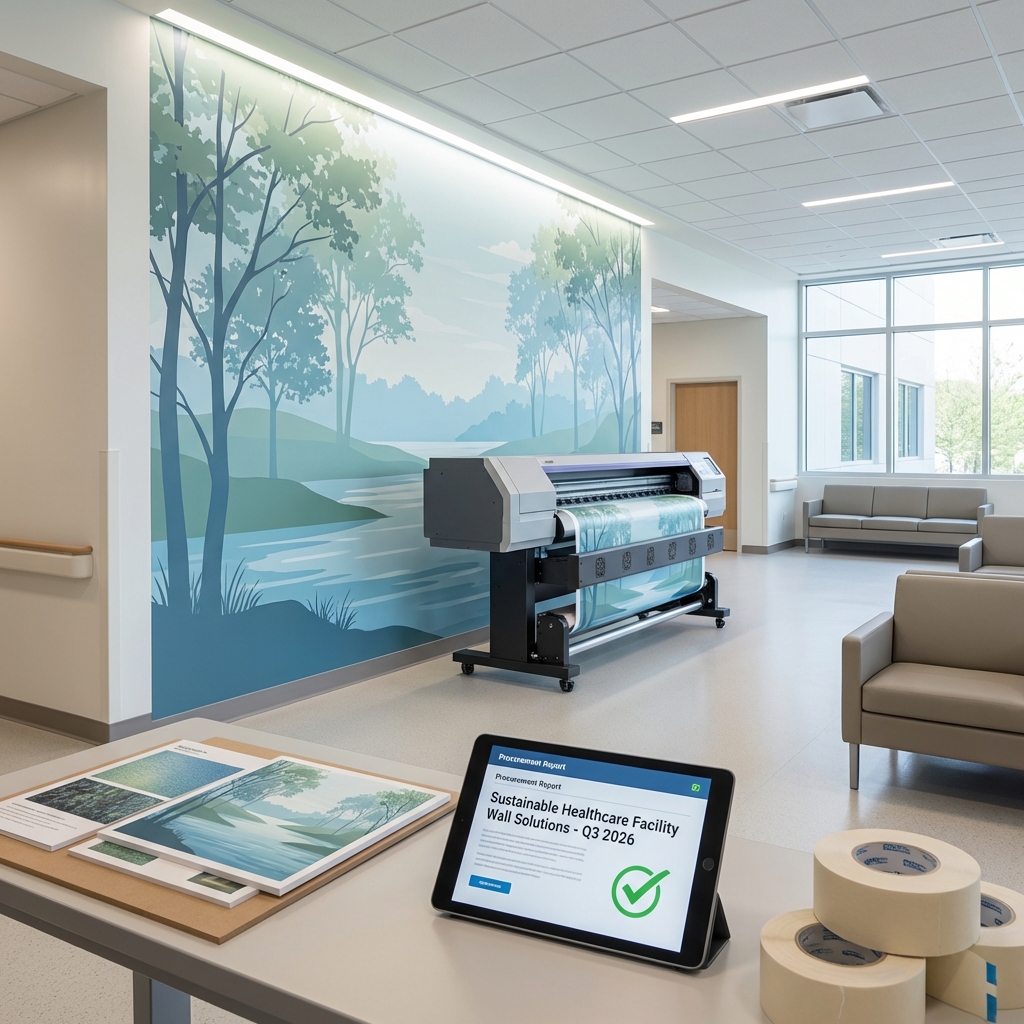
Maintenance and replacement costs. This is where the advantage becomes dramatic. With vinyl, you budget for touch-ups, seam repairs, and full-area replacement every 5-7 years. With direct-to-wall printing, you budget zero maintenance and zero replacement until year 10+, when you simply paint over and refresh the design if needed.
Downtime and operational cost avoidance. When you factor in the cost of closing rooms, rerouting traffic, or coordinating around clinical operations, the operational value of faster, less-disruptive installation becomes significant. Many healthcare systems value this alone at 15-25% of the material cost.
To illustrate: a hospital corridor wall covering project might present like this:
- Vinyl approach: $6,000 material + $4,000 labor + $2,000 substrate prep + $8,000 replacement cycle (5-year refresh) = $20,000 total cost over 10 years
- Direct-to-wall printing: $9,000 material + $2,000 labor + zero prep + zero replacement = $11,000 total cost over 10 years
We provide detailed cost-of-ownership analyses comparing your current wall covering approach to our direct-to-wall printing system. Procurement teams use these analyses to justify the investment internally.
What to do next: Request a total cost of ownership comparison for your highest-maintenance wall covering areas. We’ll model both approaches over 10 years, including labor, replacement cycles, and operational disruption. The analysis typically justifies the switch.
Getting Buy-In From Your Leadership and Procurement Teams
Introducing a new vendor or technology to procurement teams requires credibility, documentation, and clear alignment with institutional priorities. We’ve worked with facility leaders through this process dozens of times and have developed a repeatable approach.
First, we provide evidence. This includes performance certifications, durability testing documentation, case studies from comparable healthcare systems, and references from existing health system clients. Your procurement team will ask for: Does this solve our problem? Has it worked elsewhere? What are the performance guarantees?
We address these directly:
Performance documentation. We provide ASTM testing results, chemical resistance certifications, and cleanability validation. These documents give your procurement team the technical language they need to justify the vendor selection internally.
Case studies from healthcare. We share anonymized case studies from hospitals, urgent care networks, and medical office buildings where we’ve deployed wall graphics. These include project scope, timeline, budget, and post-installation feedback. Your leadership team can review outcomes from systems similar to yours.
References and site visits. We facilitate conversations between your procurement director and our existing healthcare clients. Direct conversation with peers in other health systems carries enormous weight in procurement decisions.
Pilot program structure. For larger organizations, we recommend starting with a pilot project: a single clinical area or corridor where we deploy direct-to-wall printing at full scale, deliver results, and gather feedback. This gives your leadership team confidence before committing to system-wide deployment. The pilot also generates internal champions among staff and maintenance teams who experience the difference directly.
Integration with existing vendor management. We provide contracts, insurance, and compliance documentation in formats your procurement team expects. We’re not asking them to change process; we’re fitting into their existing vendor management structure.
Sustainability alignment. If your health system has ESG or sustainability commitments, we position direct-to-wall printing as a vehicle for achieving those goals. Reduced waste, zero adhesives, long lifecycle, and paint-over capability all support sustainability reporting.
The strongest path to buy-in is demonstration. When the procurement team sees a finished mural in your facility—professional appearance, zero seams, durable surface, installed overnight—the value becomes obvious. We recommend identifying a high-visibility space for the pilot project, somewhere leadership and staff encounter the graphic regularly and develop confidence in the solution.
What to do next: Schedule a conversation with our team about structuring a pilot project at your largest or most challenging facility. We’ll discuss scope, timeline, and success metrics that align with your procurement team’s evaluation criteria. The goal is building internal confidence that leads to broader system adoption.
—
The shift from traditional wall coverings to direct-to-wall printing isn’t about decoration. It’s about procurement efficiency, operational reliability, and cost predictability in environments where failures are disruptive and expensive. We’ve built our business helping healthcare leaders make this transition. If you’re managing wall covering programs across multiple campuses or dealing with recurring vinyl and wallpaper failures, we’re here to discuss how a performance-based alternative could change your procurement cycle and your facility appearance.
Contact us to learn more
Frequently Asked Questions (FAQ)
How quickly can we install direct-to-wall printing in an occupied healthcare facility without disrupting patient care?
We typically complete installations in under 5 hours, and our on-site printing process eliminates shipping delays and fabrication errors that slow down traditional solutions. Our low-disruption method works well in occupied buildings because we don’t require adhesives, panels, or extended construction timelines, so your facility can remain operational during the upgrade.
What makes our direct-to-wall printing more sustainable than vinyl wall coverings and wallpaper?
We significantly reduce lifecycle waste because our durable, cleanable surfaces last longer and require fewer replacements than vinyl or wallpaper over a facility’s operational lifespan. Our paint-over-ready finishes also allow you to refresh graphics without removing layers of old material, which keeps waste out of landfills and reduces your procurement costs year over year.
Can we handle multi-campus hospital system rollouts with consistent results across multiple locations?
Yes, we specialize in consistent execution across multi-location and national rollouts by managing the design, printing, and installation process from our operations. This approach gives your procurement team one vendor partner who understands healthcare facilities and can deliver the same high-quality results whether you’re upgrading two buildings or twenty, with predictable timelines and performance metrics that your leadership team can rely on.