Introduction: The Rise of Sustainable Commercial Interior Solutions
Corporate real estate, facilities teams, and institutional owners are under pressure to make interiors work harder—with less environmental impact, shorter timelines, and predictable lifecycle costs. As tenant expectations evolve and brand experiences migrate from screens to physical space, the demand for sustainable interior branding has accelerated. Teams want wall graphics that look architectural, not temporary; that can be installed in hours, not days; and that reduce waste from day one.
Sustainable office mural printing has emerged as a practical path forward. Instead of relying on vinyl wall coverings or labor-intensive processes that create material waste and business disruption, direct-to-wall printing delivers high-resolution imagery, wayfinding, and instructional graphics directly onto the built surface. For commercial landlords, healthcare systems, universities, and multi-location brands, this approach offers an eco-friendly wall graphics solution that is fast, consistent, and built for high-traffic performance.
EastCoast MuralPros helps organizations apply this low-impact wall printing technology at architectural scale. The result is sustainable interior branding that aligns with procurement requirements, facilities standards, and brand guidelines—without the hidden costs and compromises common to traditional methods.
Environmental Impact of Traditional Vinyl and Wallpaper in Office Spaces
Vinyl wall coverings and printed wallpaper have been office staples for decades, but their environmental footprint is significant. Many vinyl products contain PVC and plasticizers, and they often rely on adhesives and laminates that are difficult to recycle and may introduce unnecessary chemicals into occupied spaces. Even when responsibly specified, the cumulative impact across fabrication, transport, installation, and end-of-life can be hard to justify.
Common sustainability challenges with vinyl and wallpaper include:
- Material intensity: Substrates, adhesives, laminates, release liners, and packaging contribute to bulk and waste. Large-format installations often require overage for seaming and pattern matching.
- Transport emissions: Rolls, panels, and crates travel from print shops to job sites, adding shipping emissions and the risk of damage or fabrication error that necessitates reprints.
- Installation waste: Trimming at seams, offcuts, and protective liners typically head to a landfill. Misalignment, wall conditions, or on-site surprises can render entire drops unusable.
- Adhesive use: Many adhesives introduce volatile organic compounds (VOCs) during installation and complicate removal, which can damage walls and create additional repair waste.
- Short service life: In high-traffic areas, seams can lift and edges can chip. When damage occurs, replacing a panel or full wall covering is often the only option, generating yet more waste.
Removal amplifies the problem. Traditional wall coverings that fail or age out commonly require labor-intensive demolition, patching, and repainting—each step with its own embodied carbon and cost. For corporate environments managing frequent tenant turnover, seasonal marketing, or evolving safety messaging, the environmental burden compounds quickly.
How Direct-to-Wall Printing Technology Reduces Waste and Emissions
Direct-to-wall printing changes the equation by eliminating the largest sources of material waste. Instead of printing on vinyl or paper and transporting finished goods, the imagery is printed directly on the wall using specialized, UV-LED inkjet technology. There are no substrates to manufacture, ship, or discard—and no adhesives to manage.
Key ways this approach lowers environmental impact:
- No vinyl, no liners, no lamination: Sustainable office mural printing removes entire material categories from the process, cutting waste at the source.
- On-site production: Printing happens where the wall is. That means fewer crates, less packaging, no oversize shipping, and a near-zero rate of damage-in-transit reprints.
- Efficient curing: UV-LED inks cure instantly on contact, reducing drying time, overspray, and downtime. Many UV-LED systems operate with low-VOC formulations compared to solvent-based alternatives.
- Right-sized output: Digital workflows print precisely what is needed—no overruns for pattern matches, no backup panels for seam failures, and minimal trimming.
- Reduced rework: Because the graphic is registered directly to architectural features, tolerance issues and seam misalignments are virtually eliminated.
For teams evaluating performance and sustainability side-by-side, this is a practical, measurable improvement. When combined with proactive wall assessment and standardized color management, direct-to-wall systems reduce risk, waste, and variability across locations. For a deeper comparison of environmental impacts, see EastCoast MuralPros’ perspective on direct-to-wall printing vs vinyl.
Durability and Lifecycle Efficiency: Cost Savings Over Time
Sustainability is not only about what you avoid upfront—it’s also about how long a system lasts under real conditions. In high-traffic corridors, elevator lobbies, nurses’ stations, and university commons, the failure modes of graphic systems are predictable: edges peel, seams collect grime, and impacts lead to localized damage that requires replacing entire panels. A direct-to-wall, seam-free print minimizes those points of failure.
When correctly specified and cured, direct-to-wall graphics deliver a durable, cleanable finish that stands up to daily wear. Facilities teams can incorporate routine cleaning with common non-abrasive agents, and the lack of edges or overlaps means fewer places for dirt and moisture to accumulate. If a localized incident does occur, targeted touch-ups or small-area reprints minimize material use and downtime.
Lifecycle efficiency advantages include:
- Fewer replacements: Seamless prints reduce premature failure and extend usable life.
- Lower maintenance: No adhesive creep, edge chipping, or delamination to monitor and repair.
- Simplified updates: Graphics are paint-over-ready when programs, tenants, or brand standards change.
- Predictable costs: Reduced reprints, fewer site returns, and minimal waste bring budgeting clarity.
For environments with stringent performance requirements, the operational benefits compound. High-contact areas can be specified with protective topcoats or service protocols without introducing vinyl or laminate layers. EastCoast MuralPros outlines additional durability considerations for high-traffic spaces in this overview of direct-to-wall printing benefits.
Design Flexibility and Brand Expression Without Environmental Compromise
Sustainable interior branding should expand, not limit, design possibilities. Direct-to-wall printing supports photoreal, high-resolution imagery at architectural scale, enabling visuals that feel integrated with the building rather than added onto it. Because there are no seams, panoramic compositions, gradient fields, and typography retain clarity and cohesion across long runs and tall walls.
This flexibility is practical for brand storytelling and space planning:
- Brand environments: Launch campaigns, mission statements, ESG dashboards, and culture walls can be deployed quickly without committing to years-long lifespans. When strategy shifts, new content can be printed or painted over with minimal waste.
- Wayfinding and safety: Directional cues, pictograms, room IDs, and instructional graphics can be embedded into the wall system to reduce signage clutter and improve accessibility. Consistent iconography and color coding streamline navigation without adding fixtures.
- Material harmony: Designers can tone imagery to match paint and flooring palettes, or use white-ink techniques on primed surfaces for sophisticated, low-contrast results.
- Artist collaborations: Digital artists and illustrators can scale their work precisely to architectural dimensions. EastCoast MuralPros provides collaborative tools to manage color, resolution, and tiling in a way that maintains fidelity on-site.
Beyond walls, in-studio printing extends the language of a brand onto doors, tables, fixtures, and freestanding standees—ideal for launch moments, exhibitions, and pop-up environments. These elements can be refreshed seasonally through subscription programs that align with marketing calendars and campus event cycles, avoiding the churn of short-lived, disposable materials.
Installation Speed and Minimal Disruption in Occupied Buildings
Sustainability and speed do not have to be at odds. With on-site printing, installation windows shrink dramatically because there is no shipping, uncrating, or panel staging. For many office and institutional projects, a typical wall can be printed in under five hours, reducing the need for extended closures or off-hours staffing.
Low-disruption characteristics include:
- No adhesives, no mess: Eliminates the odors, dust, and cleanup associated with wall covering adhesives, trimming, or heat guns.
- Quiet operation: Digital print passes are far less intrusive than demolition or construction activities, enabling work to proceed in occupied areas with basic cordoning.
- Predictable schedules: On-site teams can coordinate with facilities to phase work around meetings, clinic hours, or class schedules, and adjust dynamically to field conditions.
- Fewer dependencies: Without reliance on panel fabrication or cross-country shipping, projects are less vulnerable to delays outside the building’s control.
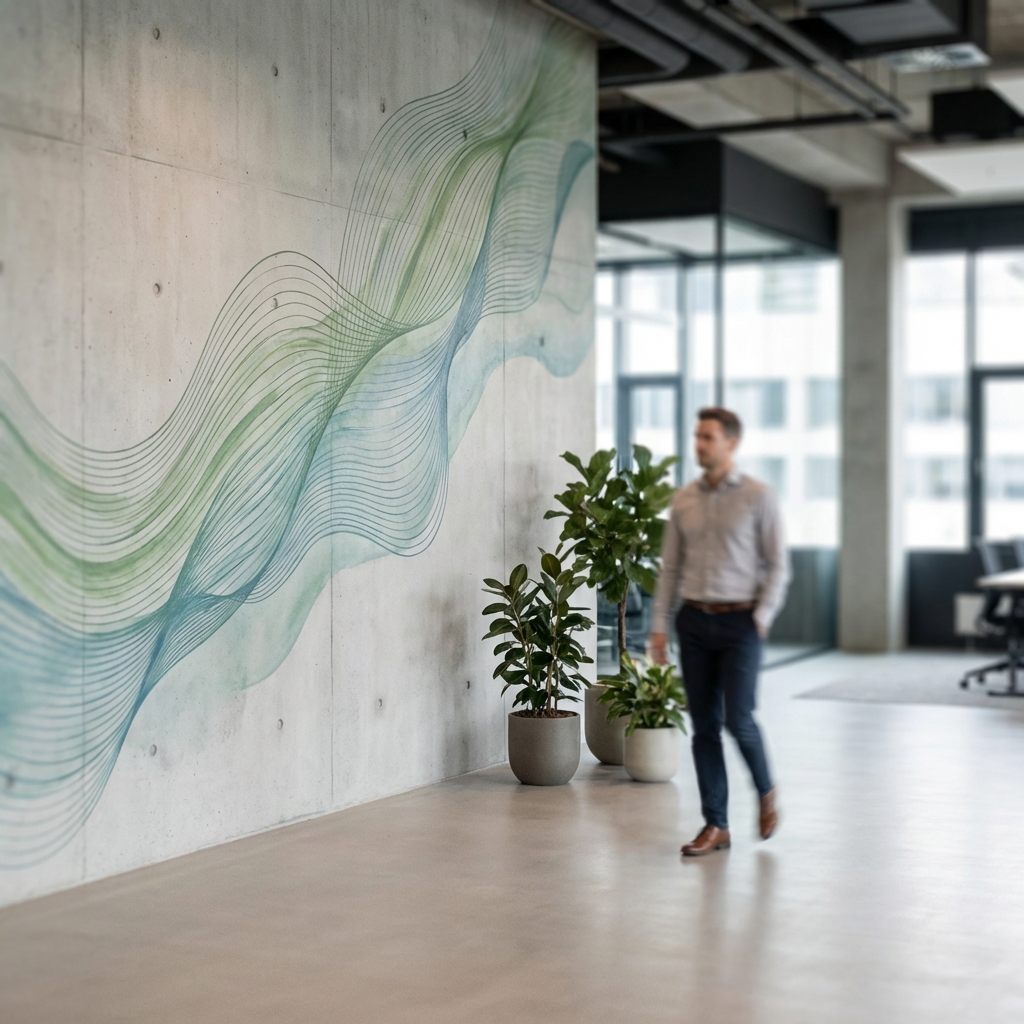
For hospitals and healthcare facilities, less time in the corridor is a patient experience and infection control advantage. For corporate offices, it enables conference room, café, and hallway updates overnight or over a single weekend—aligning aesthetic improvements with business continuity.
Compatibility with Existing Office Surfaces and Infrastructure
A key advantage of sustainable office mural printing is broad compatibility with common building substrates. Direct-to-wall systems can print on both finished and unfinished surfaces, including drywall, CMU, sealed concrete, and properly prepared brick. This creates design opportunities in places where traditional wall coverings struggle—such as textured block, large expansion joints, or areas with frequent temperature and humidity swings.
A professional site assessment typically includes:
- Substrate review: Confirming stability, moisture content, and appropriate primers or sealers for porous or highly textured materials.
- Surface prep: Light sanding, patching, or skim coating as needed to achieve the desired finish quality. Minimal prep is required for many painted walls.
- Edge cases: Planning around door frames, outlets, baseboards, and datum lines to ensure crisp registration; setting as-built coordinates for consistent alignment across floors or buildings.
- Environmental conditions: Verifying temperature, ventilation, and access for safe, efficient curing and quality control.
Because the print is integral to the surface, it reads like architecture—especially valuable in lobbies, stair towers, elevator cores, and long office corridors where continuity matters. And when building programs change, paint-over readiness means the substrate remains serviceable for the next tenant or departmental need.
Maintenance, Cleanability, and Long-Term Performance Standards
Facilities and procurement teams prioritize solutions that are both durable and maintainable. Direct-to-wall prints are designed for daily life in busy hallways, open offices, break areas, and healthcare settings, where hand traffic and intermittent impacts are expected.
Recommended maintenance practices include:
- Routine cleaning: Use soft cloths or sponges with mild, non-abrasive cleaners to remove scuffs and fingerprints without dulling the image.
- Disinfecting protocols: Many cured UV-LED ink systems tolerate diluted disinfectants; always confirm compatibility with the provider’s technical data and test in inconspicuous areas.
- Spot repair: Localized abrasions can often be minimized with targeted reprints or small-area touch-ups, avoiding a full-wall replacement.
- Scheduled refreshes: For content that is time-sensitive—like recruiting campaigns or seasonal wayfinding—subscription refreshes keep messaging accurate without adding new substrates to the waste stream.
From a performance standpoint, seam-free construction eliminates the most common failure points, while on-site color management enables consistent reproduction of brand tones across locations. Documented finish standards, mockups, and approval workflows keep stakeholders aligned, reducing the risk of rework. For institutions with strict procurement and risk controls, these predictable processes support a stronger, longer-lasting outcome.
Scalability for Multi-Location Corporate and Institutional Rollouts
Enterprise-grade branding and wayfinding must perform consistently across dozens—or hundreds—of walls, floors, and sites. Direct-to-wall printing is particularly well-suited for these rollouts because it removes manufacturing variability and adapts to as-built conditions on the ground. This is critical for national retail, hospitality, higher education, and healthcare systems pursuing uniform experience standards.
Scalability elements to expect from a mature partner include:
- Centralized color and asset management: Locked brand palettes and ICC profiles, art templates for common wall types, and naming conventions that prevent version drift.
- Field playbooks: Repeatable surveys, substrate checklists, and photo documentation to standardize prep and approval across markets.
- Integrated scheduling: Sequencing that aligns with tenant turnover, semester breaks, clinic remodels, or brand milestones—backed by SLAs that protect business operations.
- Consistency in execution: The same printheads, inks, and calibration routines across regions to minimize visible differences between sites.
- Cost and waste control: Predictable per-wall pricing, reduced shipping, and fewer reprints compared to panel-based methods.
EastCoast MuralPros serves multi-location and national programs with a focus on speed-to-value and quality assurance. For owners managing complex portfolios, the ability to produce environmentally responsible wall graphics consistently, with minimal downtime, is a differentiator in both brand delivery and facilities performance.
Real-World Applications Across Healthcare, Education, and Corporate Environments
Every sector faces its own set of constraints. Sustainable office mural printing adapts to each environment while delivering tangible improvements in usability, brand cohesion, and resource efficiency.
Healthcare systems and medical facilities:
- Wayfinding clarity: Color-coded wings, zone markers, and pictograms reduce patient stress and improve staff navigation—without adding sign clutter or cleaning challenges.
- Staff areas: Inspirational messaging, wellness content, and clinical care protocols can be printed where they are most useful and updated as standards change.
- Durable finishes: Cleanable, seam-free surfaces support routine infection control practices and withstand corridor traffic and mobile equipment.
Colleges, universities, and K–12 districts:
- Campus identity: Mascots, mottos, and donor recognition can span atriums, gym lobbies, libraries, and student centers with crisp, photoreal quality.
- Instructional graphics: Lab safety reminders, studio critiques, and makerspace workflows can be printed adjacent to the activity to reinforce learning.
- Summer projects: Fast installation windows align with semester breaks, and paint-over-ready finishes simplify future program changes.
Corporate workplaces and multi-tenant office buildings:
- Brand storytelling: Culture walls, customer success narratives, and ESG dashboards bring strategy to life without adding fixtures that clutter corridors.
- Agile spaces: Rooms reprogram quickly—training rooms to town halls to project hubs—through graphics that can be updated on a subscription cycle.
- Leasing velocity: Landlords refresh spec suites and amenity areas rapidly between tenants, improving first impressions while avoiding material-heavy build-outs.
Retail, hospitality, museums, and cultural institutions:
- Seasonal campaigns: In-studio printed elements like doors, tables, and standees coordinate with on-wall graphics for cohesive, time-bound experiences.
- Exhibitions: Photoreal, high-resolution imagery suits galleries and museum walls where detail and color fidelity matter, while direct-to-wall application preserves the spatial clarity of the architecture.
- Brand consistency: Multi-property hospitality rollouts benefit from on-site calibration and repeatable processes that keep experiences aligned from market to market.
Across all these settings, low-impact wall printing technology helps teams communicate with precision, reduce environmental burden, and keep operations moving.
Conclusion: Making the Business Case for Sustainable Workspace Graphics
Facilities directors, architects, and procurement teams are increasingly tasked with delivering green office design solutions that also meet real-world performance, budget, and schedule targets. Direct-to-wall, sustainable office mural printing offers a rare combination: it removes nonessential materials and adhesives, accelerates installation, and stands up to traffic and cleaning over time. It also supports brand expression, wayfinding, and instructional clarity without sacrificing aesthetics or sustainability.
The business case includes:
- Lower waste and emissions by eliminating vinyl, liners, and excessive shipping.
- Faster, predictable installations that fit within operational windows.
- Lifecycle efficiency through seam-free durability, cleanability, and simplified updates.
- Portfolio-wide scalability with consistent color, quality, and execution standards.
- Greater design freedom, from photoreal imagery to integrated wayfinding and safety graphics.
For organizations actively seeking alternatives to vinyl wall coverings, wallpaper, and construction-heavy upgrades, EastCoast MuralPros provides a performance-based pathway to environmentally responsible wall graphics. The result is sustainable interior branding that aligns with ESG commitments and day-to-day operational needs—delivered quickly, cleanly, and at scale.
Contact us to learn more