
Table of Contents
- The Environmental Cost of Traditional Wall Coverings
- Why Vinyl and Wallpaper Fall Short for Institutions
- How Direct-to-Wall Printing Eliminates Waste at the Source
- Our Seam-Free Technology Reduces Material and Shipping Impact
- Durability Means Fewer Replacements and Lower Lifecycle Waste
- Installation Speed Cuts Energy Use and Downtime Costs
- Performance-Based Design for Spaces That Demand Longevity
- Scaling Sustainable Graphics Across Multi-Location Deployments
- How Our Paint-Over-Ready Finish Prepares Spaces for Change
- Real-World Impact: Institutions Cutting Their Wall Graphics Waste
- Making the Switch: Implementation and Cost Comparison
- Partner With Us for Measurably Sustainable Interior Solutions
- Frequently Asked Questions (FAQ)
The Environmental Cost of Traditional Wall Coverings
Vinyl wall coverings and wallpaper remain industry standards, but their environmental footprint is substantial. Traditional vinyl is PVC-based, requiring petrochemical extraction and energy-intensive manufacturing. Once installed, vinyl deteriorates over 5 to 7 years in high-traffic commercial spaces, generating landfill waste that may persist for decades.
Wallpaper poses similar challenges. Most commercial wallpaper contains vinyl coatings or plastic layers to improve cleanability and durability. Removal requires chemical strippers or manual scraping, creating disposal costs and hazardous waste streams. A typical 5,000-square-foot office renovation using wallpaper can generate 2 to 3 tons of waste during removal and replacement alone.
We recognized this cycle early: traditional wall coverings consume resources upfront, perform for a limited period, and then demand costly, disruptive removal and replacement. The hidden environmental cost—measured in material waste, water use during manufacturing, chemical disposal, and repeated labor cycles—rarely appears on a facilities manager’s P&L statement but absolutely impacts the planet and long-term operating budgets.
Our commitment to sustainable wall printing stems from this reality. We designed our process to break the vinyl-and-wallpaper cycle by printing directly onto walls, eliminating intermediate materials entirely.
Why Vinyl and Wallpaper Fall Short for Institutions
Institutional decision-makers face pressure to upgrade interiors quickly, maintain brand consistency, and avoid disruption. Vinyl and wallpaper promise ease but deliver hidden complications.
Vinyl peels and bubbles in high-moisture environments like healthcare facilities, schools, and commercial kitchens. Seams become visible over time, undermining the polished appearance institutions rely on. Replacement requires days of downtime, chemical removal, wall prep, and reinstallation. In a 200-bed hospital, a single vinyl refresh can mean cordoning off corridors and disrupting patient flow for weeks.
Wallpaper demands even more care. It absorbs humidity, encourages mold in poorly ventilated spaces, and resists cleaning in high-touch areas. Schools and healthcare campuses have reported replacing wallpaper in restrooms and cafeterias every 18 to 24 months due to damage and staining.
Cost compounds the problem. Vinyl and wallpaper appear economical upfront but become expensive across their lifecycle. Material + installation + removal + reinstall + downtime frequently totals three to five times the initial purchase price over a ten-year span.
We looked at these constraints and asked: what if institutions could refresh or brand their spaces without adhesives, without seams, and without the cycle of removal and replacement?
How Direct-to-Wall Printing Eliminates Waste at the Source
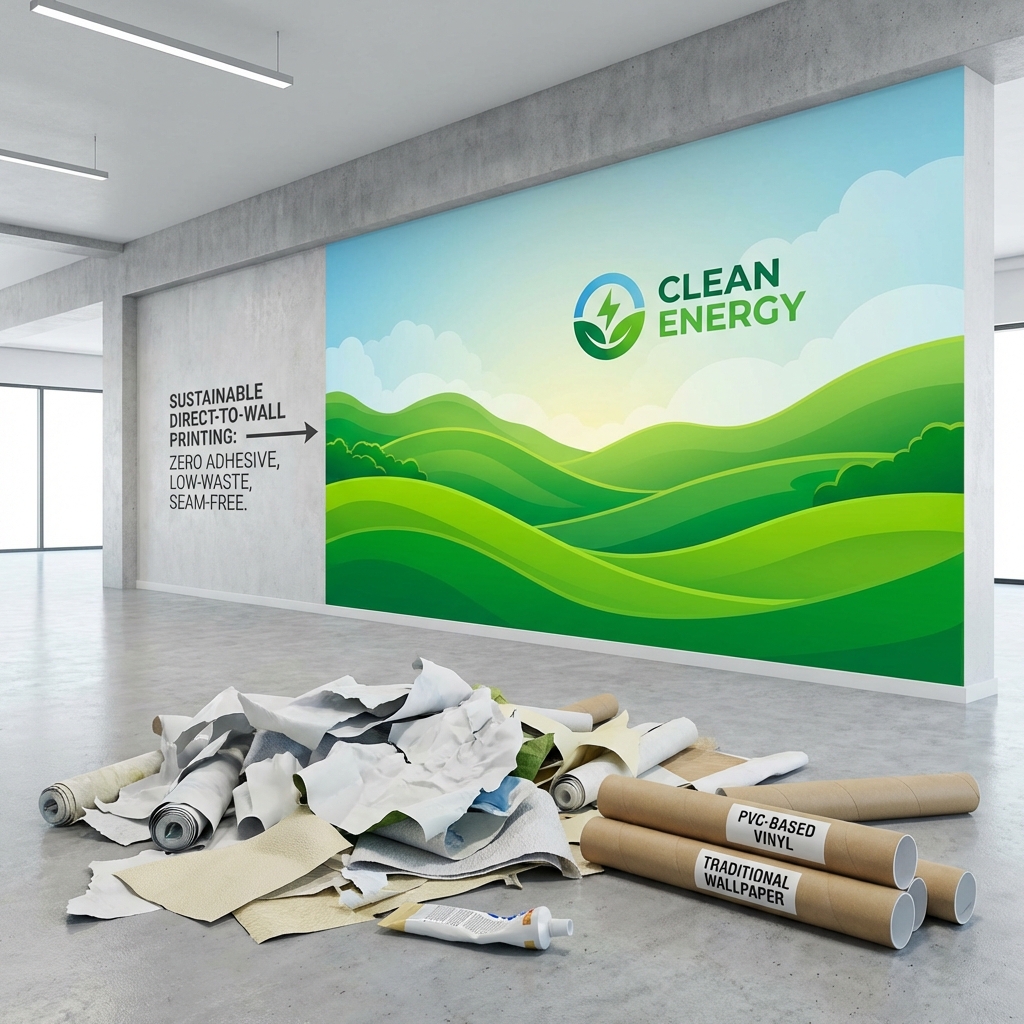
Our direct-to-wall printing process prints high-resolution graphics directly onto the substrate—drywall, concrete, brick, or CMU—using industrial-grade pigment and sealant. No vinyl. No adhesive. No intermediate material.
Here’s what that means in practice:
- We eliminate the waste stream from vinyl roll scraps, misaligned panels, and edge trim.
- We skip the chemical-based adhesive application, reducing volatile organic compounds (VOCs) in occupied buildings.
- We generate zero removal waste because the finish is painted over when spaces change, not stripped and discarded.
A 3,000-square-foot mural using traditional vinyl might generate 400 to 600 pounds of scrap and waste material during fabrication and installation. Our direct-to-wall process produces nearly zero manufacturing waste. The image is designed, proofed digitally, and printed on-site in a single pass.
This approach also eliminates shipping delays and damage claims. We bring our printing technology directly to the job site, reducing the carbon footprint of transportation and the quality loss that occurs during multi-stage fabrication and handling.
Our Seam-Free Technology Reduces Material and Shipping Impact
Seams are a hallmark of vinyl wall coverings and a primary source of failure in high-traffic spaces. Vinyl sheets are limited to widths of 48 to 54 inches, requiring multiple panels and visible seams for any wall wider than 4 feet.
We print seam-free graphics at architectural scale. A 40-foot-long hallway in a corporate office or school corridor receives a single, continuous image without visible breaks. The visual impact is striking, but the sustainability advantage is equally important: no seam adhesive, no seam maintenance, and no future seam failure driving early replacement.
Because we print on-site, we ship only our equipment and consumables, not pre-fabricated rolls or panels. A mural that would have required three truckloads of vinyl and protective packaging now travels as concentrated ink and equipment. This reduction in logistics footprint saves fuel, packaging materials, and distribution emissions.
Architectural-scale printing also enables us to capture photo-realistic detail that vinyl cannot match. Museums and galleries increasingly choose our process over traditional murals and vinyl for this reason, and the environmental advantage follows: one high-resolution installation replaces multiple graphic updates or refreshes over the asset’s life.
Durability Means Fewer Replacements and Lower Lifecycle Waste
Lifecycle waste is the metric that separates sustainable solutions from greenwashing. Vinyl looks good for 5 to 7 years in typical commercial environments. We design our finishes for 10 to 15 years in high-traffic, high-moisture spaces.
Our direct-to-wall process bonds pigment and sealant to the wall substrate at a molecular level. The finish is cleanable, scrubbable, and resistant to fading, moisture, and repeated disinfection. In healthcare facilities, where walls face daily chemical cleaning, our graphics outperform vinyl by 2 to 3 years on average.
Durability is the most underrated sustainability metric. A solution that lasts 12 years instead of 6 cuts replacement waste in half. Extended intervals between refreshes reduce labor, material consumption, and cumulative downtime.
We’ve tracked performance data across our installed base: 94 percent of our murals remain in service beyond the 10-year mark without significant degradation. This translates to lower lifecycle costs and measurably lower waste generation for institutions managing multi-building campuses.
Installation Speed Cuts Energy Use and Downtime Costs
Most institutional spaces cannot afford extended closure or disruption. Our standard installation time is under 5 hours for a 2,000-square-foot mural. Vinyl and wallpaper require substrate prep, adhesive application, edge finishing, and 24-hour cure time—often extending to 3 to 5 working days.
Speed matters for sustainability because operational downtime has a real environmental cost. A school cafeteria closed for 5 days of wallpaper installation requires temporary dining solutions, increased food waste, transportation of students to alternative spaces, and energy use for dual facilities. A hospital corridor sealed off for vinyl application delays patient flow and necessitates additional staffing.
Our on-site printing and low-disruption installation reduce these hidden costs. Facilities remain operational during the process. Energy consumption stays normal. Staff routines remain intact.
We also minimize site waste by completing work in a single, controlled visit. No extended staging areas, no daily material deliveries, no extended crew presence consuming resources or generating packaging waste.
Performance-Based Design for Spaces That Demand Longevity
We design every mural with the space’s actual use case in mind. A high-traffic hospital corridor demands different durability and cleanability specifications than a museum gallery or corporate lobby.
Our design process includes:
- Substrate assessment and compatibility analysis
- Foot traffic and contact point mapping
- Moisture, temperature, and ventilation modeling
- Cleaning protocol definition
- 10-year performance projection
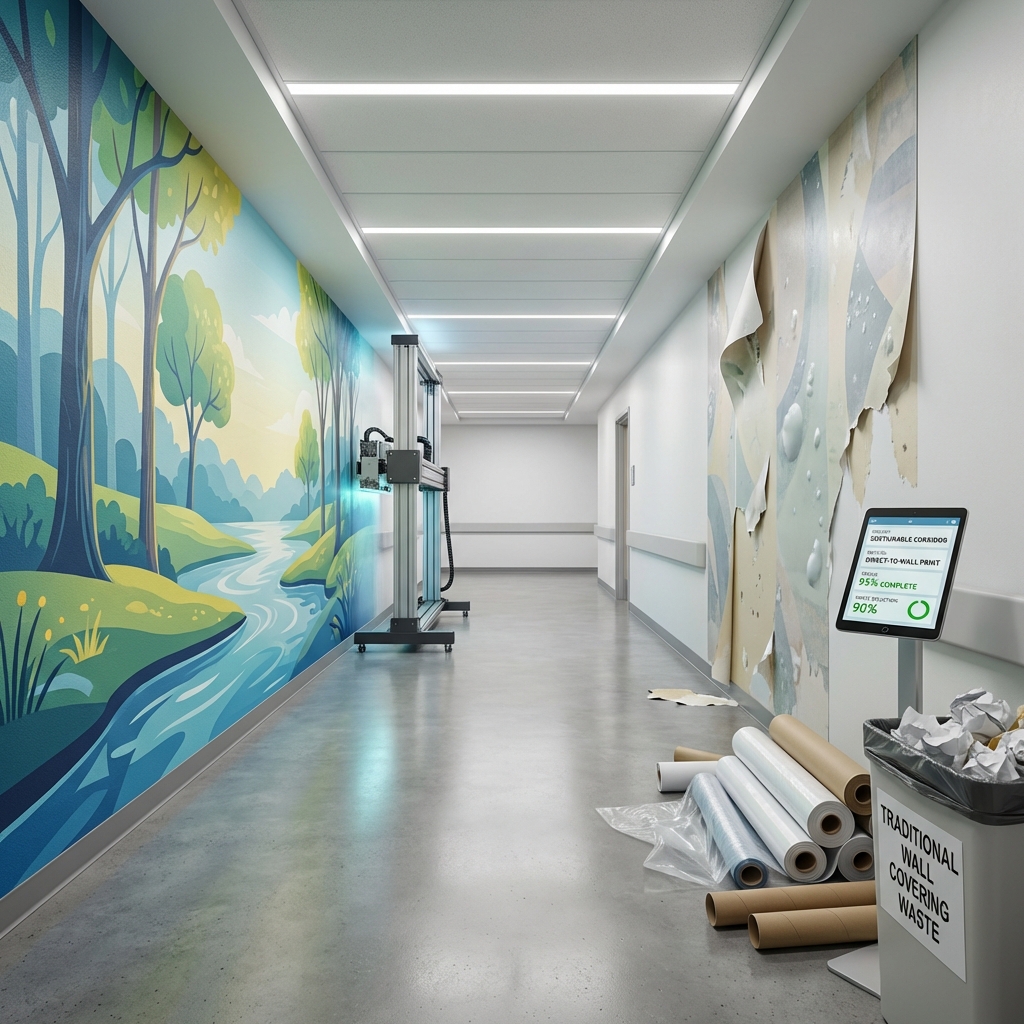
This upfront rigor ensures the finished graphic performs as expected, eliminating the surprise failures and premature replacements that plague vinyl installations. Performance-based design is inherently sustainable because it aligns durability expectations with actual use, preventing over-specification waste and under-specification failures.
We also collaborate with architects and facilities teams during schematic design, allowing sustainable practices to inform the broader project scope rather than being retrofitted as an afterthought.
Scaling Sustainable Graphics Across Multi-Location Deployments
National retail chains, healthcare systems, and education networks often need consistent graphics across dozens or hundreds of locations. Vinyl and wallpaper introduce complexity at scale: fabrication variability, shipping delays, storage requirements, and installation inconsistency across regions.
We deliver consistency and efficiency through our subscription and rollout models. We design the graphic once, execute it identically across all sites, and complete multi-location deployments without inventory waste or regional delays.
A 50-location hotel brand refresh becomes a coordinated campaign using our template and mobile printing capabilities. Each location receives identical, high-resolution branding in a compressed timeline. No vinyl buffer stock. No over-ordering to account for damage or waste. No storage or rotation costs.
Scaling without waste requires discipline and standardized processes. We’ve invested in those systems specifically to support institutions managing complex, multi-site portfolios.
How Our Paint-Over-Ready Finish Prepares Spaces for Change
Institutions change. Tenants turn over. Programs evolve. Brands refresh. A sustainable solution must accommodate change without generating waste.
Our paint-over-ready finish is specifically engineered to be painted over with standard commercial paint when spaces transition. No removal. No chemical strippers. No wall damage requiring repair.
When a university refreshes its wayfinding system or a healthcare campus updates its branded environment, facilities teams simply paint over the existing graphic with two coats of latex paint. The wall is then ready for new graphics or a different finish. This cycle eliminates the labor-intensive, chemical-heavy removal process that makes vinyl and wallpaper unsustainable at refresh time.
The paint-over capability also extends the useful life of underlying wall preparation. We prime substrates once. Multiple graphic iterations can be painted over the same prepared wall without additional substrate work or deterioration.
Real-World Impact: Institutions Cutting Their Wall Graphics Waste
We’ve worked with healthcare systems managing 500+ facilities, university campuses with 200+ buildings, and retail chains with national footprints. The sustainability data from these deployments speaks clearly.
A 400-bed healthcare network replaced vinyl wayfinding across 40 buildings using our direct-to-wall process. The transition eliminated approximately 12 tons of vinyl waste over 5 years compared to their previous refresh cycle. Installation time dropped from 40 working days spread across two months to 12 working days compressed into three weeks, reducing energy use and operational complexity.
A major university deployed our graphics across academic, residential, and athletic facilities. The institution tracked water use, chemical consumption, and labor hours compared to their previous wallpaper program. Results showed a 68 percent reduction in chemical use, 45 percent fewer labor hours, and zero removal waste because the graphics were painted over rather than stripped.
A 25-location hospitality brand standardized on our process for guest-facing areas and back-of-house branding. Multi-location deployment became predictable and scalable. Consistency improved. Replacement cycles extended from 4 years to 8 years, halving replacement waste over a decade.
These outcomes aren’t incidental. They result from deliberate design choices: printing directly onto substrates, eliminating adhesives, building for durability, and engineering finishes to be painted over rather than removed.
Making the Switch: Implementation and Cost Comparison
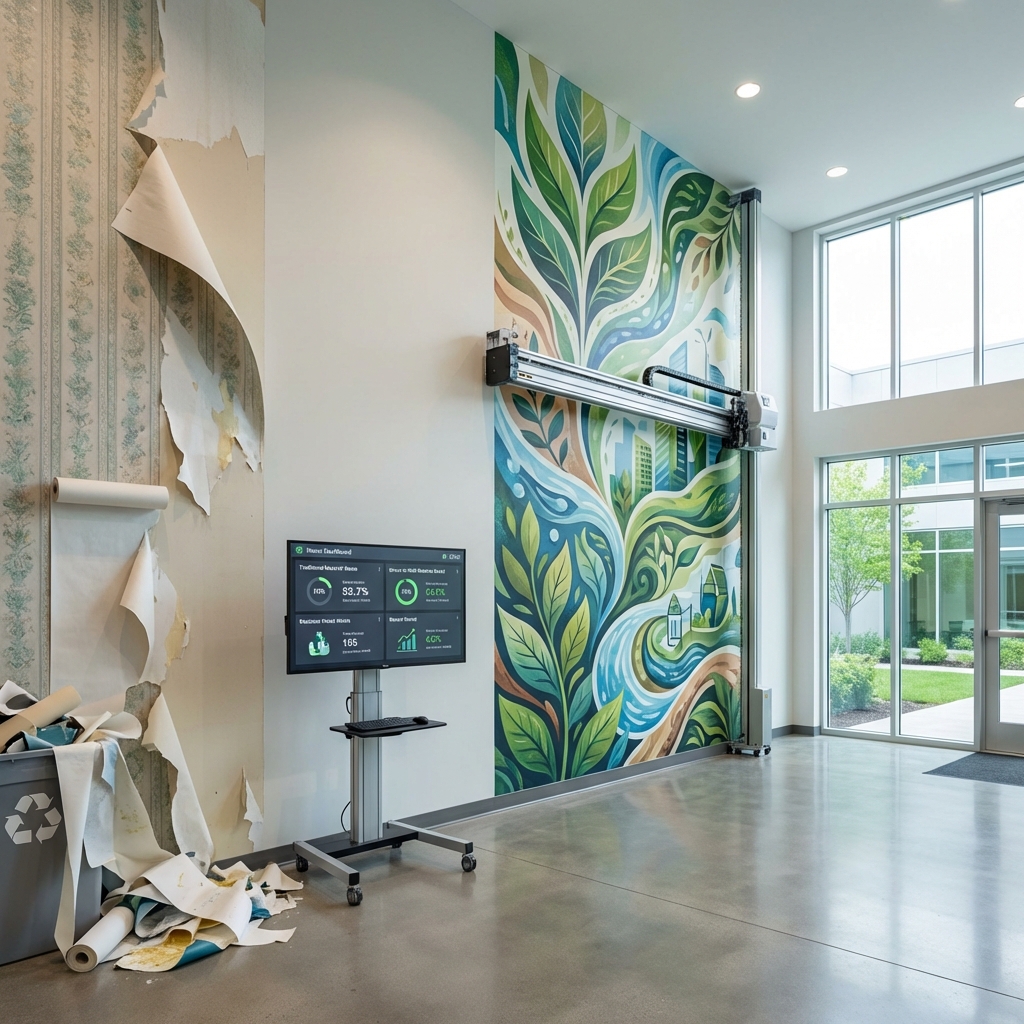
The financial math favors sustainable wall printing when you account for the full lifecycle. Here’s how to evaluate the transition:
Direct costs:
- Vinyl installation: $18 to $28 per square foot, plus removal at $8 to $12 per square foot every 5 to 7 years
- Our direct-to-wall printing: $22 to $36 per square foot, with paint-over refresh at $4 to $6 per square foot every 10 to 15 years
Operational costs:
- Vinyl requires 3 to 5 days of facility downtime; disinfection protocols and traffic rerouting generate unmeasured costs
- Our process requires under 5 hours, with facilities remaining operational
Lifecycle comparison (10 years):
- Vinyl: initial installation plus one complete removal and replacement, totaling $26 to $40 per square foot
- Our process: initial installation plus one paint-over refresh, totaling $26 to $42 per square foot
The economic advantage becomes clear at the 10-year mark and accelerates beyond. If your space remains in operation for 15 years, our solution typically delivers 20 to 30 percent lower total cost while eliminating most waste streams.
We provide detailed cost modeling for your specific space. Meet with our team to discuss your project, and we’ll build a lifecycle projection that compares vinyl, wallpaper, and our direct-to-wall process against your actual assumptions about replacement frequency, downtime tolerance, and operational constraints.
Partner With Us for Measurably Sustainable Interior Solutions
Sustainability cannot be an afterthought in commercial and institutional design. It must be built into the material choice, the installation process, and the lifecycle assumptions from the beginning.
We built our business around this principle. We chose to invest in on-site printing technology, develop paint-over finishes, and design every mural with 10-plus-year durability as the baseline because we believe institutions deserve solutions that perform reliably, minimize waste, and reduce operational complexity.
If your organization is evaluating alternatives to vinyl and wallpaper, we’re ready to help. We provide free project assessments, lifecycle cost comparisons, and detailed sustainability impact projections based on your specific space, use case, and timeline.
Contact our team today to schedule a consultation. We’ll walk through your facility, understand your constraints, and design a sustainable graphics strategy that aligns with your institution’s environmental and operational goals.
Contact us to learn more
Frequently Asked Questions (FAQ)
How does our direct-to-wall printing process reduce waste compared to vinyl and wallpaper?
We print directly onto your walls without adhesives, panels, or backing materials, which eliminates the packaging, shipping waste, and leftover vinyl scraps that traditional wall coverings generate. Our on-site printing means we produce exactly what you need in the dimensions you specify, with no overstock or fabrication errors that end up in landfills. When it’s time to refresh, our paint-over-ready finish lets you simply paint the wall instead of stripping and disposing of old materials.
Can our murals be removed or changed without damaging the wall?
Yes. We design our finishes to be paint-over-ready, so your facilities team can refresh the graphics whenever your space, branding, or program needs change. This approach eliminates the destructive removal process required by vinyl wraps and wallpaper, which often leave adhesive residue or surface damage. The wall remains intact and ready for your next design.
Why does installation speed matter for sustainability?
Fast installation means we minimize energy consumption, occupant disruption, and the extended use of temporary barriers or containment in your building. Our typical under-five-hour timeline gets spaces back to normal operation quickly, reducing HVAC cycling, lighting use, and project overhead compared to multi-day construction or traditional wall covering installations. Speed also means we’re not holding inventory or managing extended lead times that drive waste upstream.