
The Evolution of Healthcare Environment Design and Branding
Healthcare interiors have moved from decorative art to outcomes-focused environments where branding, communication, and safety work together. Clear wayfinding, calming imagery, and consistent visual systems reduce confusion and stress while supporting clinical workflows. Zero-VOC wall printing has emerged as a practical bridge between design intent and operational reality, offering high-definition results without adhesives, seams, or lingering odors.
Traditional vinyl wall coverings and hand-painted murals struggle in clinical settings. Adhesives can fail at seams, cleaning can degrade edges, and long installations disrupt units. Paint touch-ups and rebranding cycles are slow, while off-gassing or strong paint smells are unwelcome in patient areas. These limitations push facilities teams toward cleaner, faster, and more durable methods.
Adhesive-free mural technology enables hospital interior branding that feels integrated with the architecture. Direct-to-wall systems produce crisp, photoreal imagery that’s easy to clean and stands up to high-traffic corridors, nurse stations, and public lobbies. Because there’s no film layer, surfaces remain seam-free and paint-over-ready for future program changes or tenant improvements.
Operationally, fast wall graphics installation matters as much as aesthetics. On-site printing minimizes staging, eliminates shipping risks, and allows teams to schedule work after hours or between census fluctuations. For example, a pediatric corridor can receive nature scenes, room markers, and multilingual icons overnight, while an ED can add color-coded paths and large-format zone identifiers to improve healthcare facility wayfinding with minimal downtime.
Lifespan and maintenance now drive procurement decisions. Durable clinical wall finishes must tolerate routine cleaning protocols without yellowing, bubbling, or edge lift. Systems that scale across multiple campuses and deliver the same color, resolution, and application method reduce variability and rework. Subscription refresh models also help hospitals align seasonal campaigns, accreditation updates, or service-line launches with predictable costs and schedules.
When evaluating providers, facilities and design teams often prioritize:
- Verifiable zero-VOC inks and materials, with documentation
- Cleanability and abrasion performance suited to clinical protocols
- After-hours, low-disruption installation and clear safety plans
- Compatibility with drywall, CMU, concrete, and brick
- Consistent color management for multi-site rollouts and replacements
EastCoast MuralPros brings zero-VOC wall printing, adhesive-free execution, and under-five-hour installations to active healthcare spaces. Their on-site approach delivers high-resolution hospital interior branding and integrated wayfinding at scale, with paint-over-ready results that simplify future changes. Learn more about their sustainable and zero-VOC solutions for clinical environments.
Prioritizing Patient Safety with Zero-VOC and Adhesive-Free Solutions
Hospitals can’t compromise on indoor air quality, especially near sensitive populations. Zero-VOC wall printing eliminates solvent odors and adhesive off‑gassing that can irritate patients, staff, and visitors. By printing directly to painted drywall, CMU, concrete, or brick, EastCoast MuralPros delivers high‑resolution graphics without vinyl, liners, or chemical adhesives—reducing airborne irritants while aligning with IAQ goals common to LEED and WELL standards. The result is hospital interior branding that feels integrated into the architecture, not applied on top of it.
Infection prevention teams also benefit from seam‑free, adhesive‑free mural technology. Traditional vinyl seams and edges can peel, trap soil, and complicate cleaning; direct‑to‑wall prints eliminate those harborage points and are designed to withstand routine disinfection in high‑traffic corridors, waiting rooms, and clinical support areas. Durable clinical wall finishes from EastCoast MuralPros stand up to frequent wipe‑downs while preserving crisp imagery for codes, isolation protocols, or patient education.
Clear visual communication supports safer patient flow. Healthcare facility wayfinding can be embedded directly into corridors and elevator lobbies—think color‑coded routes, unit identifiers, and large pictograms at decision points—so families reach the right desk without stopping to handle physical signage. In pediatrics and oncology, calming nature scenes or donor recognition walls can be printed at architectural scale to improve experience without adding fixtures or clutter. This integrated approach reduces distraction and keeps egress paths clean.
Operationally, fast wall graphics installation matters as much as material safety. EastCoast MuralPros typically completes a wing or lobby in under five hours, often during off‑hours, with low noise and minimal containment requirements—ideal for occupied floors and 24/7 departments. On‑site printing cuts shipping delays and fabrication errors, and the paint‑over‑ready finish simplifies future program or tenant changes. For health systems, consistent execution across multiple campuses supports standardization and rapid rollouts without construction. Learn how teams modernize walls without operational downtime.
Key patient‑safety advantages with EastCoast MuralPros include:
- Zero‑VOC wall printing with no adhesive off‑gassing or strong odors.
- Low‑disruption, fast wall graphics installation suitable for active units.
- Seam‑free surfaces that clean easily and resist peeling or bubbling.
- Durable finishes compatible with rigorous, frequent disinfection.
- Paint‑over‑ready outcomes that support policy changes and future remodels.
Minimizing Operational Downtime Through Rapid On-Site Installation
Hospitals can’t afford closures or lingering odors from renovations. Zero-VOC wall printing makes it possible to update corridors, patient rooms, and public spaces during normal operations, with no adhesives, no panels, and no curing delays. EastCoast MuralPros brings mobile, direct-to-wall printers into the facility and produces high-resolution graphics in place, so departments stay open and patient flow is preserved.
The workflow is designed for speed. Artwork is aligned on the wall and printed directly onto finished or unfinished surfaces—painted drywall, CMU, concrete, even sealed brick—so most zones are completed in under five hours. Because the process is zero-VOC and adhesive-free, there’s no off-gassing and no waiting period; areas can return to service as soon as the last pass is done. Teams commonly schedule evening or weekend windows to minimize foot-traffic interruptions and avoid rescheduling clinical staff.

For hospital interior branding and healthcare facility wayfinding, on-site production keeps rollouts on schedule. A pediatrics corridor can receive calming imagery, floor-to-floor color-coding, and room identifiers overnight, with patient check-ins resuming in the morning. In perioperative or imaging suites, instructional graphics and safety reminders are printed directly on walls outside sterile zones, reducing sign clutter while maintaining clear communication for patients and visitors.
Operational leaders see time saved at every step of this fast wall graphics installation approach:
- On-site production eliminates shipping delays and fabrication errors common with vinyl panels or routed signage.
- Adhesive-free mural technology avoids peel, bubble, and seam failures that trigger rework and downtime later.
- Minimal prep and contained footprints keep adjacent rooms and corridors usable throughout the install.
- Phased, zone-by-zone scheduling supports live environments, from emergency department corridors to outpatient lobbies.
- Consistent execution across multi-location networks speeds national updates without retraining local crews.
Durable clinical wall finishes are essential for cleaning and compliance. EastCoast MuralPros prints produce smooth, cleanable surfaces designed to withstand routine hospital-grade disinfectants, supporting EVS workflows without edge-lift or moisture intrusion. When programs change, paint-over-ready finishes allow rapid swaps during low-census periods or over holiday breaks, and a subscription option helps facilities plan seasonal refreshes without adding construction projects to the docket. The result is faster, safer upgrades that protect patient experience and operational continuity while outperforming vinyl wall coverings and wallpaper over the lifecycle.
Enhancing the Patient Experience with High-Resolution Wayfinding
Hospitals reduce anxiety when directions are obvious, consistent, and visible at every decision point. Zero-VOC wall printing integrates clear wayfinding directly into the architecture, avoiding sign clutter and the maintenance burden of adhesive panels. Because the graphics read as part of the environment, they support hospital interior branding while making it easier for patients and families to move confidently from lobby to unit, and from unit to services like imaging or labs.
High-resolution, adhesive-free mural technology enables crisp pictograms, multilingual labels, and color-coded pathways that remain legible from a distance and under varied lighting. Seam-free, edge-to-edge graphics eliminate peeling corners and gaps that distract or confuse users. Durable clinical wall finishes are cleanable to hospital protocols, so traffic-heavy areas—ED corridors, elevators, outpatient check-in—stay readable after repeated cleaning.
Consider a children’s hospital that prints animal-themed “trail” markers from triage to radiology, reinforced at every intersection with floor-to-wall arrows and bilingual labels. In an oncology clinic, subtle colored bands on corridor walls guide visitors between infusion bays and family lounges without the visual noise of suspended signs. These environmental cues complement code-required signage and help reduce staff interruptions for directions, especially during shift changes and visiting hours.
Operationally, fast wall graphics installation is crucial. EastCoast MuralPros prints on-site, often completing a department or corridor in under five hours during low census windows, minimizing disruption and eliminating shipping or fabrication delays. Paint-over-ready finishes and a subscription model make it simple to adjust routes after renovations, rename clinics, or add seasonal messaging without demolition or downtime. The result is consistent healthcare facility wayfinding across campuses and satellite locations.
To maximize clarity and compliance, align design with these best practices:
- Use high-contrast palettes and large type sizes calibrated to viewing distances in long corridors.
- Pair text with universally recognized pictograms and multilingual labels.
- Repeat cues at every decision node; extend color bands across floors, walls, and turns.
- Place information at eye level for ambulatory visitors and consider lower sightlines for pediatric areas.
- Specify non-glare, cleanable finishes; avoid seams and edges that trap soil.
- Involve clinical and facilities teams to validate routes and test a pilot zone before full rollout.
EastCoast MuralPros delivers zero-VOC wall printing that meets the pace and precision hospitals require, from emergency departments to full-campus systems. The team’s adhesive-free approach produces photoreal, high-resolution wayfinding and instructional graphics on drywall, CMU, concrete, and brick—with consistent execution across multi-location networks. For hospitals balancing patient experience with safety and schedule certainty, it’s a performance-based alternative to vinyl wall coverings and traditional signage build-outs.
Maintaining Clinical Standards with Durable and Cleanable Surfaces
Clinical environments demand materials that support indoor air quality, cleanability, and predictable performance. That’s why many facilities now specify zero-VOC wall printing as part of their finish schedules—minimizing off-gassing and eliminating the adhesives common to vinyl. With adhesive-free mural technology printed directly to the wall, there are no seams, overlaps, or plastic layers to compromise hygiene or durability in high-traffic zones.
Durable clinical wall finishes must withstand daily wipe-downs and the bumps of carts and gurneys without peeling or bubbling. Direct-to-wall graphics create a bonded, seam-free surface that resists abrasion and won’t curl at edges like traditional wallcoverings. If program needs change, paint-over-ready finishes allow teams to update areas without demolition, panel removal, or landfill waste.
To align with infection control and environmental services protocols, plan for maintenance at the specification stage:
- Select smooth or properly prepared substrates so the finish is continuous and easy to clean.
- Verify cleanability ratings for the printed system and match them to your housekeeping checklist.
- Detail wall protection zones (e.g., chair rails or corner guards) where impact is highest to extend finish life.
- Establish refresh intervals; a subscription approach keeps corridors and units compliant and on-brand without major downtime.
Hospitals and clinics also benefit from fast wall graphics installation that minimizes disruption to staff and patients. On-site direct-to-wall printing is typically completed in under five hours per area, with low noise and minimal staging—ideal for occupied corridors, nurses’ stations, family waiting rooms, and LDRP suites. Because there are no adhesive cures or panel seams, spaces return to service quickly and without lingering odors.
Integrated graphics improve safety and clarity without adding signage clutter. Color-coded zones, floor-specific iconography, and unit-level instructions can be printed at architectural scale as part of healthcare facility wayfinding. The result is cohesive hospital interior branding that’s legible at distance and consistent across multiple wings or campuses.
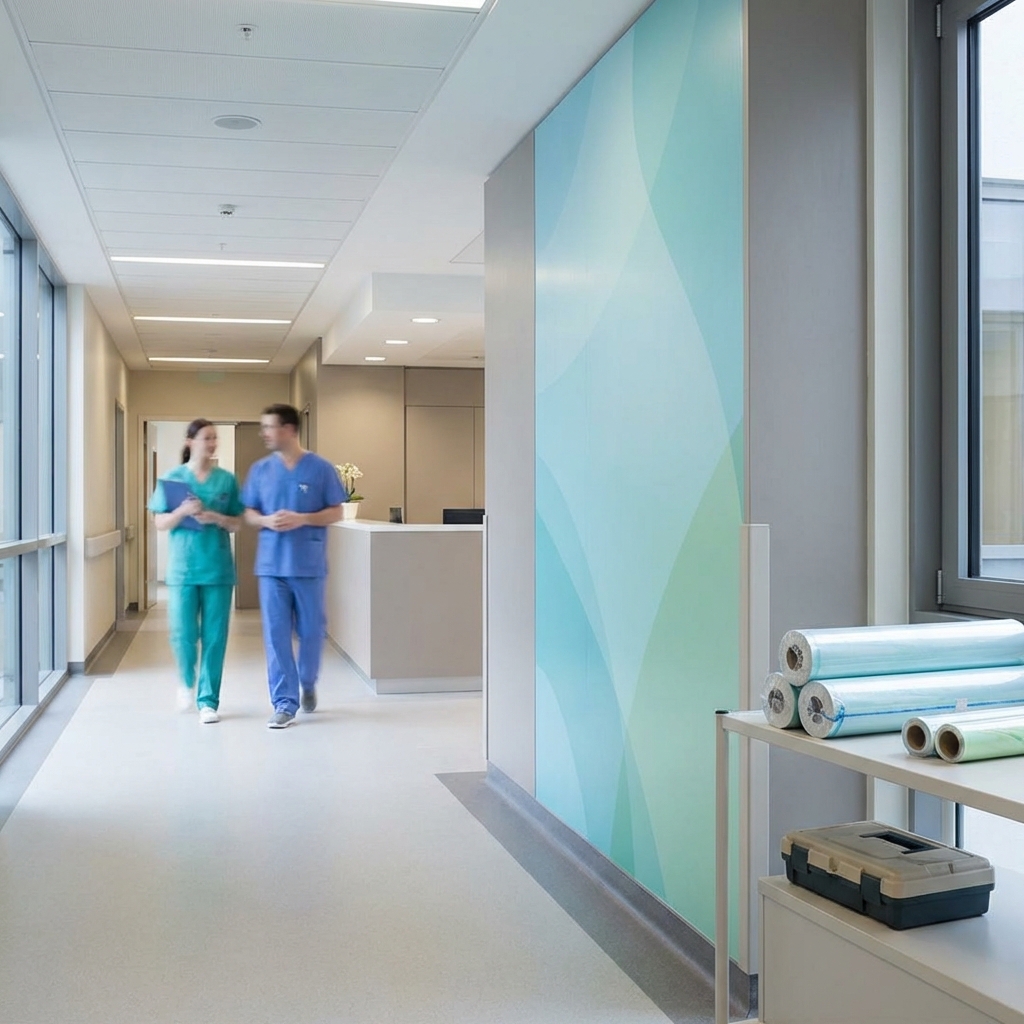
EastCoast MuralPros enables this approach with adhesive-free, direct-to-wall printing for finished and unfinished substrates including drywall, CMU, concrete, and brick. Teams get durable, cleanable surfaces designed for high-traffic environments, consistent execution across multi-location networks, and on-site printing that avoids shipping delays and fabrication errors. For hospitals pursuing zero-VOC wall printing standards, EastCoast MuralPros helps specifiers align materials, documentation, and maintenance plans so facilities meet clinical expectations—fast.
The Sustainability Advantage: Reducing Waste in Healthcare Facilities
Sustainability goals in healthcare aren’t just about energy and water—they’re about reducing material waste and keeping interiors healthy for patients and staff. Zero-VOC wall printing helps facilities replace PVC-based wallcoverings and adhesive-heavy installs with a leaner, cleaner process. By printing directly to painted or unfinished substrates, hospitals cut out entire waste streams while meeting strict indoor air quality expectations.
Traditional vinyl wall coverings create piles of off-cuts, release liners, cardboard cores, and adhesive containers—most of which head straight to the dumpster. Direct-to-wall, adhesive-free mural technology eliminates these consumables and the failure points that send graphics to landfill early. On-site production also reduces shipping materials and over-fabrication, and fast wall graphics installation minimizes temporary protection supplies and labor-intensive rework.
Where waste disappears with direct-to-wall systems:
- No vinyl, adhesive liners, or panel backers to dispose of—prints go straight on drywall, CMU, concrete, or brick.
- Seam-free visuals mean fewer edges to fail, peel, or trap soil, extending service life and reducing replacements.
- Durable clinical wall finishes that withstand routine cleaning help maintain appearance longer, delaying end-of-life cycles.
- Paint-over-ready surfaces allow decommissioning or program changes without demolition; a simple repaint resets the wall.
- Integrated healthcare facility wayfinding can be updated zone-by-zone without removing substrates or replacing sign hardware.
- On-site printing eliminates over-shipment, crating, and the waste from mis-sized or misprinted panels.
Consider a pediatric corridor refresh. A vinyl approach typically involves tearing off aging coverings, landfill-bound adhesive waste, new rolls cut to size, and days of corridor disruption. With zero-VOC wall printing, the team prints high-resolution themes and directional cues directly on prepared walls in a single shift, with no substrate scrap and minimal containment—keeping patient flow intact while dramatically reducing what goes in the bin.
EastCoast MuralPros brings these sustainability gains to hospital interior branding at scale. Their adhesive-free, direct-to-wall process supports zero-VOC wall printing standards and delivers consistent results across campuses with low disruption in occupied buildings. Facilities teams gain photoreal imagery for wayfinding and education, fast rollouts for pilot-to-system programs, and lifecycle efficiency through cleanable, durable finishes. When it’s time to change, walls are simply repainted—no panels to pull, no adhesives to abate, and significantly less waste across the portfolio.
Conclusion: Streamlining Interior Upgrades for Modern Medical Institutions
For hospitals balancing brand experience with clinical rigor, zero-VOC wall printing has become a practical path to faster upgrades and safer environments. By eliminating wallpaper pastes and pressure-sensitive adhesives, this approach reduces odor, off‑gassing risk, and debris in occupied wings. The result is hospital interior branding that lands quickly, supports infection-control standards, and looks integrated with the architecture rather than applied on top of it.
Operationally, fast wall graphics installation matters as much as the visuals. With on-site, adhesive-free mural technology, large corridors or waiting rooms can be refreshed between shifts—often in under five hours—without shutting down clinics or rescheduling procedures. For example, a radiology suite can receive updated modality wayfinding and ADA-compliant room identifiers overnight, avoiding multi-day downtime or temporary signage.
Beyond aesthetics, healthcare facility wayfinding and safety communication benefit from the scale and clarity of direct-to-wall print. Color-coded wings, bilingual care protocols, and fall-risk reminders can be printed as seam-free wall graphics at architectural scale so patients and staff see the right information at the right moment. Photoreal imagery for pediatrics, donor recognition walls, or wellness themes can share the same substrate and cleaning regimen as clinical zones, streamlining maintenance.
Lifecycle performance is where durable clinical wall finishes pay off. These surfaces are engineered to withstand routine cleaning and disinfectants, can be applied to drywall, CMU, brick, or concrete, and remain paint-over-ready for future tenant or program changes. With no panels to fail and no seams to collect dirt, facilities teams see fewer repairs and simpler end-of-life transitions, especially when paired with a subscription model for seasonal or policy-driven refreshes.
To move quickly while protecting compliance, standardize your specification checklist:
- Require adhesive-free installation with documented, low-emitting materials and on-site print controls.
- Request third-party emissions documentation for the ink system and finishes (e.g., GREENGUARD Gold/CDPH equivalency).
- Define cleaning and disinfectant compatibility with test swatches on your actual wall substrates.
- Set installation windows, dust/odor controls, and ICRA protocols for occupied areas.
- Include a paint-over or decommissioning plan to simplify future program changes.
- Ensure consistency benchmarks for multi-site rollouts, including color targets and substrate tolerances.
EastCoast MuralPros helps hospitals execute this playbook with direct-to-wall printing that’s adhesive-free, schedule-reliable, and built for scale. Their teams deliver photoreal results for branding, wayfinding, and instructional graphics, with on-site printing that reduces shipping delays and fabrication errors. For facilities, procurement, and design leaders seeking a performance-based alternative to vinyl and wallpaper, the approach streamlines upgrades today and simplifies maintenance tomorrow.
Call to Action
Contact us to learn more