Table of Contents
- The Vinyl Wall Covering Problem: Why Peeling, Bubbling, and Replacement Cycles Are Costing You
- What Vinyl-Free Wall Graphics Actually Are and How They Work
- Why Direct-to-Wall Printing Outperforms Traditional Vinyl, Wallpaper, and Hand-Painted Murals
- Installation Speed That Fits Your Timeline: Under 5 Hours, Minimal Disruption
- Durability and Cleanability That Survives High-Traffic Environments
- Sustainability Without Compromise: The Environmental Case for Adhesive-Free Graphics
- Scaling Graphics Across Multiple Locations Without Quality Loss or Fabrication Delays
- Design Flexibility and Wayfinding Integration Without Signage Clutter
- Cost Efficiency Over the Lifecycle: Why Vinyl-Free Costs Less Than You Think
- Our Collaborative Process: From Your Vision to Installation
- Real Results: How Healthcare Systems, Schools, and Enterprises Are Using Vinyl-Free Graphics
- Get Started: Your Vinyl-Free Wall Graphics Project
- Frequently Asked Questions (FAQ)
The Vinyl Wall Covering Problem: Why Peeling, Bubbling, and Replacement Cycles Are Costing You
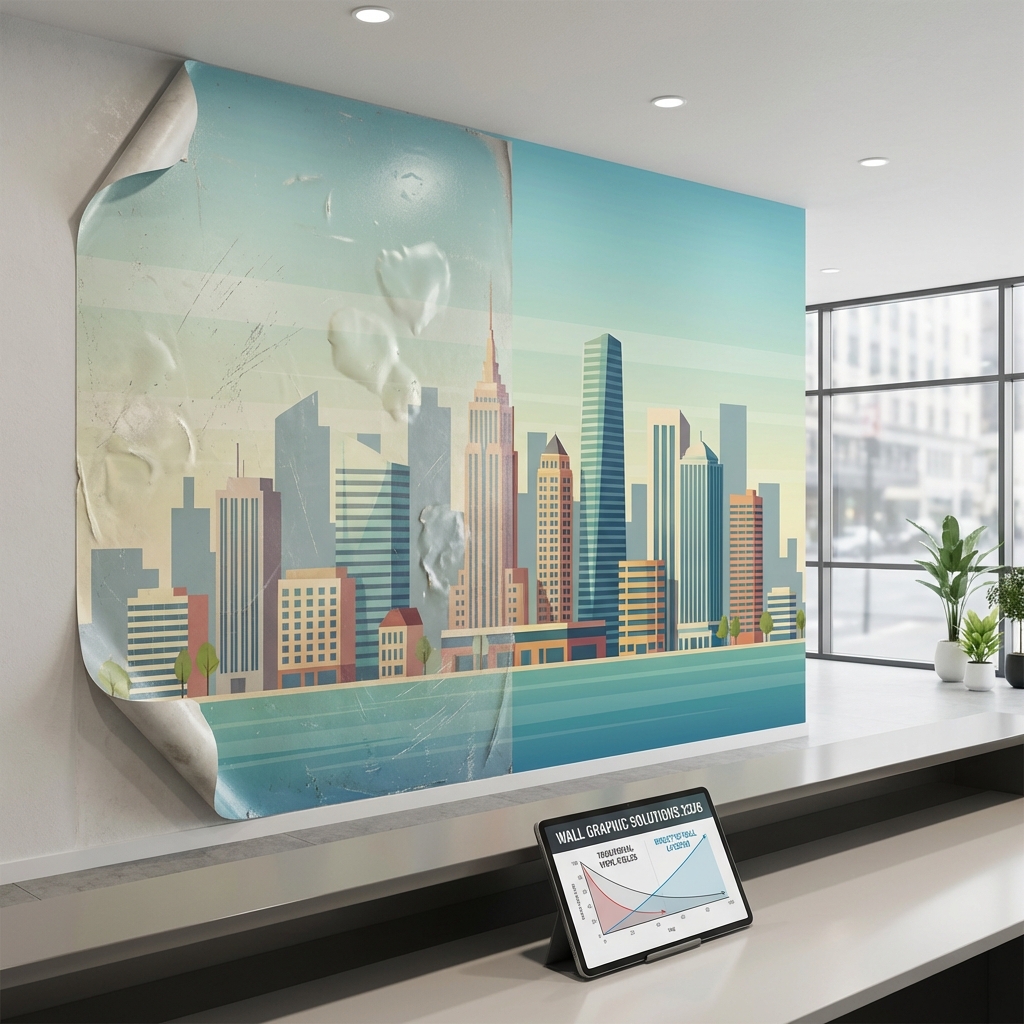
Vinyl wall coverings and traditional wallpaper deliver consistent disappointment across commercial and institutional spaces. We’ve walked into countless lobbies, hallways, and patient rooms where vinyl edges are curling, seams are bubbling, and colors have faded within 18 to 36 months. The problem isn’t isolated to budget-tier products either; even premium vinyl shows wear in high-traffic environments.
The core issue is adhesion. Vinyl relies on glues that weaken over time, especially in spaces with temperature swings, humidity changes, or frequent contact. A hospital corridor sees hundreds of footsteps daily plus cleaning cycles with harsh detergents. A school hallway endures enthusiastic students, carts, and seasonal HVAC fluctuations. Vinyl simply can’t sustain performance in those conditions without degradation.
Beyond performance, the replacement treadmill strains budgets. Removing old vinyl takes labor and time. Substrate prep for new installations often reveals damage underneath, adding cost and delay. Then comes the wait for fabrication and shipping. When you’re managing a 50-building real estate portfolio or a 15-campus school district, this cycle repeats constantly and unpredictably.
We’ve partnered with facilities directors who reported replacing vinyl graphics every two to three years on the same walls, burning through budgets that could have funded longer-term solutions. The math favors durability and speed from day one.
What Vinyl-Free Wall Graphics Actually Are and How They Work
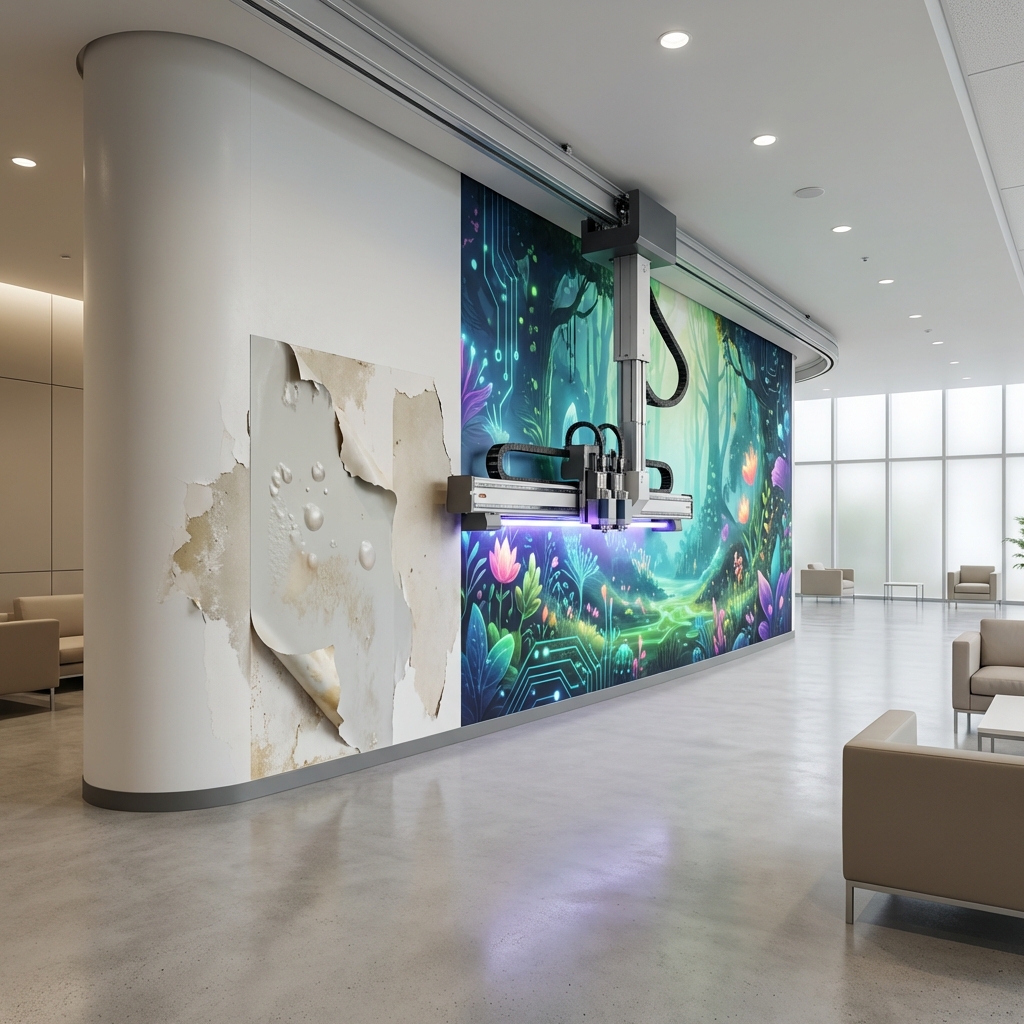
Vinyl-free wall graphics are printed directly onto your wall surface using advanced industrial printing technology, then sealed with a durable, cleanable finish. There’s no adhesive, no vinyl substrate, no panel seams. The image becomes part of the wall itself.
Here’s how we do it: Our process begins with wall preparation and substrate analysis. We assess the surface (drywall, concrete, CMU block, brick) and prime it as needed to ensure consistent ink adhesion. Once the wall is ready, our industrial-grade printer applies high-resolution color directly to the surface at architectural scale, producing photoreal detail that rivals hand-painted murals without the timeline or cost.
After printing, we apply a protective topcoat that provides cleanability, durability, and resistance to fading, abrasion, and moisture. The result is a seam-free, integrated graphic that feels permanent because it is bonded to the substrate itself, not floating on top of it.
Unlike vinyl, which relies on adhesives that degrade, or hand-painted murals, which require skilled artisans and weeks of labor, our direct-to-wall approach delivers precision, speed, and consistency. And because nothing is peeling off, there’s no ongoing maintenance crisis waiting for you.
Why Direct-to-Wall Printing Outperforms Traditional Vinyl, Wallpaper, and Hand-Painted Murals
We’ve seen organizations compare vinyl, wallpaper, hand painting, and direct-to-wall printing side by side. The performance gaps are stark.
Vinyl degrades quickly in high-traffic or humid environments. Edges lift, colors fade, and seams show. Hand-painted murals offer artistry but demand 4 to 8 weeks of onsite labor, specialized talent, and zero tolerance for changes. Wallpaper performs poorly in spaces that need regular cleaning or experience moisture or temperature swings.
Direct-to-wall printing combines the artistry of hand painting with the precision of industrial manufacturing. Direct-to-wall printing vs vinyl systems deliver photoreal resolution at any scale, require no adhesives, and create finishes that withstand decades of use in demanding environments.
We can print wayfinding graphics that remain legible and vibrant in corridors with constant traffic. We can apply brand imagery to cafeteria walls that see daily cleaning. We can install educational graphics in science labs where chemical exposure and humidity are facts of life. The sealed, hard finish resists staining, fading, and wear in ways adhesive-based products simply cannot match.
Performance translates to peace of mind. You’re not planning replacement cycles; you’re investing in infrastructure.
Installation Speed That Fits Your Timeline: Under 5 Hours, Minimal Disruption
Most vinyl installations take 1 to 2 days when you account for adhesive setting time, seam finishing, and curing delays. Hand painting takes weeks. Our installations are typically completed in under 5 hours, and the space is ready for use immediately after.
That speed matters in occupied buildings. A hospital can’t close a patient corridor for days. A school can’t shut down a main hallway during the academic year. A corporate office can’t disrupt tenant operations during business hours. Our process minimizes downtime and keeps your operations flowing.
Here’s the sequence: substrate prep happens first (2 to 3 hours depending on wall condition), printing follows (1 to 2 hours for standard wall sections), and then topcoat application (30 to 60 minutes). You’re done the same day. Our team coordinates with your operations staff to schedule work during the lowest-traffic windows, and we handle all cleanup.
This speed also reduces risk. The fewer days a project runs, the fewer chances for weather delays, access issues, or scope changes. Project management for occupied facilities becomes simpler when your installation window is measured in hours, not weeks.
Durability and Cleanability That Survives High-Traffic Environments
Our sealed, printed graphics are designed for abuse. We use industrial-grade inks and protective coatings that resist scratching, staining, fading, and moisture. The finish is cleanable: you can wipe walls with mild detergent and a soft cloth without damaging the image or colors.
This durability addresses a real problem in healthcare, education, and hospitality. A pediatric hospital lobby sees kids touching walls, markers being used, sticky fingers everywhere. A school hallway gets backpacks, carts, scuffing, and intentional damage. A hotel corridor faces daily housekeeping and guest wear. Our graphics don’t degrade under these conditions.
We’ve installed murals in emergency departments that remain vibrant after three years of constant cleaning and contact. We’ve printed wayfinding graphics in multi-story schools where tens of thousands of students pass by annually. We’ve applied graphics to hotel walls that see turnover every few days and aggressive cleaning protocols. These aren’t theoretical durability claims; they’re documented outcomes.
The sealed finish also prevents moisture infiltration, which means no mold risk, no substrate rot, and no hidden failures months after installation. In damp environments like locker rooms, basements, or exterior-adjacent walls, this sealed barrier is a major advantage over vinyl, which can trap moisture and degrade adhesives.
Sustainability Without Compromise: The Environmental Case for Adhesive-Free Graphics
Vinyl wall coverings and wallpaper create waste streams. Old material is stripped, landfilled, or incinerated. Adhesives contain solvents and chemicals. Replacement cycles mean more manufacturing, more transportation, more disposal every few years.
Our process is fundamentally different. Because we print directly onto existing walls, we eliminate the material waste of vinyl substrates. No adhesives mean no chemical solvents or off-gassing. No peeling or replacement cycles mean 10+ years of use from a single installation rather than 2 to 3.
We also offer paint-over-ready finishes, which means when your space needs a complete refresh, you can paint over our graphics rather than strip and dispose of them. The wall becomes a canvas that evolves with your organization rather than accumulating waste.
For institutions and enterprises focused on sustainability certifications (LEED, carbon goals, waste reduction), vinyl-free graphics align directly with those commitments. You’re reducing material consumption, eliminating adhesive chemicals, and extending the lifecycle of your interior investments.
Scaling Graphics Across Multiple Locations Without Quality Loss or Fabrication Delays
Multi-location rollouts are a nightmare with traditional vendors. Vinyl gets fabricated in batches, shipped to each site, and installed by different teams. Color inconsistency, seam misalignment, and installation quality vary wildly across locations. A 50-location retail brand refresh can take 6 to 8 months to execute.
We manage scaling differently. Our team works from master design files and prints on-site at each location. This approach eliminates shipping delays, reduces fabrication errors, and ensures consistency across all installations because we’re printing from the same file and using identical equipment.
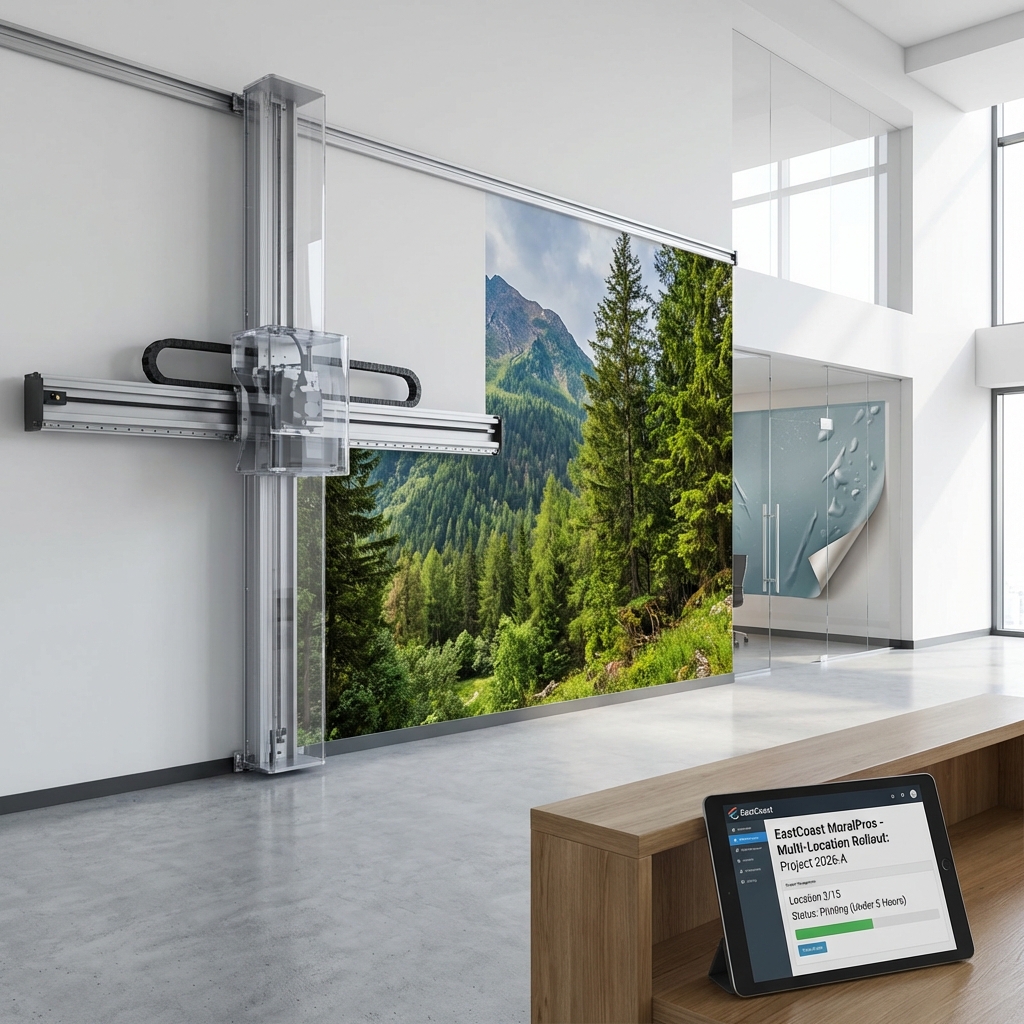
A healthcare system rolling out wayfinding graphics across 12 hospitals can complete the full program in under 3 months, not 9. A retail chain updating 40 store entrances maintains perfect brand consistency because every location uses the same artwork and printing process. A university refreshing dorm wayfinding across 20 residence halls coordinates a tight timeline because onsite printing eliminates the fabrication bottleneck.
We’ve managed national programs where coordination across locations was critical. Our process makes scaling predictable and controllable.
Design Flexibility and Wayfinding Integration Without Signage Clutter
One of the most underrated benefits of direct-to-wall printing is design freedom. We can print custom artwork, photography, data visualization, and wayfinding information at any scale. We integrate color, imagery, and information directly into the wall rather than layering signs on top of it.
A hospital can print directional wayfinding graphics that feel like intentional architectural elements, not clutter. A university can turn a blank stairwell into a vertical gallery of student art without hanging frames. A corporate office can display brand values or team achievements as integrated wall art rather than posters.
We work with your design team to translate vision into printable files. We handle color management, resolution optimization, and substrate compatibility. Your internal teams stay focused on the creative vision; we handle the technical execution.
This flexibility also enables experimentation. Pilot a wayfinding concept in one wing before committing to a full rollout. Test brand imagery in a single office before scaling to 20 locations. Update seasonal messaging or educational content without stripping and reprinting. The paint-over-ready finish means you can evolve spaces without waste.
Cost Efficiency Over the Lifecycle: Why Vinyl-Free Costs Less Than You Think
The upfront cost of direct-to-wall printing is competitive with premium vinyl, sometimes higher on a square-footage basis. But lifecycle cost tells a different story.
Vinyl requires replacement every 2 to 3 years. Each cycle includes removal labor, substrate preparation, new material, installation, and disposal. A 2000-square-foot main corridor on a vinyl cycle costs roughly $8,000 to $12,000 every few years. Over 10 years, that’s $30,000 to $40,000 in direct costs, plus the operational disruption of repeated installations.
Our graphics, installed once, function for 10+ years with minimal maintenance. The same 2000-square-foot corridor costs roughly $12,000 to $16,000 upfront, then drops to annual cleaning and inspection. Over 10 years, you’re at roughly $1,200 to $1,600 in maintenance, total lifecycle cost closer to $14,000 to $18,000.
The math improves further when you factor in operational costs: avoided downtime, reduced labor for removal and prep, no repeated project management cycles, and predictable budgeting. Facilities directors appreciate the stability and the absence of surprise replacement projects.
For large-scale installations, the economic advantage grows. A 50-building portfolio using vinyl incurs replacement projects constantly. Using direct-to-wall graphics, you complete the initial rollout in 3 to 4 months, then operate maintenance-light for a decade.
Our Collaborative Process: From Your Vision to Installation
We partner with you from initial concept through final installation, ensuring your vision becomes reality and the execution matches your standards.
The process begins with a discovery conversation. We learn your goals, timeline, space constraints, and aesthetic preferences. We assess your walls physically or via detailed photos and measurements. We discuss integration with existing branding, wayfinding strategies, or educational objectives. This groundwork prevents surprises and misalignment later.
Next, we develop design recommendations and present mockups showing how artwork will look at scale on your actual walls. We handle color management, resolution optimization, and layout to maximize visual impact. You provide feedback, and we iterate until the design is locked.
Once design is approved, we manage all technical preparation. We verify substrate condition, perform any needed priming, and schedule installation at times that work for your operations. Our team handles printing, topcoat application, and cleanup. We document the completed work and provide maintenance guidance.
Throughout, we communicate progress and address questions promptly. You’re not left wondering whether the project is on track; we keep you informed and maintain transparency on timeline and cost.
Real Results: How Healthcare Systems, Schools, and Enterprises Are Using Vinyl-Free Graphics
Healthcare systems are using our murals to reduce patient and staff anxiety. A pediatric hospital printed large-scale nature scenes in waiting areas, and parents reported noticing reduced stress levels. A mental health facility integrated calming imagery into patient rooms as part of therapeutic design. An emergency department used our graphics to streamline wayfinding, reducing patient confusion and improving staff efficiency.
Schools are transforming corridors and common spaces. A large school district replaced vinyl signage with integrated wayfinding graphics across all 15 campuses, improving student navigation while eliminating the visual clutter of signs. A university residence life program printed student artwork in dorm hallways, creating a gallery-like environment that residents embraced. A K-12 system integrated educational content (periodic table, historical timelines, language learning) into classroom hallway walls, turning dead space into learning resources.
Enterprise clients use our graphics for brand reinforcement and workspace identity. A financial services firm printed brand stories and values across office walls, creating cohesive identity as new tenants joined shared spaces. A hospitality group printed location-specific heritage imagery in lobbies, differentiating properties while maintaining brand consistency.
In every case, the decision factor was durability, speed, or design flexibility that vinyl couldn’t deliver. The outcomes reinforced the value of choosing the right substrate and technology.
Get Started: Your Vinyl-Free Wall Graphics Project
If you’re managing spaces where vinyl is peeling, wallpaper is failing, or traditional signage is cluttering your environment, we’re ready to help. Start with a conversation about your space, goals, and timeline. We’ll assess your walls, discuss design possibilities, and show you how direct-to-wall printing compares to your current approach.
Contact our team for a site visit or virtual consultation. We’ll provide a scope of work, timeline, and investment range tailored to your project. You’ll get transparent guidance on whether vinyl-free graphics are the right fit and what to expect during installation.
The shift from vinyl to direct-to-wall printing is happening across healthcare, education, retail, and corporate real estate because the performance, durability, and cost advantages are real and measurable. We’re here to bring that technology to your spaces.
Contact us to learn more
Frequently Asked Questions (FAQ)
How quickly can we install our direct-to-wall graphics in an occupied building?
We typically complete installations in under 5 hours, and we work during off-hours or low-traffic periods to minimize disruption to your operations. Unlike traditional wall coverings or hand-painted murals, our process doesn’t require adhesives, curing time, or construction permits, which means your team can occupy the space immediately after we finish.
What makes our vinyl-free graphics more durable than wallpaper or vinyl wall coverings?
We print directly onto your existing wall surface (drywall, concrete, brick, or CMU) and seal the finish to be cleanable and resistant to scuffing in high-traffic environments. Our graphics don’t peel, bubble, or degrade like adhesive-based vinyl or wallpaper, and they’re designed to survive years of use in hospitals, schools, corporate offices, and retail spaces without replacement.
Can we scale this solution across multiple locations without quality loss or shipping delays?
Yes. We bring our printing technology on-site to each location, which eliminates fabrication errors, shipping damage, and the inconsistencies that come with off-site production. This approach also lets us maintain consistent execution across your entire rollout, whether you’re refreshing five walls or fifty locations.