Table of Contents
- The Problem With Vinyl Logo Walls
- Why Vinyl Fails Your Brand Standards
- How Direct-to-Wall Printing Changes the Game
- Seamless Logo Walls Without Adhesive Damage
- Installation Speed That Respects Your Operations
- Durability and Cleanability at Scale
- Multi-Location Brand Consistency Made Simple
- Cost Efficiency and Lifecycle Advantages
- The Sustainability Factor Your Stakeholders Want
- How Our Process Protects Your Investment
- Getting Started With Your Logo Wall Transformation
- Frequently Asked Questions (FAQ)
The Problem With Vinyl Logo Walls
Your lobby entrance matters. It’s where clients form their first impression, where employees walk past your brand values every single day, and where wayfinding either works seamlessly or frustrates people within minutes. When vinyl logo walls start to peel, bubble, or fade after two years, that first impression crumbles along with the graphics.
We’ve spent years watching organizations invest in vinyl wall coverings, only to call us when adhesion fails, seams separate, or color degrades under fluorescent light and foot traffic. The pattern is consistent: vinyl solves a short-term problem but creates longer-term headaches around maintenance, replacement costs, and brand perception.
Here’s what we’ve learned: there’s a better way. Our direct-to-wall printing technology eliminates the core vulnerabilities that make vinyl logo walls unreliable. We print graphics permanently onto your walls without adhesives, without panels, and without the lifecycle failures that plague traditional approaches.
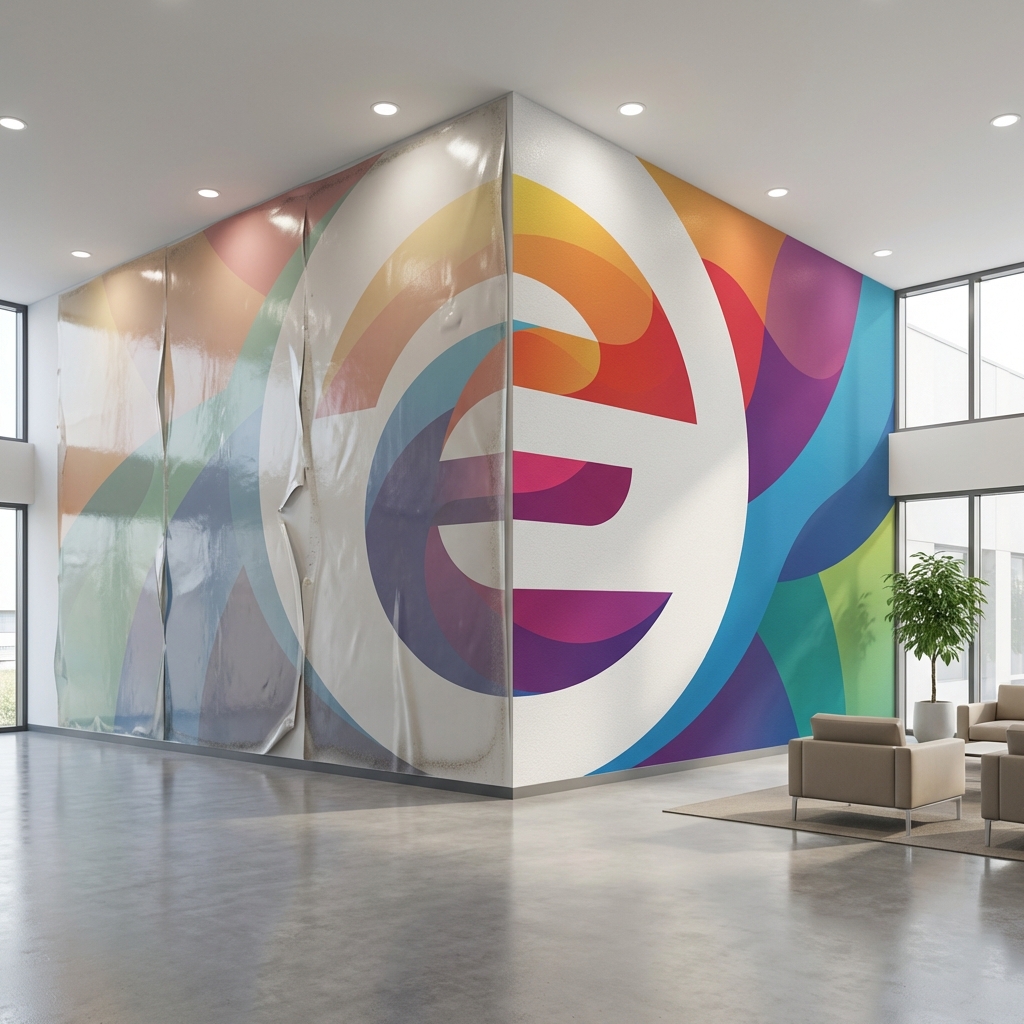
Vinyl wall coverings—adhesive-backed graphic films applied to your existing wall surface—arrive with built-in failure modes. Corners curl. Seams bubble. Adhesive breaks down under heat, humidity, and physical contact. In high-traffic commercial environments like hospital corridors, corporate lobbies, and university buildings, vinyl simply doesn’t hold up.
The core issue is physics. Vinyl relies on adhesive strength to bond a thin film to your wall substrate (the underlying surface material). Every environmental fluctuation, every cleaning cycle, every person brushing past the graphic stresses that bond. In spaces with temperature swings, variable humidity, or frequent cleaning—which describes most commercial buildings—adhesive degradation accelerates.
We’ve reviewed hundreds of vinyl installations that failed within 18 to 36 months. Peeling edges. Water damage seeping behind the film. Ghosting (permanent adhesive residue left after removal). Even well-installed vinyl is a consumable. You’re not upgrading your space; you’re installing a timed expiration date.
Actionable takeaway: Before choosing any wall graphic solution, audit your space for environmental factors: humidity levels, temperature swing ranges, cleaning frequency, and foot traffic density. These conditions determine whether vinyl will survive or fail.
Why Vinyl Fails Your Brand Standards
Your logo wall represents organizational identity. It appears in client meetings, employee onboarding videos, and social media photography. When that wall degrades, it signals neglect—even if the rest of your space is immaculate.
Vinyl limitations compound this problem. Resolution ceilings mean detailed logos or fine typography blur at a distance. Color fidelity drifts under UV exposure and aging. Multi-location rollouts become logistical nightmares: different wall substrates require different vinyl weights and adhesion strategies, so your logo can look subtly different across your campus or national footprint. Seams—those unavoidable lines where vinyl sheets meet—disrupt visual continuity, especially on expansive walls.
We’ve seen organizations accept compromises because they believed vinyl was their only practical option. Darker logos to hide seams. Simplified designs to avoid fine detail. Smaller graphics to avoid substrate complexity. Your brand vision shrinks to fit vinyl’s constraints.
And then there’s the refresh problem. When your brand evolves or a lease-up period demands a wall update, removing vinyl is destructive. Adhesive residue requires chemical strippers or grinding, damaging paint and substrate. Full wall repainting often follows. Your one-wall update becomes a multi-day project with disposal costs and surface repair.
Actionable takeaway: Document your brand’s visual requirements for logo walls before evaluating any printing technology: minimum line weights, color precision specs, and resolution targets. This clarifies whether vinyl can actually deliver your standards or whether alternatives deserve evaluation.
How Direct-to-Wall Printing Changes the Game
We print directly onto your wall surface using industrial-grade inkjet technology. No vinyl. No adhesive. No panels. The wall itself becomes the substrate, and our inks bond chemically with that surface at a molecular level.
The difference is fundamental. Instead of relying on adhesive durability (which inevitably fails), we rely on ink permanence and surface integration. Our process works on drywall, concrete, CMU block, brick, and finished painted surfaces. We achieve photorealistic resolution—crisp detail at architectural scale—that vinyl simply cannot match. A 40-foot corporate logo, a detailed wayfinding map, or a high-resolution museum reproduction all print with consistent quality.
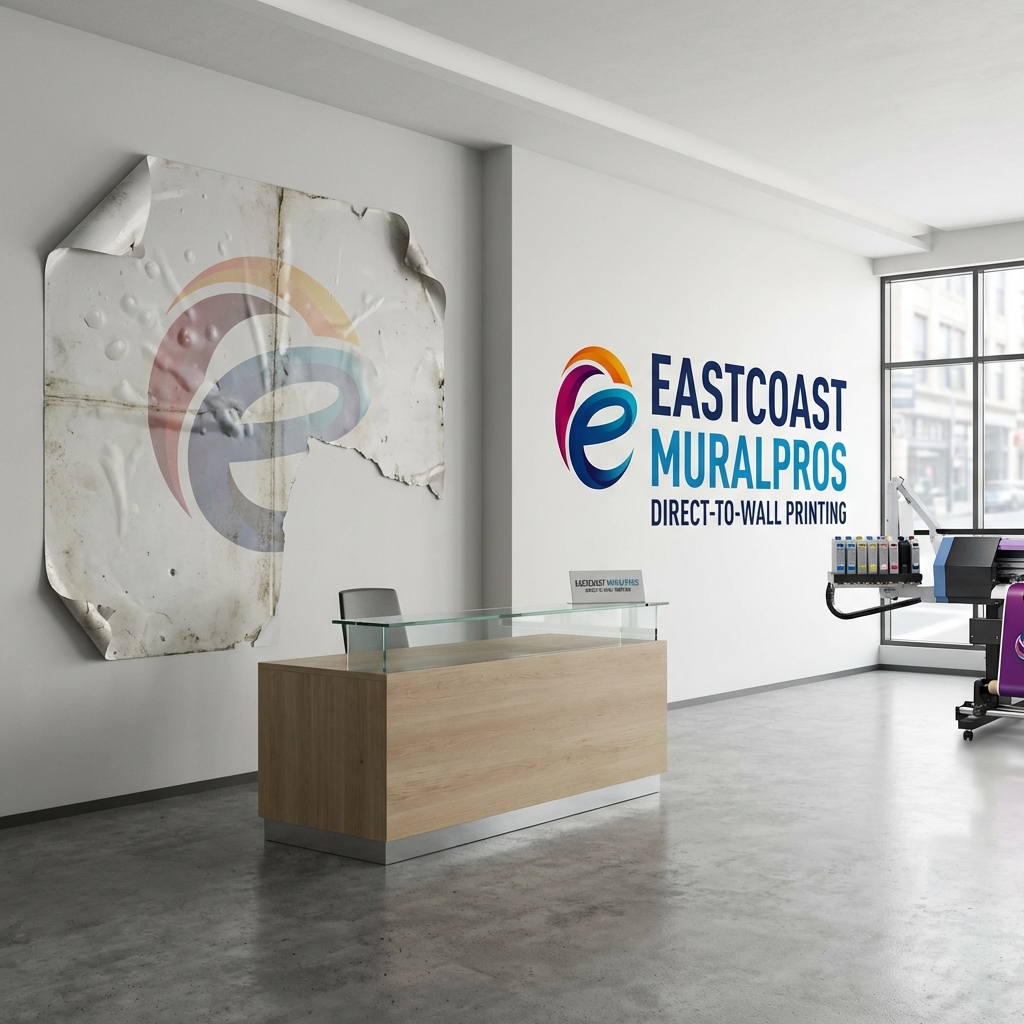
Multi-location consistency becomes straightforward. We arrive at each location with the same file, the same digital process, and the same output standard. Environmental variables don’t matter: your logo looks identical whether it’s installed in Tampa humidity or Denver altitude. No more guessing whether substrate differences will affect the final result.
Installation is genuinely fast. Most logo walls print and cure within 5 hours, minimizing disruption to occupied buildings. We handle substrate prep, printing, and finishing on-site. Your facility teams don’t manage overnight delivery windows, complex installation choreography, or extended downtime.
Actionable takeaway: Request a sample print on an inconspicuous wall in your building before committing to a full installation. This lets you evaluate durability, cleanability, and color accuracy in your specific environment over 4-6 weeks.
Seamless Logo Walls Without Adhesive Damage
Seams represent one of vinyl’s most visible compromises. On a 30-foot wall, you need multiple vinyl sheets, and seams become visual anchors—exactly where you don’t want them. They collect dust, trap moisture, and eventually separate.
We print seamlessly across any wall size. A 60-foot branded corridor? One continuous graphic with no seams. Your eye moves across the wall without interruption, just as your design was intended. This matters most on expansive walls, in high-visibility spaces, and for detailed imagery like wayfinding maps or educational graphics.
Adhesive damage doesn’t exist in our process. No removal residue. No ghosting. When your building eventually leases to a new tenant or your program changes, we simply paint over the mural with standard wall paint. The surface underneath is uncompromised—ready for repainting, new graphics, or restoration to blank wall. This paint-over-ready finish is invaluable for landlords managing frequent tenant transitions or institutions rolling out new branding.
We’ve worked in hospitals where wall graphics need to withstand aggressive cleaning (bleach-based solutions, pressure washing), schools where wayfinding updates happen annually, and corporate buildings where refreshes coincide with leadership transitions. In every scenario, our approach eliminates the secondary damage that vinyl removal causes.
Actionable takeaway: If your space experiences high cleaning frequency or aggressive environmental conditions, request durability testing data specific to your cleaning protocols. We can verify that our surfaces withstand your actual maintenance practices.
Installation Speed That Respects Your Operations
Operational disruption drives decision-making in occupied buildings. A hospital can’t close a corridor for three days. A corporate office can’t relocate employees during business hours. A school can’t disrupt classes for wall updates.
Our installation timeline respects these constraints. We arrive early morning or after hours. Our small team (typically two technicians) completes substrate assessment, printing, and finishing within a single shift. No overnight drying cycles. No multi-day cure windows. Wayfinding goes live immediately. Your lobby is operational before your staff morning meeting.
This speed works because we eliminate traditional fabrication steps. Vinyl requires measurement, cutting, pre-production at an off-site facility, quality checks, shipping, and on-site installation. We compress that workflow: precise on-site measurement, direct printing, immediate finishing. Each step happens in your space, eliminating shipping delays, fabrication errors, and installation complexity.
For multi-location rollouts, this efficiency multiplies. Rolling out new branding across 15 locations? We schedule installations in sequence over 2-3 weeks, completing one building every 1-2 days. Your corporate real estate team manages a predictable calendar; each location experiences minimal disruption.
Actionable takeaway: If downtime matters to your operations, calculate the cost of a three-day closure (lost productivity, tenant communication, rescheduled meetings). Compare that against the cost of installation that completes in under five hours. The ROI becomes immediately clear.
Durability and Cleanability at Scale
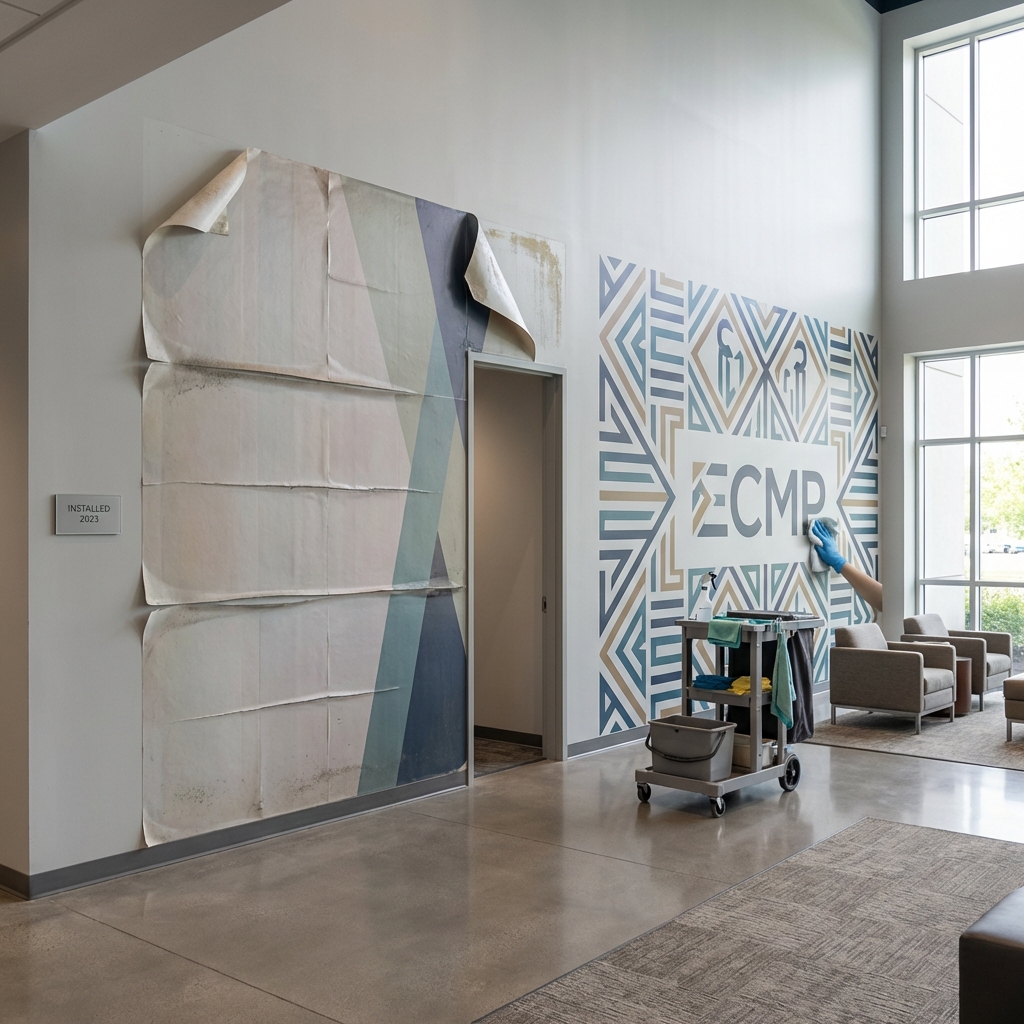
Vinyl wears visibly. After 18 months in a high-traffic corridor, edges lift. After three years, color noticeably fades. After five years, the wall looks aged—not because of dirt, but because the vinyl itself has degraded.
Our surfaces are designed for durability in punishing environments. Hospital corridors with continuous foot traffic. School hallways with children, maintenance crews, and frequent cleaning. Retail spaces with seasonal updates and intense use. We’ve installed logo walls that encounter daily aggressive cleaning, direct sunlight through floor-to-ceiling windows, and heavy physical contact.
Cleanability is built in. Your housekeeping team can scrub our surfaces with standard commercial cleaners, mild bleach solutions, and even pressure washing (at appropriate settings). The graphic doesn’t degrade. Colors don’t fade. Detail doesn’t blur. We’ve tested these surfaces against hospital-grade disinfectants, school bathroom cleaning protocols, and retail deep-clean procedures. They hold.
This durability translates to cost advantage. Vinyl replacement cycles run 18-36 months in heavy-use environments. Our surfaces remain visually pristine for 7-10 years with standard maintenance. That’s a fundamental difference in total cost of ownership.
Actionable takeaway: Ask your housekeeping or maintenance team about current wall graphic cleaning protocols. We can confirm that our surfaces withstand those exact practices without degradation.
Multi-Location Brand Consistency Made Simple
Rolling out a rebrand across 12 locations creates logistical complexity. Different wall conditions. Different contractors. Different installation dates. Inevitably, subtle variations emerge: slightly different color rendering, minor spacing inconsistencies, misaligned elements. Your brand looks coherent from the design file but fragmented across your portfolio.
We maintain pixel-perfect consistency because we control the printing process. Same file. Same digital workflow. Same output specifications at every location. Whether installation happens in Boston or Phoenix, your logo wall looks identical. This matters enormously for organizations where brand perception hinges on consistency—retail chains, healthcare systems, educational institutions.
Our process also simplifies vendor management. Instead of coordinating with regional contractors, managing different skill levels, and reviewing inconsistent quality, you work with a single team that understands your specifications and delivers predictable results. We handle travel, scheduling, substrate assessment, printing, and finishing. Your real estate team focuses on facility access and timing; we manage the technical execution.
We’ve completed full-campus rebrands for universities (50+ buildings), hospital systems (15+ facilities), and national retail chains (20+ locations). Consistency isn’t an aspiration; it’s our default output.
Actionable takeaway: Before launching a multi-location rollout, document your exact color specs (Pantone, RGB, or CMYK standards), logo sizing rules, and spacing guidelines. We convert these into a master template that ensures identical output at every location.
Cost Efficiency and Lifecycle Advantages
Vinyl’s low upfront cost hides long-term expense. Installation, removal, repainting, reinstallation, waste disposal—these costs accumulate over five years. We’ve calculated total cost of ownership for clients comparing our approach to traditional vinyl refreshes. Over a ten-year building lifecycle, our solution typically costs 30-40% less than vinyl replacement cycles, and substantially less than hand-painted alternatives.
The economics work because our surfaces don’t degrade. No refresh cycles. No removal and reinstallation. No disposal costs. Maintenance is minimal—occasional light cleaning to remove dust or marks, but no restoration work or full repaints required.
For landlords managing frequent tenant transitions, this advantage is compounded. Each tenant departure previously required vinyl removal and wall repainting. With our approach, you simply paint over the existing graphic. New tenant? New graphic printed directly onto the refreshed surface. Your capital expenditure per transition drops significantly.
We also eliminate waste. Vinyl ends up in landfills. Our process uses only the ink and base materials needed for the specific graphic—no excess rolls, no scrap, no disposal burden.
Actionable takeaway: Request a three-year total cost comparison from your facilities team: calculate current annual spending on vinyl installation, removal, repainting, and disposal. Compare that against our pricing model. The gap often surprises stakeholders.
The Sustainability Factor Your Stakeholders Want
Corporate sustainability commitments increasingly influence purchasing decisions. Vinyl generates waste. Installation typically requires adhesive chemicals. Removal produces disposal costs and environmental burden. These factors matter to procurement teams, facilities directors, and leadership focused on ESG commitments.
Our process aligns with sustainability goals. No adhesives. No vinyl waste. No chemical off-gassing. We print only what the specific wall requires, eliminating overproduction and scrap. Our inks are formulated to minimize environmental impact while maintaining durability.
This sustainability advantage also carries a narrative benefit. When your employees pass a logo wall, they see organizational values reflected in how that space was created. When your clients visit your headquarters, they experience brand consistency supported by environmental responsibility. It’s subtle but meaningful.
For institutions with green building certification (LEED, WELL, etc.), our process aligns naturally with certification criteria. Schools, universities, and healthcare systems increasingly factor environmental impact into interior upgrade decisions. We help you meet those standards without compromising visual quality.
Actionable takeaway: If sustainability influences your organization’s decisions, ask your procurement team whether your current wall graphic approach aligns with published ESG commitments. The gap often becomes a decision-driver for switching technologies.
How Our Process Protects Your Investment
Every installation carries risk: substrate damage, installation errors, color mismatches, or unexpected environmental issues. We’ve designed our process to eliminate preventable failure modes.
We begin with detailed substrate assessment. Is your drywall damaged? Does your concrete have moisture issues? Are you painting over previous graphics? We identify these conditions before printing, not after. If substrate prep is needed, we specify exactly what’s required and why.
We collaborate on design validation before installation. Color matching happens on-site with your team present. High-resolution files get reviewed at full scale on a test section. You approve the result before we proceed to the full wall. This eliminates surprises and ensures the final graphic matches your vision.
During installation, we monitor environmental conditions continuously. Temperature and humidity are critical to ink curing and surface integration. We adjust timelines if conditions fall outside optimal ranges. This discipline means your graphic achieves maximum durability and longevity.
Finally, we provide clear maintenance guidance. Simple recommendations prevent issues: use pH-neutral cleaners, avoid abrasive scrubbing near fine details, don’t apply adhesives to the surface. Most facilities maintain our graphics with minimal effort once they understand these basics.
Actionable takeaway: Before scheduling installation, work with your facilities team to ensure your building’s environmental controls (HVAC, humidity) are functioning properly. If your space experiences temperature or humidity swings, let us know—we’ll adjust our timeline and process accordingly.
Getting Started With Your Logo Wall Transformation
The path forward is straightforward. Schedule a facility assessment where we evaluate your wall substrate, environmental conditions, and design vision. We photograph existing conditions, measure wall dimensions, and discuss your timeline, budget, and refresh plans.
From that assessment, we develop a specific proposal: detailed cost breakdown, timeline, substrate prep requirements, and post-installation maintenance guidelines. You’ll have clarity on investment, disruption, and expected lifespan before committing.
If you’re evaluating direct-to-wall printing or comparing it to vinyl alternatives, request a test installation on a less-visible wall. This lets you evaluate durability, cleanability, and color accuracy in your actual environment before rolling out to primary spaces.
For multi-location projects, we develop a master template—your logo scaled correctly, colors validated, spacing finalized—that ensures consistency across every installation. We then schedule a rollout calendar that respects your operational constraints and coordinates with your facilities schedule.
Contact us to start a conversation. We’ll listen to your current challenges with wall graphics, clarify what our process actually delivers, and help you determine whether direct-to-wall printing solves your specific problem. No pressure, no sales pitch—just practical guidance from a team that’s completed hundreds of logo wall installations and learned what actually works at scale.
Contact us to learn more
Frequently Asked Questions (FAQ)
How does direct-to-wall printing avoid the peeling and bubbling problems we see with vinyl?
We apply ink directly to your wall surface using our proprietary printing technology, which eliminates the adhesive layer that causes vinyl to fail over time. Since there’s no glue to degrade, moisture to trap, or seams to separate, our prints maintain their integrity through years of use in high-traffic environments. We’ve engineered our process to bond with finished drywall, CMU, concrete, and brick, creating a surface that’s genuinely part of your wall rather than applied on top of it.
Can we install your direct-to-wall graphics without shutting down our facility?
We complete most installations in under 5 hours with minimal disruption to your operations. Our on-site printing eliminates fabrication delays and shipping errors, and we work efficiently around your occupancy schedule. Whether you’re managing a hospital, school, or corporate office, we coordinate timing that fits your business without requiring closures or major construction downtime.
What happens when our tenant changes or we need to refresh the design?
We finish our graphics with a paint-over-ready surface, so rebranding or updating your space is as simple as painting over the existing mural. This gives you flexibility for future tenants or program changes without removal costs or wall damage. We also offer seasonal or strategic refresh subscriptions if you prefer periodic professional updates rather than in-house painting.